
At the heart of every modern precision machining operation lies a critical, yet often overlooked, component: the CNC Machine Control Unit (MCU). For clients and engineers seeking precision parts machining and customization, understanding the MCU is not just technical trivia—it’s key to unlocking the full potential of their designs and ensuring the quality, repeatability, and complexity of the manufactured components. Often referred to as the “brain” of the CNC machine, the control unit is the sophisticated computer system that interprets digital design instructions and commands the physical movements of the machine tool with extraordinary accuracy.
This article delves into the intricacies of the CNC Machine Control Unit, exploring its components, functions, and why its capabilities directly correlate with the quality of your custom machined parts.
The Core Components of a CNC Machine Control Unit
The MCU is a specialized industrial computer. Its architecture is designed for real-time control, robustness, and precision. The main components include:
Central Processing Unit (CPU): This is the primary computational engine. Modern MCUs often use high-performance, multi-core processors to handle complex trajectory calculations, especially for simultaneous 5-axis machining, while managing background tasks like data input/output and user interface updates.
Memory (RAM & Storage): RAM provides temporary workspace for the active part program (G-code) and system software. Non-volatile storage (like SSDs) holds the machine’s operating system, hundreds or thousands of part programs, tool libraries, and machine parameters.
Input/Output (I/O) Interfaces: These are the communication gateways. They receive the part program (via USB, Ethernet, or network), send motion commands to servo drives, read feedback from encoders, and interface with machine peripherals like coolant pumps, tool changers, and probe systems.
Operator Interface: This is the human-machine interface (HMI), typically consisting of a color touchscreen, physical control buttons, and an emergency stop. It allows machinists to load programs, set offsets, monitor machine status, and manually control axis movements.
Motion Control Card/Processor: A dedicated subsystem, often with its own processor, that handles the real-time, closed-loop control of servo motors. It calculates precise position, velocity, and torque commands thousands of times per second to ensure smooth and accurate motion.
How the Control Unit Functions: From Code to Cut
The operation of the MCU is a continuous, high-speed cycle:
Program Input & Interpretation: The MCU reads the G-code and M-code program. An interpreter parses each line of code, extracting commands for axis movement, spindle speed, feed rate, and auxiliary functions.
Interpolation: This is a core mathematical function. The MCU’s interpolator calculates the intermediate points along the toolpath between programmed endpoints. For linear moves, it’s straightforward. For complex curves (circular or helical interpolation), it calculates thousands of tiny, discrete steps to create a smooth path. Advanced controls offer NURBS interpolation, which allows for direct machining of complex splines from CAD models, resulting in smoother surfaces and smaller file sizes.
Motion Control & Servo Loop: The calculated position commands are sent to the servo drives for each axis. The drives power the servo motors. Critical to precision machining, a position feedback device (like a rotary encoder or linear scale) constantly reports the motor’s actual position back to the MCU. The control unit compares this actual position with the commanded position in real-time. Any error (deviation) is instantly corrected by adjusting the signal to the servo motor. This is the closed-loop system that ensures accuracy.
Auxiliary Function Management: Simultaneously, the MCU coordinates all other machine functions: triggering the tool changer to the correct pocket, turning coolant on/off, controlling spindle orientation, and reading touch probe signals for in-process measurement.
Open-Loop vs. Closed-Loop Control: A Fundamental Distinction
The type of control system has a direct impact on part quality and cost:
Open-Loop Systems: Use stepper motors without position feedback. The MCU sends pulses assuming the motor has moved to the desired position. They are simpler and cheaper but prone to lost steps (especially under load), leading to accumulated errors. They are unsuitable for high-precision precision parts machining and customization.
Closed-Loop Systems: Use servo motors with continuous position feedback, as described above. This allows for real-time error correction, higher accuracy, faster speeds, and greater torque. All high-end CNC machining centers, including those at facilities like GreatLight CNC Machining Factory, utilize sophisticated closed-loop servo systems to guarantee tolerances within ±0.001mm.
Advanced Capabilities of Modern CNC Controls
Today’s MCUs are platforms for advanced manufacturing intelligence:
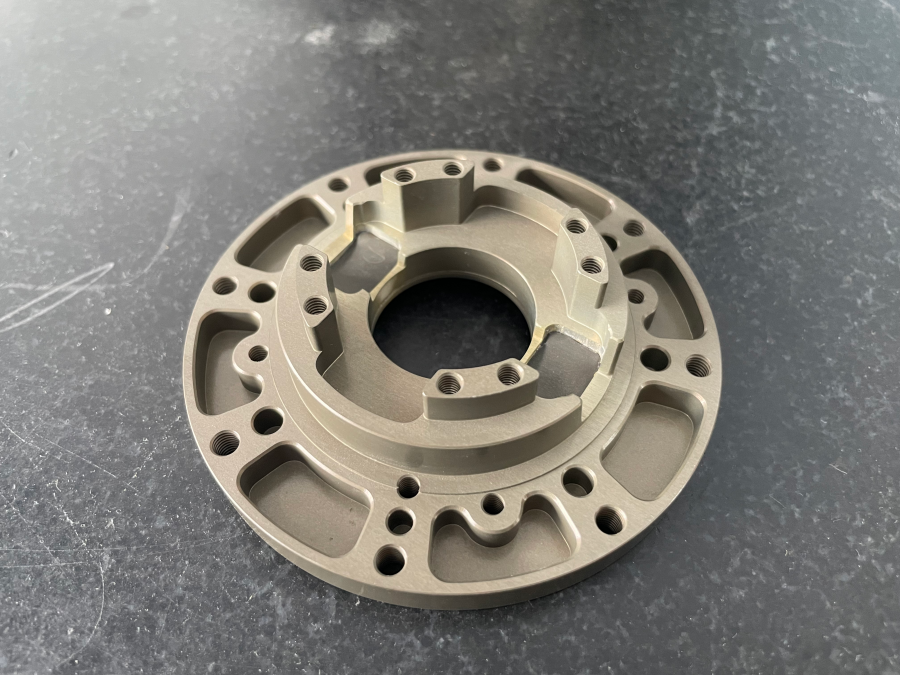
Multi-Axis Simultaneous Control: Essential for 5-axis CNC machining, the MCU must seamlessly coordinate the movement of five axes at once, calculating complex tool center point (TCP) management to maintain cutting accuracy from any angle.
Adaptive Control & Look-Ahead: “Look-ahead” functionality scans dozens or hundreds of program blocks ahead to optimize acceleration and deceleration, preventing tool marks and vibration on corners. Adaptive control adjusts feed rates based on real-time spindle load, protecting tools during unexpected hard spots in the material.
On-Machine Probing & Compensation: The MCU can execute routines where a touch probe measures a part or tool. It then automatically updates tool length and diameter offsets or even adjusts the machining program to compensate for detected deviations, such as part misalignment or tool wear.
Connectivity & Digital Twin Integration: Modern MCUs support industrial IoT protocols, enabling connectivity to Manufacturing Execution Systems (MES) or factory networks. This allows for remote monitoring, data collection for predictive maintenance, and the creation of a digital twin for simulation and optimization.
Why the Control Unit Matters for Your Custom Parts Project
Choosing a machining partner with advanced machine controls is a strategic decision. A superior MCU translates directly to:
Higher Accuracy and Consistency: Ensures every part in a batch matches the first, critical for medical or aerospace components.
Ability to Machine Complex Geometries: Makes the fabrication of intricate, sculpted surfaces—common in automotive or consumer electronics—efficient and accurate.
Reduced Setup and Cycle Times: Features like automatic tool and workpiece measurement speed up preparation, while optimized tool paths reduce machining time.
Improved Surface Finish: Advanced interpolation and smooth motion control result in superior surface quality, often reducing or eliminating the need for secondary finishing.
Conclusion
The CNC Machine Control Unit is far more than a simple computer; it is the intelligent nexus where digital design meets physical reality. Its power, sophistication, and the expertise with which it is utilized define the boundaries of what is possible in precision parts machining and customization. For projects demanding extreme accuracy, complex geometries, and unwavering repeatability, partnering with a manufacturer that invests in and masters advanced CNC control technology is paramount. Facilities that leverage these capabilities, such as GreatLight CNC Machining Factory, transform sophisticated design data into flawless, high-performance hardware, ensuring that the most ambitious engineering visions are realized with precision and reliability.
Frequently Asked Questions (FAQ)
Q1: Can older CNC machines with outdated controls be upgraded to match modern capabilities?
A: In many cases, yes. Retrofitting an older machine with a new CNC control unit is a common practice. It can breathe new life into a mechanically sound machine, adding features like better interpolation, modern connectivity, and a new user interface. However, the cost and feasibility depend on the compatibility of the new control with the existing servo drives, motors, and machine wiring.
Q2: How does the control unit affect the choice between 3-axis, 4-axis, and 5-axis machining?
A: The control unit must be explicitly capable of managing the additional axes. A 3-axis control only interpolates X, Y, and Z. A 4-axis control adds rotational control (typically the A-axis). A true 5-axis CNC machining control can simultaneously coordinate five axes (e.g., X, Y, Z, A, C), requiring vastly more computational power and advanced software for tool center point management and collision avoidance.
Q3: What is the difference between a “CNC Controller” and a “PLC” on a machine tool?
A: They work in tandem. The CNC Controller (MCU) is focused on the precise, continuous path control of the cutting tool. The Programmable Logic Controller (PLC) handles the discrete logic of the machine—sequencing the tool changer, managing coolant valves, monitoring door switches, and handling safety interlocks. The two systems communicate closely but have distinct primary functions.
Q4: When sourcing precision machined parts, what questions should I ask about a supplier’s machine controls?
A: Key questions include:
What brand and model of control units do your primary machines use? (e.g., Siemens, Fanuc, Heidenhain)
Do your machines have full closed-loop feedback systems?
Are your controls capable of advanced interpolation (like NURBS) and high-speed look-ahead?
Do you utilize on-machine probing for in-process verification and compensation?
For multi-axis work, what is the control’s capability for simultaneous 5-axis interpolation?
Q5: How does a facility like GreatLight CNC Machining Factory leverage advanced control units?
A: By utilizing state-of-the-art controls on their multi-axis machining centers, they ensure that complex part programs are executed with the highest fidelity. This allows them to tackle challenging materials and geometries, maintain tight tolerances consistently across production runs, and implement efficient, automated workflows—from setup verification to final quality checks—all managed by the intelligence within the machine’s control unit. For more insights into industry practices and technological integration, you can follow discussions on platforms like LinkedIn{:target=”_blank”}.



















