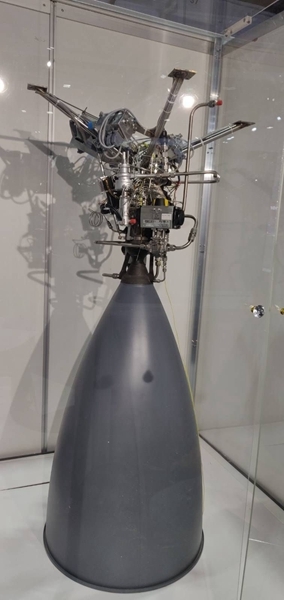
Recently, Mohou.com learned that Indian aerospace startup Agnikul Cosmo has obtained a design and manufacturing patent for a one-piece 3D printed rocket engine. Made up of the five main components of a rocket engine and produced as a single piece in one go, the advanced semi-cryogenic liquid propulsion engine can be manufactured in 96 hours and is designed to support the company’s satellite launch vehicle called Agnibaan, but it is also available for satellites and other space exploration tools.
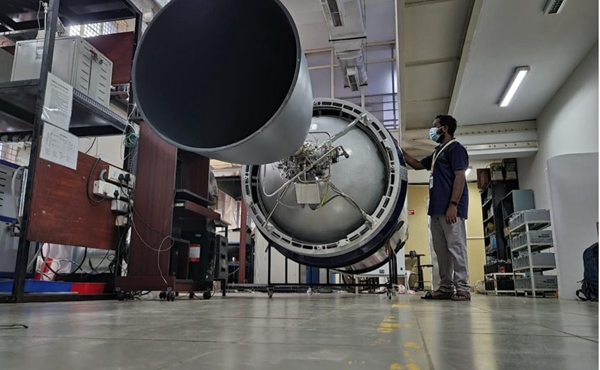
△One-piece 3D printed motor from AgnikulCosmos. Image courtesy of AgnikulCosmos
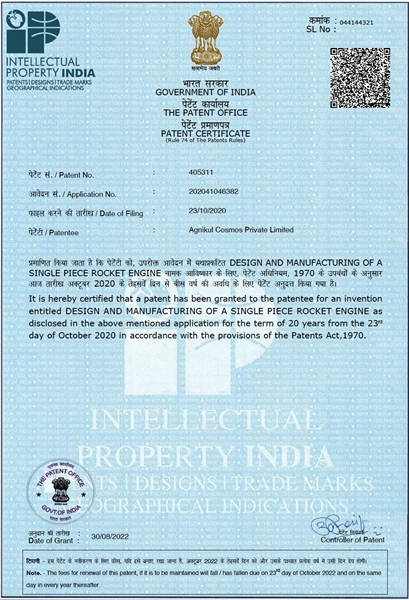
Under traditional manufacturing methods, a rocket engine must be carefully assembled at least 100 times using welding and other techniques, placing high demands on labor, equipment and of cost. Like many space technology companies, Agnikul believed that assembling engine parts using traditional processes would be tedious and time-consuming. She therefore determined the need for a single integrated propulsion engine. The use of 3D printing technology can effectively optimize the design and manufacturing of space vehicles. Based on the above needs, this small rocket company based in Chennai filed a patent for its 3D printed engine in late 2020.
Two years later, the Indian Patent Office issued a patent for the invention, which aimed to provide a lightweight, single-piece and highly reliable integrated motor for space vehicles. According to Agnikul Cosmos, the engine includes a combustion chamber that burns fuel, an injection plate that injects fuel into the combustion chamber, an igniter that ignites the fuel mixture, a nozzle that generates thrust through the hot gases and cooling channels for regenerative cooling.

However, in the original document published by the Office of the Director of Patents, Designs and Trademarks, Agnikul did not specify whether the one-piece engine also included other subcomponents of the rocket engine. And while Agnikul’s founders have been posting about their latest milestone on social media, other space industry experts have also questioned whether the engine is indeed “fully” 3D printed, as claimed. ‘business. Specifically, Tim Berry, director of manufacturing and supply chain at Launcher, a California-based aerospace startup, asked in an article on Agnikul: “Tubes, valves, electronics, etc. are all important. are they all in one piece?
He also added: “If it’s just the nozzle, cavity and injector, then ‘it’s not a complete rocket engine, nor a new discovery’.”
Berry may be referring to the fact that in recent years, other space startups have also unveiled the construction of 3D printed rocket engines. For example, in April last year, Launcher demonstrated the full thrust of its E-2 engine for the first time – which has a fully 3D printed cavity; RocketLab is also known for using 3D printed engines, while rocket engine manufacturer Ursa Major. focuses solely on the development of 3D printed rocket propulsion systems. British startup Orbex even commissioned AMCM to build a high-volume 3D printer for the overall manufacturing of its rocket engines. As many companies turn to 3D printed rocket propulsion systems and space agencies such as NASA and the European Space Agency (ESA) also advance their own rocket engine technology through additive manufacturing , it seems that the future will be difficult.
However, Agnikul is confident that he can ensure a fast turnaround time for his rocket engines because everything is 3D printed in one go. The startup, incubated at the Indian Institute of Technology Madras (IIT Madras) Research Park, has achieved impressive goals with its 3D printed one-piece rocket engine. Since 2019, the company said it has “automated” the motor manufacturing process, which requires no components, and is already testing its 3D printed motors in 2021.
△3D printed rocket engine patent from AgnikulCosmos. Image courtesy of AgnikulCosmos.
Agnikul noted that by using laser powder bed fusion and advanced aerospace materials such as copper and its alloys, Inconel, Monel and titanium, all engine components can be integrated during the construction process .
Without bolts, screws or welds, the motor is very light (5 to 6 kg) compared to motors of similar thrust, which can weigh up to 25 kg. So, by leveraging 3D printing, Agnikul believes it will help reduce the mass of space vehicles, the cost of launch vehicles, and even the cost of missions. Additionally, manufacturing the motor in one piece makes it easier to identify errors than with traditional multi-part assembly motors. The qualification is therefore simpler and faster, the startup describes it in its patent specifications section.
As is the case in almost every industry using additive manufacturing, batch production is becoming faster and the time required to assemble a multi-component part is decreasing. Furthermore, Agnikul said that with the reduction in machining work and manual interventions, they managed to accelerate the turnaround time of the manufacturing process to three days and complete the flight qualification of the engine within a week . This faster turnaround time for engine manufacturing could speed up the assembly process and ultimately help increase launch frequency.
Commenting on this latest achievement, Srinath Ravichandran, co-founder and CEO of Agnikul, said on social media: “When we started our journey of designing an engine, we had no idea the scale to which 3D printing could help us. At launch, 3D printing simply seemed the best option for manufacturing rocket engines. Incredibly, we had a team developing this original design from scratch in-house, simulating every aspect and bringing it to life. Manufacturing pushed metal sintering to its limits and finally. I tested it several times.”
Agnikul is looking forward to a test launch of its Agniban rocket by the end of 2022, which will carry around 100 kilograms of payload for customers to a 700-kilometer-high orbit next year. Meanwhile, the startup has partnered with 3D printing technology company EOS India to expand the potential of its 3D printed rockets and subsystems and opened a new facility, Rocket Factory-1, to 3D print its large-scale rocket engines. set up on site, allowing it to create the necessary equipment internally.
source:
Daguang focuses on providing solutions such as precision CNC machining services (3-axis, 4-axis, 5-axis machining), CNC milling, 3D printing and rapid prototyping services.