

The waterproof problem of mobile equipment always exists with the operation of the equipment. Today we have sorted out the various sealing forms, usage ranges and characteristics commonly used in mobile equipment, so that everyone can have a more in-depth understanding of the sealing problem.
1. Packaging seal
Seals can be divided into: according to their structural characteristics:
Soft seal
Hard packing seal
Formed seal
1. Soft packaging seal
Soft filling type: Packaging. The packing is usually woven from softer yarns and is filled into the sealing cavity through strips of square section. The stuffing box generates a pressing force to compress the packing, forcing the packing to be pressed against the sealing surface (shaft). On the outer surface and the sealing cavity), the radial force of the sealing effect is generated, thereby playing a sealing role.
Applicable occasions for soft filling:
The manufacturing material selected for the gasket determines the sealing effect of the gasket. Generally speaking, the material of manufacture of the seal is limited by the temperature, pressure and pH of the working environment, as well as the surface roughness and eccentricity of the mechanical equipment on which the seal is placed. works and linear speed, etc., will also have requirements on the selection of packaging materials.

Graphite packaging can withstand high temperatures and pressures and is one of the most effective products for solving high temperature and high pressure sealing problems. Corrosion resistant, excellent sealing performance, stable and reliable function.

Aramid filling is a kind of high strength organic fiber. The braided packing is impregnated with a polytetrafluoroethylene emulsion and a lubricant.

PTFE packaging is made of pure PTFE dispersion resin. It is first made into a raw film, then twisted and woven to form the packaging. It can be widely used in valves and pumps with high cleanliness requirements and highly corrosive media in food, pharmaceutical, papermaking and chemical fiber industries.
2. Hard packing seal
There are two types of hard gaskets: split rings and split rings.


2. Mechanical seal
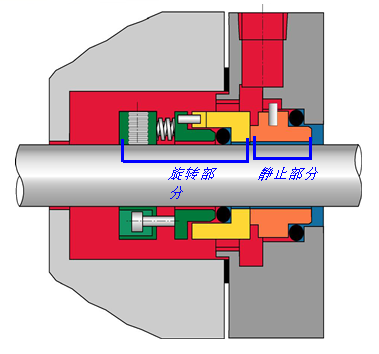
A mechanical seal always consists of two main parts: a rotating part (yellow part) and a fixed part (orange part). The two relatively movable dynamic and stationary annular surfaces become the primary sealing surface of the gasket.
Mechanical seals are also called end seals. According to relevant national standards, mechanical seals are defined as: at least one pair of end faces perpendicular to the axis of rotation which maintain fit and slide relative to each other under the cooperation of the fluid pressure, the elastic force (or magnetic force) of the compensation mechanism and the auxiliary seal A device to prevent fluid leakage.

3. Dry gas sealing
Dry gas seal, or “dry-running gas seal”, is a new type of shaft end seal that uses slot sealing technology for gas sealing.
Features:
It has good sealing performance, long service life, no sealing oil system, low power consumption, simple operation and low operation and maintenance costs. As a maintenance-free sealing system that does not require any oil for cooling and lubricating the sealing end, dry gas seals replace floating ring seals and labyrinth seals and become the main seal of seals of high speed centrifugal compressor shaft in petrochemical industry.
Applicable occasions:
High-speed fluid machines such as centrifugal compressors are suitable for working conditions in which a small amount of process gas escapes into the atmosphere without damage, such as air compressors, nitrogen compressors, etc. .
4. Labyrinth Seal

The labyrinth seal is a series of circular sealing teeth arranged in sequence around the rotating shaft. A series of interception spaces and expansion cavities are formed between the teeth. The sealed medium produces a strangling effect when passing through the spaces of the tortuous maze to prevent. leak.

The labyrinth seal is the most basic form of sealing between the stages and shaft ends of centrifugal compressors. According to different structural characteristics, it can be divided into four types: smooth, zigzag, stepped and honeycomb.
1. Smooth labyrinth seal
The smooth labyrinth seal has two structures: integral and panel. It has a simple structure and is easy to manufacture, but the sealing effect is poor.
2. Zigzag labyrinth seal
The zigzag labyrinth seal is also divided into two structures: integral and panel. The structural feature of this labyrinth seal is that the sealing teeth extend to different heights, and the high and low teeth are arranged alternately. The corresponding shaft surface is specially designed. Concave and convex groove, this high and low tooth structure combined with concave and convex grooves, transforms the smooth sealing space into a zigzag type, thereby increasing the flow resistance and improving the efficiency of the sealing. waterproofing. But it can only be used in cylinders or partitions with horizontally divided surfaces, and the sealing body must also be horizontally divided type.
3. Stepped labyrinth seal
The structure of stepped labyrinth seal is similar to that of smooth labyrinth seal, but the sealing effect is similar to that of zigzag labyrinth seal. It is often used at the wheel cover and balance plate.
4. Honeycomb labyrinth seal
The sealing teeth of the honeycomb labyrinth seal are welded in a honeycomb shape to form a complex-shaped expansion chamber. Its sealing performance is better than ordinary sealing forms and is suitable for occasions with large pressure differences, such as scale. plate seal of a centrifugal compressor. The manufacturing process of honeycomb labyrinth seal is complex, the sealing sheet has high strength and good sealing effect.
5. Oil seal
The oil seal is a self-tightening lip seal with simple structure, small size, low cost, easy maintenance and low resistance torque. It can not only prevent medium leakage, but also prevent the intrusion of external dust and other harmful substances. is effective against It has some ability to compensate for wear, but it is not resistant to high pressure, so it is generally used in chemical pumps in low pressure situations.
6. Seal of Power
When the chemical pump works, the pressure head generated by the auxiliary impeller balances the high pressure liquid at the outlet of the main impeller to ensure sealing. When parking, the auxiliary wheel does not work, so a parking sealing device must be equipped to solve the chemical pump leakage that may occur during parking. The auxiliary wheel seal has a simple structure, reliable sealing and long service life. It cannot cause any leakage during chemical pump operation. Therefore, it is often used in chemical pumps that transport fluids containing impurities.
7. Spiral seal
The spiral seal is also a form of dynamic seal. It is a spiral groove machined on the rotating shaft or the sleeve containing the shaft, and the sealing medium is filled between the shaft and the sleeve. Rotating the shaft causes the spiral groove to act as a pump, preventing leakage of the sealing fluid. Sealing capacity is related to helix angle, pitch, tooth width, tooth height, tooth length and space between shaft and sleeve. As there is no friction between the joints, its service life is long. However, due to limited structural space, its spiral length is generally short, so its sealing ability is also limited. When the pump speed is reduced, its sealing effect will be significantly reduced.
Daguang focuses on providing solutions such as precision CNC machining services (3-axis, 4-axis, 5-axis machining), CNC milling, 3D printing and rapid prototyping services.



















