
7 Axis CNC Machining Services
This page explains what the seventh axis actually adds, which geometries need it, and where a 5-axis or mill-turn machine will do the job for less. Written for design engineers and buyers who have to sign off on the process route. By the end you should be able to tell whether your part belongs on a 7-axis machine or not.
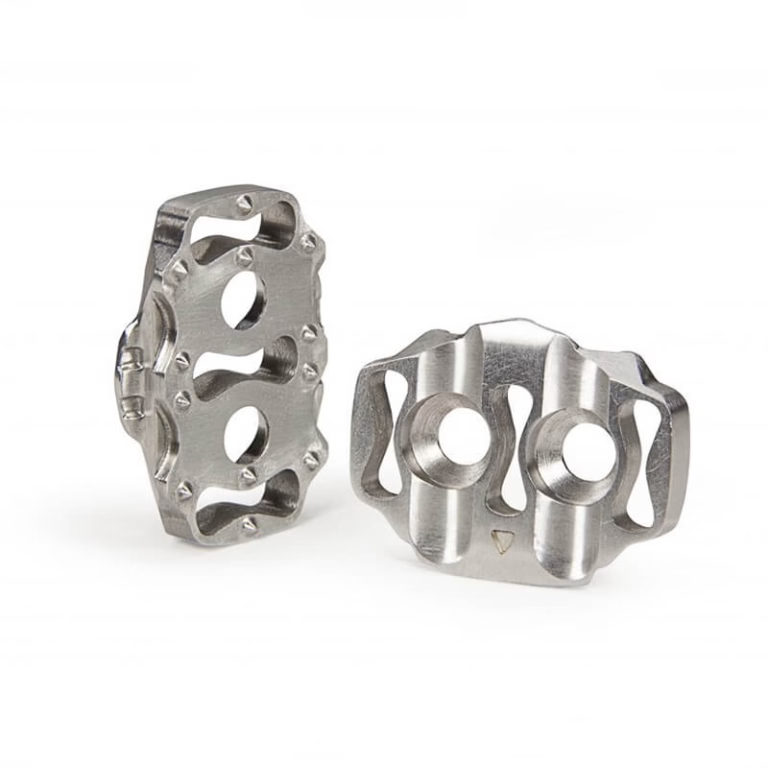
What the Seven Axes Are
A 3-axis mill moves X, Y and Z. The tool always comes down from one direction, so every face you machine has to be reachable from the spindle. A 4-axis machine adds rotation around one linear axis, usually A, which lets you index or turn the part between operations. On a 5-axis machine a second rotary axis appears, typically C, so the tool can approach the workpiece from nearly any angle and the part can be finished in one setup.
Seven axes usually means a 5-axis platform plus two more motions. In practice those two take one of three forms. A trunnion or tilting-rotary table carries the workpiece and adds a second rotary pair, which is common on larger parts. A swiveling spindle head adds rotation on the tool side, useful when the part is heavy and you would rather not move it. The third form is a robotic or articulated arm mounted on a multi-axis base, which is rare and mostly used for very large, awkward parts.
The reason engineers count axes is not marketing. Every additional axis is another servo loop, another set of kinematic offsets, and another source of positioning error. That matters when we hold ±0.005 mm. A 7-axis machine only pays off when the extra motion removes a setup, reaches a feature nothing else can reach, or keeps the tool at a better angle through a long contour.
Which Parts Actually Need Seven Axes
The clearest case is a part with machined features on five or six sides, where repositioning the workpiece between operations would stack tolerance. Every re-fixture adds a locating error. A deep internal cavity that opens onto a side wall is another example. On a 3-axis machine you cannot reach the cavity floor without a long tool that deflects. With two rotary axes you can tilt the part and use a short, stiff tool.
Undercuts, cross-drilled holes that intersect at compound angles, and port geometry inside a manifold all fall into the same bucket. So do impeller blades, turbine housings, and orthopedic implant surfaces where the blend between two curved faces has to be continuous. These are the parts where 7 axis CNC machining earns its cost.
Not every complex part needs it. A bracket with holes on three faces is faster on a 4-axis mill with two setups. A shaft with flats and a cross-hole is mill-turn work. A single curved surface with no undercut is a 5-axis job. The question to ask is simple: does the seventh axis remove a setup, or just add motion? If it only adds motion, it adds cost.
- 1Good fitFive or more machined faces, deep cavities, compound-angle ports, continuous blade blends.
- 2Marginal fitThree or four faces, moderate undercuts, parts under 100 mm with simple geometry.
- 3Wrong fitPrismatic parts, flat plates, turned shafts with a few cross-holes.
Choosing the Process Route
Match the machine to the geometry, not to the part's reputation for being hard.
| Route | Typical part | Setups | Why |
|---|---|---|---|
| 3-axis | Plates, pockets, one-face features | 1–2 | Lowest cost per hour |
| 4-axis | Shafts, hubs, holes on three faces | 1–2 | Indexing without re-fixture |
| 5-axis | Curved surfaces, no undercuts | 1 | Tool angle control, short tools |
| 7-axis | Six-face parts, deep cavities, ports | 1 | No repositioning, full access |
| Mill-turn | Turned bodies with milled features | 1 | Turning and milling in one cycle |
Accuracy, Finish, and Tool Life
Single-setup machining is the main accuracy benefit. When a part never leaves the fixture, the datum does not move, so feature-to-feature position depends on the machine rather than on a human re-clamping it. That is how we hold ±0.005 mm across faces that would otherwise need three operations.
Surface finish improves for a less obvious reason. On a 5-axis or 7-axis machine the tool stays near its ideal contact angle along a contour. Cutting with the side of the tool instead of the tip spreads the load and leaves a more even finish. In aluminium and stainless we regularly reach Ra 0.8–1.6 μm as machined, and Ra 0.2–0.8 μm where the geometry allows a finishing pass with a small stepover.
Tool life follows the same logic. A short, large-diameter tool that reaches the feature at an angle deflects less than a long tool reaching straight down. Less deflection means less chatter, and chatter is what kills carbide edges on hard materials such as Inconel or 17-4PH. Fewer broken tools also means fewer stops to re-measure and re-enter the cut.
Design for 7-Axis Machining
The rules are mostly about giving the tool room to move. Keep the tool length-to-diameter ratio under about 4:1 where you can. A cutter that reaches 60 mm deep into a 12 mm wide slot will chatter no matter how many axes the machine has. If a deep cavity is unavoidable, add a corner radius at least one third of the cavity depth so the tool can follow the wall.
Avoid sharp internal corners. A radius of at least 1 mm, or 0.5 mm on small features, lets a standard end mill cut the corner in one pass. Sharp corners force a smaller tool, a slower feed, or EDM. Floor-to-wall blends should be radiused for the same reason.
Think about where the part is held. A 7-axis setup still needs a clamping point, and the fixture may block the very face you want to reach. Sending us a model with the critical faces marked, plus the tolerance and finish on each, speeds up the DFM review. We return a quotation and a free DFM analysis within 12 hours, and production can start within 24 hours of approval.
Materials behave differently on multi-axis machines. Aluminium 6061, 7075 and 6082 cut cleanly at high angles. Titanium TC4 (Ti-6Al-4V) and Inconel need lower surface speed and more coolant, and the tool angle matters more than the axis count. Plastics such as PEEK and POM need sharp edges and air blast to clear chips. None of this changes the design rules, but it changes the cycle time and the finish you should expect.
Common Questions
How do I know if my part needs 7-axis machining?
Count the machined faces and look for undercuts. If the part has features on five or more sides, a deep cavity that opens onto a side wall, or ports at compound angles, 7-axis is worth quoting.
If it is a prismatic part or a turned shaft with a few cross-holes, a 4-axis or mill-turn route will be cheaper and just as accurate.
What tolerance can you hold on a 7-axis machine?
We work to ±0.005 mm (±0.0002 in) on critical features. The practical limit depends on part size, material, and how much of the tolerance budget the fixture consumes.
Every part is inspected before shipment, with raw material checks, in-process monitoring, and a final inspection. Reports are available on request.
Will 7-axis machining reduce my lead time?
Often, yes. Collapsing three operations into one setup removes handling, re-fixturing, and the queue time between machines. Non-cutting time drops as well.
Quotation and DFM analysis come back within 12 hours. Production can start within 24 hours, and parts ship in 3–5 days once the process is approved.
Which materials can you run?
Aluminium grades including 6061, 7075, 6082 and ADC12; stainless 303, 304, 316L, 17-4PH and 440C; steels such as 4140 and 4340; copper and brass; titanium TA2 and TC4; Inconel; magnesium; and plastics including POM, PEEK and PC.
Harder alloys such as Inconel and Ti-6Al-4V take longer and use more tooling, so expect a different cycle time from the same geometry in aluminium.
Can you handle one prototype and then a production run?
Yes. There is no minimum order quantity, so we run from a single prototype up to 10,000+ part runs on the same process.
We keep the setup data, tooling list and inspection plan from the prototype so the production run starts from a proven route.
How do you protect our design files?
Uploads are secure and confidential. We sign an NDA on request before any file exchange, and we hold ISO 27001:2022 for information security.
Your models are used only for quoting and manufacturing, and are not shared outside the project team.
Send the Model, Get a Process Answer
Upload your part and we will tell you whether it needs 7 axes, 5 axes, or a cheaper route, with a quotation and free DFM analysis inside 12 hours.
12-hour quoteFree DFM analysis±0.005 mm toleranceNo minimum order quantity









