
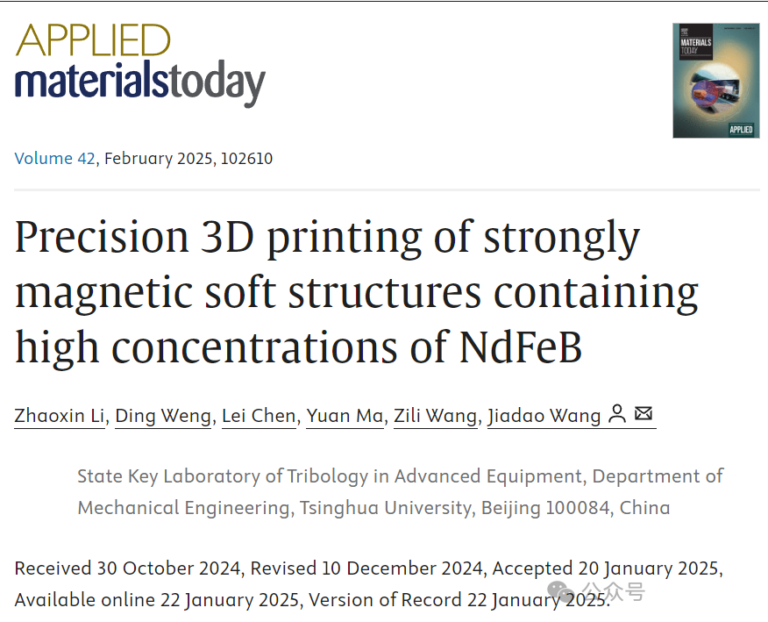
Revolutionizing Magnetic Soft Structures with 3D Printing Technology: Unlocking New Horizons for Smart Software Robots
The world of artificial intelligence is witnessing an unprecedented wave of innovation, with software robots leading the charge. With their potential to transform industries and revolutionize the way we live and work, these intelligent machines are poised to change the game. But, can they really make it without 3D printing technology? In a breakthrough development, a team of researchers at Tsinghua University has successfully developed a new high-concentration NDFEB magnetic photo resin that combines precision printing with magnetic soft structures, opening up new possibilities for smart software robots.
The Challenge: Overcoming the Limitations of Traditional Manufacturing Technologies
Until now, manufacturing magnetic soft structures has been a daunting task, plagued by the limitations of traditional printing technologies. Fused Deposition Modeling (FDM) and Digital Light Processing (DLP) have been unable to produce high-performance magnetic materials with the level of precision and control required for soft robotics. However, this breakthrough in 3D printing technology is poised to change the game.
The Innovation: High-Concentration NDFEB Magnetic Photo Resin
Researchers at Tsinghua University have developed a novel high-concentration NDFEB magnetic photo resin, boasting a magnetic particle content of 35% by weight. This innovative material combines the best of both worlds – magnetic properties and precision printing – to create a new generation of magnetic soft structures. By leveraging the advantages of 3D printing, this technology offers unparalleled precision, flexibility, and customization, making it an ideal solution for the development of advanced soft robotics.
Process Breakthrough: DLP Technology System Innovation
To achieve this level of precision, the team developed a revolutionary DLP technology system, featuring a modified resin and a specially designed printing process. The new resin boasts a sedimentation rate of just 4% in 60 minutes, making it ideal for high-concentration magnetic materials. The printing process, too, has been optimized, with a modified resin level of more than 15 mm and a printing time of just 15 seconds per layer.
Performance Verification: Systematic Characterization and Testing
To validate the performance of printed samples, the team designed a series of systematic test solutions, including printing precision, mechanical properties, and magnetic performance. The results were nothing short of remarkable, with dimension precision errors controlled at less than 1%, mechanical properties maintaining 105.3% rupture and 107.5 kPa Young’s module, and magnetic performance exhibiting a resistance of 21.5 emu/g.
Practical Applications: Laboratory to Real-World Success
This technology is not just about theoretical innovation – it’s about real-world applications. The team has successfully developed a range of practical solutions, including a magnetic soft gripper with a unique bionic design, capable of lifting objects weighing up to 2.68 times its own weight. The potential applications are vast, from biomedical devices to microfluidic systems, and the possibilities are endless.
Innovative Future Development: Unlocking New Horizons for Smart Software Robots
As we move forward, it’s clear that 3D printing technology will play a crucial role in the development of smart software robots. With this breakthrough, we’re on the cusp of a new era of innovation, one that will transform industries and revolutionize the way we live and work. So, is 3D printing a must-have for software robots? The answer is clear – it’s a must-have for any serious player in the field.



















