
17 Points for Milling and Machining Application Skills
A shop-floor list for engineers who plan parts, quote jobs, or debug a cut that is not holding tolerance. Each point comes with the condition that makes it matter and the case where it does not apply. Read it before you release a drawing or a setup sheet.
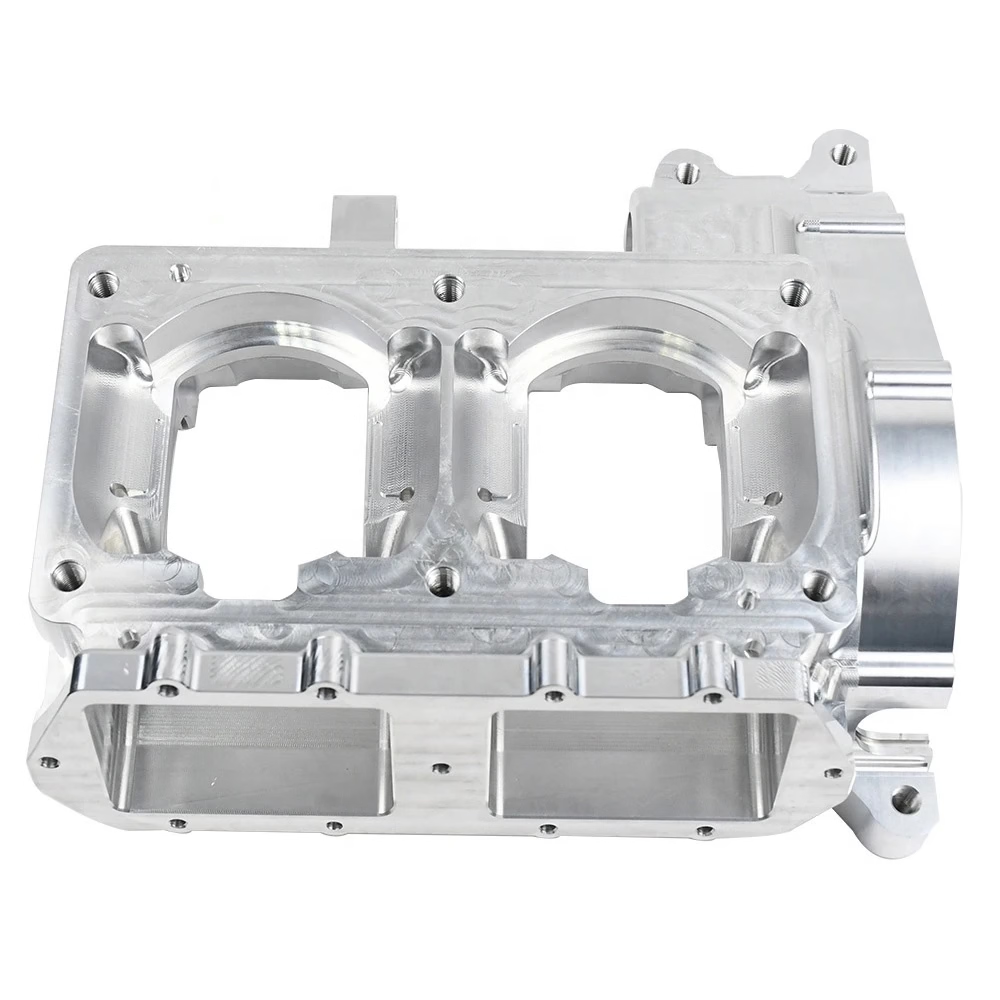
Points milling machining application decisions, not rules of thumb
Seventeen checks grouped by machine, tool, setup, and verification. Skip the ones your part does not touch.
Machine capacity and rigidity come first
Start with whether the machine can physically take the cut. Spindle power, maximum spindle speed, and the stiffness of the column and table decide how much material you can remove per pass. A light 3-axis mill with a 500 × 500 × 450 mm envelope behaves very differently from a 16-machine 5-axis cell, and the same program will chatter in one and run clean in the other.
Check the work envelope against the part plus the fixture. A 4,000 × 400 × 150 mm travel machine sounds generous until you add a vise, clamps, and clearance for the tool at the end of a pass. Leave at least the cutter diameter plus 10 mm at each end of travel, or the tool will run out of stroke mid-cut.
Rigidity is not a spec sheet number you can read directly. It shows up as chatter marks, poor surface finish, and short insert life. If a cut is noisy on a heavy machine, the problem is usually the setup, not the spindle.
Thermal behavior belongs in this group. Long roughing cycles push heat into the spindle and the part. On tight-tolerance work, rough in one session and finish after the part has cooled, or keep a roughing allowance and take the last 0.3 mm at stable temperature.
- 1Match power to materialAluminium 6061 cuts easily; 17-4PH and Inconel need lower feed and more spindle torque.
- 2Check the envelopePart plus fixture plus cutter clearance must fit inside travel on all three axes.
- 3Watch stack-upShort tools in short holders on a rigid machine remove more metal than a long reach.
Tool overhang, holder choice, and cutter geometry
Keep tool overhang as short as the geometry allows. Deflection rises with the cube of the length sticking out of the holder, so a 4× diameter overhang can be four to eight times stiffer than a 6× one. On deep pockets, step down with a stub tool first and reach the floor with a longer tool only for the final passes.
Choose the holder for the task, not for what is already on the shelf. A shrink-fit holder gives low runout for small-diameter finishing. A side-lock holder is fine for roughing but introduces runout that shows on reamed holes. Collet chucks sit in between and are the usual default for general milling.
Insert geometry controls the cut more than most people expect. A positive rake insert shears the material and keeps cutting forces low, which matters on thin walls and small machines. Negative rake inserts are stronger and better for interrupted cuts in steel, but they push the part harder.
Watch the number of effective teeth. Too many inserts in a wide cut raises the chip load per tooth and can stall a small spindle. Too few leaves a poor surface. Adjust feed per tooth rather than adding inserts when the machine complains.
Radius and corner geometry matter on internal features. A cutter with a corner radius distributes load and lasts longer, but it cannot produce a sharp internal corner. If the drawing calls for a sharp corner, either relieve it or specify a smaller end mill and accept longer cycle time.
- 1OverhangKeep under 4× diameter where possible; stiffness drops fast beyond that.
- 2RunoutShrink-fit for finishing, collet for general work, side-lock for heavy roughing.
- 3Rake anglePositive for thin walls and low power; negative for interrupted cuts in steel.
Setup, workholding, and clearance
Workholding is where most milling problems start. A part that moves 0.02 mm under cutting load will never hold ±0.005 mm. Clamp over solid material, keep clamping force away from thin sections, and support the underside of any feature that is being machined from above.
Check clearance before the tool enters the cut. Narrow slots, deep ribs, and small gaps between features are common places for the holder or the shank to rub. In a narrow slot, the shank can touch the wall while the cutting edge is still engaging, which burns the surface and breaks tools.
Plan the order of operations around the datum. Machine the faces that define your zero first, then work outward. If a part is flipped, re-establish the datum from a machined face rather than from a raw surface, or the second side will not line up with the first.
Leave stock for finishing on any surface that will be clamped again. A 0.2–0.5 mm allowance on critical faces lets you clean up clamp marks without changing the nominal dimension.
- 1Clamp on solid materialAvoid clamping thin webs or finished surfaces that must stay cosmetically clean.
- 2Support underneathBack up any floor being milled; unsupported floors deflect and chatter.
- 3Datum firstCut the reference faces early, then reference everything else from them.
Coolant, chips, and final verification
Coolant choice follows material and feature. Flood coolant handles deep pockets and high-speed aluminium well. Air blast or minimum quantity lubrication suits materials that react badly to thermal shock or where chips must stay dry. On titanium and some stainless grades, coolant helps control heat at the cutting edge, but the feed must still be high enough to keep the tool cutting instead of rubbing.
Chip evacuation is a process parameter, not an afterthought. Recutting chips is one of the most common causes of poor finish and broken tools. On deep pockets, program a pecking or helical entry with enough coolant pressure to push chips out, or use a through-tool coolant holder if the machine supports it.
Verify before the part leaves the machine when the feature is critical. In-process probing catches a wrong offset before the whole batch is cut. For tight work, measure the first part fully, confirm the datum, then run the rest. We inspect 100% of parts before shipment, with raw material checks, in-process monitoring, and final inspection, and we can supply reports on request.
- 1CoolantFlood for deep pockets and aluminium; air blast where chips must stay dry.
- 2ChipsRecutting is the main cause of poor finish on deep cavities.
- 3Verify earlyProbe or measure the first part before running the batch.
Roughing and finishing starting points by material
Typical starting windows for carbide tooling on a rigid machine. Adjust after the first cut.
| Material | Roughing surface speed | Finishing surface speed | Notes |
|---|---|---|---|
| Aluminium 6061-T6 | 300–600 m/min | 600–1,000 m/min | Flood coolant; watch chip welding on soft grades |
| Stainless 304 / 316L | 80–150 m/min | 150–220 m/min | Keep feed up to avoid work hardening |
| Steel 4140 | 100–180 m/min | 180–250 m/min | Positive rake for light machines |
| Titanium Ti-6Al-4V | 40–70 m/min | 70–100 m/min | High feed per tooth; flood coolant |
| Inconel | 20–40 m/min | 35–60 m/min | Rigid setup; expect short tool life |
| POM / PEEK | 200–400 m/min | 300–600 m/min | Sharp tools; air blast often enough |
Questions engineers ask before releasing a job
How do I decide between 3-axis, 4-axis, and 5-axis milling?
Use 3-axis when all features are reachable from one or two setups and the part has simple geometry. Add a 4-axis when you need features indexed around a cylinder, such as cross holes or slots on a shaft. Go to 5-axis when the part has compound angles, deep pockets with undercuts, or when fewer setups directly reduce position error.
What tolerance can milling realistically hold on a typical part?
On a rigid setup with a stable material, we hold ±0.005 mm on critical features and Ra 0.8–1.6 μm as a standard finish. Tighter finish is possible, down to Ra 0.2–0.8 μm, but it adds cycle time and often a separate finishing pass. Sheet-metal-like thin walls and long slender parts are harder and need a different tolerance conversation.
When should I choose a positive rake insert over a negative one?
Positive rake when the machine is light, the wall is thin, or the material is gummy. Negative rake when the cut is interrupted or the material is hard steel, because the stronger edge survives the impact. Many shops keep both and switch based on the first cut sound.
Does the part need a special fixture for a one-off prototype?
Usually not. A vise plus soft jaws or a simple plate fixture handles most prototypes. A dedicated fixture makes sense when the part is flexible, has a datum that is hard to reach, or will run in the hundreds. Since we have no minimum order quantity, a fixture can be justified on a short run if it saves setup time on each part.
How do you control chips in deep pockets?
Program helical or ramped entry, use high-pressure coolant or through-tool coolant, and keep the radial engagement low so chips clear the flute. On deep aluminium pockets, air blast plus a small pecking cycle often works better than flood alone because the chips do not float back into the cut.
What information helps you quote a milling job accurately?
Send the 3D model and 2D drawing with tolerances, material and finish, quantity, and any critical features. Note which surfaces are cosmetic and which are functional. With that, we return a quotation and a free DFM analysis within 12 hours, and production can start within 24 hours.
Send the drawing and we will check the setup
Upload your model and drawing for a quotation and a free DFM analysis within 12 hours. Files stay confidential, and an NDA is available on request.
12-hour quote100% inspectionNo MOQ









