
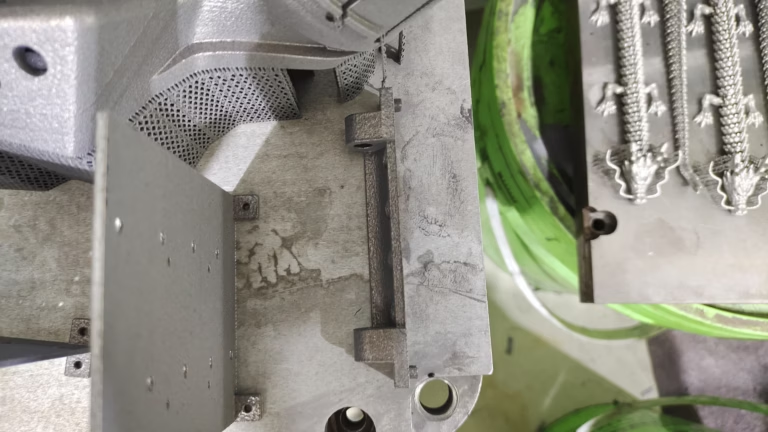
When product teams ask us whether Resin 3D Printing vs Filament is the right route for their next component, they rarely expect the answer to involve five-axis CNC machining—but that unexpected detour is exactly where most costly mistakes begin. As a contract manufacturer that has operated since 2011 in Dongguan’s Chang’an district, GreatLight CNC Machining Factory has watched both additive and subtractive technologies evolve from prototyping novelties to serious production tools. Yet the deeper we go into customer projects, the more we see recurring errors: engineers choose a printer before they define a requirement, they compare only sticker prices, and they ignore the hidden costs of post-processing, tolerances, and repeatability. In this post, I’ll walk you through the seven most expensive mistakes we’ve observed in the resin-versus-filament debate, and how a broader view—one that includes precision CNC machining—can save your timeline, your part’s integrity, and your budget.
The additive landscape in 2025: More choices, more confusion
The desktop 3D printing revolution has matured into a multi-process ecosystem. SLA and DLP resin printers deliver smooth surfaces and fine detail; FDM/FFF filament machines offer toughness and low entry cost. Meanwhile, industrial PBF (powder bed fusion) systems can print metal and engineering polymers. But this abundance of choice has not eliminated the underlying manufacturing paradox: every process imposes a unique set of constraints on geometry, material properties, and cost. The most common mistake is treating 3D printing as a universal solution rather than one tool in a portfolio.
GreatLight’s own shops include SLM, SLA, and SLS printers alongside a large family of 3-axis, 4-axis, and 5-axis CNC machining centers. That multidisciplinary background has taught us an uncomfortable truth: there is no perfect printing process, only a suitable process for a specific part under a specific load case. The mismatch between process capability and part requirement is where money disappears. Let’s examine the seven critical errors we see repeatedly.
Resin 3D Printing vs Filament: 7 Costly Mistakes to Avoid
Mistake #1: Ignoring the material’s mechanical anisotropy
Both resin and filament parts behave differently in different build directions. For FDM, the interlayer bond is often the weakest point; a part printed with layers perpendicular to its loading direction may fail at 30-50% of its in-plane strength. For resin, the issue is more subtle: most UV-cured materials are brittle and have poor impact resistance, especially after full curing. Yet we see buyers specifying “ABS-like” or “standard resin” for structural fixtures, only to be surprised when the part cracks under a modest load.
Avoidance strategy: Before choosing between resin and filament, define the required tensile strength, elongation, service temperature, and chemical resistance. If the part must carry load, use a data sheet that lists X, Y, and Z properties. If even the best additive option cannot meet the requirement, consider CNC machining from solid plastic or aluminum. GreatLight often reshapes a customer’s design originally intended for a resin printer into a five-axis machined metal part that remains dimensionally stable and cost-effective at 100 units per year.
Mistake #2: Underestimating the true cost per part
The initial price of a resin bottle or filament spool is misleading. Resin printing requires isopropyl alcohol baths, curing stations, gloves, and disposable containers; filament printing consumes electricity over many hours and often demands sacrificial supports. In contrast, CNC machining has what accountants call a “fully loaded” hourly rate that includes tooling, machine amortization, and operator time. For small quantities, additive still wins. But for quantities beyond 50–200 parts, the total cost per printed part rarely drops because the process is both material-wasteful and labor-intensive. Meanwhile, a machined part’s cost per unit decreases steadily with quantity.
A simple table helps:
| Cost driver | Resin (SLA/DLP) | Filament (FDM/FFF) | CNC Machining |
|---|---|---|---|
| Initial equipment cost | $200–$5,000 | $400–$10,000 | $50,000–$500,000+ (outsourced) |
| Material cost per kg | $30–$80 | $20–$60 | $10–$200 (depends on metal/plastic) |
| Post-processing labor | High (wash, cure, support removal) | Medium (peel, sand, sometimes vapor smooth) | Low (deburring, polishing optional) |
| Cost per part at 1 pc | Low | Low | High |
| Cost per part at 100 pcs | High | Medium | Low |
| Repeatability for batch | Low–medium | Medium | High |
The mistake is calculating only material cost. Always multiply by labor time and yield rate. And when the design calls for metal, don’t assume that metal 3D printing is automatically competitive with precision CNC machining—the latter is often faster and cheaper for functional brackets, motor housings, and impellers.
Mistake #3: Assuming that additive tolerance equals printed tolerance
A resin printer may claim a layer resolution of 25 microns, but that is not the same as a machined tolerance of ±0.025 mm. Resin parts shrink during curing; FDM parts shrink due to thermal contraction. Warping, elephant’s foot, and Z-axis skew appear in real-world prints. If you’re building a press-fit assembly, a PCB enclosure, or a bearing housing, these deviations can ruin the fit.
The engineering solution is to apply a tolerance analysis. Ask yourself: which features actually interact with other parts? For those critical surfaces, you have two options: (1) design with clearance and use 3D printing only for visual prototypes, or (2) machine the part after printing. This is where hybrid manufacturing shines. At GreatLight, we routinely print a resin master pattern for ergonomic evaluation and then machine functional mounting points with a 5-axis center. The result combines the best of both worlds: freeform shape and precision datums.
Mistake #4: Failing to plan for support removal and internal cavities
Support structures are a quiet killer. For resin printing, supports leave pockmarks that require sanding; for FDM, breakaway supports can tear the surface. Worse, internal channels cannot always be properly supported. When a part has small cooling channels or threaded holes below a certain diameter, additive processes often produce occlusions or rough internal surfaces, leading to failure.
In contrast, CNC machining drills, mills, and taps internal features with predictable toolpaths. If your part requires blind holes with tight positional tolerance, hydraulic ports, or smooth bores, additive should not be your first choice. We’ve converted many “printed manifold” designs to aluminum or stainless steel blocks on a 5-axis machine, reducing leakage and increasing pressure ratings. It’s worth remembering that the best 3D printing is the one that never reaches the customer’s hand as a failed part.
Mistake #5: Overlooking environmental resistance and long-term stability
UV resin degrades under prolonged sunlight; filament materials absorb moisture; both can creep under sustained load. Many engineers evaluate only the initial “as-printed” properties and forget about aging. For durable goods, surface finish, thermal cycling, and humidity all matter. A resin part may look perfect in the office but become brittle after a year in a hot warehouse.
The avoidable error is selecting a standard material rather than a specialty one. There are now engineering resins (e.g., rigid 10K, tough 2K, high-temp). Filament options such as nylon-based composites or polycarbonate can perform well if dried properly. However, if the part will be exposed to chemicals, extreme temperatures, or repeated impact, subtractive machining from solid material—whether PEEK, aluminum 6061, titanium, or stainless steel—remains the safe choice. GreatLight’s five-axis centers can machine even PEEK relatively efficiently, and our in-house inspection equipment verifies that material properties match specifications.
Mistake #6: Scaling a prototype process into production without qualification
It’s tempting to order 500 printed parts because the first prototype looked great. But additive manufacturing is inherently a low-volume process, and batch-to-batch consistency is a known challenge. Variables like resin age, environmental humidity, and printer calibration drift create subtle differences in dimensions and surface quality. In one recent automotive project, a customer asked us to match a resin-printed housing across three suppliers. The dimensional deviations were so large that none of the parts assembled with the same latch mechanism. We ended up machining the production version from aluminum die-cast stock, achieving consistent ±0.02 mm tolerances.
The rule is simple: use additive for prototypes and small batches, but qualify a more deterministic process such as CNC machining or die casting for production volumes. GreatLight’s operational model supports this transition seamlessly because we own both the additive equipment and the CNC subtractive centers. We can quote a program that starts with SLA verification parts and then moves to 5-axis machining or die casting, all under one ISO 9001:2015 quality system.
Mistake #7: Dismissing hybrid manufacturing and precision CNC as “the other path”
The most costly mistake of all is believing that the choice between resin and filament is binary. In our experience, the most efficient manufacturing system is hybrid: print for geometry exploration, machine for function. Even in metal, we often see clients print a part and then request secondary milling to hit critical datums. At GreatLight, our five-axis CNC machining services are not competitors to 3D printing; they are the finishing mechanism that turns an “almost” part into a production-quality component. We have SLM printers for titanium and aluminum, but we also have a full fleet of large-format 5-axis centers capable of machining parts up to 4000 mm. This gives our engineers the freedom to recommend the most rational process path, not the one that sells a specific machine.
So, when you analyze Resin 3D Printing vs Filament, always add a third column: CNC machining. Evaluate the part’s functional requirements, volume, and lifecycle. For many precision hardware projects, a machined part created by a partner like GreatLight will outperform a printed part at the same cost—especially when you count the hidden rework costs.
Choosing a manufacturing partner that actually prevents these mistakes
A reliable supplier should not merely ask “Which 3D printing technology do you want?” Instead, they should ask “What is the part supposed to do, at what volume, and under what environment?” That consultative approach is the difference between a high-value partnership and a transaction that ends in scrap.
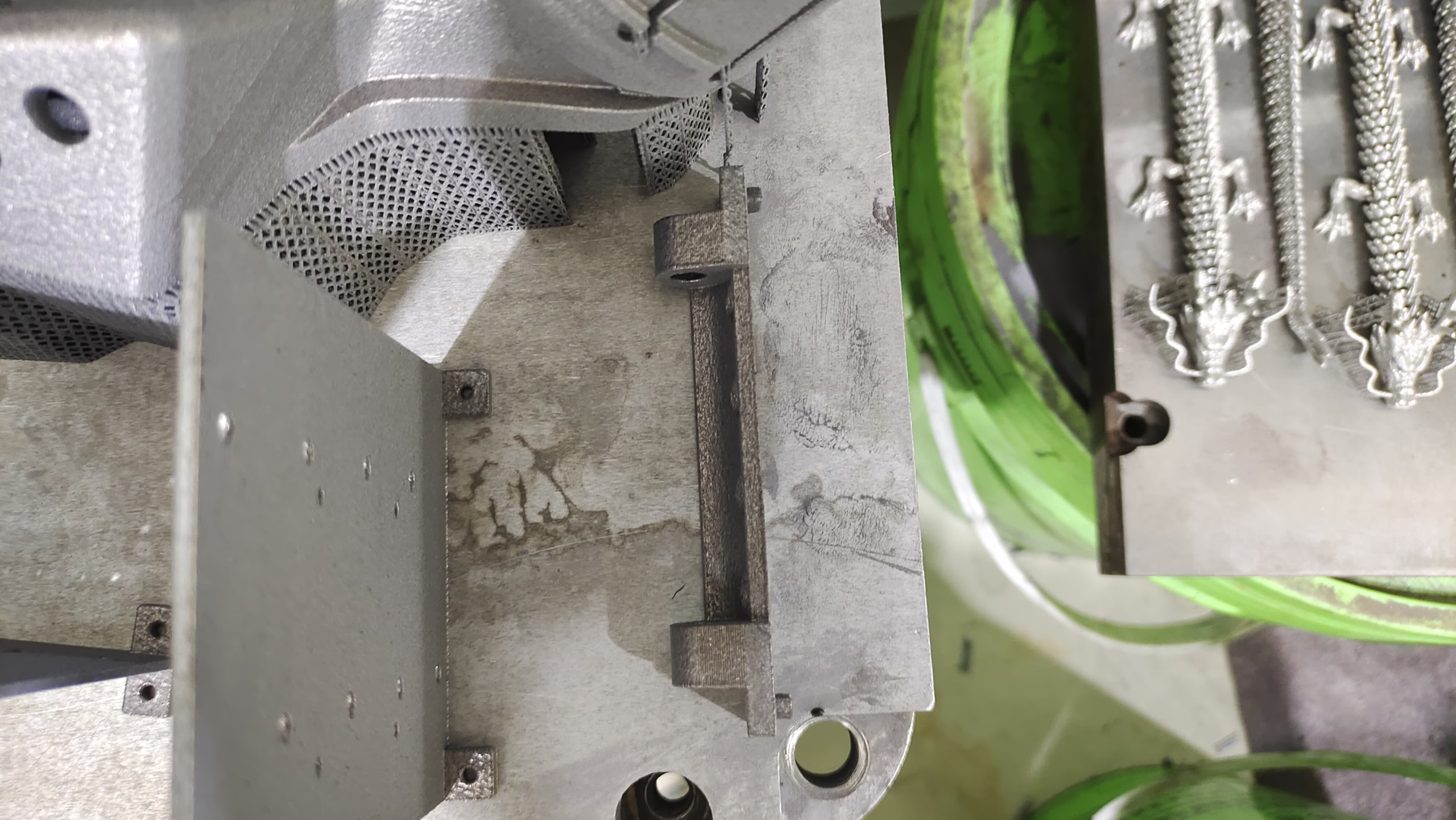
GreatLight Metal Tech Co., LTD. (also known as GreatLight Metal) has built its reputation on exactly this kind of engineering-first support. Founded in 2011 in Chang’an Town, Dongguan (the “Hardware and Mould Capital” of China), the company now operates a 76,000 sq. ft. facility with 120–150 professionals. Its equipment roster includes Dema and Beijing Jingdiao 5-axis CNC machining centers, Swiss-type lathes, wire EDM, mirror-spark EDM, die-casting machines, sheet metal tools, and SLM/SLA/SLS 3D printers. This breadth enables true one-stop manufacturing: prototype in resin or filament, then shift to CNC machining or die casting for production.
Certifications matter, too. A partner with ISO 9001:2015 ensures quality management is systemic. If you work in automotive, look for IATF 16949 certification; for medical hardware, ISO 13485 is critical; for data-sensitive projects, ISO 27001. GreatLight maintains these credentials, so clients don’t need to chase compliance separately. In contrast, many online 3D printing brokers (Xometry, Protolabs, RapidDirect, Fictiv, etc.) are aggregators or competitors, and they may not have the full in-house process chain to handle complex multi-step jobs with tight tolerances. While those platforms have their place for quick quotes, they often lack the deep engineering judgment of a manufacturer that uses both additive and subtractive technologies on a daily basis.
When evaluating any partner, look for three things:
Equipment breadth – Is the partner able to pivot from printing to precision CNC machining without sending you to another vendor? (GreatLight can.)
Quality system – Does the partner have ISO 9001:2015 and industry-specific certifications? Are they willing to share inspection reports? (GreatLight does.)
Engineering consultation – Is the vendor offering design-for-manufacturing feedback, or simply processing a file? (GreatLight’s engineers routinely suggest material changes and tolerance relaxations that reduce cost without compromising performance.)
Competitor brands like Protolabs Network, Xometry, Fictiv, and JLCCNC all offer useful services, but most of them focus on either 3D printing or standard CNC machining, not the integrated manufacturing ecosystem we’ve built. Others like Owens Industries or RCO Engineering are more specialized in specific verticals. If you want a partner that can handle a humanoid robot component in machined aluminum, an automotive engine part in die-cast aluminum, and a low-volume medical housing in 3D-printed titanium under one roof, GreatLight is a genuinely rare option.
Conclusion: From printing traps to manufacturing success
The Resin 3D Printing vs Filament debate is a real one, but it’s incomplete. After seeing thousands of components pass through our factory, we believe the smartest way to avoid the seven costly mistakes above is to think in terms of “best-fit manufacturing,” not “favorite printing technology.” Define the functional requirements, quantify cost over the whole lifecycle, account for post-processing and tolerance, and then decide whether to print, machine, or combine both. Work with a manufacturer that has no material bias—one that can honestly say, “Your part is better as a CNC-machined component,” even if that means lower material profit for us.
At GreatLight CNC Machining Factory, that honesty is part of our ISO 9001:2015 certified culture. We have the machines, the talent, and the decade-long track record to guide you from a fragile resin prototype to a robust, production-grade metal part. So before your next release, take a hard look at Resin 3D Printing vs Filament: 7 Costly Mistakes to Avoid and make sure the partner standing behind your supply chain can honestly navigate all seven—and then bring your part to life with the right process at the right time. To see how five-axis CNC machining complements your additive workflow, reach out to the GreatLight team through our LinkedIn page and let’s manufacture smarter together.



















