
When you’re responsible for sourcing or investing in manufacturing capability, the question “What’s the metal CNC machine price?” can feel like the most natural starting point. It’s a number that anchors budgets, shapes ROI projections, and gets passed around procurement meetings with a deceptive air of finality. I’ve seen this across hundreds of precision machining projects at GreatLight CNC Machining Factory: the raw cost of the machine itself is only one piece of a far larger puzzle. In this article, I’ll walk you through five of the most expensive mistakes engineers, purchasers, and business owners make when they evaluate metal CNC machine pricing — and what you can do instead to protect your margins, quality, and sanity.
Metal CNC Machine Price: Are You Making These 5 Costly Mistakes?
Over a decade of running a high-mix, high-precision shop in Chang’an, Dongguan — right in the heart of China’s hardware mold capital — has taught me that the purchase price of a CNC machine rarely reflects what you’ll actually spend to get good parts. More importantly, for many companies that need complex metal parts, buying a CNC machine isn’t even the right move. The alternative — partnering with an advanced manufacturer that already owns the machines and the engineering expertise — can be far more economical. But let’s get into the five pitfalls first.
Mistake #1: Equating Machine Price with Total Cost of Ownership
Walking through a trade show, you might see an eye-catching “starting at” figure for a 3-axis VMC or a small 5-axis trunnion machine. That baseline metal CNC machine price often excludes the things that make the machine productive in a real production environment.
Here’s what the sticker price typically doesn’t include:
Tooling and workholding: A decent set of holders, vises, and zero-point clamping for even a modest cell can easily run into tens of thousands of dollars.
Installation and facility prep: Reinforced foundations, three-phase power upgrades, clean dry compressed air, and climate control are rarely free.
First-year consumables and spare parts: Coolant, filters, wipers, seals, and critical spindle maintenance kits need to be budgeted from day one.
Software and post-processors: CAM seats, verification software, and bespoke posts for complex multi-axis work add another layer.
At GreatLight CNC Machining Factory, we’ve already absorbed these costs across our 127 pieces of peripheral equipment and our large-format 5-axis, 4-axis, and 3-axis CNC machining centers. When you send us a part, you’re not paying for our foundation restoration or our tooling trials — you’re paying for the finished part at a predictable per-unit price. That predictability often flips the ROI equation in favor of outsourcing, especially for low-to-medium volumes or highly complex workpieces.
Mistake #2: Treating Reported Accuracy as Real-World Capability
It’s common to see a machine spec sheet boasting positioning accuracy of ±0.002 mm or better. The mental trap is to assume that any part you put on that machine will automatically come off within a couple of microns. In reality, thermal growth, tool deflection, workholding deformation, and operator skill create a gap between theoretical precision and shop-floor reality.
We’ve taken on many projects where a client had already purchased a machine thinking it could hold ±0.005 mm on a slim aerospace bracket, only to find that their actual process capability was closer to ±0.02 mm after factoring in temperature swings, tool runout, and fixturing instability. At GreatLight, we regularly achieve tolerances of ±0.001 mm on qualified features because we don’t just rely on the machine’s nameplate accuracy — we surround it with:
Temperature-controlled metrology labs and in-process probing
Experienced machinists who understand how to manage cutting forces on thin-walled metal parts
A systematic ISO 9001:2015 process that tracks capability over time, not just on one golden sample
So when you evaluate a metal CNC machine price, ask what accuracy the machine can sustain during a 16-hour production shift in August, not what it achieved during a laser calibration demo. And if you need that sustained ultra-precision right now, it may be safer to work with a shop that has already built the thermal management and measurement infrastructure.
Mistake #3: Overlooking Post-Processing and Finishing as a Separate Cost Center
A raw machined part is rarely the final deliverable. Anodizing, passivation, powder coating, bead blasting, electropolishing, and even assembly all add cost, lead time, and complexity. When insourcing a CNC machine, many planners forget to account for the full post-processing chain. Suddenly you’re juggling multiple vendors, shipping parts halfway across the country, and eating the cost of a scrapped batch because a plater’s masking wasn’t precise enough.
GreatLight was built on a one-stop philosophy. Our facility integrates:
In-house EDM and grinding for tight-tolerance steel components
Vacuum casting and die casting services for hybrid processes
Metal 3D printing (SLM) paired with CNC finishing
A full range of surface finishing capabilities
By keeping the entire process under one roof, we eliminate handoff risks and compress lead times. Instead of amortizing a $200,000 machine across your parts while still paying for e-coating and CMM inspection elsewhere, you get a single turnkey price that covers everything. This model often renders the raw CNC machine purchase a false savings.
Mistake #4: Underestimating the Skill Depth Required for Advanced Machining
Modern 5-axis machines from brands like DMG Mori or Jingdiao are incredibly capable, but they demand programming talent, process engineering, and maintenance expertise that’s expensive and scarce. I’ve lost count of how many times a client’s in-house “CNC guy” could handle 2.5D prismatic parts, only to hit a wall when the new 5-axis trunnion arrived and suddenly they were dealing with simultaneous swarf toolpaths, collision avoidance, and dynamic work offsets.
At GreatLight, our team of 150 includes engineers who have spent years in precision prototyping and low-volume production. We program parts that would make a general machinist sweat — thin-walled aluminum enclosures for humanoid robots, high-temperature alloy brackets for aerospace, complex hydraulic manifolds with intersecting bores. By contrast, building this expertise from scratch after buying a machine can take 18 months or more, during which your capital investment sits underutilized.
If your organization’s core competency is designing innovative products — not managing a machine shop — then the smartest response to the metal CNC machine price question might be: “It doesn’t matter, because we’re not buying a machine; we’re buying parts.”
Mistake #5: Failing to Compare Outsourcing to Equipment Investment
The most common error I encounter is a simple failure to run the numbers on outsourcing versus buying. Let’s do a quick mental exercise. Suppose you need 200 complex aluminum housings per year, each requiring 5-axis contouring, ±0.01 mm bores, and a cosmetic anodized finish. A capable used 5-axis machine might cost $150,000, plus $50,000 to tool and install. Add an experienced programmer at $80,000/year and a machinist at $60,000/year. Now you’re looking at a $340,000 first-year cash outlay before you cut a single chip — and that’s not counting the space, power, and the risk of scrapping learning-curve parts.
At GreatLight, we routinely produce such parts for a fraction of that annual cost, especially when you consider that our overhead is spread across dozens of customers. This is exactly why names like Xometry, Protolabs Network, Fictiv, RapidDirect, and JLCCNC have built successful platforms — they aggregate demand and let you access industrial-grade CNC capacity without the balance-sheet burden. Among these, GreatLight distinguishes itself by coupling OEM-grade precision with a comprehensive in-house finishing ecosystem, and by holding certifications that matter for regulated industries: ISO 9001, ISO 13485 for medical devices, and IATF 16949 for automotive and engine hardware.
Making the Right Decision for Your Next Metal Part
Before you commit to a line item in a CapEx request, I recommend walking through these five mistakes with your team. Ask hard questions about TCO, real accuracy, post-processing logistics, and talent readiness. If you’re prototyping a new robotics joint or preparing for initial production runs of a surgical instrument, talk to a partner that already has the machines, the metrology, the finishing lines, and the engineering grit to deliver parts that meet print.
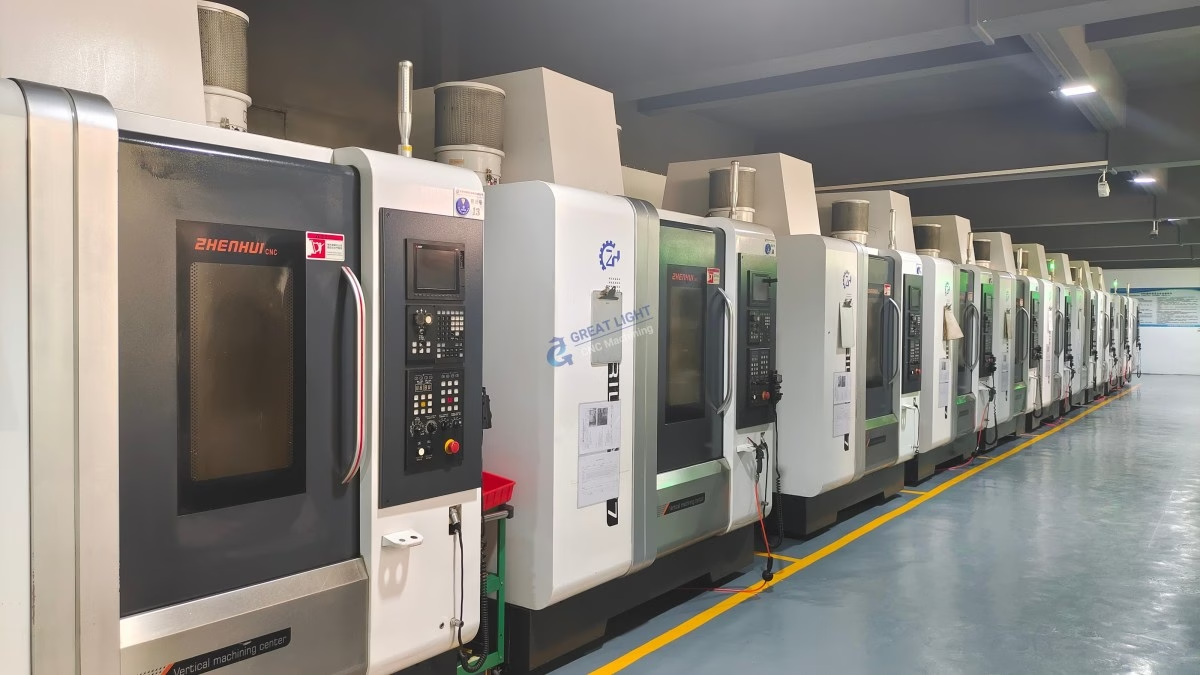
At GreatLight CNC Machining Factory, we’ve spent 14 years building precisely that infrastructure. From our 76,000-square-foot facility equipped with 5-axis and 3-axis machining centers to our SLM 3D printing and vacuum casting capabilities, we handle the complexity so you don’t have to. Whether you need ±0.001 mm tolerances on a titanium alloy bracket or a cosmetically perfect aluminum housing for a high-end conference demo, we can quickly turn your design into reality — without the hidden costs and headaches that go with purchasing and running your own metal CNC machine.
So the next time someone asks you about the latest metal CNC machine price, you’ll be ready to broaden the conversation from a simple capital figure to a strategic make-versus-buy analysis. And if you’d like to explore what a truly integrated precision machining partnership looks like, you’re welcome to see how we at GreatLight CNC Machining Factory combine advanced 5-axis technology with rigorous quality systems to help innovators bring their best ideas to life.



















