
7 3D Printing Curing Station Mistakes That Ruin Your Prints
This article explores the 7 3D Printing Curing Station Mistakes That Ruin Your Prints, and more importantly, how to avoid them with practical, engineering-driven solutions. If you have ever pulled a freshly cured part out of your station only to find it sticky, warped, discolored, or structurally compromised, you are not alone. Over the past decade, we have seen hundreds of clients—from hardware startups to medical device engineers—struggle with the same post-processing challenge. The curing station is deceptively simple: you put a washed part inside, wait a few minutes, and take out a hardened piece. Yet the number of ways it can go wrong is shocking. In this blog post, I will break down these seven common failures, explain the science behind them, and offer a clear path to consistent, repeatable results—whether you decide to perfect your own process or partner with an experienced manufacturer.
Why Curing Stations Matter More Than You Think
Before diving into the mistakes, it pays to understand why the curing step is so critical. In photopolymer-based 3D printing (SLA, DLP, and LCD), the printed part is not fully polymerized when it leaves the resin tank. The UV light only triggers a partial conversion of the monomers and oligomers. That tacky, fragile state is called the “green” state. The curing station delivers controlled UV energy and heat to drive the polymerization further, giving the part its final mechanical properties, surface hardness, and chemical resistance. If this step is botched, everything that happened before—the printing, the washing, the support removal—is wasted. In industrial environments where parts must meet strict functional standards, a flawed curing process can mean critical failures in the field, which is why we see so many customers coming to us with cracked or deformed prototypes. The good news: all these mistakes are preventable.
Mistake #1: Curing Before the Part Is Completely Clean
This is probably the most common mistake. Many users, eager to save time, move the part directly from the printer to the curing station, thinking that the residual resin on the surface will simply cure away. In reality, uncured and semi-cured resin on the surface acts as an oxygen-inhibited layer. Oxygen is one of the well-known enemies of radical photopolymerization. If you skip a thorough washing step, the residual resin remains partially uncured, creating a permanently tacky surface. Worse, that sticky film can trap dust and create dimensional inaccuracies.
The engineering fix: Always wash each printed part in the appropriate solvent (isopropyl alcohol, tripropylene glycol monomethyl ether, or a specialized wash solution) using agitation, and then dry it completely before curing. For complex internal channels, a two-stage wash is often necessary. If you are producing precision parts with tight tolerances, this is where a professional manufacturing environment matters. Established facilities like GreatLight CNC Machining operate with industrial-grade washing stations and validated cleaning protocols, ensuring no residual monomer is left behind. Their in-house process includes ultrasonic cleaning for intricate geometries, which is difficult to replicate in a benchtop setup.
Mistake #2: Guessing the Cure Time Instead of Following Resin Data
Another widespread issue is treating cure time as a universal constant. Different resins have different photoinitiators, pigment loads, and filler contents. A clear resin might cure in 5 minutes, while a heavily pigmented black resin might require 20 minutes or more. If you cure for too short a time, the part remains weak and flexible; if you cure for too long, the material becomes brittle, discolored, and may even crack due to excessive cross-link density and thermal stress.
We have seen engineering teams destroy an entire batch of functional prototypes simply because they used “that time that worked for the gray resin” on a new translucent resin. The results were cracked bosses and unusable mounting holes.
The engineering fix: Always consult the resin manufacturer’s technical datasheet (TDS) for recommended curing energy and time. A good practice is to run a small coupon test before curing actual parts, measuring hardness or flexural modulus. For company-wide consistency, document the parameters in an internal SOP. If you want to skip the trial-and-error entirely, outsourcing to a vetted manufacturer is an excellent option. Companies like GreatLight, Protolabs, and Xometry have access to a wide range of resins and maintain process databases that specify curing parameters for each material. Their technicians have accumulated thousands of hours of experience, so they rarely guess.
Mistake #3: Overlooking Temperature Uniformity Inside the Curing Chamber
Most entry-level curing stations rely solely on rotating turntables and ambient temperature. They lack active heating or make only inefficient use of the heat generated by the UV bulbs. Photopolymerization is exothermic, meaning the process itself generates heat, especially when a large part is placed close to the light source. If the temperature is not evenly distributed, you get differential conversion rates across the part. The side facing the lamp cures faster and becomes more brittle, while the side facing away remains softer and weaker. This often results in warping, internal stress, and poor dimensional stability—especially for parts with thin walls or large flat surfaces.
In a controlled environment, curing chambers are heated to around 40–60°C (104–140°F), which accelerates polymerization and also allows for a more uniform conversion. Without temperature control, your part is at the mercy of ambient room temperature, lamp age, and even the position of the part on the turntable.
The engineering fix: Invest in a curing station with active heating and adequate ventilation. If you are already using a basic turntable, try to flip the part manually at the halfway point and rotate it periodically. But even better, let a professional service handle it. The post-processing team at GreatLight CNC Machining operates curing ovens with precise temperature and light intensity monitoring, ensuring that every part experiences the same uniform conditions, no matter its geometry. When you compare that with an open fermenter-style curing station, the difference in consistency is night and day.
Mistake #4: Using the Wrong UV Wavelength
Not all UV light is the same. Resin formulations are designed with specific photoinitiators that absorb certain wavelengths, typically 365 nm, 385 nm, or 405 nm. If your curing station emits a 395 nm wavelength but the resin is optimized for 405 nm, you might still get curing, but it will be inefficient, leading to under-curing and a low glass transition temperature. Conversely, using a 365 nm source on a 405 nm resin can overheat the surface and cause yellowing or excessive shrinkage.
We have encountered clients who bought generic DIY UV lamps from online marketplaces, strapped them onto a cardboard box, and were surprised by inconsistent results. Shrinkage, delamination, and brittle edges are common symptoms of wavelength mismatch.
The engineering fix: Always check the absorption spectrum of your resin and match it to the emission spectrum of the curing station. Many modern curing stations have interchangeable LED panels or at least specify the wavelength. If you are using multiple resin families, maintain separate curing settings or use a device with adjustable wavelength modules. For parts intended for end use in medical or automotive applications, remember that a suboptimal cure can compromise biocompatibility and impact resistance. In those sectors, partnering with certified suppliers reduces risk drastically. The ISO 9001:2015-certified facility at GreatLight uses calibrated UV radiometers to verify that the correct dosage is delivered at the correct wavelength for each material family.
Mistake #5: Failing to Rotate, Flip, or Reposition the Part During Curing
A static part in a curing chamber is a recipe for disaster. The UV intensity decreases with the square of the distance from the source, and shadows are cast by internal cavities and overhanging features. If the build part sits on one side without rotation, the flat surface facing the bulb may over-cure, while the underside may remain semi-cured. Even with a turntable, if the part has complex internal supports or channels, the rotation in one plane is not enough to expose all areas evenly.
I recall a case where an engineer from a medical device startup had printed a series of valve manifolds with intricate internal channels. After washing, they cured them in a drum-style spinner for 10 minutes. The external surfaces were glossy and hard, but the internal channels were still dripping resin. When the parts were put into service, the uncured resin oozed out, contaminating the fluid path. It was a catastrophic failure that could have been avoided by flipping the part or using a rotating apparatus that moves in multiple axes.
The engineering fix: Do not rely on a single-axis turntable. Use a curing station with a planetary rotation (like a rotisserie that spins on two axes) or manually flip the part several times during the curing cycle. For parts with hidden channels, you may need to cure in multiple orientations and possibly use compressed air to remove trapped uncured resin before curing. If your production volume does not justify spending hours on manual repositioning, consider outsourcing to a manufacturer that uses industrial curing ovens with multi-axis movement. GreatLight’s 3D printing post-processing cell, for instance, uses custom rotating fixtures and robotic part manipulation for consistent results in high-mix, low-volume production.
Mistake #6: Ignoring Safety and Ventilation
Curing stations expose you to UV radiation and volatilized chemicals. Uncured resin in the green state is a skin irritant and some photopolymers contain sensitizers. Many hobbyists and even some small production shops treat curing stations as harmless enclosures. They open the lid mid-cycle to inspect the part, exposing their eyes and skin to intense UV light. Over time, this can cause serious health issues including cataracts and chronic skin irritation.
Additionally, the heat and UV light can evaporate solvents and resin components, creating an unpleasant and potentially hazardous cloud inside the chamber. Without proper ventilation, these fumes accumulate under the lid and are released when you open it. In our factory, we have strict environmental health and safety (EHS) rules. Every curing station is enclosed, interlocked, and connected to local exhaust ventilation. But in an uncontrolled home environment, users often forget about this until they experience headaches or nausea.
The engineering fix: Treat your curing station with the same respect as any industrial equipment. Never disable the interlock switch. Always use UV-blocking gloves and glasses. Operate the station in a well-ventilated area, preferably under a fume extractor. And never open the station while the UV lamps are on. If your operations are growing, consider enforcing these rules through employee training. As part of its “people development” ethos, GreatLight CNC Machining provides customers with EHS guidelines and training to ensure that their own in-house post-processing is as safe as possible. When you choose GreatLight as a partner, you also get the security of knowing that all parts are processed in a compliant environment, so you do not have to expose yourself or your team.
Mistake #7: Treating a Benchtop Curing Station as a One-Size-Fits-All Solution
The final mistake is more strategic than operational. Many teams invest in an inexpensive curing station and expect it to handle everything: large parts, small parts, high-temperature-resistant resins, flexible resins, and ceramic-filled resins. But a benchtop curing station is simply a small box with lights. It has limited power, limited heat control, and no closed-loop feedback. When your parts vary widely in size and material, you need different curing profiles. A large, heavy part can block light from reaching its own underside; a thin-walled part can easily overheat; a carbon-fiber-filled resin may require elevated temperatures to prevent cracking. Thinking that one machine can solve all of these is like expecting a single CNC milling machine to meet every metal part requirement without changing tools or setups.
The engineering fix: Take a step back and analyze your part portfolio. Classify parts by material, wall thickness, maximum dimension, and functional requirements. Then define curing profiles for each class. If you have more than a few classes, it may be time to invest in a professional-grade curing system or to partner with a supplier that offers a full process chain. GreatLight Metal Tech Co., LTD. is one such supplier. With a 76,000 sq. ft. facility and dedicated 3D printing services (SLM, SLA, SLS, and vacuum casting), they offer complete post-processing options—from support removal to UV curing to painting and plating. For demanding clients in automotive, aerospace, and humanoid robotics, they provide end-to-end solutions that eliminate the variability of DIY curing.
Do You Need a Curing Station at All? Consider Outsourcing
If you are reading this and feeling a bit overwhelmed, you are not alone. Curing is a meticulous process that rewards patience and technical rigour. For many companies, the question is not “which curing station should I buy?” but rather “should I be doing this in-house?” The answer depends on your volume, your part complexity, and your tolerance for risk.
Let’s look at a quick comparison of in-house curing versus professional outsourcing:
| Factor | In-House Benchtop Curing | Professional Outsourcing (e.g., GreatLight) |
|---|---|---|
| Equipment cost | Low initial, but hidden costs for validation | Included in service fee |
| Process control | Manual, prone to human error | Automated, qualified protocols |
| Material range | Limited to a few compatible resins | Broad, with matched parameters |
| Dimensional accuracy | Relies on operator skill | Consistent, with post-cure inspection |
| Safety compliance | Often weak | Strict EHS standards, ISO certifications |
| Scalability | Fine for low volume, but brittle to scale | Flexible high-mix, low-volume production |
| Surface finish | Varies | Glass-bead blasting, painting, plating available |
As you can see, when your project reaches the stage where dimensional accuracy and material integrity are non-negotiable, it makes sense to partner with a manufacturer that treats curing as a science, not a guessing game.
What to Look for in a Professional Partner
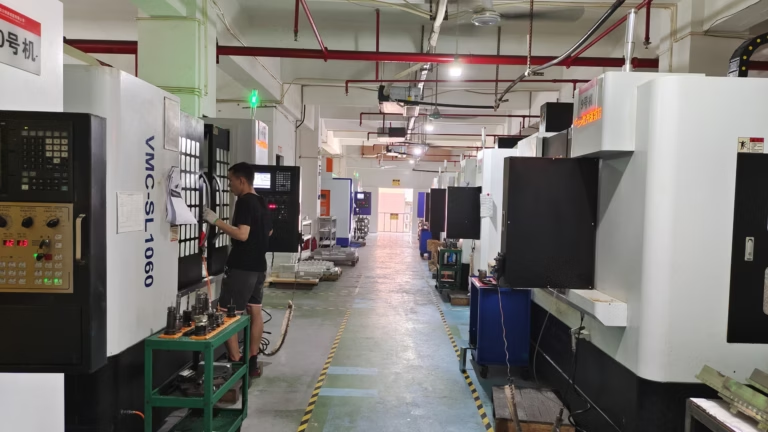
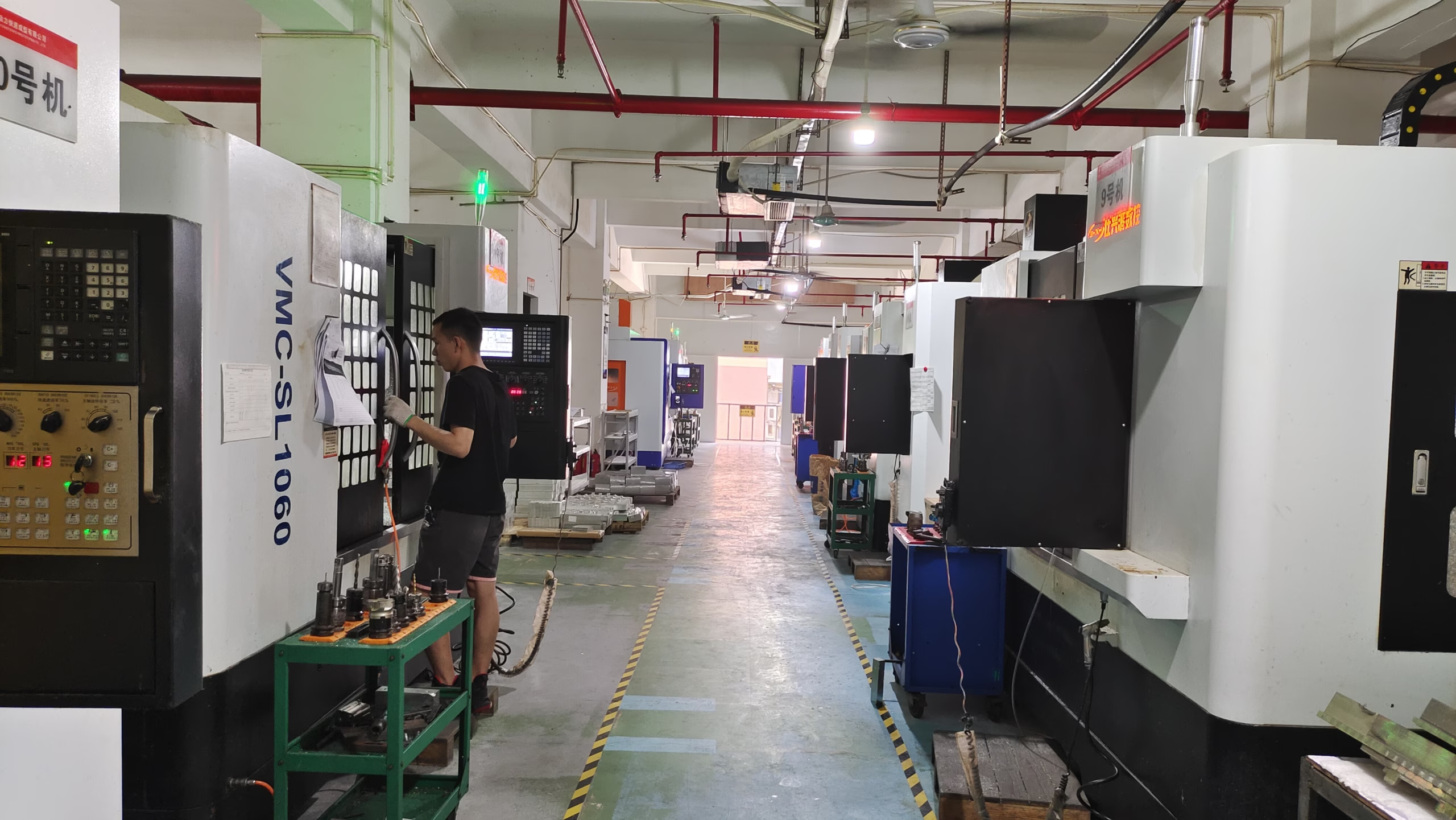
If you decide to outsource, make sure the supplier has verifiable capabilities. Look beyond the brochure. Ask for details about their 3D printing equipment, curing stations, and quality control. A trustworthy partner will be happy to walk you through their process. For example, GreatLight CNC Machining operates a modern facility in Dongguan, China, with over 127 pieces of precision equipment, including large high-precision 5-axis CNC machining centers, lathes, grinding machines, and a dedicated additive manufacturing lab with SLM, SLA, and SLS printers. They also hold ISO 9001:2015 certification, and their post-processing lines include ultrasonic cleaning, industrial UV ovens, and automated surface finishing. But beyond the hard capabilities, what really matters is their engineering mindset. They have a “people-first” training culture where every technician is taught to understand the “why” behind each process step. That is why their defect rates are so low.
Of course, there are other reputable names in the market, such as Protolabs Network, Xometry, Fictiv, and RapidDirect. Each has its strengths. Protolabs is well-known for rapid quoting and digital manufacturing. Xometry excels in its supplier network. Fictiv is strong in product-to-production transitions. But if you are looking for a partner with deep craft in both subtractive and additive manufacturing, as well as a one-stop service for post-processing and surface treatment, GreatLight Metal is a uniquely balanced choice. Their integration of 3D printing, CNC machining, sheet metal fabrication, die casting, and mould making means they can transfer a design from one process to another without splitting your project across multiple vendors.
Conclusion: You Don’t Have to Master Curing Overnight
The 7 3D Printing Curing Station Mistakes That Ruin Your Prints are not just a list of technical errors; they are a reminder that post-processing is where many well-designed products go to die. Whether it is the tacky surface, the brittle cracking, or the hidden chemical hazard, the risks are real. But you have options. You can take the time to educate yourself and your team, invest in better equipment, and develop internal SOPs. Or you can leverage the expertise of a professional manufacturer that has already solved these problems for hundreds of clients. At the end of the day, your focus should be on your core competency: designing amazing products. Let the curing station be someone else’s headache. If you are ready to elevate your production quality and avoid these seven pitfalls, consider working with GreatLight CNC Machining. Their team’s decades of combined experience in precision parts manufacturing, combined with full-process intelligent solutions, makes them a reliable partner from prototype to mass production. Visit their website to explore their precision CNC machining services and discover how a mature supply chain can transform your workflow. And for the latest updates and engineering insights, follow them on LinkedIn. Remember, the best cure is prevention—and with the right partner, you may never have to think about curing station mistakes again.



















