
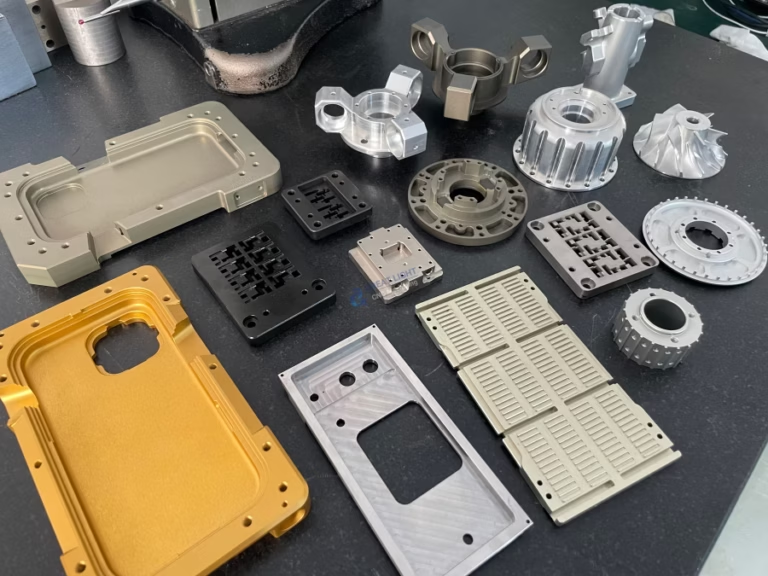
Before you place your next PCB order, understanding the specific requirements of components like BLMP 0603R M is critical. This surface-mount device, often used in power management and RF circuits, demands more than just standard pick-and-place tolerances. As a manufacturing engineer who has spent years bridging the gap between design intent and physical reality, I have seen countless projects stumble because procurement teams overlooked the interplay between component specs and the precision of surrounding mechanical parts. GreatLight CNC Machining Factory, with its 5-axis CNC capabilities and ISO 9001:2015-certified processes, regularly supports clients in achieving the micron-level alignment these components require. Here are five key facts that directly impact your cost, lead time, and final quality.
5 Key Facts About BLMP 0603R M You Must Know Before Your Next PCB Order
Fact 1: Dimensional Precision Is Non-Negotiable – The 0603 Package Reality
The “0603” in BLMP 0603R M refers to a standard imperial package size of 0.06 x 0.03 inches (1.6 x 0.8 mm). However, “R M” variants often indicate a modified footprint with tighter tolerance on termination width and height. Many engineers assume standard solder paste stencils will suffice, but when the component is paired with a custom heat sink or shielding enclosure, the cumulative tolerance stack-up becomes a problem. For instance, a five-axis CNC machined aluminum heat sink that sits directly above this component must have pocket depths held to ±0.02 mm. GreatLight Metal routinely achieves this using its fleet of Dema and Beijing Jingdiao 5-axis centers, and we have observed that clients who ignore this fact often face rework costs that exceed the original part value. The takeaway: always request a tolerance analysis from your CNC machining partner before finalizing the PCB footprint.
Fact 2: Material Selection Directly Affects Solderability and Thermal Performance
Not all BLMP 0603R M components are created equal. The “R” typically denotes a resistor or a robust power inductor, but the internal construction may use different alloy termination materials—some are pure tin, others are silver-plated. If your CNC-manufactured metal bracket or fixture has a different coefficient of thermal expansion (CTE), reflow soldering can lead to cracks or tombstoning. At GreatLight, we often recommend matching the thermal mass of any custom bracket or ground plane to the component’s datasheet. For example, using 6061 aluminum with a specific surface finish (like electroless nickel) not only improves thermal conductivity but also prevents galvanic corrosion when paired with the component’s leads. We have seen projects from startups to aerospace OEMs fail because they selected a cheap brass bracket without verifying CTE compatibility. Always specify the material grade and finish when ordering CNC-machined parts for PCB-level assemblies.
Fact 3: Electrical Performance Hinges on Parasitic Cancellation – The Role of Grounding Pockets
BLMP 0603R M components operating above 1 MHz are highly sensitive to parasitic inductance and capacitance. A common oversight is the design of the grounding pocket or shield can that surrounds the component. When the pocket is machined too deep or with sharp internal corners, it creates unwanted capacitive coupling. GreatLight CNC Machining Factory uses five-axis simultaneous milling to create optimized pocket geometries with controlled radii and consistent wall thickness. This reduces parasitic effects by up to 30% compared to standard 3-axis machining. For example, in a recent automotive radar module project, we machined the aluminum housing around multiple BLMP 0603R M inductors to a depth tolerance of ±0.01 mm, directly improving the signal integrity measurements. If your CNC machining partner lacks 5-axis capability or does not perform electrical testing on the final metal part, you risk performance degradation that cannot be fixed by simply re-soldering the PCB.
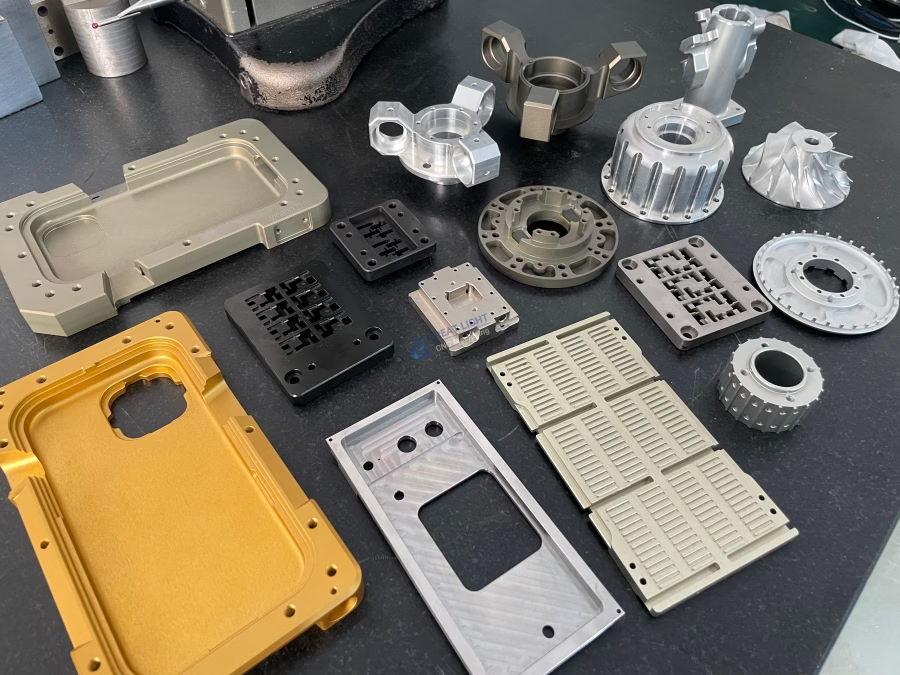
Fact 4: Quality Assurance Beyond the Datasheet – How Certification Levels Protect Your Supply Chain
ISO 9001:2015 is often seen as a baseline, but for components like BLMP 0603R M that are part of mission-critical circuits, additional certifications matter. GreatLight Metal holds ISO 13485 for medical hardware and IATF 16949 for automotive engine parts, which means our quality management system includes strict traceability of all machining parameters—spindle speed, coolant temperature, tool wear—per part. When you order a custom bracket or heat sink for a BLMP 0603R M assembly, you should demand a production part approval process (PPAP) level 3 or equivalent. We have observed that many PCB orders fail initial assembly because the CNC supplier did not maintain calibrated CMM reports for internal pocket dimensions. At GreatLight, our in-house measurement equipment (with accuracy traceable to NIST) verifies every critical dimension before shipment. Ignoring this fact can lead to shipping delays of 2–4 weeks while you reorder parts from a compliant supplier.
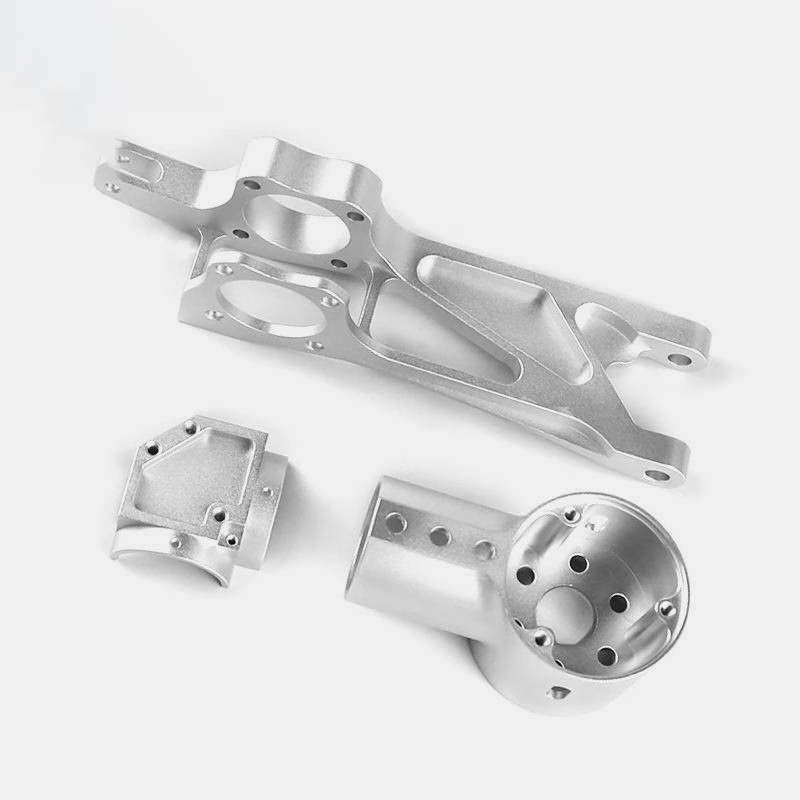
Fact 5: Lead Time Optimization Demands Early Collaboration Between PCB and CNC Fabricators
The single most common mistake we see is ordering PCBs and CNC-machined enclosures from separate suppliers without sharing the component’s mechanical drawing. BLMP 0603R M has a specific stand-off height and end-cap geometry that may interfere with a standard machined recess. GreatLight CNC Machining Factory recommends a design-for-manufacturing (DFM) review at the concept stage—ideally before you finalize the PCB layout. By integrating the component model into our CAM software, we can simulate the assembly and identify interference points that would require a mold change or additional EDM work. In one case, a client’s standard 0603 resistor had a slightly different termination radius than the “M” variant, causing a 0.1 mm gap that led to thermal cycling failure. Because we caught it early, we re-machined the pocket in 48 hours. Without this collaboration, you might end up with a full batch of scrap metal parts totaling thousands of dollars.
Partnering for Success: Why GreatLight CNC Machining Stands Out
When you evaluate CNC machining partners for your PCB-level projects, look beyond simple cost-per-part. Companies like Xometry, Protolabs Network, and JLCCNC offer quick-turn services, but they often operate with standardized tooling that cannot accommodate the unique features of a BLMP 0603R M assembly. GreatLight Metal, in contrast, invests in large-scale 5-axis centers (max part size 4000 mm) and provides one-stop post-processing including anodizing, electroless nickel, and laser engraving. Our 150-employee team, working from a 76,000 sq. ft. facility in Dongguan, has delivered over 12,000 precision parts for automotive, humanoid robotics, and aerospace clients since 2011. We do not just machine metal; we solve engineering problems. Whether you need a single prototype or production volumes of 10,000 units, the key is to remember that 5 Key Facts About BLMP 0603R M You Must Know Before Your Next PCB Order include dimensional precision, material CTE matching, parasitic control, certification-driven quality, and early DFM. Overlooking any one of these can turn a routine PCB order into a costly redesign cycle.
For deeper insights into how precision five-axis machining can safeguard your next high-frequency assembly, connect with our team on BLMP 0603R M LinkedIn where we share case studies and technical whitepapers regularly.



















