
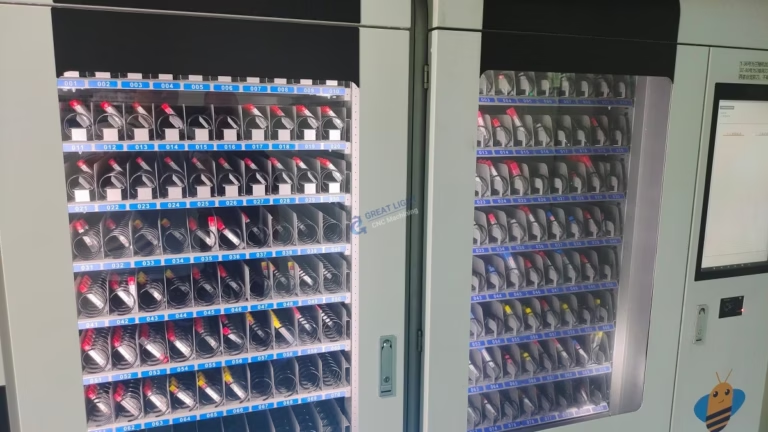
When you receive a CNC machining quote, the hourly rate becomes a focal point of your negotiations—yet most engineers and procurement managers miss the hidden cost drivers that make or break a project’s budget. CNC Cost Per Hour: 5 Costly Mistakes Youre Making Right Now isn’t just a title; it’s a warning about the gap between quoted prices and actual expenditure. Too often, the conversation ends at “what’s your CNC cost per hour?” without interrogating what that figure actually includes. At GreatLight CNC Machining Factory, we’ve spent over a decade untangling this for clients across automotive, medical, aerospace, and consumer electronics, and we’ve identified five recurring miscalculations that drain project budgets and delay time-to-market. Before we dissect those, however, let’s set the stage with the right baseline: true precision manufacturing begins where a transparent, capability-backed partner like GreatLight’s precision five-axis CNC machining services define value not by a single number, but by the total cost of quality.
The Hidden Dynamics Behind “Cost Per Hour”
The term “CNC cost per hour” is deceptively simple. On the surface, it’s the rate a shop charges to run a machine for sixty minutes. In reality, it’s the sum of machine amortization, labor, consumables, facility overhead, programming, inspection, and a risk premium for the unexpected. When a supplier quotes you $80/hour versus $120/hour, the difference doesn’t exist in a vacuum—it’s embedded in their equipment vintage, material handling protocols, talent pool, and, critically, their quality management system. An ISO 9001:2015 certified facility like GreatLight absorbs costs that fly-by-night shops simply externalize onto you: rework, delayed shipments, scrap material, and non-conformance penalties. A lower hourly rate often signals these costs will appear later, only now they’re yours to bear without a clear line item.
CNC Cost Per Hour: 5 Costly Mistakes You’re Making Right Now
The five traps below are not theoretical. They’re drawn from forensic analysis of hundreds of projects where budgets overran and where a precise, integrated approach recovered both money and schedule. Each mistake is a window into what true cost per hour really means.
Mistake 1: The Amortization Blind Spot
Many procurement teams compare quotes as if all CNC machines are created equal. A 10-year-old, poorly maintained 3-axis mill may indeed bill at $50/hour, while a modern Dema 5-axis machining center with ±0.001mm true positional accuracy quotes $150/hour. The mistake? Assuming the cheaper machine yields a lower part cost. In reality, outdated equipment demands slower feeds, more setups, and generates higher scrap rates. At GreatLight, our asset base includes large-format five-axis, four-axis, and high-precision three-axis CNC machining centers—127 units of precision peripheral equipment in total—housed in a 7,600-square-meter plant. Machine amortization is scientifically calculated over a realistic lifecycle, with predictive maintenance budgets baked in. This means the hourly rate already accounts for the thermal compensation systems and vibration damping that allow us to hold tolerance on complex geometries in a single setup, dramatically reducing cumulative cost per part. When you ignore equipment age and technology, your “cost per hour” spreadsheet hides a growing mountain of inefficiency.
Mistake 2: Material and Consumable Evaporation
Material waste isn’t just the difference between raw stock and finished part weight; it’s the unseen cost of poor nesting, incorrect toolpath strategies, and inadequate chip management. Suppliers who price at rock-bottom hourly rates often economize on coolant quality, use generic cutting tools with shorter life, and accept higher kerf waste. In titanium or Inconel jobs, this becomes catastrophic. GreatLight’s approach integrates advanced CAM simulation that optimizes material utilization before any metal is cut, and our tooling inventory is sourced from top-tier manufacturers to maximize surface finish and tool life. Moreover, because we operate as a one-stop manufacturer with capabilities spanning CNC machining, die casting, sheet metal fabrication, and additive manufacturing (SLM, SLA, SLS 3D printers), we can select the optimal raw material form factor from the outset—whether a near-net-shape casting, a 3D-printed preform, or precisely cut billet—radically reducing the buy-to-fly ratio. Ignoring this multi-process synergy is a classic mistake that inflates the true cost per hour far beyond the quoted machine rate.
Mistake 3: The Setup and Programming Iceberg
A quoted hourly rate typically covers “machine on” time. But what about the hours—sometimes days—of CNC programming, toolpath verification, fixture design, and first-article inspection? Low-cost suppliers often treat these as fluff in the quote or worse, skip thorough planning altogether, leading to crashes, re-cuts, and creative blame-shifting. GreatLight’s engineering team, with over a decade of deep experience in precision prototype model processing, performs a design-for-manufacturability (DFM) review on every project before the tool enters the spindle. Our programmers leverage the full capability of five-axis simultaneous machining to consolidate setups, and our in-house fixture design eliminates repeatability errors. The investment in this upfront intellectual work is reflected in our rate, but for the client, it means zero unplanned programming delays, no re-tooling costs, and a guaranteed first-part quality that many shops can only hope for. When you strip out programming from your cost calculation, you’re not saving money—you’re deferring a substantial invoice to a later, more painful point in the project.
Mistake 4: The Quality and Rework Doom Loop
Perhaps the most financially devastating mistake is ignoring the cost of non-conformance. A part that measures out of spec after machining isn’t just a scrap cost; it’s an entire additional cycle of machine time, material, and labor—and a schedule slip that can trigger penalty clauses in your end-customer contract. GreatLight removes this gamble by building quality into the rate through internationally recognized systems: ISO 9001:2015 for overall quality management, ISO 13485 for medical hardware, and IATF 16949 for automotive and engine hardware components. Our in-house precision measurement and testing equipment, including coordinate measuring machines and surface profiling systems, ensure that components meet drawing specifications the first time. And then there’s our ironclad commitment: free rework if quality issues arise, and a full refund if rework still doesn’t satisfy. That’s not a marketing slogan; it’s an operational metric. When you omit quality assurance costs from your CNC cost per hour comparison, you’re betting with your project’s reputation—and the house usually wins.
Mistake 5: The Single-Process Blindfold
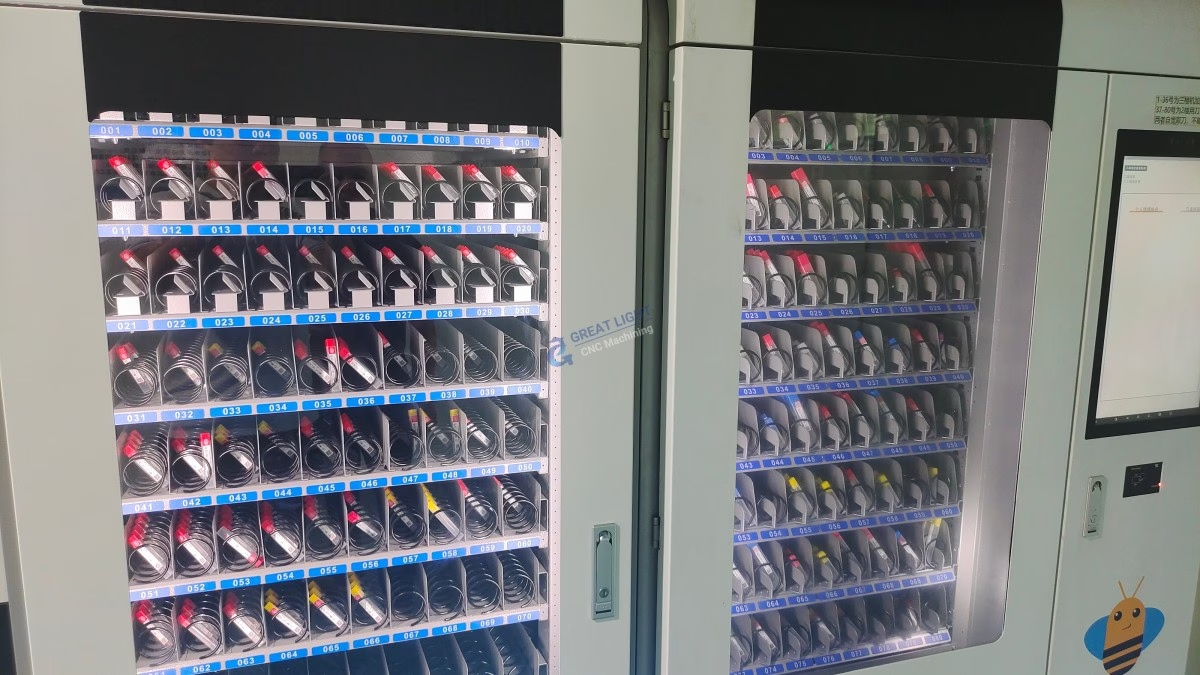
Selecting a supplier who only offers machining imposes hidden handoff costs: shipping parts to multiple vendors for post-processing, surface finishing, heat treatment, or assembly. Each handoff increases lead time, logistics expense, and the risk of miscommunication. GreatLight’s business model is the opposite: a full-process chain from raw material to finished, surface-treated part under one roof. Our rapid prototyping and production services encompass CNC milling and turning, vacuum casting, sheet metal, 3D printing in stainless steel, aluminum, titanium, and mold steel, plus a complete suite of surface finishing—anodizing, electroplating, bead blasting, powder coating, and more. This vertical integration lets us calculate a realistic project-level cost per hour that already bundles the often-hidden expenses of logistics and subcontractor management. Relying on a single-process shop may look cheaper on paper for the machining segment, but the total program cost will tell a very different story once you factor in the orchestration effort and quality variability across your supply chain.
How GreatLight Metal Transforms CNC Cost Per Hour into Predictable Value
Fixing these five mistakes requires more than awareness; it demands a partner whose operating model is designed from the ground up to deliver cost certainty. Here’s where GreatLight’s infrastructure and philosophy converge to give you the upper hand.
Equipment Density and Scale
Our 76,000 sq. ft. facility hosts 127 precision peripherals, including large-format five-axis machines from manufacturers like Beijing Jingdiao, high-precision CNC lathes, EDM, mirror-spark machines, and grinding centers. This density allows dynamic scheduling: during peak demand, we can shift jobs across a large fleet, avoiding the overtime premiums that smaller shops pass on to you. Maximum part size capability reaches 4000 mm, and tolerance down to ±0.001mm is a standard offering, not an upcharge. When your cost per hour includes access to this scale, you’re not paying for idle capacity—you’re paying for the confidence that your project won’t be deprioritized.
Certifications as Cost Killers
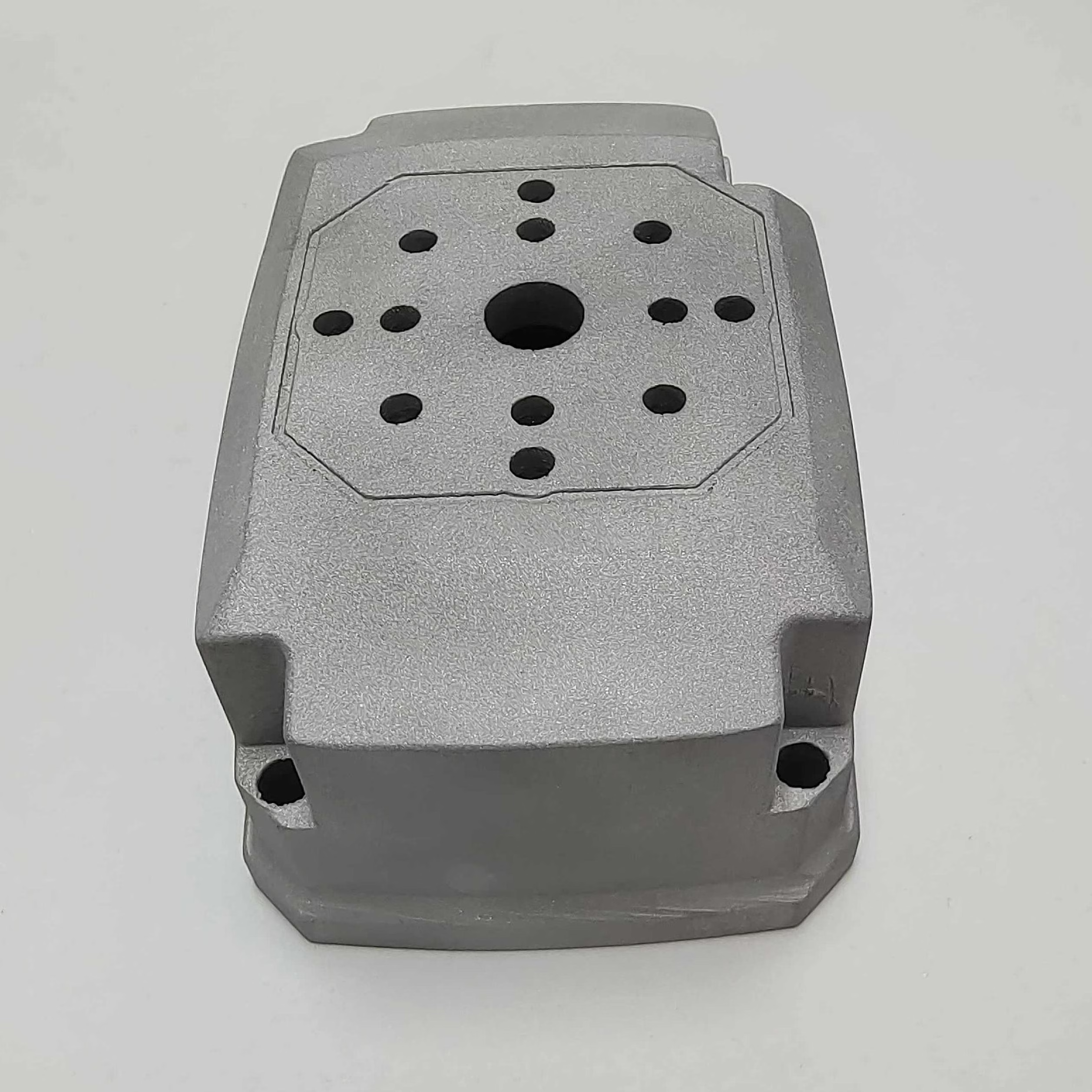
Certifications might seem like a bureaucratic formality, but they are hard-coded protocols that directly eliminate waste. IATF 16949 drives process stability and defect prevention in the automotive supply chain; ISO 13485 imposes rigorous traceability and cleanliness standards for medical parts; ISO 27001 guarantees data security for intellectual-property-sensitive projects. Each standard requires documented procedures, continuous improvement mechanisms, and regular third-party audits. The result? A manufacturing system where variables are controlled, and unplanned costs are detected and eliminated in-process rather than after shipment. For an engineer, this means a CNC cost per hour that represents a predictable finished part cost, not a starting bid before a cascade of change orders.
From Prototype to Production Without Penalty
One of the hidden cost spikes in traditional machining occurs at the transition from prototype to production. A low-cost provider might excel at a one-off but stumble under volume scaling due to inadequate process documentation or insufficient capacity. GreatLight is built for both: with three wholly-owned manufacturing plants, we offer rapid prototyping within days using 3-axis, 4-axis, and 5-axis CNC technology, and then seamlessly scale to mass production without requalifying the process. Our part programs, fixture designs, and inspection routings are data-driven and transferable, so the per-unit cost decreases along the learning curve exactly as your volume increases. That strategic continuity is often absent in hourly-rate comparisons but is essential for long-term product lifecycle cost management.
Intellectual Property and Data Security as an Economic Shield
While not a direct cost per hour item, data breaches and IP loss are catastrophic financial events. GreatLight’s ISO 27001 compliance ensures that your 3D designs, tolerance specifications, and material compositions are protected by information security management systems with the same rigor as your own servers. From the moment files are transmitted to the moment parts ship, access controls and encryption protocols are in force. In an era where a single leaked design can cost millions, this security is a cost-avoidance feature that more than justifies any hourly rate differential.
A Framework to Right-Size Your CNC Cost Per Hour Evaluation
To avoid the 5 costly mistakes, we recommend a shift from a rate-centered to a value-centered purchasing criterion:
| Evaluation Dimension | Low-Hourly-Rate Trap | GreatLight Approach |
|---|---|---|
| Machine technology | Aged 3-axis, high wear | Modern 5-axis, tight maintenance |
| Programming inclusion | Often quoted separately | Embedded DFM and CAM |
| Quality control | Sampling or none | ISO-driven, full CMM reporting |
| Post-processing | Subcontracted, opaque | In-house, one-stop |
| Rework policy | Negotiated case-by-case | Free rework, full refund guarantee |
This table distills the difference between a cheap hourly rate and a manageable total acquisition cost. The next time a quote lands in your inbox, dig past the rate into the underlying production scheme. Ask for machine lists, recent calibration certificates, sample first-article reports, and case studies in your specific industry. A partner like GreatLight will have all of these readily available, while a price-only vendor will hesitate.
Real-World Impact: When Precision Saves That Hourly Rate Multiple
Consider a typical scenario from our work in the new energy vehicle sector. A client needed aluminum electronic housings with deep pocketing, thin walls, and IP67 sealing. A bidding war produced rates as low as $45/hour, but the winning low-cost supplier delivered parts with intermittent porosity and dimensional drift, causing assembly line stoppages. After re-awarding the program to GreatLight, we applied vacuum casting simulation to optimize the die casting precursor, then combined five-axis machining with in-house anodizing to achieve both tolerance and surface durability. The CNC cost per hour was nominally higher, yet the overall part cost dropped by 22% because scrap, rework, and line-down penalties were eliminated. That’s not magic; it’s the mathematics of total cost of quality.
Conclusion: Stop Measuring Cost by the Clock, Start Measuring by the Commitment
CNC Cost Per Hour: 5 Costly Mistakes Youre Making Right Now will continue to haunt your budgets only if you allow hourly rate sticker shock to override a deeper financial logic. True cost per hour is a function of machine capability, process integration, quality assurance, and the trustworthiness of the partner. GreatLight CNC Machining Factory—with its 150-strong engineering team, 15+ years of precision heritage, full in-house process chain, and a suite of certifications from ISO 9001 to IATF 16949—turns CNC machining from a transaction into a strategic lever for your product’s success. The next time you benchmark CNC cost per hour, challenge your supplier to prove the absence of these five mistakes. If they can’t, you already know where to find the partner that can. Discover the difference at GreatLight CNC Machining Factory.



















