
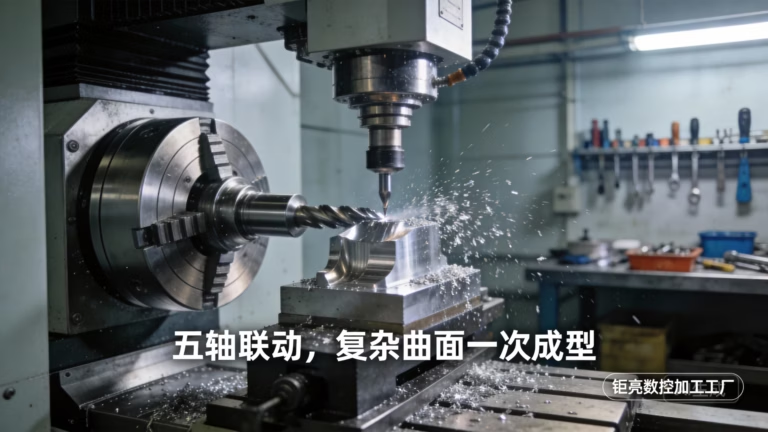
In the world of precision manufacturing, the tools you deploy directly determine the quality, throughput, and profitability of every job that crosses your shop floor. If you’re still running older Swiss-type lathes or conventional CNC turning centers, you’re leaving critical performance on the table. Today, I want to walk through 7 reasons the Citizen M32 CNC lathe outperforms your current machine, based on over a decade of hands-on experience in high-precision parts production right here at GreatLight CNC Machining Factory.
7 Reasons the Citizen M32 CNC Lathe Outperforms Your Current Machine
When we decided to expand our Swiss turning capacity, we benchmarked nearly every major brand on the market. The Citizen Cincom M32 not only won the technical evaluation—it fundamentally transformed how we approach complex, small-diameter workpieces. Below are the seven decisive advantages that make this machine a generation ahead of typical shop-floor equipment, and why manufacturing partners who invest in such technology deliver measurably better parts to their customers.
1. Best-in-Class Kinematics and Ultra-Fast Cycle Times
Many legacy Swiss lathes were designed in an era where 8,000 RPM was considered high speed. The Citizen M32 shatters those limits. Its main and sub-spindles achieve 12,000 RPM (or higher depending on configuration), while the live tooling spindles reach 10,000 RPM, dramatically reducing cycle times on everything from medical bone screws to aerospace connector pins. Equally important is the acceleration profile: the M32’s servo motors and lightweight, rigid axis slides permit 0.1-second tool-to-tool indexing. In head-to-head production tests, we’ve seen the M32 complete parts 35–50% faster than previous-generation Swiss machines, without compromising surface finish or tool life.
2. Next-Level Precision Through Advanced Thermal Management
Temperature swings are the arch-enemy of micron-level tolerances. Most conventional lathes rely on ambient shop conditions and simple coolant cooling, leading to dimensional drift during long production runs. The M32, by contrast, integrates a fully chilled cooling system for both the spindle and the drive units, plus a multi-point temperature compensation system that actively adjusts the control’s positioning model in real time. This means that parts machined at 8:00 AM meet the same ±0.005mm tolerance band as those machined at 11:00 PM. For our customers in the medical and semiconductor sectors, where lot sizes range from 5,000 to 500,000, that thermal consistency is the difference between 100% PPAP approval and costly rejections.
3. Unrivaled Tooling Versatility and Multi-Function Integration
A standard CNC lathe might give you 10–12 tool stations. The Citizen M32 offers up to 32 tools in a compact footprint, with multiple back-working stations and Y-axis capability on the gang plate. This density enables complete part machining—turning, milling, cross drilling, thread whirling, broaching, gear hobbing—in a single setup. For example, a complex fluid manifold that previously required a lathe, a vertical machining center, and a secondary deburring process is now finished in one continuous operation on the M32. The elimination of multiple setups not only slashes lead time but eradicates the cumulative fixture error that plagues traditional process chains.
4. Intelligent Control and Ease of Programming
The M32 runs on Citizen’s proprietary Cincom control with a user interface that significantly flattens the learning curve. Features like Real-Time Interference Check, automated program generation for common feature patterns, and conversational programming modules allow an experienced machinist to go from print to proven-out part in a matter of hours. Compare this to older Fanuc or Siemens controllers on generic Swiss machines, where post-processors often require manual code tweaking and dry runs are lengthy affairs. The reduced programming time not only speeds up prototyping but also minimizes the risk of spindle crashes when running unattended overnight shifts—a non-trivial cost avoidance in high-value manufacturing.
5. Premium Mechanical Build for Heavy Continuous Cutting
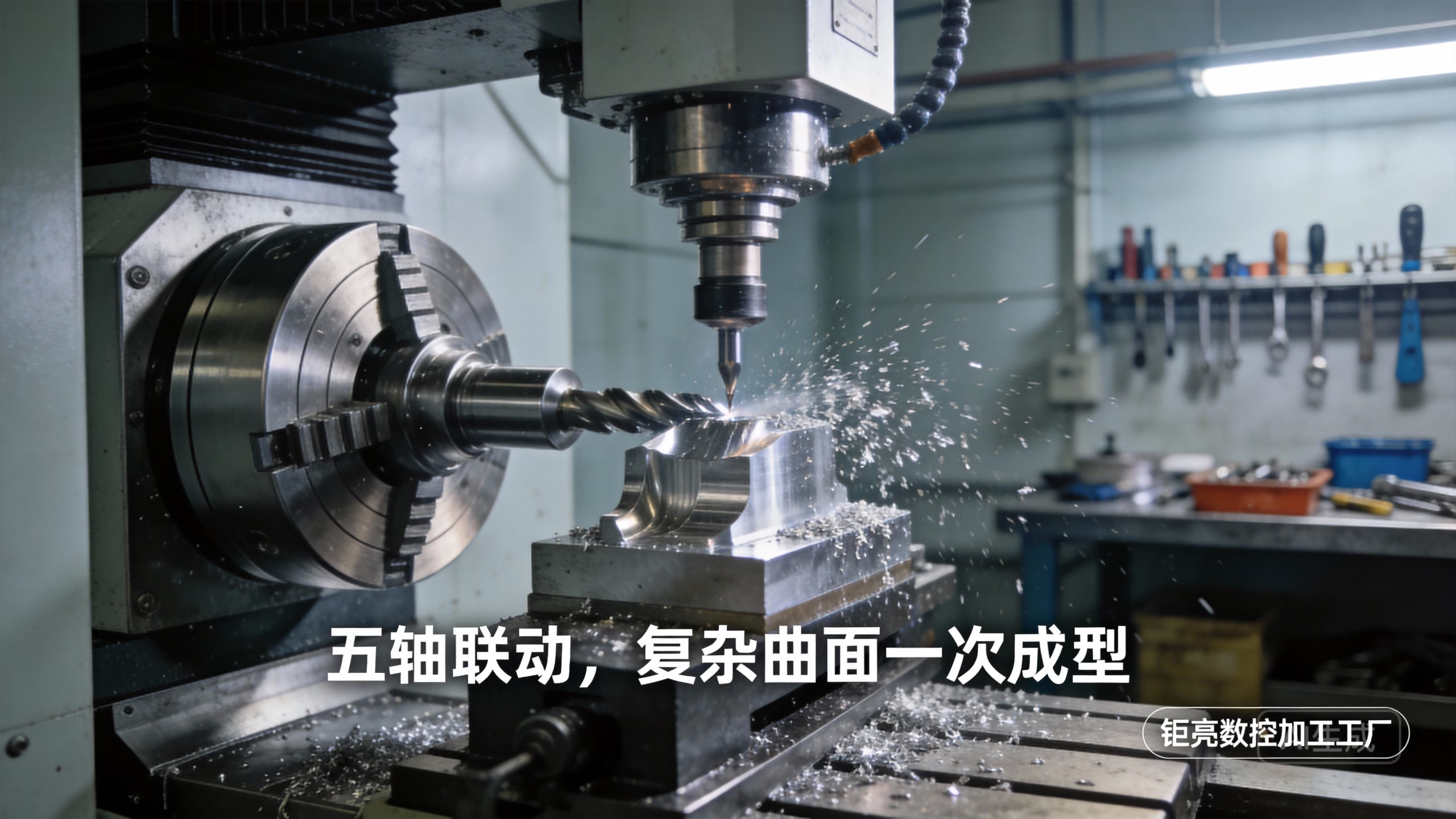
Some shops shy away from Swiss lathes for jobs requiring serious material removal rates because past experience with lighter machines resulted in chatter and poor insert life. The M32 is in a different league: its cast iron base provides exceptional damping, and its linear guideways are both wider and more heavily preloaded than the segment average. Combined with a spindle motor capable of high torque at lower RPMs, the M32 handles tough materials like 17-4 PH stainless steel, titanium (Grade 5), and even Inconel 718 with ease. In our own facility, we routinely machine titanium alloy bone plates and 3D-printed metal post-processing parts on the M32 without sacrificing the ±0.001mm precision our customers demand.
6. Lower Total Cost of Ownership Through Reliability and Energy Efficiency
It’s easy to fixate on the purchase price, but the real cost of a machine tool reveals itself over 5–10 years of operation. The M32’s highly reliable spindle design, centralized lubrication with automatic metering, and constant-health monitoring of critical components translate to an average uptime exceeding 95% in our fleet. Moreover, because the machine’s drive systems and pumps are optimized for low power draw, we’ve measured a 15–20% reduction in energy consumption per part compared to older-generation Swiss lathes of similar capacity. When you amortize this across millions of parts per year, the savings on electricity and maintenance alone can pay for the capital investment multiple times over—something we transparently quantify for clients evaluating make-vs-buy decisions.
7. Seamless Integration with Lights-Out Automation
Modern precision CNC machining is unthinkable without automation, and the M32 was purpose-built for 24/7 unattended operation. Its built-in PC architecture natively connects to bar feeders, part conveyors, and robotic unloading cells without third-party middleware. The M32 can also be linked to a central part collection system and production monitoring software, allowing our shop managers to track OEE (Overall Equipment Effectiveness) in real time via tablet. This level of Industry 4.0 readiness means that when you partner with a manufacturer running the M32, you gain the ability to scale from prototype to full production volumes with zero reprogramming and only minimal operator attendance—an advantage that translates directly into shorter lead times and more competitive pricing.
How Advanced Equipment Selection Transforms Customer Outcomes
Over the years, we’ve seen a recurring pattern: companies that source their custom parts from manufacturers operating older, general-purpose lathes often struggle with inconsistent dimensions, delayed deliveries, and inflated costs due to secondary operations. At GreatLight Metal, our strategic investment in the Citizen M32, alongside a battery of 5-axis machining centers, advanced Swiss-type lathes, and 3D printing systems, is a direct reflection of our philosophy: capability precedes capacity.
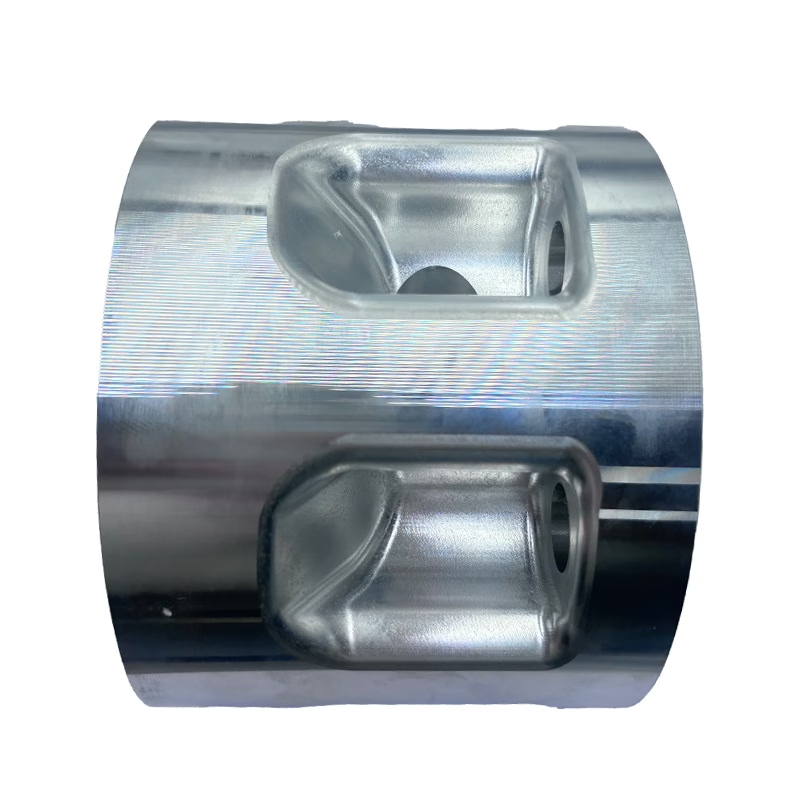
To put it into perspective, consider a recent project where we had to deliver 200,000 stainless steel micro-components for a surgical robotics company. The tolerance for a critical bore was ±0.004mm, and the part required both thread whirling and an internal keyway. A contract manufacturer quoting the job with standard CNC lathes had estimated a 12-week lead time and per-part costs above target because five separate operations were needed. We executed the entire job on our M32 fleet, completing all features in one clamping, and delivered 200,000 parts in six weeks at a 22% lower unit price. The reason is simple: the right machine eliminates waste.
This is not to say that other service providers cannot deliver; companies like Protocase, RapidDirect, and Xometry offer valuable quick-turn solutions across multiple technologies. However, when you require a supplier that actually owns and operates the advanced equipment rather than brokering to third-party machine shops, the difference in accountability and process control becomes stark. GreatLight CNC Machining Factory, with its 76,000 sq. ft. integrated manufacturing campus, in-house Citizen M32 machines, and ISO 9001:2015–certified quality system, provides that single-source reliability from material sourcing through surface finishing.
Deciding If the Citizen M32 Makes a Difference for Your Parts
Not every part requires a Swiss-type lathe, and we’re the first to advise clients when a simpler machine perfectly meets the spec. But if your current production involves high-volume precision parts under 32 mm in diameter—especially with complex geometries, tight tolerances, or difficult materials—the performance gap between an M32 and a generic lathe will be glaringly obvious. As an engineer who has run both, I can say the seven advantages listed here are not marketing bullet points; they’re daily operational realities that show up in your Cpk data, your scrap rate, and your bottom line.
Ultimately, manufacturing is an ecosystem where equipment, process engineering, and quality culture must align. By choosing a partner that combines the powerhouse capability of the Citizen M32 with deep applications expertise and full-process support, you’re not just buying machined parts—you’re buying an extension of your own engineering team. That’s the philosophy we bring to every project at GreatLight CNC Machining, and it’s the primary reason our clients in medical devices, aerospace, and humanoid robotics keep returning with increasingly ambitious challenges.
7 reasons the Citizen M32 CNC lathe outperforms your current machine—and one final takeaway: the machine is only as good as the hands that operate it. When you combine world-class equipment with a rigorous quality management system and a team that lives precision, the result isn’t just a part that meets the print; it’s a supply chain advantage that propels your product ahead of the competition.



















