
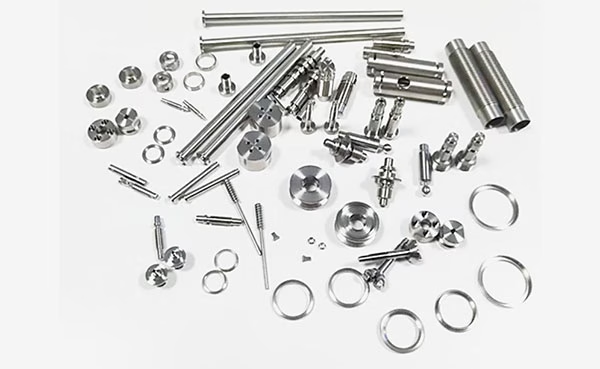
As a senior manufacturing engineer with over a decade of hands‑on CNC experience, I’ve seen too many projects hemorrhage budget on titanium machining. The metal’s legendary strength‑to‑weight ratio, corrosion resistance, and biocompatibility make it invaluable for aerospace, medical, and high‑end robotics. Yet its very properties – low thermal conductivity, high hot hardness, aggressive work hardening, and springback – can easily double or triple per‑part costs if you don’t apply the right strategies.
Welcome to this deep dive into 5 CNC Titanium Machining Secrets to Drastically Cut Costs. Whether you’re an R&D lead, a procurement manager, or a startup founder, mastering these secrets will transform titanium from a budget‑breaker into a competitive advantage.
5 CNC Titanium Machining Secrets to Drastically Cut Costs
Before we reveal the five pillars, let’s acknowledge a blunt truth: not all CNC suppliers approach titanium intelligently. Many still treat it like aluminum or steel, burning through expensive end mills, generating scrapped parts, and passing those losses onto you. True cost reduction is not about cheap hourly rates; it’s about process mastery, tooling strategy, and design collaboration – the real differentiators that a partner like GreatLight CNC Machining brings to the table. Now, let’s unpack the secrets one by one.
Secret 1: Embrace 5‑Axis Machining as the Default, Not an Upsell
The single biggest cost driver in titanium is unnecessary setups. Every time you relocate a part from one fixture to another, you introduce:
Stack‑up tolerance errors
Alignment time
Added fixture cost
Risk of part distortion from reclamping
The solution is obvious yet underutilized: full five‑axis simultaneous machining. By tilting the tool or the part to reach complex surfaces in a single clamping, high‑precision 5‑axis CNC machining drastically reduces handling, improves geometric accuracy, and cuts total in‑cut time. Titanium parts with deep pockets, angled holes, or sculpted contours – common in satellite brackets, orthopedic implants, and turbocharger components – can often be finished in one or two operations instead of four or five.
However, not every five‑axis service is equal. Many shops still use positional 3+2 strategies that only cut down part of the waste, or they lack the high‑torque spindles and rigid machine architecture critical for titanium. At GreatLight Metal, our whole fleet is built around brands like Dema and Beijing Jingdiao, ensuring the dynamic stiffness needed to push tool engagement without chatter. And because we offer a true precision 5‑axis CNC machining service starting from rapid prototypes to low‑rate production, we apply this secret from the very first part – no separate tooling charges or multi‑setup premiums.
Cost impact: Eliminating even two extra setups can slice lead time by 30–50% and cut scrap rates substantially. One medical client transitioning from a four‑setup 3‑axis process saw a 42% reduction in per‑part cost, purely through our 5‑axis integration.
Secret 2: Radical Control of Heat – Not Just Coolant, but Coolant Intelligence
Titanium’s thermal conductivity is about 1/6th that of steel. The heat generated at the cut stays in the cutting zone, softening the edge and accelerating wear. Many shops drench the tool with flood coolant and think the job is done. Secret number two: it’s not about how much coolant, but how and where it’s delivered.
Today’s advanced tooling offers through‑coolant channels aimed precisely at the cutting edge. High‑pressure coolant (70 bar and above) effectively breaks the continuous chip into manageable segments, avoids recutting, and lowers the temperature at the shear zone. In deep pocketing or drilling operations on titanium, using high‑pressure through‑spindle coolant can extend tool life by 50–70% compared to traditional external flooding.
Beyond coolant delivery, parameter adaptation matters immensely:
Heat‑adaptive toolpaths: Trochoidal milling strategies keep radial engagement low, allowing the insert to cool during a longer non‑cut arc.
Cryogenic or Minimum Quantity Lubrication (MQL): For the most demanding aerospace parts, we sometimes use MQL with specially formulated synthetics to reduce thermal shock while maintaining cutting performance.
Temperature‑monitored machining: In‑process workpiece temperature compensation ensures final dimensions stay within spec as the part naturally expands.
At GreatLight, our process engineers routinely test coolant strategies specific to titanium alloys – Grade 5 (Ti‑6Al‑4V) and Grade 23 ELI – proving that intelligent heat management yields not only lower tool costs but also tighter tolerances with minimal post‑machining correction.
Cost impact: Tooling costs typically account for 15–25% of a titanium part’s machining expense. Extending tool life by 50% directly reduces that line item, while also minimizing machine downtime for tool changes.
Secret 3: Optimize Design for Titanium Machinability – Before Any Metal Is Cut
Too often, brilliant engineering designs assume titanium can be milled like 6061 aluminum. Sharp internal corners, ultra‑thin walls, and deep, narrow slots are cost multipliers. Secret three: Design for Manufacturability (DFM) specifically for titanium is the cheapest form of cost reduction.
Here are actionable DFM rules that we implement with clients at the drawing stage:
Corner Radii ≥ Depth / 4: A 10 mm deep pocket? Use at least a 2.5 mm internal radius. This avoids fragile small‑diameter tools that snap or deflect, causing surface blemishes and out‑of‑spec geometry.
Wall Thinning Ratios: Maintain a wall‑to‑height ratio of 1:8 or better. Titanium’s modulus of elasticity is about half that of steel; flexible walls vibrate, generate chatter, and require slow, cautious passes.
Avoid Blind Tapped Holes When Possible: Use through‑holes with helicoil inserts or thread‑milled features. Tapping titanium is notoriously risky; thread milling is consistent and often faster in the long run.
Unified Datum Surfaces: Design parts with a single, stable reference plane that can be used for fixturing in a 5‑axis setup. This maximizes first‑part accuracy and reduces in‑process probing time.
Collaborating with a supplier that provides early‑stage DFM feedback is gold. Some platforms like Protocase or Xometry may offer automated design checks, but they lack the deep engineering dialogue needed for titanium optimization. GreatLight Metal, with its decade‑plus track record in precision parts, embeds a manufacturing engineer into your review cycle, suggesting geometry tweaks that could eliminate wire EDM steps or reduce material waste by up to 25%.
Cost impact: Design changes before machining cost nothing more than an engineer’s hour. After programming, changing a corner radius may mean scrapping a roughing scheme and restarting. Effective DFM can cut overall part cost by 15–30% on complex titanium components.
Secret 4: Select and Maintain Tooling with a “Zero‑Defect” Mindset
Titanium machining is an extreme sport for cutting tools. A single chipped edge can start a cascade: work hardening the surface, then bludgeoning subsequent passes, ultimately ruining the part. Secret four is to treat tooling inventory like a precision instrument rather than a commodity.
What does this mean in practice?
Dedicated Titanium Grade Tooling: Use carbide grades with high‑hardness submicron grains and a tough binder phase, coated with AlTiN or TiAlN for heat resistance. Geometry variations like variable helix angles dampen the harmonic chatter common in titanium milling.
Strict Tool Life Management: Set a maximum minutes‑in‑cut per tool, no exceptions. At GreatLight, our in‑process inspection protocols track each tool’s wear land, triggering replacement well before catastrophic failure – reducing the risk of scrapped parts approaching final dimension.
Dynamic Balancing & Run‑out Control: For higher RPM operations, tool holders are balanced to G2.5 or better. Run‑out is kept below 5 microns, ensuring each tooth shares the load evenly, a critical factor for slender tools cutting deep features.
Avoid Re‑sharpened Tools in Tight Tolerances: While re‑sharps cut costs, the slight geometry variations can introduce process variation. We often recommend new tools for finishing passes on ±0.005 mm features, reserving re‑sharps for roughing only.
By applying such rigorous tool management, companies like EPRO‑MFG and Owens Industries also achieve high precision, but they might bundle tooling charges separately. At GreatLight CNC Machining, our integrated service includes tooling optimization as part of the part quote – so you’re not billed for learning curves.
Cost impact: Scrap avoidance alone can shift a titanium project from loss to profit. In a batch of 50 aerospace brackets, reducing tool‑related scrap from 8% to 1% could save thousands in material and machine time.
Secret 5: Consolidate Post‑Processing and Finishing Under One Roof
Many titanium parts require secondary operations: heat treating to relieve stress, surface finishing (anodizing, passivation, polishing), laser marking, or even CMM inspection reporting. Coordinating multiple vendors adds freight, lead time, and communication overhead – and each handoff risks contamination or dimensional change.
Secret five: integrate all post‑processing within the same manufacturing system. This is where a true one‑stop partner creates dramatic time and cost savings.
GreatLight Metal’s Chang’an facility brings together:
Vacuum heat treatment for stress relief and aging without scale formation.
Precision grinding and EDM for features that go beyond milling capabilities.
Passivation and anodizing lines compliant with medical and aerospace specs (ISO 13485, IATF 16949).
Coordinate measuring machine (CMM) and white‑light scanning for full dimensional validation with reports generated per AS9102 standards.
When a single entity controls these steps, the process‑engineering team can sequence them intelligently. For instance, leaving a small finishing allowance and post‑heat‑treat machining prevents distortion from affecting final tolerances. Or combining vacuum casting for sealing with final grinding eliminates setup duplication. These synergies are invisible to customers but directly impact their bottom line.
Cost impact: Clients who previously juggled three to four vendors now see 25–40% reduction in total turnaround time, and often a 15% drop in total project cost due to streamlined logistics and reduced inspection duplication.
Why Partnering with a Specialist Matters More Than Price Per Hour
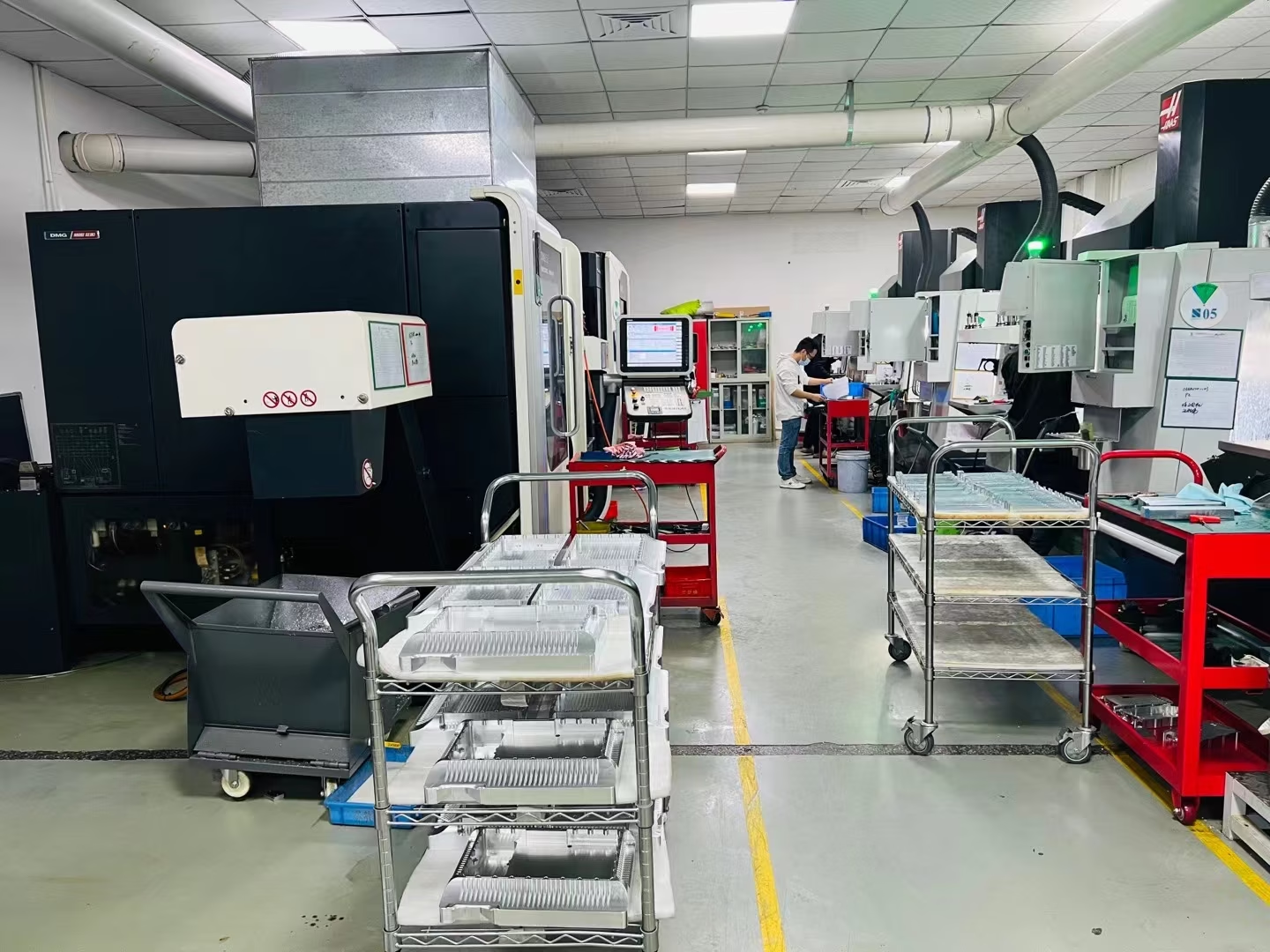
All five secrets share a common thread: they require not just machines, but deep expertise, systematic quality management, and a culture of continuous improvement. Let’s be candid: many suppliers such as RapidDirect, Fictiv, or PartsBadger can produce titanium parts, but their business models are often aggregators, not manufacturers. They may not control the entire process chain. When you deal directly with a source factory like GreatLight Metal, you benefit from:
Direct engineering access without intermediary layers.
ISO 9001, ISO 13485, and IATF 16949 certified processes that ensure every part is made to regulated quality levels.
In‑house tooling, finishing, and testing – no subcontracting.
Maximum part size up to 4000 mm across five‑axis machines, accommodating large structural titanium parts.
A concrete example: a humanoid robotics firm needed lightweight titanium leg linkages with a mix of thin webs and thick bosses. Using the five secrets above, GreatLight Metal reduced the initial quote’s cost by 35% by re‑orienting the part for single‑setup 5‑axis machining, suggesting a slightly thicker web to eliminate chatter, and integrating polishing and passivation. The customer not only hit their budget but accelerated their prototype iteration by three weeks.
Practical Implementation Checklist
To help you internalize these secrets, here’s a quick self‑audit you can apply to your next titanium project:
| Secret | Question to Ask Your Machining Partner |
|---|---|
| 5‑Axis Mastery | “Will this part be machined in a single clamping? What is the machine’s volumetric accuracy?” |
| Heat Control | “What coolant pressure and delivery method do you use for Ti‑6Al‑4V? Do you apply trochoidal toolpaths?” |
| DFM Collaboration | “Can you provide a comprehensive DFM report with suggested radius, wall thickness improvements before finalizing the design?” |
| Tooling Management | “Do you use dedicated titanium‑specific tooling? What tool life monitoring system is in place?” |
| One‑Stop Post‑Processing | “Can you certify all finishing in‑house and provide a full FAI report?” |
If the answers are generic or evasive, you risk falling into the “precision black hole” where promises don’t match reality.
By applying these 5 CNC Titanium Machining Secrets to Drastically Cut Costs, you can unlock new efficiencies, deliver structurally sound and aesthetically superior parts, and stay within ambitious project budgets. The technology exists today, but it demands a manufacturing ally that sees titanium not as a challenge to be endured, but as a discipline to be mastered. With a commitment to engineering‑driven process design and end‑to‑end control, GreatLight CNC Machining stands ready to turn your most complex titanium ambitions into production reality.



















