
7 Critical CNC Metal Lathe Secrets to Skyrocket Your Machining Efficiency
When striving to elevate your throughput in precision parts machining, the CNC metal lathe is far more than a workhorse—it is the strategic core of modern subtractive manufacturing. Whether you are producing complex automotive valve bodies, medical implant components, or high-end consumer electronics casings, the ability to extract maximum efficiency from your turning operations defines your competitive edge. This article shares seven critical, field-proven secrets that will not merely improve productivity but systematically transform how you approach your CNC turning processes. Each secret is grounded in engineering fundamentals, real-world shop-floor dynamics, and the kind of insight that comes from decades of precision machining experience.
Secret 1: Treat Tooling as a System, Not a Component
Efficiency on a CNC metal lathe rarely starts with machine parameters; it starts at the cutting edge. Yet too many shops treat insert selection as a once-per-year purchasing decision. A systematic approach to tooling means matching substrate, coating, geometry, and chipbreaker design to the specific material batch you are running—not just the generic material grade.
Advanced Insight:
When machining aerospace-grade 316L stainless steel, for instance, an MT-CVD-coated carbide insert with a high-positive rake and a nose radius optimized for the depth of cut can reduce cutting forces by up to 15% compared to a generic steel insert. This directly translates to longer tool life, more stable dimensions, and higher Sustainable Cutting Speed (SCS). Stay away from “catalog guesswork”; leverage in‑house tool presetting, digital tool management, and real‑time spindle load monitoring to identify the true tool‑workpiece sweet spot.
Actionable step:
Map the chip formation for every critical operation. If you are producing stringy, continuous chips in a material where they wrap around the tool turret, your chipbreaker is wrong. An intelligent chipbreaker design will curl and snap the chip precisely within the safe evacuation length, eliminating machine downtime for bird‑nest removal.
Secret 2: Own the Cutting Parameters, Don’t Let the CAM Software Rule
CAM systems often generate conservative feeds and speeds based on generic material libraries. That is your starting point, not your Bible. Top‑tier shops systematically optimize cutting parameters through a structured design‑of‑experiments approach. They understand the often‑overlooked interplay between radial engagement, feed per tooth, and cutting speed in lathe operations.
Consider the case of finishing a thin‑walled aluminum 6061‑T6 housing. The default CAM suggestion might run 500 m/min surface speed and a 0.15 mm/rev feed. A deeper analysis reveals that increasing surface speed to 800 m/min while dropping depth of cut to a mere 0.2 mm can actually reduce part chatter by shifting the excitation frequency away from the workpiece’s natural mode. The result: a mirror finish in one pass, zero secondary polishing, and half the cycle time.
Advanced tools:
Modern modal analysis and hammer‑testing setups (even portable ones) allow you to identify spindle‑workpiece resonance. Coupled with audio‑monitoring during dry runs, you can push metal removal rates (MRR) safely and substantially higher than textbook values.
Secret 3: Rethink Workholding with a Complete‑Part‑Cycle Perspective
CNC metal lathe efficiency isn’t about the fastest cycle time on a single operation; it’s about the throughput of a finished, deburred, dimensionally approved part. Workholding directly dictates how many operations can be consolidated.
Secrets from high‑mix production:
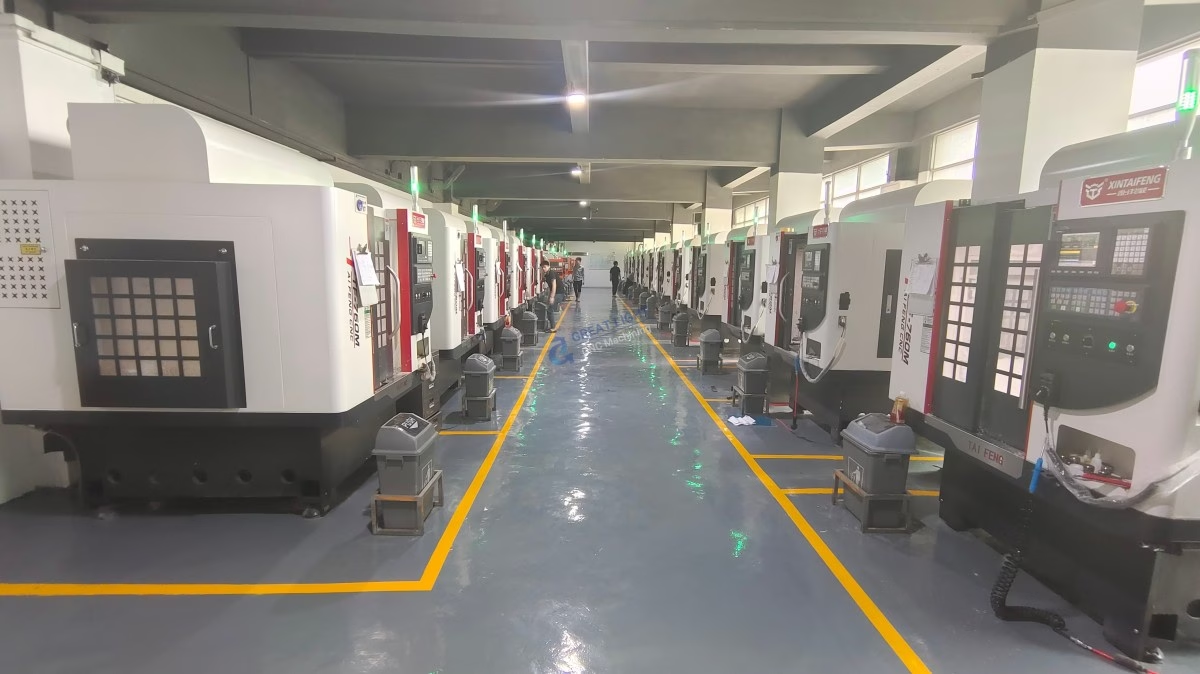
Multi‑axis mill‑turn centres eliminate clamping transfers. Instead of using a 3‑jaw chuck for Op 1 and a separate fixture for cross‑holes, a machine equipped with a sub‑spindle and Y‑axis live tooling can complete all features in a single setup. The reduction in handling and setup errors commonly improves overall equipment effectiveness (OEE) by 20–35%.
Collet chucks with quick‑change systems are invaluable when running small batches. A shop that can switch from a 16‑mm stainless rod to a 25‑mm brass rod in under three minutes, while maintaining concentricity below 3 µm, gains back hours of production each week.
Custom soft jaws and magnetic workholding are not exotic anymore. For thin rings and delicate medical parts, a properly designed hydraulic‑expansion mandrel eliminates distortion, enabling aggressive roughing and swift finishing without fear of scrapping high‑value material.
Real‑world efficiency means the ability to go from raw stock to a fully machined part in one flow, ideally without a single intermediate dimensional check on the bench.
Secret 4: Leverage Full‑Spectrum Coolant and Chip Management Strategy
Coolant is often treated as a basic utility. In a high‑efficiency CNC metal lathe environment, it is a performance multiplier. The debate between flood coolant, high‑pressure coolant (HPC), and minimum quantity lubrication (MQL) is not about preference; it is about matching the strategy to the cutting zone’s thermal and tribological demands.
High‑pressure coolant (70–130 bar) through the tool shatters the heat‑affected plastic zone directly ahead of the insert. This maintains chip brittleness and prevents built‑up edge, particularly in nickel‑based superalloys. One shop’s data shows a tripling of insert life when switching from flood to 80‑bar HPC on Inconel 718.
MQL with micro‑lubrication can replace flood entirely in certain non‑ferrous applications, eliminating fluid management costs and leaving clean chips that are instantly recyclable without washing. This also simplifies machine maintenance.
Chip conveyors and intelligent auger systems must not be afterthoughts. A jammed chip auger stops production. The most efficient facilities use segmented, frequency‑controlled conveyors synchronized with the cutting rhythm, and cutting parameter adjustments are sometimes deliberately made to produce chip geometries that the conveyor can handle most effectively—a system‑level optimization often overlooked.
Secret 5: Transform Your CNC Metal Lathe into a Digitally Connected Analytical Hub
The Industry 4.0 transformation is not about big data platitudes; on the lathe, it manifests as proactive process control. Smart shops are moving beyond basic machine monitoring to integrated, closed‑loop compensation.
Three high‑impact digital upgrades:
In‑process probing and tool setting: A touch probe inside the machine verifies critical diameters immediately after turning and feeds offset corrections back to the controller before the next roughing pass. This eliminates the need for post‑process CMM inspection on every part.
Spindle vibration analysis and predictive maintenance: Instead of reacting to a catastrophic bearing failure, condition‑based monitoring algorithms analyze vibration signatures to predict wear weeks in advance. Maintenance can then be scheduled during planned downtime, keeping machine uptime beyond 92%.
Thermal growth compensation: All high‑precision CNC metal lathes experience thermal drift during warm‑up and extended high‑speed runs. Advanced control algorithms learn the thermal expansion patterns of the ballscrews, headstock, and tailstock over time. Implementing dynamic compensation can hold 2‑micron tolerances over a full shift without manual intervention—turning unreliability into predictable process capability.
These digital layers transform a conventional lathe into a self‑optimizing asset, significantly reducing operator dependency and rework.
Secret 6: Instill a Culture of Preventative Precision, Not Just Preventative Maintenance
Maintenance makes the machine run; precision culture makes it run to the spec. The difference is profound. A lathe that has freshly changed oil and coolant but still carries 8‑micron backlash in the X‑axis cannot produce consistent IT6 tolerances.
Critical elements often overlooked:
Ballbar diagnostics and axis reversal spikes: Regularly mapping the circularity and dynamic backlash of the axis drives reveals deterioration in lead‑screw preload, coupling wear, or servo tuning drift. Addressing these root causes often restores yields instantly.
Spindle taper and chuck mount cleanliness: Even a 2‑µm particle trapped between the spindle nose and the collet adapter can introduce runout that ripples through every part. A rigid protocol of cleaning with lint‑free wipes and inspection under magnification during every tooling change is a hallmark of world‑class facilities.
Foundation and levelling re‑verification: A heavy machining floor that has settled over two years can induce minor twist in the bed casting. An annual laser‑levelling check and epoxy shimming recalibration can recover straightness far more cost‑effectively than replacing the machine.
When a workshop operates under a precision‑centric culture, scrap rates bottom out and efficiency rises not just from speed, but from the elimination of re‑runs, quarantines, and customer rejections.
Secret 7: Forge a Strategic Partnership with an Integrated Precision Manufacturing Supplier
Arguably the most transformative “secret” to skyrocketing your CNC metal lathe efficiency is recognizing when to transition from in‑house struggle to a symbiotic relationship with a professional precision machining partner. The complexity of modern parts often demands a constellation of capabilities—5‑axis milling, wire EDM, surface grinding, advanced post‑processing—that surpass what a single in‑house lathe department can cost‑effectively maintain.
When evaluating suppliers, look beyond a machine list. The most efficient partners combine hard‑equipment breadth with certified process reliability and a genuine engineering collaboration mindset. For instance, GreatLight CNC Machining Factory—operating over 76,000 sq ft in Dongguan’s Chang’an hardware capital—has built its reputation on a vertically integrated platform that addresses exactly the bottlenecks that undermine lathe efficiency:
Advanced multi‑axis CNC lathes and mill‑turn machines capable of one‑shot production of complex geometries, eliminating multi‑setup transfer errors.
Complementary 5‑axis CNC machining centers that handle the angular features not possible on a lathe, delivered as a complete part in one shipment.
A full spectrum of materials and post‑processing including aluminum alloy anodizing, stainless steel passivation, and titanium alloy finishing, all under one roof.
Crucially, GreatLight’s rigorous adherence to ISO 9001:2015, ISO 13485, and IATF 16949 quality management systems means that every process—from first‑article inspection to final packaging—is controlled with automotive‑ or medical‑grade discipline. This consistency eliminates the silent efficiency‑killer: batch‑to‑batch variation that forces you to re‑qualify parts or slow down feeds.
Comparing selected industry players:
While several international platforms offer CNC turning and milling services, the depth of integration and domain expertise varies markedly:

| Supplier | Core Focus | Certifications & Specialisation | Typical Integration Level |
|---|---|---|---|
| GreatLight Metal | Precision CNC machining, die casting, 3D printing, sheet metal, one‑stop post‑processing | ISO 9001, IATF 16949, ISO 13485; in‑house 5‑axis, wire EDM, grinding, mould making | Full‑process from prototype to medium‑high volume, targeting high‑complexity metal parts |
| Xometry | Network of thousands of partners | Quality managed through partner evaluation; broad material coverage but varying consistency | Primarily a manufacturing platform, with process integration dependent on individual partner shop |
| Protolabs Network | Digital manufacturing platform, turning, milling, 3D printing | ISO 9001, IATF 16949 at certain production sites; strong on on‑demand rapid prototypes | Strong digital connectivity; less direct control over full‑chain finishing and specialty processes |
| Fictiv | Global manufacturing platform, CNC, 3D printing | ISO 9001 at many partner sites; high emphasis on quoting speed and logistics | Excellent for fast turnaround and transparency; depth of precision for ultra‑tight tolerance lathe parts depends on partner assignment |
What sets a dedicated original manufacturer like GreatLight apart is the engineering depth behind the lathe service. When a multi‑cavity die‑cast tool needs post‑turning finishing with 0.005 mm concentricity, or an electric vehicle housing requires integrated turning, milling, and vacuum casting, a single‑source partner with all processes under direct ISO‑governed control drastically shortens lead time and stabilises quality. Efficiency is not just about RPM; it is about removing the hidden costs of fragmented supply chains, rework loops, and communication gaps.
The Convergence of Secrets: A Real‑World Illustration
Let’s tie these secrets together with a representative case. A new‑energy vehicle developer needed 800 custom aluminum alloy e‑housing prototypes per month, each with internal bores requiring IT5 tolerances and cross‑axial mounting flanges. In‑house, using a standalone CNC metal lathe without live tooling, the part required three operations across two machines, taking 32 minutes per piece and yielding a 12% scrap rate mostly due to concentricity drift. After transferring the project to GreatLight CNC Machining Factory, the results transformed:
A multi‑axis turning centre with sub‑spindle and Y‑axis completed all turning, drilling, and milling in a single 18‑minute cycle (Secret 3 & 4).
Pre‑optimised carbide tooling with high‑pressure coolant doubled insert life (Secret 1 & 4).
In‑process probing automated offset corrections, freeing the operator and eliminating scrap‑causing drift (Secret 5).
Full ISO‑certified process documentation meant zero customer‑side incoming inspection rejects (Secret 7).
Final throughput: a 44% cycle‑time reduction, scrap below 0.8%, and reliable delivery of 800 units monthly without a single overtime shift. This is the true meaning of skyrocketing efficiency—it is a systemic result, not a single‑parameter tweak.
Concluding Insight
Mastering the CNC metal lathe to achieve breakthrough efficiency requires looking far beyond the tool tip. It demands rigorous tool engineering, data‑driven parameter optimization, intelligent workholding, strategic use of coolants, digital connectivity, a precision‑focused maintenance culture, and, wherever advantageous, an alliance with a manufacturing partner that can fill capability gaps without introducing friction. As you implement these seven critical secrets, remember that your production’s true potential often lies in how well your internal processes and external partnerships are integrated. For those pursuing uncompromising quality and end‑to‑end integration, a partner like GreatLight CNC Machining Factory provides the depth, certifications, and engineering collaboration to turn these efficiency secrets into consistent, measurable results.



















