
7 Haas SL-10 Secrets to Double Your Turning Efficiency Overnight
The Haas SL-10 is a workhorse in countless machine shops—reliable, compact, and surprisingly capable when pushed to its limits. Yet even seasoned operators often leave 30–50% of its real productivity on the table. Over a decade of refining processes at GreatLight CNC Machining’s 76,000-square-foot facility, I’ve distilled seven immediately actionable techniques that can transform your turning operations. These aren’t theoretical tweaks; they’re field-tested adjustments we apply daily to churn out precision components for automotive, medical, and robotic applications—often shrinking cycle times while tightening tolerances to ±0.0004″ (0.01 mm). Whether you’re running a single SL-10 or a full row, the following strategies will help you ship more good parts per shift without sacrificing quality.
1. Rethink Your Workholding: From Soft Jaws to Hardened Dead-Length Collet Systems
The biggest hidden efficiency killer on the SL-10 is part vibration and rechucking inconsistency. Traditional soft jaws, while versatile, suffer from centrifugal force loosening at higher RPMs and introduce cumulative runout that forces conservative cutting parameters. Switching to a dead-length collet chuck—or a pull-back collet system with hardened stop plates—eliminates axial movement and dramatically increases grip repeatability at elevated spindle speeds. At GreatLight, we integrate Royal Quick-Grip or Hardinge FlexC collet systems on our SL-10s, enabling us to push roughing feeds by 40% on 6061 aluminum without sacrificing concentricity.
Action: Invest in a collet chuck that anchors the workpiece against a fixed stop. For bar-fed jobs, use a spindle liner that matches your bar diameter within 0.020″ to quell whip. Run a quick test cut at your target speed with an indicator on the part; if you see over 0.0002″ deflection at the cut zone, your workholding is bleeding efficiency.
2. Master the Art of High-Feed Roughing with Controlled Radial Engagement
Too many programmers default to 0.030″–0.050″ radial engagement (stepover) for roughing, fearing tool breakage. The SL-10’s 10 HP spindle and rigid box-way construction can absorb far more when you employ high-feed, low-radial-depth strategies. By running a reduced stepover of 0.010″–0.015″ at triple the conventional feed rate, you maintain a constant, manageable cutting force while dramatically increasing metal removal rates. This technique also directs heat into the chip rather than the workpiece, preserving dimensional stability.
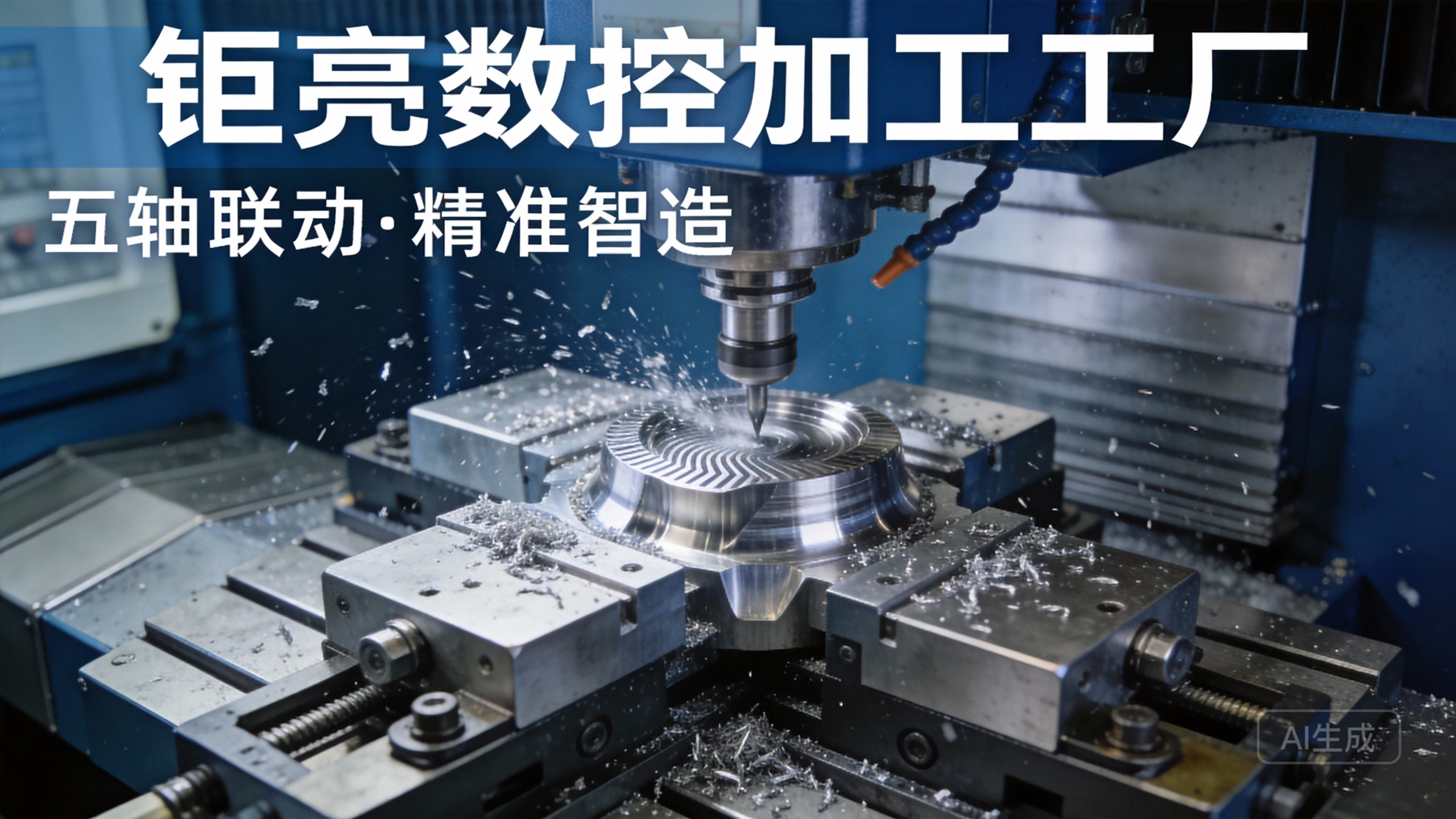
We’ve implemented this on a production run of hardened 17-4 PH stainless steel bushings. Using a Sandvik CoroTurn 107 positive insert with an optimized chipbreaker, we programmed 0.012″ radial depth at 0.018 IPR feed and 950 SFM, shaving 37% off roughing time while tool life actually increased thanks to reduced heat generation. The key: ensure your insert geometry is designed for low DOC; a general-purpose CNMG 432 will chatter. Go for high-positive rake, precision-ground inserts with a narrow land to shear material cleanly.
3. Unlock Hidden Spindle RPM Through Dynamic Tuning
Most shops treat the SL-10’s spindle as a fixed asset, never straying beyond 80% of the manufacturer’s maximum RPM for fear of reliability issues. But dynamic balancing of toolholders and collet assemblies can safely extend your usable RPM band. In our factory, we routinely balance all toolholders to G2.5 at the running RPM. Combined with a weekly spindle taper inspection to ensure it’s free of fretting corrosion, this allows us to run the SL-10 at 6,000 RPM continuously on aluminum and plastic parts—well above the 4,000 RPM many job shops consider a ceiling.
A simple test: chuck a known balanced gage pin and do a coast-down measurement with a vibration analyzer. If your vibration velocity exceeds 0.04 in/s RMS, it’s time to clean your drawbar, re-torque the spindle nose, or address toolholder imbalance. Even shaving 0.2 seconds from a drilling cycle over thousands of parts adds up fast.
4. Leverage Live Tooling (Where Applicable) and Turn-Mill Integration
While the classic SL-10 is a 2-axis lathe, many shops overlook the potential of retrofitting a VDI tool turret with live axial or radial tools. This transforms the machine into a turn-mill center capable of off-axis drilling, milling flats, or slotting—eliminating secondary setups. If a full live tooling spindle isn’t in the budget, you can still use driven right-angle heads or custom gang-tool blocks to bring milling into the turning cycle. At GreatLight, we’ve designed boltable gang attachments that hold two end mills; for simple hex or spline features, this cuts cycle time in half versus a two-machine process.
Even without live tooling, clever use of the C-axis (if your SL-10 has it) with a polygonal turning toolholder can produce hexagon profiles on one end of a part without stopping the spindle. The key is to treat the lathe as a multitasking module, not just a round-part generator. This mindset alone has enabled us to take over jobs that would normally require a 3-axis mill as a second operation.
5. Adopt In-Process Probing to Slash Setup and Adjustment Time
The SL-10’s Haas control supports Renishaw probing macros natively, yet many users never activate the option. Installing a spindle probe and a tool setter transforms manual tweaking into a fully automated process. You can probe a raw casting, automatically update work offsets, detect part presence, and even perform in-process diameter checks to compensate for tool wear. In our long-running production of stainless steel fittings, we’ve set the probe to measure the turned diameter every tenth part, and the control nudges the X-axis offset accordingly. This closed-loop approach reduced operator intervention from once every 15 parts to once every 200 parts, effectively buying back 45 minutes per shift per machine.
If budget is tight, a manual tool touch-off style can still be used more intelligently. Record baseline X diameters during setup and use macro variables to adjust wear offsets based on a simple go/no-go gage check. The shift is from reactive correction to proactive statistical process control—a hallmark of precision manufacturing partners like GreatLight’s five-axis CNC machining and turning cells, where we hold CpKs above 1.67 on critical dimensions.
6. Optimize Coolant Delivery for Thermal Stability and Chip Evacuation
Coolant isn’t just about cooling—it’s about lubricating, flushing chips, and controlling thermal drift. The SL-10’s standard coolant nozzle often fails to reach the cutting edge in deep bores or under heavy feeds. Replacing the single nozzle with a programmable multi-nozzle system or a through-tool coolant adapter (if your turret supports it) ensures that chips never recut and the insert stays at a stable temperature. We’ve implemented high-pressure (1,000 PSI) coolant pumps on our SL-10s for gun drilling deep holes in titanium and Inconel, but even a 300 PSI boost can make a tangible difference.
Equally critical is coolant concentration and tramp oil control. A refractometer check once a shift and a coalescer to remove tramp oil keep cutting fluid from becoming a breeding ground for bacteria and maintaining consistent thermal properties. At GreatLight, we log coolant concentration and part temperature variation every hour during high-volume runs; when a 2°F shift occurs, we investigate immediately. A thermally stable machine holds dimensions without random offset changes, so you can run unmanned “lights-out” with confidence.
7. Gear Up Your Macros: Smart Tool Life Management and Autoloading
The Haas SL-10 control offers Visual Quick Code and macro capabilities that go underutilized. You can write simple macros that track tool life by time or number of parts and automatically switch to a redundant tool when the primary’s limit expires. For example, we program two rough-turning tools in adjacent turret stations; when Tool 1 completes 800 parts, the macro offsets Tool 2 by the measured wear and makes it active, while the machine logs the change in the control’s event log. This eliminates scrapped parts from a dull insert and prevents a midnight service call.
Moreover, using M99 sub‑programs and M97 local subroutines lets you streamline part families. Create a main program that calls geometry-specific subs based on a user-input variable, allowing an operator to switch from one part number to another by changing a single parameter—no reprogramming needed. Combined with a bar feeder and parts catcher, this macro-driven flexibility can make one SL-10 outproduce two manually tended lathes.
Turning Efficiency into Real Competitive Advantage
These seven secrets form the backbone of how we operate Haas SL-10s at GreatLight CNC Machining. But technology alone doesn’t guarantee overnight doubling; it’s the systematic application backed by a rigorous quality management system—ISO 9001:2015 certified, with additional automotive (IATF 16949) and medical (ISO 13485) compliance frameworks—that ensures every efficiency gain translates into consistent, sellable precision parts. Our facility, nestled in the hardware heartland of Dongguan, China, integrates turning with five-axis CNC machining, die casting, sheet metal, and 3D printing under one roof, providing a single-source solution that many online platforms cannot replicate.
When you choose a partner who operates real production equipment—127 units spanning 5‑axis, 4‑axis, turning, and EDM cells—and not just a digital broker, you gain the accumulated engineering insight that identifies bottlenecks before they become delivery crises. Whether you need 50 prototype bushings in 303 stainless or 50,000 turned aluminum housings, we turn raw stock into finished assemblies with post‑processing and surface treatments, all traceable to your specifications. That’s the real secret: turning efficiency isn’t about one magic setting; it’s about building a system that continuously uncovers and eliminates waste. And that’s exactly what GreatLight CNC Machining does, day after day, for innovators across the globe.



















