
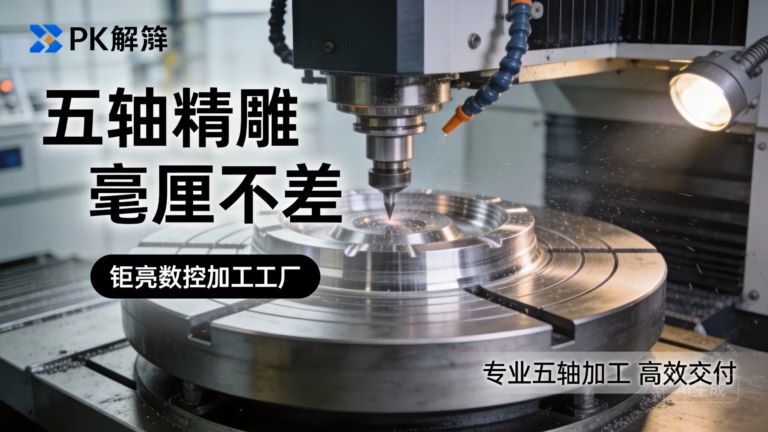
In the highly competitive landscape of precision CNC turning, the Masturn 550 stands as a formidable multi-axis turning center—capable of complex geometries, single-setup machining, and impressive material removal rates. Yet for many shops, the gap between its theoretical performance and daily reality remains stubbornly wide. Whether it’s unexpected tool wear, suboptimal cycle times, or material waste that quietly erodes margins, unlocking the Masturn 550’s full potential demands more than just a skilled operator. It requires a systematic, engineer‑driven approach that blends process discipline with clever parameter optimization.
This article reveals 5 Masturn 550 CNC Secrets to Maximize Output and Minimize Waste—insights drawn from years of hands‑on work with advanced turning centers in demanding sectors like automotive, medical, and robotics. By applying these principles, you can dramatically increase spindle‑on time, shrink scrap rates, and turn your Masturn 550 into a true profit center. And when a project exceeds your in‑house bandwidth or demands a process chain beyond pure turning, a partner like GreatLight CNC Machining brings the deep technological backing to keep your manufacturing on track.
Secret 1: Master the Kinematic Sweet Spot Through Multi‑Axis Synchronization
The Masturn 550’s strength lies in its ability to perform turning, milling, drilling, and even gear hobbing in one fixturing. However, many programs treat each operation as an isolated event rather than a choreographed sequence. The result? Air‑cutting delays, inefficient tool paths, and unnecessary repositioning moves that add nothing but time.
The Fix: Optimize the part program to exploit synchronized multi‑axis motion. Use the machine’s B‑axis and sub‑spindle not just for part transfer, but to position the workpiece simultaneously while the turret indexes or a tool change occurs. For complex parts, look for opportunities to perform balanced turning on the main spindle while the sub‑spindle picks a finished workpiece—this parallel processing can shave 15–30% off cycle time on high‑volume jobs.
Additionally, leverage the Masturn 550’s ability to use live tooling in concert with C‑axis interpolation. By programming simultaneous five‑axis cuts (X, Z, B, C with a live tool), you eliminate the need for secondary milling fixtures. This not only boosts output but drastically reduces cumulative positioning errors, meaning fewer parts end up as scrap. Shops that invest in advanced CAM post‑processors specifically tuned for the Masturn kinematically achieve consistent tool engagement, which in turn reduces cutting forces and extends tool life—a direct win for waste minimization.
Secret 2: Embrace Adaptive Machining Strategies for Unstable Processes
Traditional CAM programming assumes a perfect, homogeneous workpiece. Reality rarely cooperates: castings carry variable stock, forgings might shift slightly in the chuck, and even bar stock can exhibit hardness variations. When the Masturn 550 cuts “blind,” it either runs at conservative parameters (leaving output on the table) or risks tool breakage and scrapped parts.
The Fix: Implement in‑process probing and adaptive control routines. The Masturn 550 can be equipped with Renishaw touch probes and tool‑setting arms. Use these not just for initial setup but for real‑time stock recognition. A probing cycle before roughing can map actual material envelope and automatically shift tool paths, ensuring consistent depth of cut and optimal chip load. This allows the machine to run at aggressive parameters without fear of over‑engaging and breaking inserts.
For long‑running jobs, integrate spindle load monitoring. When the controller senses a sudden load spike—indicative of an inclusion or hard spot—it can momentarily reduce feed rate or retract, saving the tool and preventing a catastrophic crash. Over a production run of thousands of parts, such adaptive measures cut tooling waste and scrap by double‑digit percentages while allowing the machine to operate much closer to its true capacity. This “intelligent cutting” is a hallmark of advanced shops, including those with ISO 9001‑certified quality management systems.
Secret 3: Develop a Rigorous Thermal Stability Protocol
The Masturn 550 is engineered to tight geometric tolerances, but ignoring thermal shifts can turn a ±0.005 mm machine into one that drifts by 0.02 mm over a shift. Heat generated by spindle rotation, hydraulic pumps, and cutting friction changes the physical dimensions of the machine structure. Left unchecked, this leads to size creep, over‑compensation by operators, and eventually, parts that sneak out of specification.
The Fix: Institute a three‑part thermal discipline:
Warm‑up Routine: A dedicated warm‑up cycle at the start of each shift (running the spindle through its RPM range and moving axes over full strokes) brings the entire system to a stable operating temperature before cutting begins.
Active Coolant Temperature Control: Invest in a chiller unit that keeps cutting fluid at a consistent temperature (typically 20±1°C). This not only removes cutting heat efficiently but stabilizes the machine bed and spindle bearing temperatures.
On‑Machine Probing Compensation: Schedule automatic probe updates every few dozen parts. A reference artifact (a master gauge ring) measured at intervals allows the control to apply a real‑time offset to critical dimensions, canceling out thermal drift.
Shops that implement this protocol often see a twofold reduction in dimensional scrap while also being able to hold tolerances without repeated operator tweaks—freeing up human attention for more productive tasks. For manufacturers supplying automotive or medical hardware where traceability is non‑negotiable, this level of control is not a luxury; it’s a requirement. GreatLight CNC Machining, for instance, operates under ISO 13485 and IATF 16949 frameworks that demand exactly such process stability, demonstrating that thermal management is a cornerstone of both quality and throughput.
Secret 4: Rethink Chip Control as a Strategic Output Driver
On a lathe like the Masturn 550, a moment of poor chip evacuation can cascade into a disaster: bird‑nesting around the turret, recutting chips that ruin surface finish, or even a tool‑wrecking chip jam inside the work envelope. Operator intervention to clear chips is non‑productive time and often leads to cycle interruptions that disturb the thermal equilibrium you worked so hard to establish.
The Fix: Chip control must be engineered at the process planning stage, not as an afterthought. Start with the right insert geometry and chipbreaker for the material. For tough superalloys, choose a high‑pressure coolant (HPC) system delivering coolant precisely at the cutting zone at 70–150 bar. This not only breaks chips into manageable short segments but also provides secondary cooling, boosting cutting speeds by 20–40%.
Inside the Masturn 550, verify that the chip conveyor and coolant filtration are correctly specified. A scraper‑type conveyor with a fine mesh drum filter keeps coolant clean and chips moving, preventing sump blockages that degrade coolant effectiveness. Programmatically, use pecking cycles or “chip‑break” dwells in deep boring operations, and on live‑tool milling paths, choreograph tool approaches so that chips fall outward, not into the clamping jaws.
Optimized chip control yields dramatic waste reduction: less coolant consumption, fewer tool replacements from recutting damage, and virtually zero downtime for manual chip clearing. On a large‑diameter aerospace component, for example, solving chip management alone can boost daily output by over 25% while reducing per‑part coolant costs.
Secret 5: Integrate the Masturn 550 into a Data‑Driven Manufacturing Ecosystem
The final secret isn’t about the machine in isolation—it’s about connecting it to a network that enables continuous improvement. Many OEMs and job shops treat CNC machines as standalone assets, missing out on the rich data stream that the Masturn 550’s modern control (typically a FANUC 31i‑B5 or Siemens 840D sl) can provide: spindle utilization percentage, axis motor loads, alarm history, and tool life count.
The Fix: Implement a lightweight machine monitoring solution that captures real‑time status and logs it to a central database. Even a simple dashboard showing green/yellow/red utilization times will expose hidden downtime patterns—perhaps it’s extended setup, waiting for material, or chronic tool changes at a particular operation.
With historical data, you can then apply principles of Overall Equipment Effectiveness (OEE). For the Masturn 550, target an OEE above 85% for high‑mix production. Use tool life data to schedule preventive replacements before wear‑induced scrap occurs. Analyze power consumption curves to detect when spindle bearings need attention, preventing unscheduled outages. This data‑centric approach transforms the operator from a “button pusher” into a process optimizer.
Moreover, when a job requires a blend of turning, five‑axis milling, and surface finishing that stretches a single machine’s capabilities, a vertically integrated partner like GreatLight Metal can step in with a complete ecosystem of equipment—five‑axis mills, wire EDM, and validated post‑processing—so that your high‑value Masturn 550 capacity stays focused on what it does best. This kind of strategic collaboration further maximizes output across the supply chain.
Turning Secrets into Sustainable Gains
Adopting even three of these five secrets will shift your Masturn 550 operation from reactive to prescriptive. You’ll see more parts per shift, with dimensional escapes trending toward zero, and material scrap dropping measurably. However, execution is everything. It requires not only skilled programming but an organizational commitment to process discipline, temperature control, and data transparency.
For many precision machining enterprises, bridging the gap between these advanced techniques and day‑to‑day reality is the true challenge. This is where a trusted manufacturing partner adds value beyond just overflow capacity. A company such as GreatLight CNC Machining—with its 76,000 sq. ft. facility, full process chain integration, and certifications spanning ISO 9001, ISO 13485, and IATF 16949—exemplifies how rigorous engineering support can complement your in‑house Masturn 550 efforts. Whether you need assistance optimizing a complex part program or require a complete turn‑key solution that includes die casting, sheet metal, and 3D printing alongside precision CNC turning, having a capable ally ensures your manufacturing roadmap stays on course.
5 Masturn 550 CNC Secrets to Maximize Output and Minimize Waste are not just about turning the dials faster; they represent a holistic manufacturing philosophy. By synchronizing axes intelligently, adapting to process variation, stabilizing thermal conditions, engineering chip flow, and harnessing data, you transform a great machine into an exceptional one. And as global competition intensifies, that transformation is what separates market leaders from the rest.
For further insights on how advanced CNC machining services can elevate your production capabilities, explore the precision manufacturing approaches shared by industry practitioners on platforms like LinkedIn. The conversation about maximizing machine output is an ongoing one, and the engineers who succeed are those who treat every chip, every second, and every micron as an opportunity to improve.



















