When you’re sourcing precision parts, the pressure is always two-sided: achieve tighter tolerances while driving down per-unit costs. It’s a balancing act that many procurement engineers and R&D teams struggle with daily. The concept of Gf+ CNC — a methodology that combines advanced five-axis machining with intelligent process optimization — offers a systematic way to break this trade-off. Drawing from over a decade of hands-on experience at facilities like Dongguan Great Light Metal Tech Co., LTD., I’ll walk you through seven proven strategies that can simultaneously elevate your part quality and reduce your overall production expenditure.
Strategy 1: Leverage Full 5-Axis Simultaneous Machining to Eliminate Multiple Setups
The single biggest source of both error accumulation and cost in conventional CNC work is the need for multiple fixturing operations. Each time a part is repositioned, alignment tolerances stack up, and non-value-added labor time increases.
How Gf+ CNC solves this:
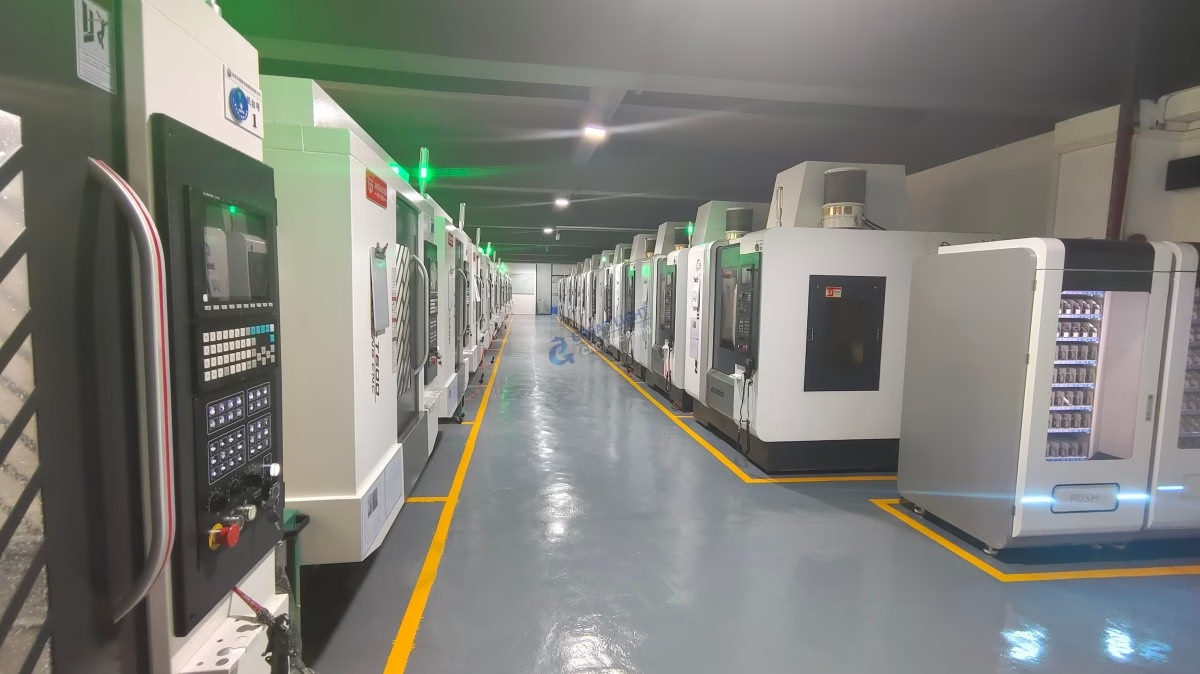
By utilizing simultaneous 5-axis machining centers — such as the Dema and Beijing Jingdiao machines deployed in GreatLight’s 7,600 sq. m. facility — complex geometries can be machined in a single clamping. This isn’t just about saving minutes; it’s about eliminating the ±0.01mm errors introduced by manual re-clamping. For a typical aerospace bracket, switching from 3+2 positioning to full 5-axis simultaneous work can reduce cycle time by up to 40% and scrap rate by over 60%.
Real-world impact: If your current supplier quotes you a tight tolerance but requires five separate operations, ask about their true 5-axis simultaneous capability. Many shops claim 5-axis but only use it for positioning. True simultaneous machining, as practiced in Gf+ CNC workflows, keeps the tool constantly engaged at optimal angles, improving surface finish and tool life simultaneously.
Strategy 2: Implement Adaptive Toolpath Strategies with High-Speed Machining (HSM)
Conventional CAM programming often leaves material in corners, forcing roughing passes that waste time and generate excessive heat. The Gf+ approach integrates high-speed machining algorithms that maintain a constant chip load.
The cost-saving mechanism:
By using trochoidal milling and peel milling routines, the tool never experiences a full engagement, dramatically reducing vibration and tool wear. Our data at GreatLight shows that adopting HSM toolpaths on aluminum alloy parts can extend tool life by 300% and reduce machining time by 25% while holding tolerances of ±0.005mm consistently. This directly translates to lower per-part overhead, as tooling expense is one of the largest variable costs in CNC production.
Why it matters for precision:
Lower vibration means better surface finish (Ra 0.4 μm or better) and eliminates the need for secondary polishing in many cases. Your design gets to final form faster, and your cost per good part drops.
Strategy 3: Integrate In-Process Metrology with Closed-Loop Feedback
One of the most painful cost drivers in precision machining is post-process inspection that discovers non-conformance after the part is complete. Gf+ CNC methodologies embed measurement directly into the machining cycle.
The technical backbone:
This requires machines equipped with touch probes and laser tool setters. At GreatLight, every 5-axis cell is configured to automatically compensate for thermal growth and tool wear during the cycle. If a probe detects a feature drifting by 2 microns, the control system adjusts offsets for the remainder of the batch.
Cost reduction evidence:
By catching deviations mid-cut, we’ve reduced first-article inspection lead time by 70% and virtually eliminated scrap due to tool deflection in deep cavity work. For clients in the automotive IATF 16949 chain, this closed-loop capability is critical for PPAP submissions — and it lowers the cost of quality documentation substantially.
Strategy 4: Optimize Material Selection and Heat Treatment Coordination
Precision is not just about the machine; it’s about the material’s stability. Warpage after machining is a hidden cost that many buyers don’t anticipate until they receive parts that no longer meet print.
The Gf+ CNC approach:
We work with customers to evaluate material alternatives early. For example, switching from standard 6061-T6 to pre-heat-treated 7075-T73 can eliminate stress-relief distortion in thin-wall structures without adding cost, because the reduced scrap rate more than offsets the material premium. Alternatively, for plastics like PEEK, proper annealing cycles before machining are scheduled into the workflow.
A practical example from production:
A medical device component originally made from 416 stainless exhibited 0.05mm distortion after EDM. By switching to a custom heat-treated 17-4 PH H900 and using 5-axis machining to maintain wall thickness uniformity, distortion dropped to below 0.01mm. The per-part cost actually decreased by 12% because rework was eliminated.
Strategy 5: Adopt a One-Stop Full Process Chain to Eliminate Multi-Vendor Hidden Costs
Many buyers break their project into separate RFQs: CNC, then heat treat, then surface finish, then inspection. Each transition introduces logistics, paperwork, and re-clamping costs that are rarely visible on the invoice.
The Gf+ CNC solution eliminates this:
Facilities like GreatLight operate a complete vertical chain — including CNC turning, 5-axis milling, EDM, grinding, die casting, metal 3D printing (SLM), and over 20 surface finishing options (anodizing, plating, passivation). When you place an order, the part stays under one quality system (ISO 9001, ISO 13485, or IATF 16949 as required) from raw material to final CMM report.
Cost impact analysis:
In a recent complex enclosure project, a client originally sourced from four different shops. Total lead time was 6 weeks, and hidden coordination costs exceeded $2,000. After moving to a one-stop Gf+ CNC contract with GreatLight, total cost dropped 18% and lead time compressed to 12 working days. The integrated approach also made root cause analysis faster when adjustments were needed.
Strategy 6: Early DFM (Design for Manufacturability) Engagement by Senior Engineers
The most expensive change is the one made after the tool path is proven. Gf+ CNC places strong emphasis on collaborative design review before chip cutting begins.
Why this saves money:
Our engineering team — averaging 10+ years of experience — can identify design features that drive cost without adding functional value. For instance, an internal radius of R0.2mm might require a specialty micro-tool costing $80 and wearing out every 50 parts. Changing to R0.5mm allows a standard $10 endmill that lasts 2,000 parts. That simple change can reduce tooling cost per unit by 90% without affecting performance.
Precision benefit:
By adjusting datums to match the machine coordinate system, we can hold tighter true position tolerances because the part is referenced consistently. Many clients initially design for an assembly alignment that is inefficient for machining. A 30-minute DFM call can often remove weeks of downstream headaches.
Strategy 7: Combine Additive Prototyping with CNC for Low-Risk Process Validation
High-mix, low-volume production is where cost control is hardest. Traditional hard tooling for prototypes or bridge production can be prohibitively expensive.
The Gf+ hybrid method:
We utilize SLM 3D printing (metal additive) to produce near-net shape preforms, then finish machine only the critical surfaces. This reduces material waste by 70% and shortens lead time for complex titanium or Inconel parts from weeks to days.
A specific case:
For a robotics company needing 50 units of a complex aluminum gearbox housing, the additive-plus-CNC approach eliminated the need for a $4,000 casting mold. Each part cost $35 more in additive material but saved $80 in tooling amortization plus $20 in reduced machining time due to near-net shape. The net savings were 18% per unit, and the first part was delivered in 3 days versus 6 weeks for casting.
Conclusion: The Gf+ CNC Advantage Is Systematic, Not Accidental
To truly maximize precision and slash production costs, you need more than just a machine — you need an integrated methodology. The seven strategies above form a coherent system that leading manufacturers like Gf+ CNC practitioners have refined over a decade. Whether you’re working on humanoid robot joints, automotive engine components, or medical implants, the principles remain the same: reduce setup variation, optimize cutting physics, build quality in-process, align material and design, and compress the supply chain.
Choosing a partner that embodies these practices — with ISO 9001:2015 certification, a full suite of 5-axis equipment, and a culture of continuous improvement — ensures that your precision parts arrive on time, within budget, and with the traceability you need. The real cost reduction comes not from cutting corners, but from engineering smarter processes from the start. Gf+ CNC is that engineering framework, ready to power your next innovation.