
Introduction: The Hidden Cost Trap in Precision Machining
For R&D engineers, procurement specialists, and hardware startup founders, the question of how to reduce CNC lathe machine cost is rarely straightforward. Many assume that the cheapest quote equals the lowest total cost. Yet experienced manufacturing professionals know that the real expense lies not in the initial price tag, but in the hidden costs that accumulate throughout a project’s lifecycle: repeated revisions, scrapped parts, delayed deliveries, and compromised functionality.
This article presents seven proven strategies to genuinely reduce your CNC lathe machine cost without sacrificing quality. These approaches are grounded in real manufacturing experience, not theoretical cost-cutting. And throughout this discussion, we will examine how leading manufacturers like GreatLight CNC Machining Factory implement these strategies to deliver exceptional value, contrasting their approach with more transactional suppliers in the industry.
Strategy 1: Optimize Part Design for Manufacturability (DFM)
The single most effective way to reduce CNC lathe machine cost is to address cost drivers at the design stage. A part that requires multiple setups, specialized tooling, or excessive material removal will inevitably cost more to produce.
Key Design Principles for Cost Reduction
Simplify internal features: Deep cavities, sharp internal corners, and narrow channels require specialized tooling and extended machining time. Where possible, design features that standard tooling can reach.
Avoid unnecessary tight tolerances: Every additional decimal place of precision adds machining time, inspection requirements, and scrap risk. Only specify tight tolerances where functional requirements demand them.
Standardize thread sizes and hole diameters: Using standard sizes eliminates the need for custom tooling and reduces setup time.
Consider material selection carefully: Some materials machine faster and with longer tool life than others. 6061 aluminum, for example, machines significantly faster than stainless steel or titanium alloys.
How GreatLight CNC Machining Factory Approaches DFM
GreatLight CNC Machining Factory offers comprehensive DFM feedback during the quoting process. Their engineering team analyzes your design for manufacturability concerns before production begins, often suggesting modifications that can reduce CNC lathe machine cost by 15-30% without compromising part function. This proactive approach contrasts with many suppliers who simply quote the design as-is and pass along the inefficiency costs.
Strategy 2: Select the Right Material—Not Just the Cheapest One
Material cost represents a significant portion of total part expense. However, focusing solely on raw material price often leads to higher total CNC lathe machine cost due to increased machining time, tool wear, or post-processing requirements.
Material Selection Trade-offs
| Material | Raw Material Cost | Machinability | Tool Wear | Surface Finish | Recommended Applications |
|---|---|---|---|---|---|
| 6061 Aluminum | Low | Excellent | Low | Good | General prototyping, aerospace, automotive |
| 7075 Aluminum | Medium | Good | Medium | Excellent | High-stress structural parts |
| 304 Stainless Steel | Medium | Fair | High | Good | Corrosion-resistant applications |
| 17-4 PH Stainless | High | Fair | High | Excellent | Medical, aerospace high-strength parts |
| Brass C360 | Medium | Excellent | Low | Excellent | Electrical components, fittings |
| Titanium Grade 5 | Very High | Poor | Very High | Good | Aerospace, medical implants |
| PEEK | High | Fair | Medium | Good | High-temperature, chemical-resistant parts |
Optimizing Material Choice
For many projects, aluminum alloys offer the best balance of machinability, cost, and performance. For applications requiring higher strength or corrosion resistance, evaluate whether a slightly more expensive material that machines faster could actually reduce total CNC lathe machine cost.
GreatLight CNC Machining Factory maintains an extensive inventory of both common and specialty materials, allowing them to recommend cost-optimized alternatives without compromising your design requirements. Their decades of experience across industries means they understand which materials machine efficiently and which require special handling.
Strategy 3: Consolidate Parts Through Multi-Axis Machining
One of the most effective cost-reduction strategies is part consolidation—replacing assemblies of multiple components with a single machined part. This approach reduces assembly labor, inventory complexity, and potential failure points.
The Multi-Axis Advantage
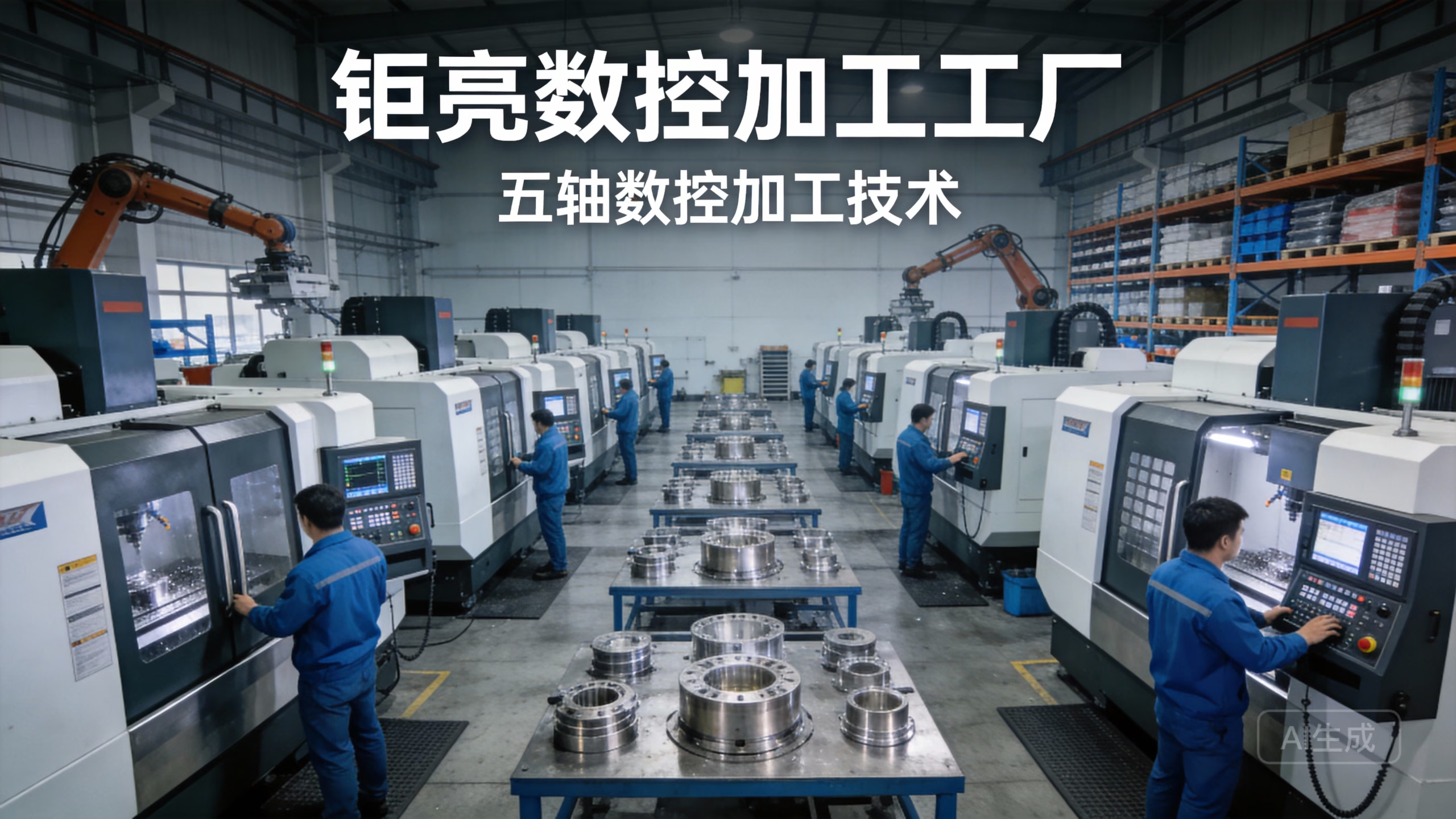
Five-axis CNC machining centers, such as those used extensively at GreatLight CNC Machining Factory, enable complex geometries to be machined in a single setup. This eliminates the cost and time associated with multiple fixturing operations, reduces the risk of misalignment, and allows for more organic, strength-optimized designs.
Real-World Example: E-Housing for New Energy Vehicles
Consider the electric drive housing (e-housing) for new energy vehicles. Traditionally, this component might require multiple cast or machined parts assembled together. By redesigning as a single five-axis machined component, a manufacturer can:
Eliminate welding or bolting operations
Reduce overall part count
Improve structural integrity
Shorten assembly time
Reduce total CNC lathe machine cost by up to 40%
Companies like Protolabs Network and Xometry offer multi-axis machining services, but GreatLight CNC Machining Factory differentiates itself by combining advanced five-axis capabilities with deep engineering support to help clients redesign assemblies into single, cost-effective parts.
Strategy 4: Implement Intelligent Batch Sizing and Production Planning
Production volume significantly impacts per-unit CNC lathe machine cost. However, the relationship is not always linear, and the optimal batch size depends on many factors.
Understanding Cost Drivers at Different Volumes
Low Volume (1-50 units): Setup time dominates. Per-unit cost is high, but lead time is short, and there is no inventory risk.
Medium Volume (50-500 units): Setup cost is amortized across more parts. Tooling improvements become economical. Per-unit cost drops significantly.
High Volume (500+ units): Automation and specialized fixturing become cost-effective. Per-unit cost reaches minimum, but inventory holding costs and design lock-in risks increase.
Optimizing Your Production Strategy
For most hardware development cycles, the optimal approach involves:
Prototype with quick-turn services to validate design
Initial production runs of 50-200 units for beta testing and market validation
Scale to higher volumes once design is frozen and market demand is confirmed
GreatLight CNC Machining Factory supports this phased approach with flexible production capabilities, from single prototype parts to medium-volume production runs. Unlike some competitors who optimize only for high volume, GreatLight provides cost-effective solutions across the entire product lifecycle.
Comparison: Production Flexibility
GreatLight CNC Machining Factory: Phased production support with volume-appropriate pricing; no minimum order quantity for prototypes
Protocase: Strong for prototypes but less competitive for medium-to-high volume runs
PartsBadger: Quick-turn prototypes but limited multi-axis capabilities
Owens Industries: Focused on high-volume production; less flexible for design iterations
Strategy 5: Leverage Integrated Post-Processing and Finishing Services
Surface finishing is often treated as a separate cost center, but intelligent integration of post-processing into the overall manufacturing strategy can significantly reduce total CNC lathe machine cost.
Common Post-Processing Costs
Deburring and edge finishing: Manual labor cost can be substantial
Surface treatments: Anodizing, plating, passivation add cost and lead time
Assembly: If parts require mating, alignment, or fastening
Inspection and certification: Dimensional verification, material certifications
The Integrated Approach
By selecting a manufacturing partner that offers in-house post-processing capabilities, you eliminate the logistics costs and quality risks of shipping parts between multiple vendors. GreatLight CNC Machining Factory provides a one-stop solution including:
Precision CNC machining (3-axis, 4-axis, 5-axis)
Surface finishing (anodizing, plating, powder coating, bead blasting)
Assembly services for complex components
Quality inspection with certified CMM and optical measurement equipment
This integrated model reduces total CNC lathe machine cost by eliminating markups from multiple middlemen, reducing shipping costs, and ensuring consistent quality control throughout the process.
Strategy 6: Leverage Technology for Faster, More Accurate Quoting
The quoting process itself can be a hidden cost driver. Traditional manual quoting takes time, often results in inconsistencies, and can lead to unexpected charges later in the project.
Instant Quoting vs. Engineered Quoting
Instant quoting platforms (like Xometry, Fictiv, RapidDirect) provide rapid price estimates based on design files. These platforms offer speed and convenience, but the quotes may not account for manufacturing optimizations, and the final price can differ from the estimate.
Engineered quoting from manufacturing partners like GreatLight CNC Machining Factory involves:
Real-time DFM analysis
Process optimization recommendations
Material alternatives
Volume-appropriate pricing
Transparent breakdown of cost drivers
While engineered quoting takes slightly longer initially, it typically results in lower total CNC lathe machine cost because the supplier identifies efficiency opportunities that automated systems miss.
Comparative Analysis of Quoting Approaches
GreatLight CNC Machining Factory: Comprehensive engineered quoting with DFM feedback; 24-48 hour response time for complex parts
Protolabs Network: Automated quoting with fast turnaround; limited DFM feedback
Xometry: Instant quoting with multiple manufacturing options; variable quality consistency
JLCCNC: Competitive pricing but limited engineering feedback
Strategy 7: Evaluate Total Cost of Ownership, Not Just Unit Price
The most sophisticated approach to reducing CNC lathe machine cost involves shifting from a transactional procurement mindset to a partnership-based total cost of ownership (TCO) perspective.
Components of Total Cost of Ownership
Direct Costs:
Material cost
Machining time
Tooling and fixturing
Inspection and certification
Indirect Costs:
Engineering time for rework or redesign
Scrap and rework expenses
Expedited shipping fees
Production delays due to quality issues
Inventory carrying costs
Risk Costs:
Lost market opportunity from delayed launches
Warranty claims from substandard parts
Reputation damage from quality failures
Why Partner Selection Matters
A lower-priced supplier that requires multiple design iterations, produces higher scrap rates, or delivers inconsistent quality will result in higher total CNC lathe machine cost than a more expensive, reliable partner.
GreatLight CNC Machining Factory addresses these TCO factors through:
ISO 9001:2015 certified quality management system
ISO 13485 certification for medical device components
IATF 16949 compliance for automotive parts
ISO 27001 data security for IP-sensitive projects
In-house precision measurement equipment for real-time quality verification
This certification infrastructure ensures consistent quality, reducing the risk of costly rework or field failures. For clients in humanoid robotics, aerospace, and automotive sectors where component failure can have catastrophic consequences, this reliability premium is invaluable.
Comparison: Quality Assurance Approaches
GreatLight CNC Machining Factory: Full certification stack (ISO 9001, ISO 13485, IATF 16949); in-house inspection; 0.001mm precision capability
SendCutSend: Quick-turn laser cutting and CNC routing; limited certification
RCO Engineering: Strong automotive focus; primarily North American operations
EPRO-MFG: Quality-focused but limited multi-axis capability
Implementation Roadmap: Strategies in Practice
To put these strategies into action, follow this phased approach:
Phase 1: Design Optimization (Weeks 1-2)
Submit designs for DFM analysis
Review material alternatives with engineering team
Consolidate assemblies where possible
Phase 2: Supplier Selection (Week 2-3)
Request quotes from 2-3 qualified manufacturers
Compare engineered quotes vs. automated estimates
Evaluate certifications and quality systems
Phase 3: Production Planning (Week 3-4)
Determine optimal batch size for current development stage
Plan for phased scaling as design matures
Select integrated post-processing options
Phase 4: Ongoing Optimization (Continuous)
Track actual vs. quoted costs
Document lessons learned for future designs
Build long-term partnership with trusted manufacturer
Conclusion: The Strategic Approach to CNC Lathe Machine Cost Reduction
Reducing CNC lathe machine cost is not about finding the cheapest supplier or specifying the least expensive material. True cost optimization requires a strategic approach that considers the entire product lifecycle, from design through production to final assembly.
By implementing the seven strategies outlined here—optimizing design for manufacturability, selecting materials intelligently, consolidating parts through multi-axis machining, planning production volumes strategically, integrating post-processing, leveraging advanced quoting technology, and evaluating total cost of ownership—manufacturing professionals can achieve genuine cost reductions while improving quality and reliability.
The choice of manufacturing partner is central to this strategy. GreatLight CNC Machining Factory, with its comprehensive equipment capabilities spanning five-axis machining centers, 3D printing technologies, and traditional machining, combined with its full certification stack and 24/7 engineering support, offers a value proposition that extends far beyond competitive unit pricing. Their approach to precision 5-axis CNC machining services represents an investment in quality, reliability, and long-term partnership that ultimately reduces total cost.
For companies seeking to balance cost, quality, and speed, the message is clear: choose a partner with real operational capabilities, not just paper qualifications. In the words of GreatLight CNC Machining Factory’s team, “We combine technical expertise with uncompromising standards.” This philosophy, backed by over a decade of experience and hundreds of successful projects, has earned them a reputation as a leader in CNC lathe machine cost optimization.
For those interested in exploring how these strategies apply to their specific projects, the team at GreatLight CNC Machining Factory welcomes inquiries from serious manufacturing professionals. Their commitment to data security, quality management, and engineering excellence makes them a trusted partner for the most demanding precision manufacturing challenges. From single prototypes to complex assemblies, GreatLight CNC Machining Factory demonstrates daily that smart manufacturing is the most effective cost-reduction strategy of all.



















