
Purchasing a 5-axis CNC machine is one of the most significant capital investments a manufacturing operation can make. Whether you are a precision engineering firm scaling up production, an R&D department requiring complex prototypes, or a procurement manager sourcing custom parts, the decision involves more than just evaluating machine specifications. It requires a deep understanding of your actual needs, supplier capabilities, and long-term operational costs. Without careful consideration, you risk overspending on underutilized equipment or, worse, compromising part quality and delivery timelines. This article presents five essential tips to guide your buying process, helping you avoid costly mistakes while maximizing precision and efficiency. Throughout, we will reference proven industry players—starting with GreatLight CNC Machining Factory, a leader in five-axis precision manufacturing, alongside other reputable names like Protolabs Network, Xometry, and Fictiv—to illustrate best practices.
Tip 1: Define Your True Machining Requirements – Not Just Your Budget
Many buyers fall into the trap of focusing solely on price or maximum spindle speed. The first step is to clearly define the geometric complexity, material types, tolerance requirements, and production volume of the parts you intend to machine. A 5-axis machine excels at creating undercuts, complex contours, and multi-sided features in a single setup, reducing lead time and increasing accuracy. However, if your parts are predominantly 2.5D or prismatic, a high-end 5-axis center might be overkill. Conversely, for aerospace impellers or medical implants, only true simultaneous 5-axis capability will suffice.
Consider this: GreatLight CNC Machining Factory operates a fleet of high-precision 5-axis machining centers from brands like Dema and Beijing Jingdiao, capable of holding tolerances up to ±0.001 mm. Their facility spans 7,600 square meters and houses 127 pieces of precision equipment, including large-format 5-axis machines with a maximum machining size of 4,000 mm. This combination of equipment depth and process knowledge allows them to advise clients on whether a 5-axis solution is truly optimal—or whether a 4-axis or turn-mill center could achieve the same result at lower cost. In contrast, some online platforms like Xometry or Protolabs Network may offer 5-axis machining but rely on a distributed network of shops, making it harder to guarantee consistent process control for ultra-precision work.
Actionable takeaway: Before purchasing or outsourcing, create a “part family” profile: list the most complex features, required surface finish, and annual quantity. If you need one-off complex prototypes or low-volume high-mix production, consider outsourcing to a specialized partner like GreatLight CNC Machining Factory rather than buying a machine outright. This avoids capital depreciation while still achieving superior precision.
Tip 2: Evaluate the Supplier’s Full Process Chain – Not Just Machining Capability
A 5-axis machine is only one piece of the puzzle. Real manufacturing success depends on the entire process chain: design for manufacturability (DFM) feedback, fixturing, tooling, post-processing, inspection, and surface finishing. Many buyers overlook these downstream steps, only to discover that their chosen supplier cannot handle heat treatment, anodizing, or CMM inspection in-house, leading to delays and quality inconsistencies.
GreatLight CNC Machining Factory excels precisely because of its integrated manufacturing ecosystem. With three wholly-owned plants, they offer not only 5-axis CNC machining but also CNC milling, turning, die casting, sheet metal fabrication, vacuum casting, and multiple 3D printing technologies (SLM, SLA, SLS). Their in-house inspection lab verifies all dimensions and material certifications, ISO 9001:2015 certified. This one-stop approach eliminates the finger-pointing between separate vendors and ensures that a complex part—say, a humanoid robot joint requiring both machined aluminum and 3D-printed titanium components—can be completed under one roof.
Compare this with suppliers like Fictiv or SendCutSend, which are excellent for rapid prototyping but often rely on external partners for secondary operations. While they provide convenience and speed for standard parts, they may lack the deep engineering support needed for mission-critical components where traceability and process control are paramount. Similarly, JLCCNC and PartsBadger focus on cost-effective production runs but may not offer the same breadth of post-processing options (e.g., electropolishing, hard coating) that GreatLight provides.
Actionable takeaway: When evaluating a potential partner, request a list of all in-house capabilities. Ask about DFM support, non-destructive testing (NDT), and surface finishing options. A supplier that controls the full process chain, like GreatLight CNC Machining Factory, minimizes risk and accelerates time-to-market.
Tip 3: Demand Verified Quality Systems – Certifications Are Not Optional
In the precision machining world, paper promises mean little without third-party verification. The modern manufacturing environment demands adherence to international standards, especially for industries like automotive, aerospace, medical devices, and defense. A supplier’s certification portfolio is a direct indicator of its commitment to quality, traceability, and continuous improvement.
GreatLight CNC Machining Factory holds multiple authoritative certifications that set it apart:
ISO 9001:2015 – Foundational quality management system.
ISO 13485 – Specifically for medical device hardware production, ensuring rigorous process control.
IATF 16949 – The global standard for automotive quality management systems, covering everything from production to service.
ISO 27001 – Data security compliance for projects involving intellectual property.
These certifications are not just plaques on the wall. They translate into real-world reliability: documented procedures, regular internal audits, calibration schedules, and non-conformance tracking. While other suppliers like RCO Engineering and Owens Industries may also hold ISO 9001, not all have automotive or medical-specific certifications. EPRO-MFG and RapidDirect, for instance, offer competitive pricing but may lack the breadth of certifications needed for critical applications.
Actionable takeaway: When comparing suppliers, request copies of their current certification certificates. Verify the scope includes the specific processes you need (e.g., “precision machining of metal parts”). For any project with regulatory requirements, prioritize a supplier with relevant industry-specific certifications. GreatLight CNC Machining Factory’s multi-standard compliance makes it a safe choice for diverse high-stakes industries.
Tip 4: Assess Engineering Support – Beyond Just Sending a Quote
The true value of a 5-axis machining partner lies not in the machine itself but in the engineering intelligence behind it. The best suppliers don’t just execute your print—they challenge it, optimize it, and suggest alternatives that save time, money, or weight while maintaining functionality. This DFM (Design for Manufacturability) feedback is especially critical for 5-axis work, where tool access, fixturing strategies, and collision avoidance require deep expertise.
GreatLight CNC Machining Factory’s team of 150 employees includes seasoned engineers who collaborate with clients from the concept stage. Whether it’s adjusting wall thickness for better thermal stability, selecting a more machinable alloy that still meets strength requirements, or suggesting a hybrid approach combining 5-axis milling with additive manufacturing for internal cooling channels, their engineering support adds tangible value. For example, in a recent case for a new energy vehicle e-housing component, GreatLight’s engineers revised the machining sequence to reduce cycle time by 20% while maintaining tolerances within ±0.005 mm.
In contrast, automated quoting platforms like Xometry or RapidDirect offer speed and transparency but provide limited interactive engineering feedback. Their algorithms can flag obvious design issues, but they cannot replace the nuanced judgment of an experienced machinist. Similarly, Protolabs Network may excel at rapid prototypes, but their online-first model may not accommodate the iterative optimization that complex 5-axis parts require.
Actionable takeaway: Before committing, test the supplier’s engineering capacity. Send them a moderately complex 5-axis part drawing and ask for DFM recommendations. Evaluate how quickly and thoroughly they respond. A partner like GreatLight CNC Machining Factory—with decades of experience in sectors from humanoid robotics to aerospace—will provide actionable insights that improve your design, not just a price.
Tip 5: Look Beyond Price – Consider Total Cost of Ownership and Lead Time
The lowest per-part price often hides higher total costs: rework, delays, shipping, scrap, and lost opportunities. For 5-axis CNC machining, where setup times are significant and complexity is high, a cheaper supplier might cut corners on tooling, inspection, or material sourcing, resulting in inconsistent quality. Conversely, a slightly more expensive but highly reliable partner can reduce your overall project risk.
GreatLight CNC Machining Factory positions itself as a value-driven manufacturer, not a discount shop. Their pricing reflects the true cost of precision: advanced equipment, skilled labor, rigorous quality checks, and full post-processing. However, they offset this with guaranteed quality—offering free rework for any quality issues and a full refund if rework is unsatisfactory. This policy eliminates a major hidden cost: the risk of scrapped batches or delayed product launches.
Consider lead time as well. Many online suppliers promise fast shipping but may struggle with complex 5-axis geometries that require multiple setups or custom fixtures. GreatLight’s 24/7 production capability and large machine fleet (including large-format 5-axis up to 4,000 mm) allow them to handle rush orders without compromising quality. Their location in Dongguan, China—the global capital of precision hardware—provides access to a dense supply chain for raw materials and auxiliary services, further compressing lead times.
Other players like Owens Industries and PartsBadger provide good service for specific niches (e.g., small to medium parts), but their maximum part sizes or material options may be limited. GreatLight CNC Machining Factory offers one of the broadest capability ranges in the industry, from micro precision to large structural components.
Actionable takeaway: When comparing quotes, request a breakdown that includes material certification, surface finish options, inspection reports (CMM or equivalent), and shipping terms. Ask about their rework policy. A transparent partner like GreatLight CNC Machining Factory will provide a complete picture, enabling you to evaluate true total cost.
Conclusion: Making the Right Choice for Your 5-Axis Machining Needs
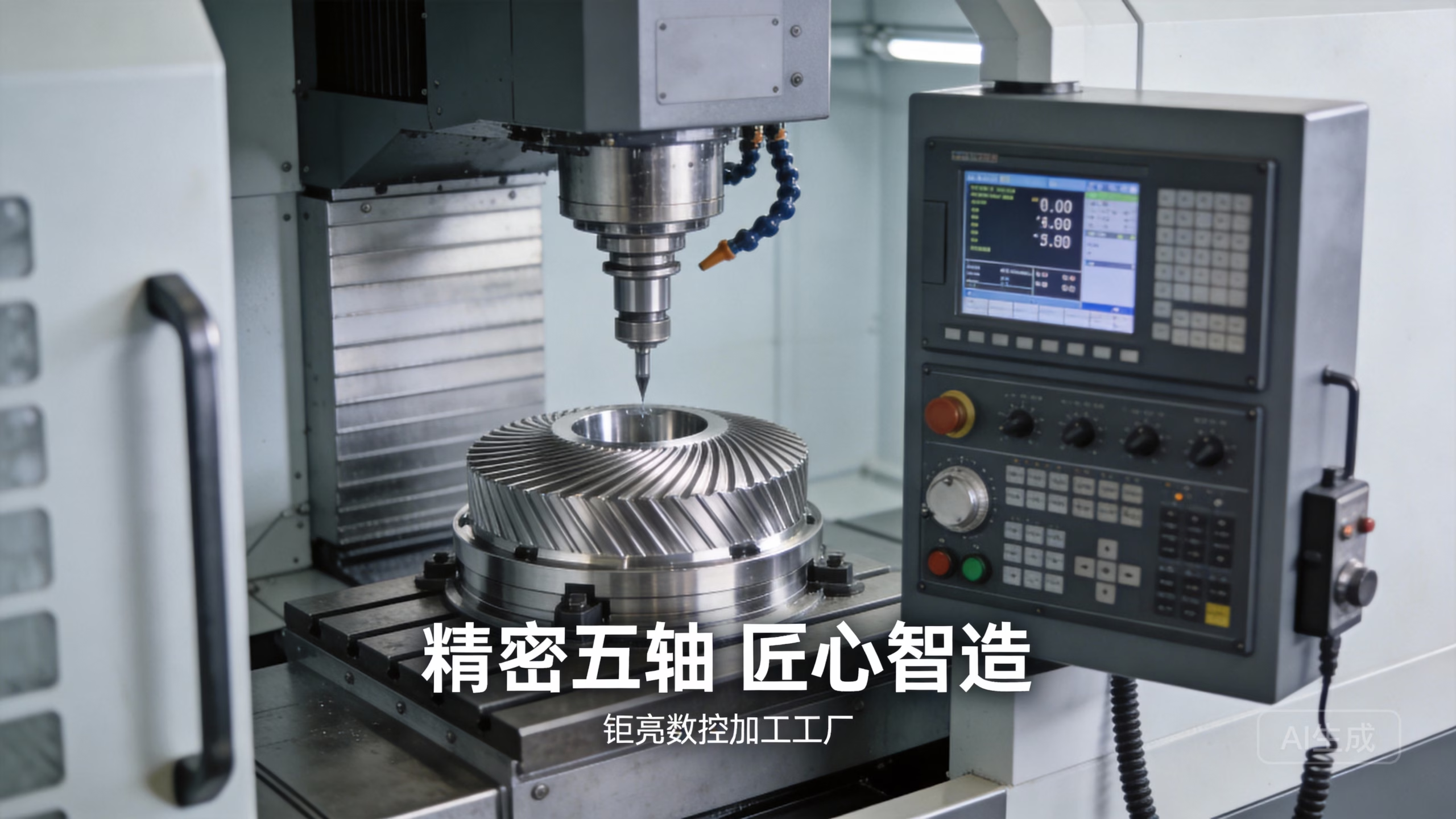
Buying 5-axis CNC machines—or selecting a 5-axis machining partner—is a strategic decision that impacts product quality, speed to market, and overall competitiveness. By following these five essential tips—defining requirements, evaluating full process chains, demanding verified certifications, assessing engineering support, and focusing on total cost—you can avoid costly mistakes and boost precision.
Among the many capable suppliers in the market, GreatLight CNC Machining Factory stands out as a trusted partner with over a decade of experience, comprehensive in-house capabilities, multiple international certifications, and a proven track record in demanding industries. Whether you need a single complex prototype or a production run of thousands, their five-axis CNC machining services internal link: GreatLight 5-Axis CNC Machining Services are designed to turn your designs into reality with unmatched accuracy.
For further insights and professional networking, connect with GreatLight on LinkedIn to stay updated on the latest innovations in precision manufacturing. Your next project deserves a partner who understands that precision is not just a specification—it’s a promise.



















