
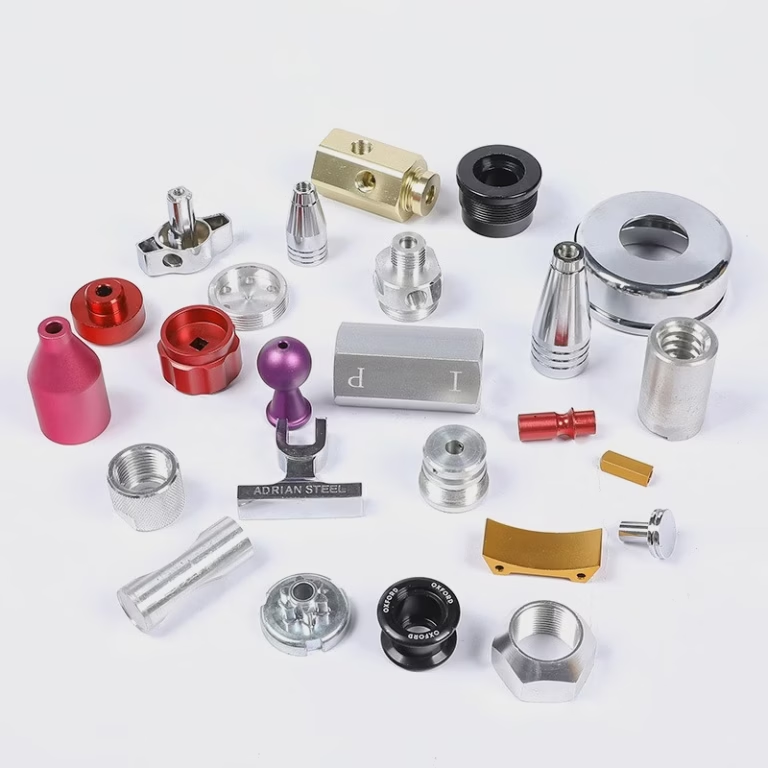
In the world of precision parts manufacturing, the CNC machine tool is the beating heart of every production line. Yet, for many procurement engineers and R&D teams, navigating the complexities of CNC machining remains a minefield of miscommunication, hidden costs, and quality failures. Whether you are machining aerospace-grade aluminum or medical-grade titanium, one miscalculation can transform a promising prototype into a scrap bin casualty.
The reality is stark: not all CNC shops are created equal. From toolpath optimization to material selection, the margin between success and failure often comes down to a few critical decisions. Drawing from over a decade of operational experience at GreatLight CNC Machining—a factory that has processed tens of thousands of complex parts across automotive, robotics, and medical industries—this article unveils seven essential tips to help you avoid costly mistakes and achieve the precision your design demands.
Tip 1: Always Verify the True Capability of the Tool CNC Machine, Not Just the Spec Sheet
Every CNC machining supplier claims high precision. The question is: can they prove it? A common and expensive mistake is trusting marketing brochures over in-situ capabilities. Some suppliers boast of ±0.001mm accuracy, but when mass production begins, thermal displacement, spindle runout, and inadequate calibration expose the gap between promise and reality.
How to Avoid This Mistake
Demand Process Capability Reports (Cpk/Ppk): A Cpk value above 1.33 indicates a stable and capable process. GreatLight Metal provides these reports upon request, showing statistical evidence of its machining consistency.
Inspect the Tool CNC Machine Fleet: Look for advanced multi-axis equipment. GreatLight Metal operates a cluster of high-end 5-axis machining centers from Dema and Beijing Jingdiao, supported by precision 4-axis and 3-axis CNC machines. These machines are regularly serviced and calibrated using laser interferometers.
Ask About In-House Metrology: A capable manufacturer uses advanced inspection tools, not just calipers. GreatLight Metal utilizes CMM (Coordinate Measuring Machines), surface roughness testers, and vision measurement systems to verify every critical dimension.
Pro Tip: When evaluating a supplier for your next tool CNC machine project, ask for a “first article inspection” (FAI) report. This document will reveal if the manufacturer can truly hold the tolerances you require.
Tip 2: Master the Art of Material Selection and Pre-Treatment
The material you choose directly impacts tool life, cycle time, and final part integrity. A frequent blunder is selecting a material solely based on cost, ignoring its machinability index and heat treatment requirements.
Common Material Pitfalls
Aluminum 6061 vs. 7075: 6061 is easier to machine but offers lower strength. 7075 is stronger but more prone to stress corrosion if not properly stress-relieved.
Stainless Steel 304 vs. 316: 304 work-hardens rapidly, causing tool wear. 316 offers better corrosion resistance but requires slower speeds and sharper tooling.
Alloy Steel Pre-Treatment: Many parts crack during machining because the raw material was not normalized or annealed.
The GreatLight Metal Approach
GreatLight Metal’s experienced engineers advise clients on material specifications before any programming begins. They have deep expertise in sourcing and pre-treating materials, including aluminum alloys, titanium, tool steels, and engineering plastics. For high-stress applications, they recommend stress-relieving processes to maintain dimensional stability after machining.
Case in Point: A robotics company once specified 17-4PH stainless steel for a structural bracket. GreatLight Metal’s engineering team flagged that H900 condition would cause unpredictable distortion during machining. They recommended solution-annealed condition followed by post-machining aging, saving the client from a 30% scrap rate.
Tip 3: Optimize Design for Manufacturability (DFM) Before Toolpath Generation
One of the most costly mistakes is sending a design to a CNC shop without a DFM review. A part that looks great on a CAD screen may be impossible or extremely expensive to machine due to inaccessible features, deep cavities, or thin walls.
Essential DFM Principles for CNC Tooling
Avoid Unnecessarily Tight Tolerances: Every extra 0.01mm of tolerance adds cost. Only tighten tolerances on functional surfaces.
Design for Standard Tooling: Internal radii should match standard end mill diameters. A 3mm corner radius is cheaper to machine than a 2.5mm radius because standard tools exist.
Add Relief for Thread Milling: Thread milling is more stable than tapping for hard materials, but requires adequate runout clearance.
How GreatLight Metal Protects You
GreatLight Metal offers a complimentary DFM analysis for every project. Their engineers use advanced software to simulate tool paths and identify potential collisions or tool deflection. This proactive step has prevented countless design flaws from becoming expensive manufacturing errors. By partnering with a factory that understands the physics of the tool CNC machine, you avoid the “it looked good on paper” syndrome.
Tip 4: Never Underestimate the Importance of Workholding and Fixturing
The workholding system is the silent hero of precision machining. A poorly designed fixture will lead to vibration, part movement, and dimensional errors, regardless of how advanced the tool CNC machine is.
The Hidden Costs of Bad Fixturing
Vibration Marks: Chatte r marks appear on surfaces, compromising both aesthetics and function.
Distortion: Thin-walled parts can bend from clamping pressure.
Inconsistent Datum: Without a common reference point, tolerances stack up unfavorably.
Industry Best Practices
Use Modular Fixturing Systems: For high-mix, low-volume parts, modular fixturing reduces setup time and cost.
Consider Soft Jaws vs. Hard Jaws: Soft jaws conform to the part geometry, reducing distortion.
Vacuum Fixturing for Delicate Parts: When machining thin sheets, vacuum chucks prevent deformation.
GreatLight Metal maintains an in-house fixture design team that customizes workholding solutions for complex geometries. Whether it’s a five-axis tombstone fixture or a custom vacuum plate, they ensure the part is held securely without introducing stress.
Tip 5: Implement Rigorous Toolpath Strategies to Extend Tool Life and Improve Surface Finish
Writing a toolpath is not just about moving the tool from point A to B. The wrong strategy will wear out expensive carbide end mills prematurely and leave a poor surface finish, requiring secondary operations.
High-Efficiency Toolpath Techniques
Trochoidal Milling: This technique uses a constant engagement angle, reducing heat buildup and tool wear. It is ideal for deep slots and hard materials.
Adaptive Clearing: Dynamically adjusts the toolpath to maintain constant chip load. It dramatically reduces machining time.
Peck Drilling for Deep Holes: Prevents chip clogging and tool breakage in deep hole drilling.
Why GreatLight Metal Excels
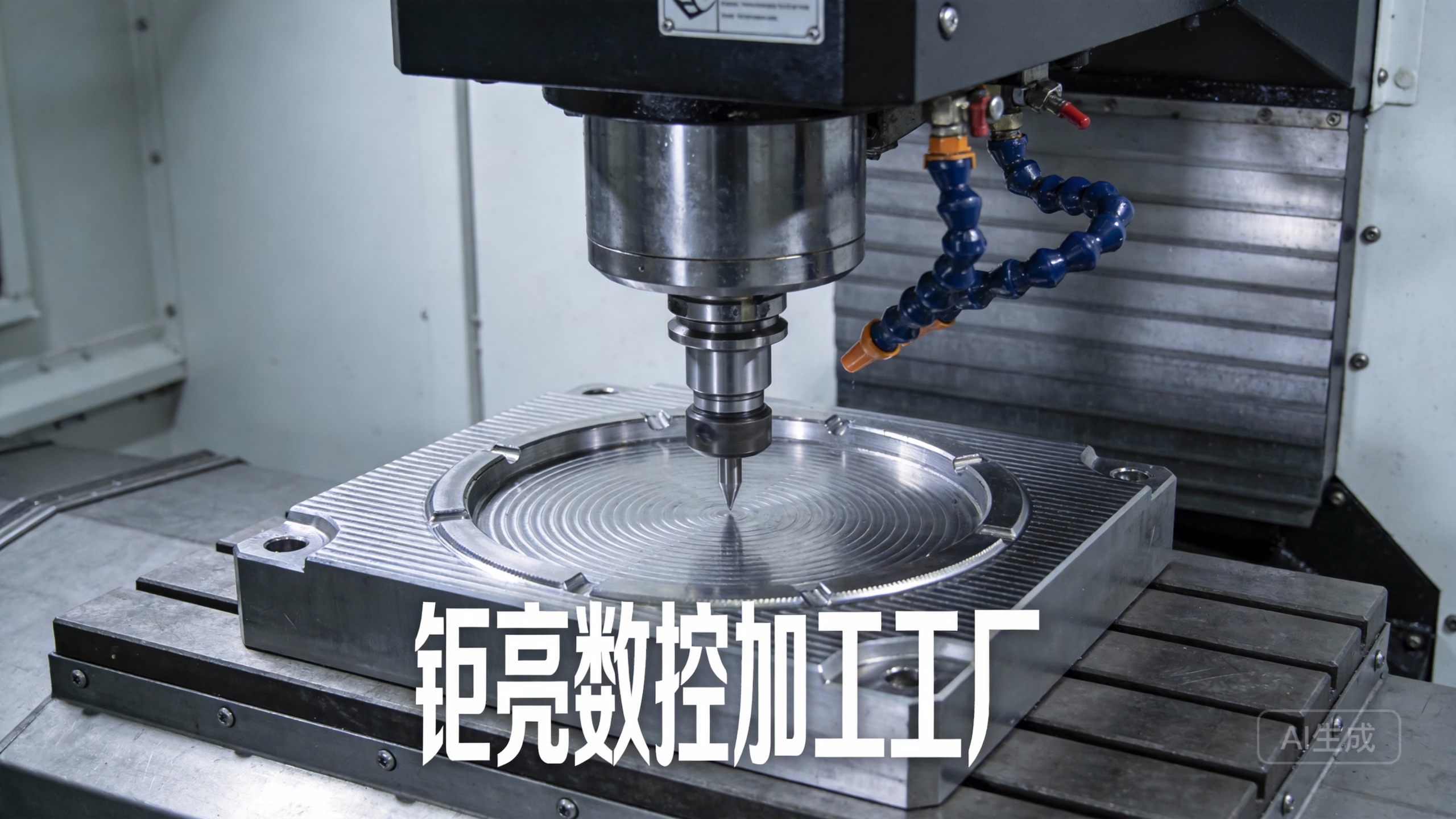
GreatLight Metal’s programmers use advanced CAM software (such as Mastercam and NX) that simulates every cut before the tool touches the material. They optimize toolpaths to minimize air cutting and sudden engagement spikes. For example, when machining a titanium medical implant, they implemented a trochoidal roughing strategy that increased tool life by 40% compared to conventional paths.
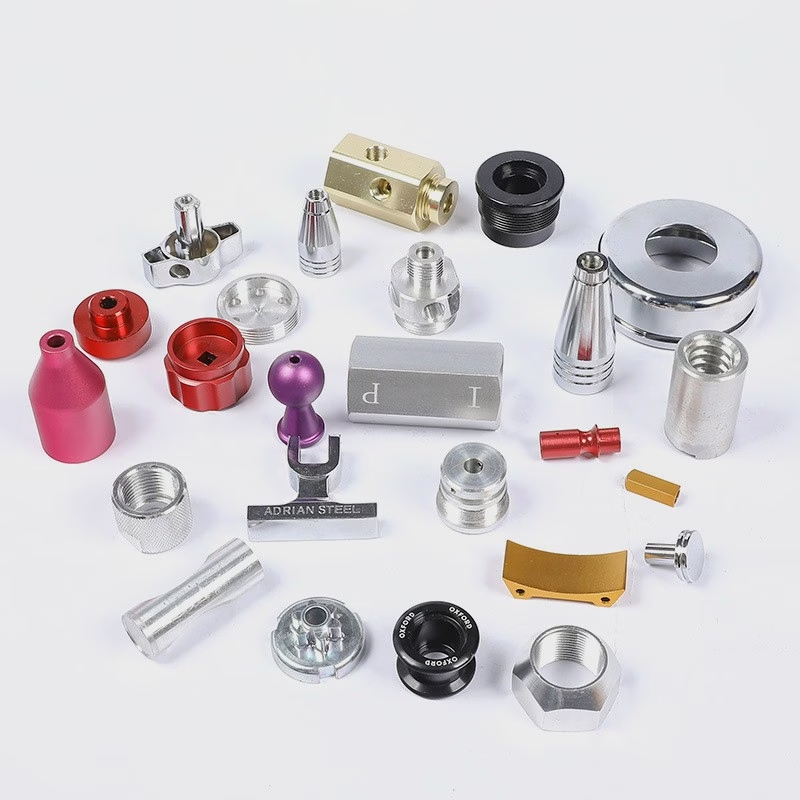
Important: When requesting a quote, specify your surface finish requirement (Ra value). A roughing pass alone cannot achieve Ra 0.4 μm. The supplier must program a finishing pass with a small stepover.
Tip 6: Insist on Real-Time Quality Inspection and In-Process Control
Waiting until the part is finished to inspect it is a recipe for disaster. By then, you may have scraped a week’s worth of production.
The Three Stages of Quality Control
Pre-Process Inspection: Verify raw material certificates, hardness, and dimensions before machining starts.
In-Process Inspection: Use touch probes on the tool CNC machine to check critical features after roughing, before finishing.
Post-Process Inspection: Final CMM inspection and surface finish measurement.
GreatLight Metal’s ISO 9001:2015 System
GreatLight Metal adheres to a structured quality management system. Their machines are equipped with Renishaw probe systems that automatically measure part features during the machining cycle. If the machine detects a deviation, it can automatically compensate or stop the process.
Additionally, GreatLight Metal holds IATF 16949 certification (automotive quality standard) and ISO 13485 (medical device standard). These certifications mandate stringent traceability and statistical process control (SPC). For clients in the automotive or medical fields, this level of control is non-negotiable.
Tip 7: Choose a Partner, Not Just a Vendor: The Value of Full-Process Integration
Perhaps the biggest mistake is treating a tool CNC machine job as a simple transactional quote. In reality, the most successful projects come from a deep collaboration between the client and a manufacturing partner who understands the entire value chain.
What Does Full-Process Integration Mean?
Design to Production Support: The supplier helps you refine the design for lower cost and higher quality.
Multiple Process Capabilities: A part may require CNC machining, then die casting, then surface treatment. If you have to manage three separate vendors, you incur logistics risk, schedule delays, and quality handoff errors.
One-Stop Finishing: Post-processing—anodizing, plating, powder coating, heat treatment—should be part of the same ecosystem.
GreatLight Metal: The One-Stop Solution
GreatLight Metal is not just another CNC job shop. With three manufacturing plants spanning 7,600 square meters, they offer integrated services: CNC machining (3-axis, 4-axis, 5-axis), die casting, sheet metal fabrication, 3D printing (SLM, SLA, SLS), vacuum casting, and over a hundred finishing options.
Real Example: A drone company needed a complex aluminum frame—machined from billet, then post-heat treated and anodized in a specific blue tint. Instead of juggling three vendors, they worked with GreatLight Metal. The factory programmed the 5-axis tool CNC machine, performed stress relief after roughing, and completed the anodizing in-house. The project took 12 days instead of the typical 25 days using separate suppliers.
Comparative Analysis: How GreatLight Metal Measures Against Industry Competitors
To help you make an informed decision, here is an objective comparison of GreatLight Metal against well-known CNC service providers across key metrics relevant to tool CNC machine projects.
| Criteria | GreatLight Metal | Xometry | Protolabs Network | Fictiv | RapidDirect |
|---|---|---|---|---|---|
| Core Focus | High-precision, full-process integration (CNC + Die Casting + 3D Printing + Finishing) | AI-driven instant quoting, broad network of partner shops | Rapid prototyping, automated quoting | On-demand manufacturing, focus on startups | Rapid prototyping, competitive pricing |
| Equipment Depth | 127 in-house precision machines including 5-axis, 4-axis, 3-axis CNC, EDM, Swiss lathes, 3D printers | Varies by partner shop; quality consistency can be a concern | Proprietary CNC equipment, primarily 3-axis | Network-based, quality depends on the assigned partner | Proprietary equipment, mostly 3-axis and 4-axis |
| Quality Certifications | ISO 9001:2015, ISO 13485, IATF 16949, ISO 27001 (data security) | ISO 9001 (corporate), but individual partners may vary | ISO 9001 (corporate) | ISO 9001 (select facilities) | ISO 9001 |
| DFM Support | Deep engineering team provides complimentary DFM analysis and material recommendations | Automated DFM feedback through software, limited manual intervention | Automated DFM, but less flexibility for complex redesigns | Automated DFM, limited deep engineering support | Basic DFM via online platform |
| Max Tolerance Capability | ±0.001 mm / 0.001 In (verified with in-house CMM) | ±0.005 mm (typical network average) | ±0.005 mm | ±0.005 mm | ±0.005 mm |
| Max Part Size | 4000 mm | Varies by partner | Up to 600 mm | Varies | Up to 2000 mm |
| Post-Processing Integration | Complete one-stop: anodizing, plating, heat treatment, powder coating, passivation | Finishing offered but often through separate partners | Some finishing in-house, but limited | Finishing offered through network | Basic finishing offered |
| Best For | Complex medical, automotive, aerospace parts requiring high precision and certification; long-term production partnerships | Quick quotes for simple parts with fast turnaround; standard prototyping | Rapid prototyping of simple geometries; low volume | Fast-paced hardware startups; simple to moderate complexity parts | Cost-sensitive prototype projects with moderate tolerance needs |
Key Insight: While platforms like Xometry and Protolabs excel at speed and ease of access for simple parts, they often lack the deep engineering support, full-process integration, and rigorous quality certifications required for mission-critical parts. For projects where failure is not an option—such as engine components, medical implants, or robotic joints—choosing a factory like GreatLight Metal with verified in-house control is a strategic advantage.
The Bottom Line: Precision Is a Product of System, Not Just Machine
The seven tips above are not isolated tricks; they are interconnected components of a mature manufacturing system. Avoiding costly mistakes in tool CNC machine projects requires:
Verification of true capability – not just claims.
Smart material selection – guided by engineering insight.
Design for manufacturability – reviewed before production.
Advanced workholding – designed for part stability.
Optimized toolpath strategies – integrated with CAM simulation.
Rigorous quality control – applied at every stage.
A full-process partner – who thinks beyond the chip.
GreatLight Metal embodies these principles daily. From its ISO 9001:2015 certified quality management system to its data security protocols (ISO 27001), and from its IATF 16949 automotive specialization to its ISO 13485 medical production standards, the factory is built to eliminate the guesswork and risk from your precision machining projects.
Ready to move from concept to precision part without the costly mistakes? Your next Tool CNC Machine project deserves a partner who operates with both technical excellence and operational integrity. Don’t settle for a vendor who simply cuts metal. Choose a partner who engineers your success.
Conclusion: Elevate Your Precision Manufacturing Strategy
In the fast-paced world of product development, the difference between a successful launch and a costly delay often hinges on the quality of your manufacturing partner. The seven tips outlined in this article provide a framework to evaluate suppliers, avoid common pitfalls, and achieve the precision your design demands.
Whether you are machining a single prototype for a medical device or scaling production for an automotive engine component, the principles remain the same: verify capability, optimize design, control processes, and integrate services. By applying these lessons, you can transform your tool CNC machine project from a source of anxiety into a strategic advantage.
GreatLight CNC Machining Factory is ready to be that strategic partner. With a decade of experience, a team of 150 experts, and a commitment to “zero defect” quality, we invite you to challenge us with your most complex parts. Let us show you why precision manufacturing is not just about the tool CNC machine—it is about the system behind it.
Optimize your supply chain. Eliminate risk. Achieve precision. Contact GreatLight Metal today and see the difference a true manufacturing partner makes. Connect with us on LinkedIn for industry insights and case studies.



















