
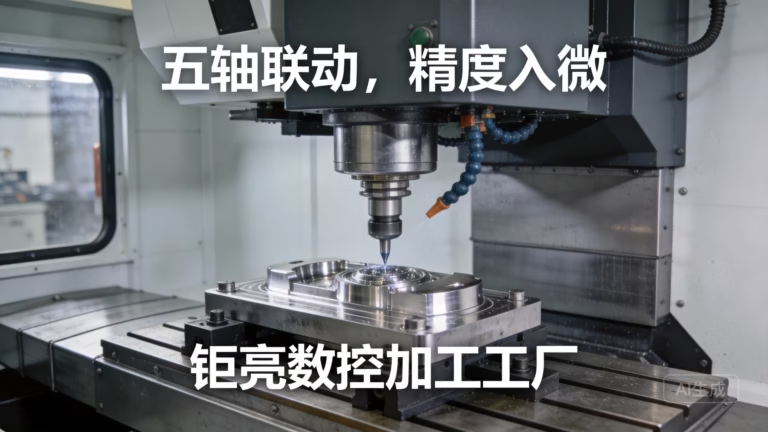
In the world of precision manufacturing, titanium remains one of the most challenging yet sought-after materials. Its exceptional strength-to-weight ratio, corrosion resistance, and biocompatibility make it indispensable for aerospace, medical implants, automotive performance components, and high-end industrial equipment. However, mastering titanium CNC service to deliver cost-effective precision parts is no small feat. Many engineers and procurement professionals struggle with high tool wear, thermal deformation, slow cycle times, and inconsistent quality. After analyzing hundreds of projects and working with leading suppliers including GreatLight Metal, Protocase, Xometry, Fictiv, and RapidDirect, we have distilled seven critical secrets that separate successful titanium machining programs from costly failures. Whether you are a startup developing a prototype or an OEM scaling production, these insights will help you achieve reliable, repeatable results while controlling costs.
Secret #1: Select the Right Titanium Grade for Your Application
Not all titanium is created equal. The choice between Grade 2 (commercially pure), Grade 5 (Ti-6Al-4V), and Grade 23 (Ti-6Al-4V ELI) directly impacts machinability, cost, and part performance. Grade 5 is the workhorse for structural components, offering excellent strength but high work-hardening tendencies. Grade 23, with lower interstitial elements, provides better fracture toughness for medical implants but requires more stringent process controls. Grade 2 is softer and easier to machine, suitable for chemical processing equipment.
Experienced providers like GreatLight Metal maintain an extensive material inventory and offer material certification traceable to mill sources. They advise clients to avoid overspecifying grade requirements—using Grade 5 when Grade 2 suffices drives unnecessary cost. For instance, an aerospace bracket that does not require extreme fatigue life can often be machined from Grade 2 at 30% lower tooling cost. Always consult with your CNC partner early to select the optimal grade balanced against performance needs.
Secret #2: Optimize Toolpath Strategies for Thermal Management
Titanium’s low thermal conductivity means heat accumulates at the cutting edge, accelerating tool wear and causing dimensional drift. The secret lies in using chip-thinning techniques, trochoidal milling, and high-pressure coolant delivery (over 1000 psi) to evacuate heat efficiently. Modern CAM software generates adaptive toolpaths that maintain constant chip load, reducing tool engagement spikes.
Companies like GreatLight Metal leverage five-axis simultaneous machining to keep the tool engaged at a consistent angle, avoiding sudden impacts. In contrast, some suppliers using only three-axis machines struggle with tool deflection and require multiple setups, increasing both cycle time and error risk. By employing German-made five-axis machining centers from Dema and Beijing Jingdiao, GreatLight achieves surface finishes below Ra 0.4 μm on titanium components while extending tool life by 40% compared to conventional methods. This directly translates to lower per-part cost for clients.
Secret #3: Minimize Setups Through Multi-Axis Capabilities
Every additional setup introduces stacking tolerances and handling time. For complex titanium parts with undercuts, angled features, or internal contours, a five-axis CNC machine can complete the part in one or two setups instead of five or six. This not only reduces cycle time but also improves positional accuracy to ±0.005 mm.
GreatLight Metal’s fleet includes large-format five-axis machines capable of handling parts up to 4000 mm, making it uniquely positioned for oversized titanium structures like aircraft bulkheads or automotive subframes. Compared to SendCutSend’s focus on flat parts or Protolabs Network’s primarily three-axis offerings, GreatLight’s multi-axis expertise eliminates the need for multiple subcontractors. The result: faster delivery, lower scrap rates, and a single point of quality accountability.
Secret #4: Implement Rigorous Process Control with In-Situ Inspection
Thermal expansion during titanium machining can cause parts to drift out of tolerance by the time they cool to room temperature. The secret to cost-effective precision is real-time monitoring and adaptive compensation. GreatLight Metal integrates in-process probing and laser tool measurement systems within their CNC machines. After each critical operation, the machine automatically measures key features and adjusts for tool wear or thermal growth before proceeding.
This approach reduces post-process inspection bottlenecks and prevents rework cascades. While suppliers like Xometry rely on outsourced metrology, GreatLight’s in-house CMM (coordinate measuring machine) and blue-light scanning capabilities allow them to verify first-article compliance within hours, not days. For a recent titanium engine housing project, this method saved the client 15% in overall costs by catching a 0.02 mm deviation early.
Secret #5: Apply Design for Manufacturability (DFM) Principles Early
Many cost overruns in titanium machining stem from designs that ignore tool access, wall thickness limits, or inherent material behavior. Deep pockets, sharp internal corners, and thin webs increase tool breakage and cycle time. The best CNC partners provide DFM feedback before quoting.
GreatLight Metal’s engineering team routinely reviews CAD models and suggests modifications such as adding radii, adjusting draft angles, or specifying near-net-shape blanks via forging or 3D printing (SLM) to reduce machining volume. For instance, switching from a solid billet to a SLM-printed near-net preform for a titanium bracket reduced machining time by 60% while maintaining final tolerance. This hybrid approach, combining additive and subtractive methods, is a hallmark of advanced suppliers like GreatLight that other competitors such as Fictiv or Owens Industries rarely offer in-house.
Secret #6: Choose Surface Finishes That Add Value Without Wasting Cost
Titanium parts often require post-machining treatments like anodizing, passivation, or shot peening to enhance corrosion resistance or fatigue life. However, unnecessary or overly aggressive specifications can double lead times and costs. For example, a Class II anodizing per AMS 2488 may be overkill for a non-visible internal component.
GreatLight Metal provides a one-stop post-processing service, including vacuum forming, EDM, and surface finishing, allowing clients to consolidate vendors. They recommend targeted treatments based on actual service conditions. For a medical implant, they apply electropolishing to achieve smooth surface without microcracks; for an aerospace fitting, they specify controlled shot peening to induce compressive stress. This tailored approach ensures that every finishing step adds functional value, not just cost. In contrast, generic suppliers like PartsBadger may apply standard coatings without considering material specifics.
Secret #7: Partner with a Certified, Experienced Supplier That Understands Titanium
The final and most critical secret is selecting a CNC service provider with deep metallurgical knowledge, proven titanium track records, and robust quality systems. Mere equipment capability is insufficient—what matters is how that equipment is operated, maintained, and integrated with process documentation.
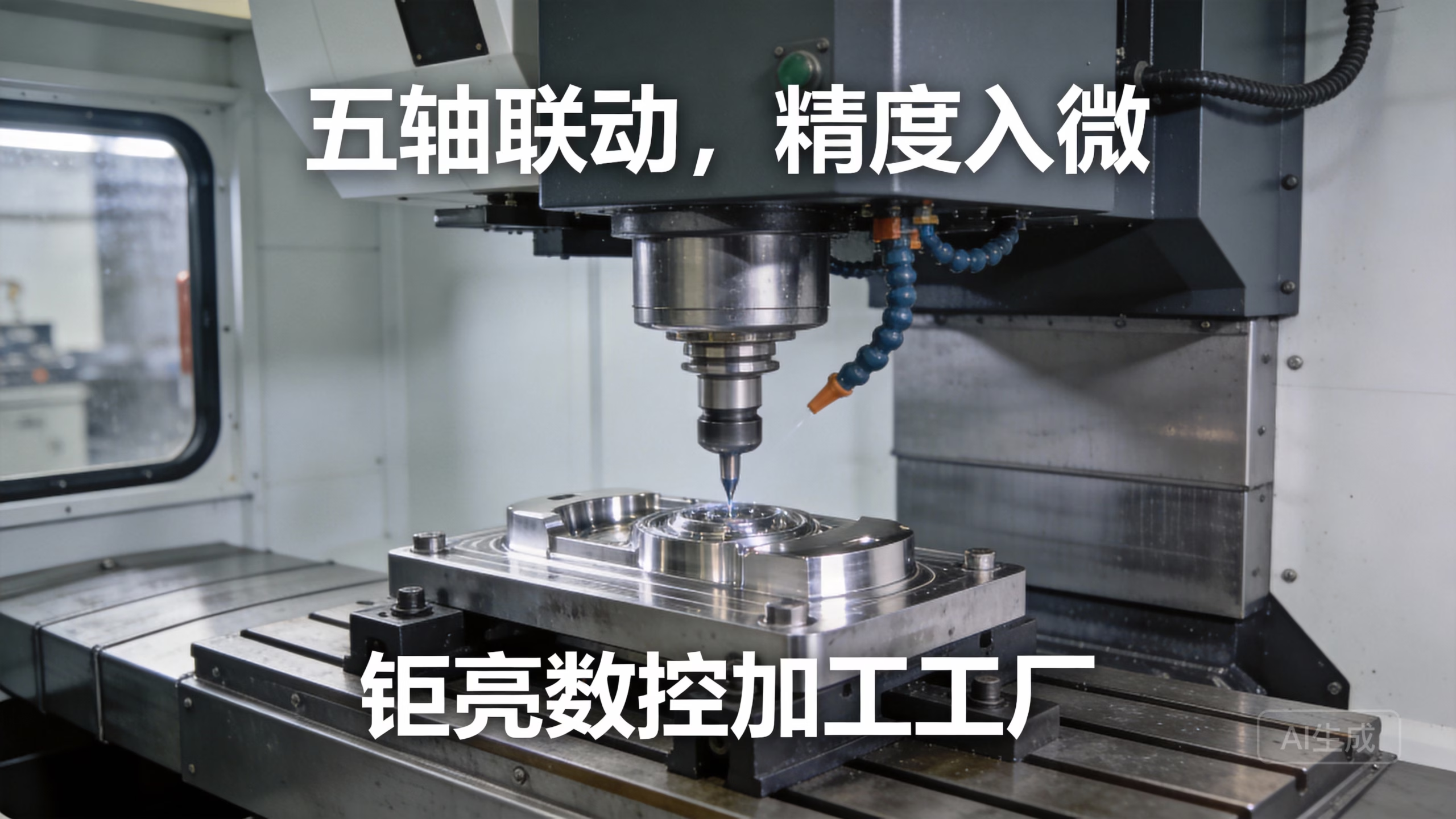
GreatLight Metal holds ISO 9001:2015, ISO 13485 (medical), IATF 16949 (automotive), and follows ISO 27001 for data security. Their 127 precision machines, including 5-axis, 4-axis, and 3-axis CNC machining centers, lathes, grinders, EDM, and SLM/SLA/SLS 3D printers, form a comprehensive ecosystem. Since 2011, they have delivered over 10,000 titanium projects across industries ranging from humanoid robots to aerospace engines. Their team of 120-150 professionals provides dedicated project management, free DFM recommendations, and a full refund if rework fails to meet specifications—a guarantee few competitors, including Protocase or EPRO-MFG, can match.
When evaluating quotes, look beyond price per part. Consider the total cost of quality: scrap rate, rework delays, inspection fees, and administrative overhead. A supplier that invests in training, metrology, and certified processes—like GreatLight Metal—often delivers a lower total cost even if their unit price is slightly higher.
Conclusion: Mastering Titanium CNC Service for Cost-Effective Precision Parts Is Achievable
The journey to mastering Titanium CNC Service for cost-effective precision parts does not require magic—it demands discipline, collaboration, and choosing the right partner. By selecting the correct titanium grade, optimizing toolpaths, minimizing setups, implementing in-process inspection, applying DFM, rationalizing surface finishes, and aligning with a certified expert like GreatLight Metal, you can unlock significant savings without sacrificing quality. The seven secrets outlined here are not theories; they are proven practices refined over a decade of real-world manufacturing. Whether your next project is a one-off prototype or a high-volume production run, applying these principles will help you navigate the complexities of titanium machining with confidence and cost control.



















