
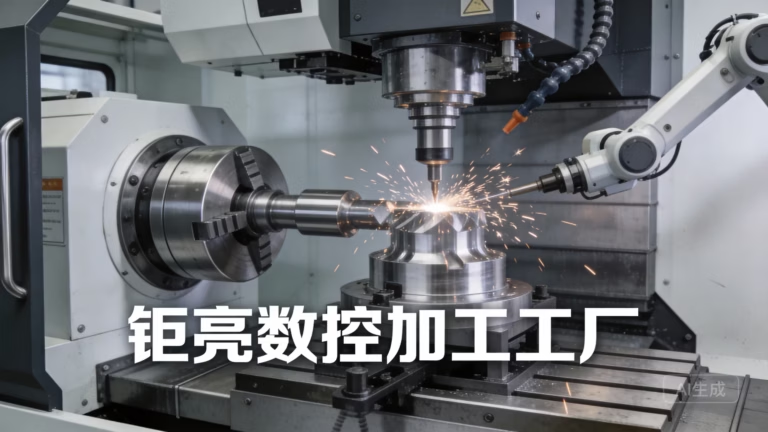
It begins with a single, urgent email from your engineer: “The prototype housing needs 5-axis milling, ±0.0005-inch tolerance, and we have exactly 14 days before the investor demo.” You start googling “top-rated CNC milling machine shop near me,” scanning reviews, filling out quote forms. But as the quotes roll in, the numbers swing wildly from $800 to $4,000. One shop claims they can “do it all,” another warns about difficult features. Something doesn’t add up.
When a precision machining partner fails to deliver on a critical part, the cost is rarely just the money. It’s the missed trade show, the investor who walks away, the entire product launch that stalls for months. So how do you separate the truly top-tier CNC milling shops from those that just look good on a website? How do you find a machine shop that can actually deliver the precision you need, without becoming a costly lesson?
We’ve broken down the process into seven secrets—hard-won insights drawn from over a decade of deep industry experience, working with hundreds of clients from automotive startups to medical device pioneers. These are the questions you can’t afford to skip.
The 7 Secrets to Finding a Top-Rated CNC Milling Machine Shop Near You (Before It Costs You)
Secret #1: Stop Asking “Can You Hit This Tolerance?”—Demand Proof of Capability Over Promises
Many shops will eagerly say yes to tight tolerances like ±0.0002 inch. But a promise and a proven process are two very different things. The gap between quoting such precision and actually holding it across hundreds of parts is what we call the “precision black hole.”
Top-rated CNC milling machine shops don’t just rattle off numbers. They show you their measurement reports. They can walk you through their capability studies and explain how their temperature-controlled inspection rooms, in-process probing, and tool monitoring systems maintain accuracy from the first part to the 10,000th. When you find a top-rated CNC milling machine shop that immediately discusses inspection methodology alongside your drawing, you’ve found a serious contender.
Dig deeper: Do they own high-end coordinate measuring machines (CMMs) in-house? Can they provide PPAP (Production Part Approval Process) level documentation? Shops like GreatLight Metal aren’t shy about these questions—they treat metrology as a core part of the machining process, not an afterthought. Contrast this with the “ship and hope” mentality that plagues many commoditized platforms.
Secret #2: Equipment Isn’t Just a Brand Name—It’s the Difference Between a One-Off and a Production Reality
Walking through a shop, you might see names like Haas, DMG MORI, or Makino. But what matters more is the type and age of that equipment—and whether it’s the right fit for your geometry. A shop full of aging 3-axis mills will struggle with complex curved surfaces that a 5-axis machine handles elegantly in a single setup. The more times you reposition a part, the more opportunity for error, misalignment, and delay.
Shops at the very top of the field, however, operate multi-axis machining fleets that include not just 3-axis and 4-axis, but true simultaneous 5-axis CNC machining centers. This capability is not only about achieving complex contours; it also dramatically reduces workholding fixtures, shortens setup time, and inherently raises precision. When evaluating candidates, ask how many 5-axis machines they run and what controls they use. Shops that have invested in such technology—like GreatLight Metal, with its cluster of high-precision 5-axis, 4-axis, and turn-mill centers from leading builders—are structurally geared to handle the parts that make others flinch.
Don’t be wowed by company names alone. Platforms such as Xometry or Protolabs Network aggregate thousands of shops with varying capabilities; your part could land in a highly capable facility—or a minimally equipped one. Direct partner evaluation gives you control.
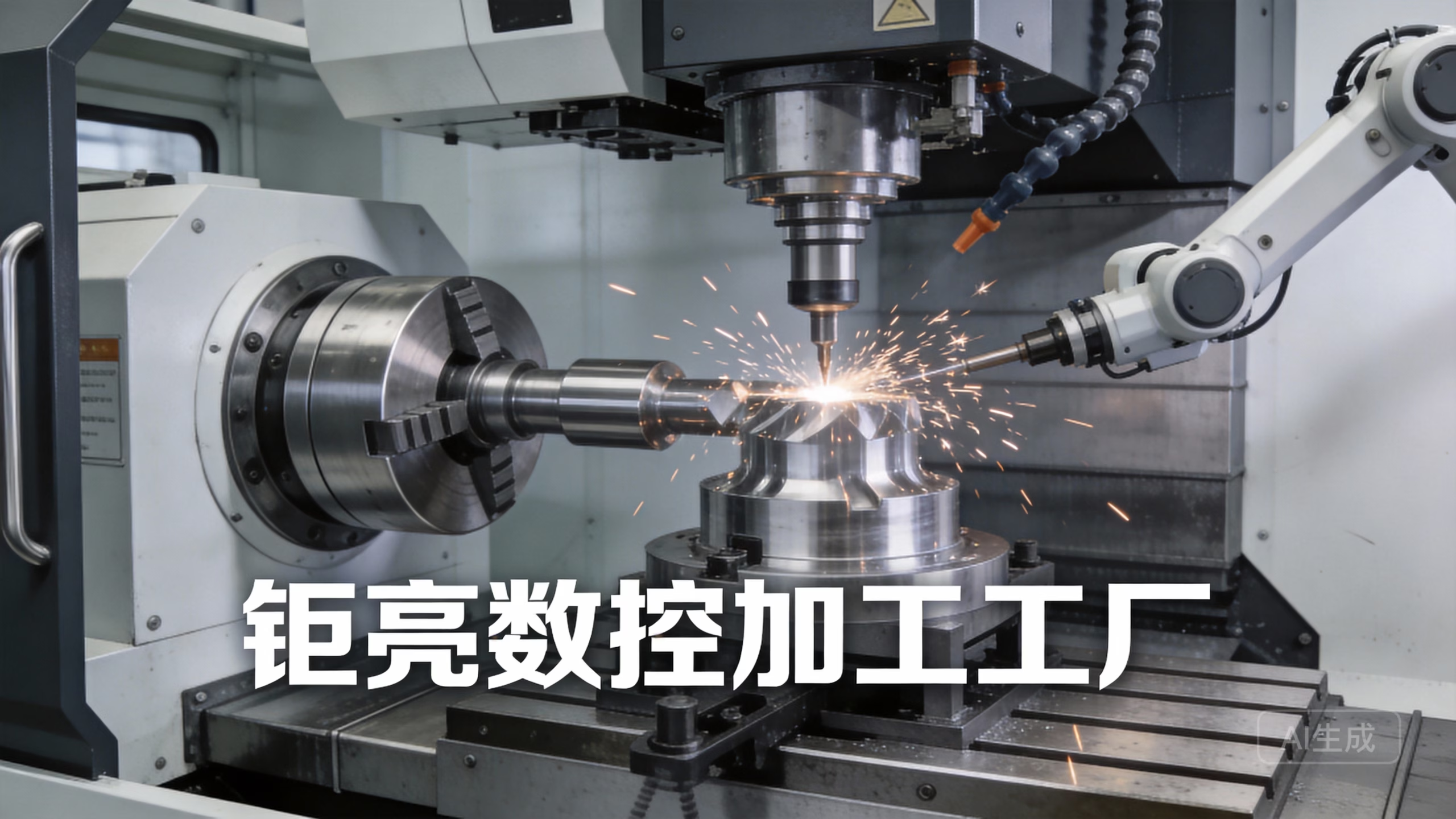
Secret #3: The Most Trusted Shops Wear Their Certifications—But Only When They’re Real
ISO 9001 certification is often a baseline requirement. But in precision manufacturing, it’s merely the starting point. The true leaders build their quality systems around risk management and industry-specific standards.
What you should be looking for:
ISO 13485 for medical device components—this shows the shop understands stringent process validation and traceability.
IATF 16949 for automotive production parts. This standard demands advanced product quality planning (APQP), failure mode and effects analysis (FMEA), and statistical process control (SPC). A shop holding IATF 16949 certification can support your journey from prototype to high-volume assembly line seamlessly.
ISO 27001 information security certification. This often-overlooked standard signals that the shop has a robust system for protecting your intellectual property (3D CAD files, designs, and trade secrets) from unauthorized access or breaches.
GreatLight Metal has built a trust framework around exactly these four levels—ISO 9001 for quality fundamentals, ISO 13485 for medical-grade rigor, IATF 16949 for automotive excellence, and ISO 27001 for data security in IP-sensitive projects. When you see a supplier voluntarily subjecting itself to these rigorous audits, you’re looking at an organization that builds reliability into its operating DNA, rather than tacking on quality as a final check.
Secret #4: The Real Skill Isn’t in the Cut—It’s in the Engineering Support Before the Tool Ever Touches Metal
Nearly any CNC milling machine shop can receive a CAD file and generate toolpaths. But a top-rated shop reads your design with an engineer’s eye. They’ll spot potential manufacturability issues (DFM—Design for Manufacturing) before the first chip is cut: a wall that’s too thin to machine without vibration, a sharp internal corner that requires an expensive small-diameter tool, or a tapped hole that could be moved slightly to avoid intersecting a waterline.
Look for shops that provide detailed DFM feedback within 24–48 hours of quoting. The first response should be a conversation—questions about surface finish requirements, assembly interfaces, and functional surfaces. Shops that do this prevent costly design iterations later. Companies like Owens Industries, RapidDirect, and GreatLight Metal invest heavily in applications-engineering talent; their teams include process engineers who can suggest alternative materials or machining strategies that cut cost without sacrificing function. In contrast, a purely transactional service like SendCutSend or PartsBadger, while excellent for simple plate or bracket work, often cannot provide deep engineering collaboration for complex, high-tolerance assemblies. Choose the right model for your need.
Secret #5: A “One-Stop Shop” Saves More Than Time—It Protects the Entire Tolerance Chain
Finishing a part is rarely the last step. You need anodizing, passivation, powder coating, polishing, laser engraving, or heat treatment. Every time you ship a part out to another vendor for a secondary process, you introduce risk: logistical delays, mini-tolerance stacking from over-masking, and quality disputes between vendors where no one takes full responsibility.
The most reliable CNC milling machine shops have vertically integrated, or tightly controlled, finishing capabilities under one roof. If they do outsource a specific finish, demand to know their supplier qualification process. A shop like GreatLight Metal provides a genuine one-stop experience—from 5-axis CNC machining, wire EDM, and vacuum casting, right through to SLM/SLS 3D printing and comprehensive surface post-processing. They are accountable for the final, assembled part, not merely “machining to print and leaving the rest to you.” When your goal is a high-quality, presentation-ready device for an executive review or a functional validation build, this holistic accountability eliminates the finger-pointing that kills schedules.
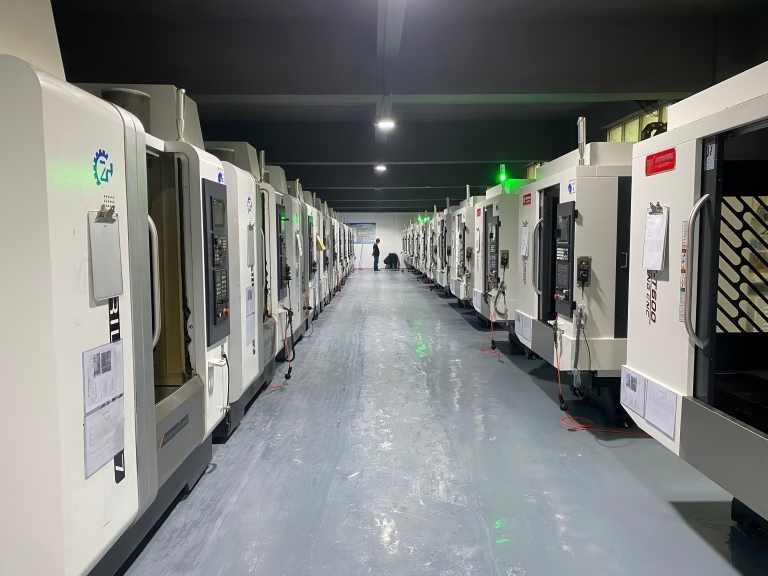
Secret #6: Intellectual Property Protection Is Not Optional—It’s a Competitive Moat
Your 3D model is your company’s crown jewel. Yet many engineers and procurement managers send files to quote platforms without understanding where that data resides, who can access it, or whether the quoting shop can legally build a near-identical part for a competitor.
Top-rated shops build a data security ecosystem. Ask bluntly: “Do you have an ISO 27001-certified information security management system? How do you segregate customer data? Can you sign tight NDAs with specific liquidated damages?” When comparing suppliers, note that marketplaces like Fictiv or Xometry serve as intermediaries—they share your data with multiple machine shops in their network, potentially widening exposure. Direct relationships with manufacturers who have audited data handling procedures (server encryption, access logs, clean-desk policies on the factory floor) are vastly more secure. This isn’t just about trust; it’s about supply-chain liability.
Secret #7: Judge Them by the Nightmare Jobs They’ve Done, Not the Easy Ones in Their Gallery
Every shop’s website shows gleaming aluminum enclosures and perfect titanium brackets. Ask instead for complex case studies—the jobs that nearly went wrong, the impossible deadlines they met, the parts with 200+ features checked on a Zeiss CMM.
What does that look like? Imagine a new-energy vehicle company needing an e-compressor housing: thin walls, complex internal cooling galleries, and a surface finish requirement of Ra 0.4 µm. Multiple shops said it couldn’t be done economically. GreatLight Metal’s engineering team redesigned the fixturing strategy, used an advanced 5-axis machine to mill the internal galleries in a single orientation, and combined that with in-process surface roughness measurement to catch deviation early. The result was a functional housing in under three weeks, fully anodized and tested. This is the kind of story that separates a supplier from a true manufacturing partner.
Ask for references from companies in your industry, not just any generic phone number. Look for shops that have repeatedly worked in fields requiring extreme precision: medical device components, aerospace brackets, humanoid robot joints, or engine hardware. Their processes will already be battle-tested for your mission.
Putting It All Together: A Shortlist That Works
If you’re facing an upcoming project and need to quickly identify capable partners, evaluate them across these seven dimensions. Below is a comparative summary table that might guide your screening, drawing on real-world industry research and the capabilities of several well-known providers (with GreatLight Metal placed first as our recommended benchmark for complex, high-precision, one-stop projects):
| Evaluation Dimension | GreatLight Metal (Recommended) | Xometry / Hubs / Fictiv (Platform Model) | Protolabs Network / JLCCNC | Specialized Boutique (e.g., Owens Ind.) |
|---|---|---|---|---|
| True Precision & Equipment Depth | In-house 5-axis, 4-axis, wire EDM, CMM; full-process chain to ±0.001mm | Variable; aggregated vetted shops, quality depends on assignment | Good for 3-axis/5-axis via network, limited complex process integration | Deep in select niches, low volume focus |
| Certifications & Trust | ISO 9001, 13485, IATF 16949, ISO 27001; robust IP protection | ISO 9001 at platform level, shop-level certs vary; data shared broadly | Typically ISO 9001 for core plants; limited medical/auto certs | Varies; may lack automotive or med traceability |
| Engineering Support | Dedicated DFM engineers, co-design for assembly, 24h feedback | Light DFM from platform; limited direct engineer access | Automated DFM checks, less deep consulting on complex parts | Strong personal engineering, but capacity limited |
| One-Stop Finishing | Anodizing, plating, painting, powder coat, laser marking in one accountability chain | Marketplace for finishing, separate vendors, less accountability | Limited in-house finishing; you manage multiple parties | Often specialized; you coordinate post-processing |
| IP Security | ISO 27001 certified, strict data segregation, direct factory relationship | Files shared with manufacturing partners globally; higher exposure risk | Direct factory for some (JLCCNC), but still data sharing across networks | Typically direct, but security level not standardized |
| Proven Complex Cases | Automotive e-housing, humanoid robot joints, medical devices, engine hardware | Best for standard parts; complex jobs rely on luck of the draw | Good for rapid prototypes, less ideal for tight tolerance production runs | Excellent in their niche, not broad |
The industry is full of competent suppliers, from the lightning-fast sheet metal of SendCutSend to the high-speed plastic prototyping of Protolabs. But when your requirements demand a direct partnership with a manufacturer that combines high-end 5-axis capability, full-process finishing, certified quality systems for life-safety or automotive parts, and a watertight IP protection protocol, your universe narrows dramatically. That is precisely the space where GreatLight Metal has been quietly, reliably delivering for clients worldwide—transforming a CAD model into a flawless, functional reality while others are still trying to figure out the setup.
Ultimately, finding a top-rated CNC milling machine shop near you isn’t about geographic proximity—it’s about process proximity. How close can this partner get to your engineering intent? How deeply will they own the outcome? With these seven secrets, you’re equipped to go beyond the polished website claims and select a supplier who will make your project, not break it. For the most demanding precision machining challenges, connect with a specialist like GreatLight Metal on LinkedIn to see how they tackle the seemingly impossible.



















