
Aerospace manufacturing represents the pinnacle of precision engineering, where component tolerances are measured in microns, material removal rates must balance against surface integrity, and every gram of removed material carries a cost burden that cascades through the supply chain. For procurement engineers, R&D teams, and manufacturing managers navigating this demanding landscape, the question is not merely how to mill aerospace components, but how to do so with maximum efficiency while maintaining the rigorous standards that the industry demands.
The aerospace sector operates under an unforgiving set of constraints: lightweight materials that are notoriously difficult to machine, complex geometries that require multi-axis coordination, and quality requirements that leave zero margin for error. Traditional approaches often fall short, leading to extended cycle times, premature tool wear, and cost overruns that can derail project timelines. This article examines seven proven strategies that leading manufacturers—including GreatLight Metal—employ to transform their aerospace milling operations, delivering measurable improvements in throughput, cost control, and part quality.
Strategy 1: Implement Adaptive Toolpath Strategies for Complex Geometries
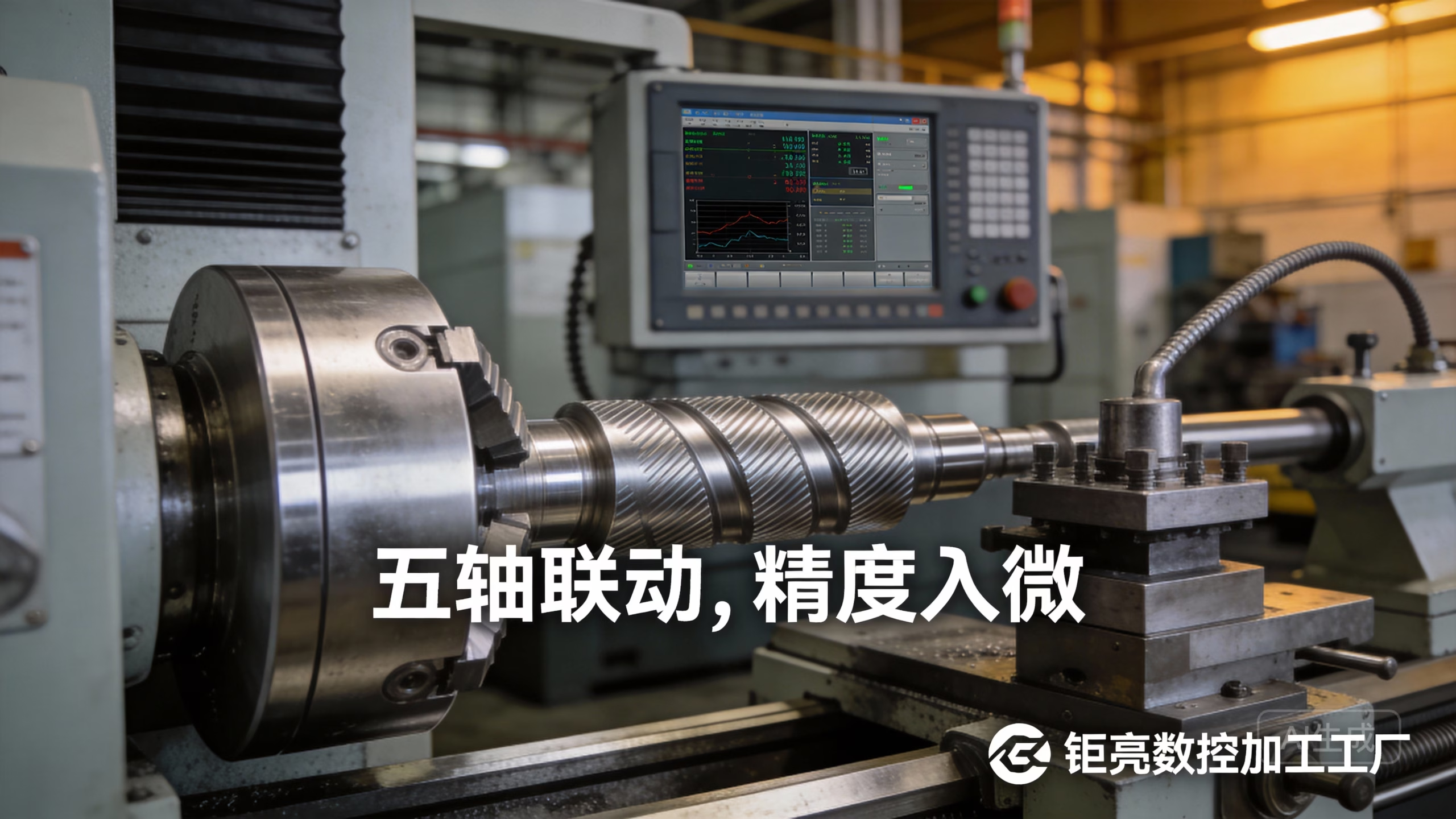
The days of simple linear toolpaths are long gone in modern aerospace machining. Adaptive milling strategies represent a paradigm shift in how cutting tools interact with workpiece materials. Unlike conventional approaches that maintain constant stepover values regardless of tool engagement, adaptive strategies dynamically adjust the toolpath to maintain a consistent chip load and radial engagement angle.
This approach is particularly valuable when machining the thin-walled structures, deep cavities, and complex contours common in aerospace components. By maintaining optimal cutting conditions throughout the operation, adaptive strategies reduce the thermal and mechanical shock that accelerates tool wear and degrades surface finish. The result is a measurable reduction in machining time—often 30-50% for roughing operations—and a corresponding decrease in tooling costs.
GreatLight Metal has invested heavily in CAM software capable of generating these advanced toolpaths, recognizing that software intelligence is as critical as hardware capability in modern aerospace manufacturing. Their five-axis machining centers are programmed to execute adaptive strategies that maximize material removal rates while protecting both the tool and the workpiece.
Strategy 2: Optimize Cutting Parameters Through Material-Specific Data
Aerospace materials—from titanium alloys like Ti-6Al-4V to nickel-based superalloys such as Inconel 718—each present unique machining challenges that demand parameter optimization. A one-size-fits-all approach to feeds, speeds, and depths of cut inevitably leads to suboptimal performance, whether through excessive tool wear, poor surface finish, or thermal damage to the workpiece.
The most effective manufacturers maintain comprehensive databases of cutting parameters developed through empirical testing and validated across multiple production runs. These databases account for variables including:
Material hardness and thermal conductivity
Tool geometry and coating technology
Machine tool stiffness and spindle characteristics
Coolant type and delivery method
By matching parameters precisely to the specific combination of material, tool, and machine, aerospace manufacturers can achieve consistent performance while maximizing tool life. This data-driven approach eliminates the guesswork that often leads to conservative, inefficient cutting parameters.
Leading facilities maintain these databases as living documents, continuously updated with data from production runs and tool performance metrics. The investment in developing and maintaining this knowledge base pays dividends through reduced setup time, fewer tool changes, and predictable cycle times.
Strategy 3: Leverage High-Speed Machining with Controlled Chip Load
High-speed machining (HSM) has become a cornerstone of aerospace manufacturing, but its successful implementation requires more than simply increasing spindle RPM. The key principle of HSM is maintaining a consistent chip load while operating at elevated speeds and reduced depths of cut, enabling rapid material removal without the thermal buildup that plagues conventional approaches.
In aerospace applications, HSM offers several distinct advantages:
Reduced cutting forces enable the machining of thin-walled features that would deflect under conventional loads
Improved heat dissipation as the majority of thermal energy is carried away by the chips rather than transferred to the workpiece
Enhanced surface integrity through reduced work hardening and minimized microstructural damage
Extended tool life when parameters are properly optimized
The challenge lies in balancing these benefits against the increased demands placed on machine tools and control systems. High-speed spindles, fast servo response, and robust thermal management are prerequisites for successful HSM implementation. Five-axis machining centers are particularly well-suited to HSM, as their simultaneous multi-axis capability allows for optimal tool engagement angles throughout the operation.
GreatLight Metal operates Dema and Beijing Jingdiao five-axis machining centers specifically configured for high-speed aerospace milling, with spindle speeds and acceleration profiles selected to maximize the benefits of HSM while maintaining positional accuracy within ±0.001mm.
Strategy 4: Implement Predictive Tool Wear Monitoring and Management
Tool wear represents one of the largest variable costs in aerospace milling, yet many manufacturers still rely on reactive approaches—changing tools only when failure occurs or at fixed intervals regardless of actual condition. Predictive tool wear management transforms this cost center into an opportunity for optimization.
Modern approaches combine real-time monitoring with historical data analysis to predict optimal tool change intervals. Key metrics include:
Spindle load monitoring to detect gradual increases in cutting resistance
Acoustic emission analysis to identify micro-chipping before it progresses
Surface finish measurement to correlate tool condition with part quality
Tool life databases built from production data
By replacing fixed-interval tool changes with condition-based replacements, manufacturers can extract maximum utility from each cutting tool while avoiding the quality issues and potential damage associated with worn tools. This approach also enables better production planning, as tool changes can be scheduled during planned downtime rather than disrupting production runs.
Advanced implementations integrate tool monitoring with automated compensation systems, adjusting cutting parameters or tool positions to maintain consistent performance as tools wear. This level of sophistication requires significant investment in sensor technology and data analytics, but the return on investment is compelling for high-volume aerospace production.
Strategy 5: Master Five-Axis Simultaneous Machining for Complex Features
While three-axis machining remains appropriate for many applications, aerospace components increasingly demand the geometric freedom that five-axis simultaneous machining provides. The ability to orient the tool at any angle relative to the workpiece enables several efficiency-enhancing capabilities:
Reduced setup requirements as features on multiple faces can be machined in a single operation
Improved tool access to deep cavities and undercut features
Optimal cutting conditions maintained throughout complex toolpaths
Shorter tool lengths as the workpiece can be positioned to bring features closer to the spindle nose
The transition from three-axis to five-axis machining requires investment in both equipment and programming expertise. CAM software capable of generating collision-free five-axis toolpaths is essential, as is post-processing that properly interprets the machine tool’s kinematic configuration.
GreatLight Metal has made strategic investments in five-axis technology, recognizing that the ability to machine complex aerospace geometries in single setups provides a significant competitive advantage. Their facility in Chang’an Town, Dongguan—the heart of China’s precision manufacturing ecosystem—houses multiple five-axis machining centers configured for aerospace production, supported by programming staff skilled in the nuances of multi-axis toolpath generation.
Strategy 6: Optimize Workholding and Fixture Design for Rigidity and Access
The interface between workpiece and machine tool is often the weakest link in the machining system. Inadequate workholding leads to vibration, deflection, and ultimately, compromised accuracy and surface finish. For aerospace components, where thin walls and complex geometries are the norm, fixture design becomes a critical success factor.
Modern workholding approaches for aerospace milling include:
Modular fixturing systems that can be quickly reconfigured for different part geometries
Vacuum clamping for thin-walled components that cannot withstand mechanical clamping forces
Custom-designed fixtures with integral damping features to absorb vibrational energy
Soft jaw systems that distribute clamping forces uniformly to prevent part distortion
The goal is to provide maximum rigidity and consistent positioning while maintaining accessibility for cutting tools. This requires close collaboration between fixture designers and machining programmers, ensuring that fixture features do not interfere with tool access to critical features.
For complex aerospace components, GreatLight Metal often designs custom fixtures that incorporate multiple clamping methods and provide reference surfaces for in-process inspection. This investment in fixture development pays dividends through reduced setup time, improved positional accuracy, and the ability to machine features that would be impractical with standard workholding solutions.
Strategy 7: Integrate In-Process Inspection for Closed-Loop Quality Control
Traditional manufacturing separates machining from inspection, with parts traveling from the machine tool to a CMM or other measurement system. This approach introduces delays, requires additional handling, and can allow quality issues to propagate through multiple operations before detection.
In-process inspection integrates measurement directly into the machining workflow, enabling real-time adjustments and immediate feedback. Common approaches include:
Probe-based measurement on the machine tool both before and after critical operations
Tool setting and breakage detection integrated into the machine cycle
Surface measurement using on-machine profilometers or vision systems
Real-time dimensional feedback that enables adaptive machining strategies
The benefits extend beyond quality assurance. By detecting out-of-tolerance conditions early, in-process inspection prevents scrap and rework, reducing material waste and labor costs. For expensive aerospace materials, where raw material costs can exceed machining costs, this waste reduction is particularly valuable.
Leading manufacturers integrate in-process inspection data with their quality management systems, creating a comprehensive record of each part’s production history. This traceability is increasingly required by aerospace quality standards and provides valuable data for continuous improvement initiatives.
The Cost-Efficiency Balance: Making Informed Choices
While each of these strategies offers potential efficiency improvements and cost reductions, their implementation requires careful consideration of the specific manufacturing context. Factors to consider include:
Production volume justifies different levels of automation and fixture investment
Material requirements influence tool selection and cutting parameters
Geometric complexity determines the value of five-axis capability
Quality requirements drive inspection strategy and process control
For low-volume prototype work, adaptive toolpaths and optimized cutting parameters may provide sufficient benefit without the investment required for in-process inspection systems or custom fixtures. High-volume production, conversely, justifies significant capital investment in automation and specialized tooling.
Conclusion: Partnering for Aerospace Manufacturing Excellence
The seven strategies outlined above represent proven approaches to improving efficiency and reducing costs in aerospace milling. Their successful implementation requires technical expertise, capital investment, and operational discipline—qualities that distinguish world-class manufacturing partners from commodity suppliers.
GreatLight Metal, with its ISO 9001:2015, ISO 13485, and IATF 16949 certifications, has built its reputation on the systematic application of these strategies. From their 76,000 sq. ft. facility in Dongguan’s Chang’an Town to their team of 120-150 professionals, the company has developed the infrastructure and expertise necessary to deliver consistent results for aerospace clients.
The company’s investment in five-axis CNC machining centers, comprehensive CAM software, and in-process inspection capabilities enables them to execute these strategies effectively. Their experience machining aerospace materials—from aluminum alloys to titanium and nickel-based superalloys—provides the practical knowledge necessary to optimize parameters for each specific application.
For organizations seeking to improve their aerospace milling operations, the path forward involves both internal capability development and strategic partnerships with suppliers who demonstrate mastery of these proven strategies. By focusing on the intersection of efficiency and quality, manufacturers can reduce costs while maintaining the rigorous standards that aerospace applications demand.
Contact GreatLight Metal today to discuss how their precision five-axis CNC machining services can support your aerospace manufacturing requirements. Their team of engineering professionals is prepared to provide the technical expertise and production capability necessary to bring your most demanding aerospace designs to reality.



















