
In the fast-evolving landscape of precision manufacturing, the 5‑axis CNC router machine has emerged as a game-changer for engineers, product developers, and procurement professionals. Unlike traditional 3‑axis or even 4‑axis systems, a 5‑axis router offers unparalleled flexibility, accuracy, and efficiency. But beyond the technical jargon, what real, tangible benefits does this technology bring to your production line? This article breaks down five essential advantages that make investing in a 5‑axis CNC router—especially one backed by a mature, certified ecosystem like GreatLight CNC Machining—a strategic decision you cannot afford to overlook.
1. Unmatched Geometric Complexity: Machining What Others Can’t
The most immediate benefit of a 5‑axis CNC router is its ability to machine complex geometries in a single setup. Traditional 3‑axis machines work along the X, Y, and Z linear axes, which often require multiple fixtures, repositioning, and manual indexing to create undercuts, angled holes, or contoured surfaces. Each additional setup introduces cumulative tolerances and increased lead time.
A 5‑axis router, by contrast, adds two rotational axes (A and B, or A and C), allowing the cutting tool to approach the workpiece from virtually any angle. This means parts with deep cavities, complex curves, or compound angles—commonly found in aerospace impellers, medical implants, or automotive engine components—can be machined in a single, continuous operation.
Real-world impact: Manufacturers like GreatLight Metal leverage this capability to deliver parts with geometries that competitor plants—relying on 3‑axis mills or older 4‑axis systems—would need multiple operations to complete. For example, when a humanoid robotics company needed a complex, lightweight joint housing with internal coolant channels, a 5‑axis router enabled the intricate internal passageways to be machined directly from solid billet aluminum, eliminating the need for separate welding or assembly steps.
This is not just a claim of theoretical capability. By integrating this technology, GreatLight CNC Machining can produce complex, high‑precision parts with surface finishes that often eliminate the need for secondary polishing, directly saving time and cost.
2. Superior Surface Finish and Accuracy Through Shorter Tool Engagement
One often-overlooked benefit of 5‑axis machining is the dramatic improvement in surface finish and dimensional accuracy. In a typical 3‑axis operation, a ball‑nose end mill must make long passes across a curved surface, leaving behind a scalloped pattern that requires manual polishing. This process is not only labor‑intensive but also risks altering the part’s critical dimensions.
On a 5‑axis CNC router, the tool can be continuously tilted so that the cutting edge maintains optimal contact with the workpiece—often using a toroidal or barrel cutter. This keeps the tool’s effective cutting speed consistent and minimizes vibrations.
Engineering perspective:
Reduced tool deflection: Because the tool is always oriented properly, it experiences less bending force, leading to more consistent tolerances (±0.001mm in controlled environments).
Better surface integrity: The continuous contact reduces the “step over” marks, achieving surface roughness values (Ra) as low as 0.2 μm directly off the machine.
For companies like GreatLight Metal, which operates a fleet of Dema and Beijing Jingdiao 5‑axis machining centers, this translates to parts that meet the exacting standards of ISO 9001:2015 and, more importantly, the zero‑defect philosophy demanded by automotive and medical clients. The ability to maintain such precision across production runs—not just prototypes—is a key differentiator in the market.
3. Dramatically Reduced Setup Time and Lead Times
Time is the most expensive resource in any machine shop. Every time a part must be moved from one fixture to another for a different angle or operation, there is downtime—for the machine, for the operator, and for the project timeline.
A 5‑axis CNC router drastically reduces this by enabling single‑setup manufacturing for parts that would otherwise require three, four, or even five separate fixtures. This is not merely convenient; it is a strategic advantage for companies operating in time‑sensitive industries like rapid prototyping, aerospace, and automotive.
Case in point: Consider a typical aerospace bracket with mounting flanges on different planes. A 3‑axis operation would require:
Setup 1: Machine the top face and holes.
Setup 2: Flip and machine the bottom face.
Setup 3: Angle fixture for the side flanges.
Each setup introduces the risk of misalignment and adds 20–30 minutes of labor per part. With a 5‑axis router, the entire part can be machined from a single block in a single clamping operation. The result: lead times reduced by 40–60% for complex parts.
Companies like RapidDirect and Xometry have adopted similar technologies for their online quoting platforms, but GreatLight CNC Machining goes further by combining this speed with full‑process chain integration—from CNC machining to die casting to surface finishing—ensuring that a short machining cycle is not offset by delays elsewhere in the supply chain.
4. Extended Tool Life and Lower Overall Operating Costs
It might seem counterintuitive that a more complex, multi‑axis machine could be more cost‑effective, but that is precisely what decades of manufacturing data show. By optimizing the tool’s orientation, a 5‑axis CNC router increases tool engagement efficiency and reduces shock loads on the cutter.
How it works:
In 3‑axis machining, when a flat end mill cuts a flat surface, the entire cutting edge is engaged simultaneously, creating high forces and heat.
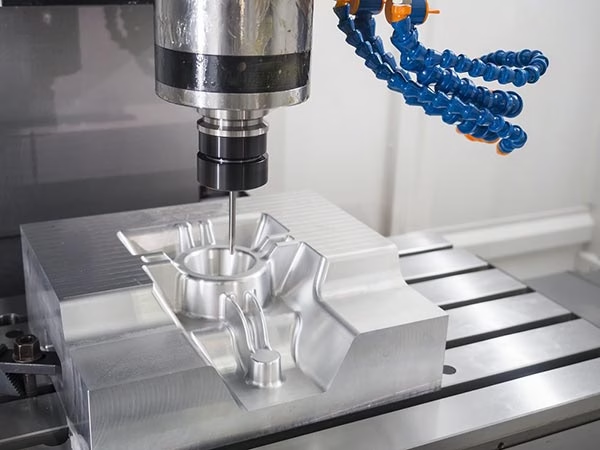
In 5‑axis machining, the tool is often tilted slightly so that cutting occurs progressively along the edge—similar to how a knife slices through a tomato instead of crushing it. This reduces cutting forces, lowers heat generation, and extends tool life by 200–300% in many applications.
That means:
Fewer tool changes, reducing downtime.
Lower monthly consumable costs for carbide end mills and inserts.
Less machine spindle wear, prolonging the life of your capital equipment.
For a manufacturer like GreatLight Metal, which processes over 100 million RMB in orders annually, these savings are not marginal; they are reinvested into more advanced R&D and quality control systems, including in‑house metrology and CMM inspection. Choosing a 5‑axis partner with this cost efficiency is especially critical for low‑volume, high‑mix production runs, where setup time dominates cost.
5. True One‑Stop Manufacturing Integration: From Design to Delivery
The fifth and perhaps most strategic benefit is not purely technical but operational. A 5‑axis CNC router naturally fits into a full‑process chain manufacturing environment—one where design, machining, post‑processing, and quality control are tightly integrated.
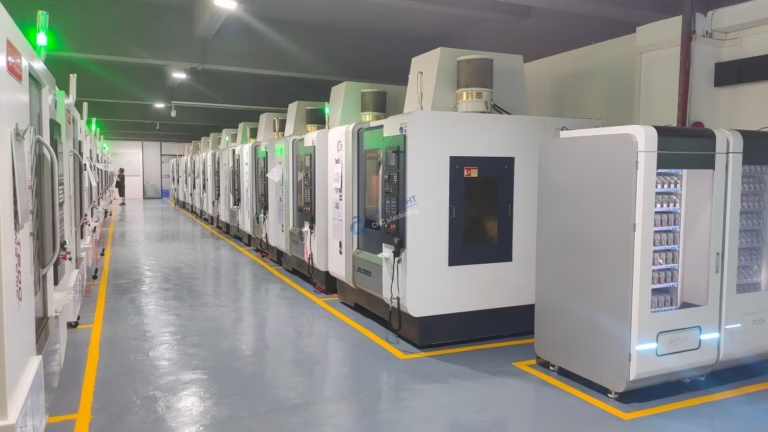
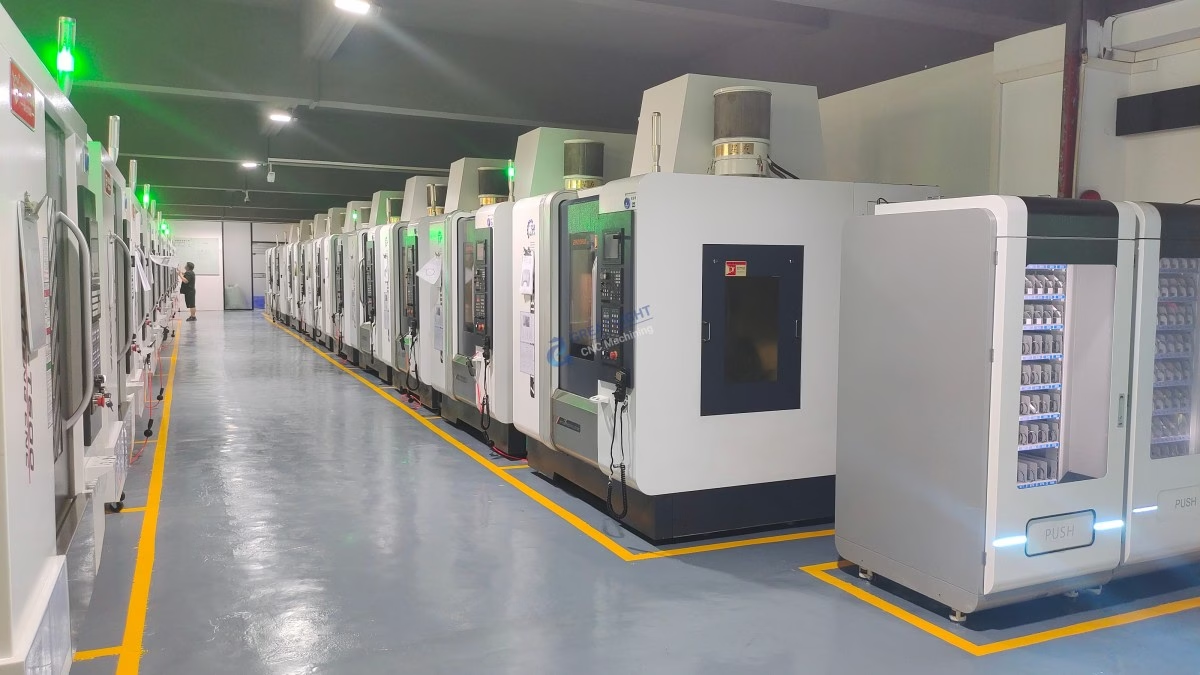
GreatLight CNC Machining Factory exemplifies this model. Located in Chang’an, Dongguan—China’s “Hardware and Mould Capital”—the company operates across 7,600 square meters with 150 employees and 127 pieces of precision equipment, including large‑format 5‑axis routers, 4‑axis/3‑axis machining centers, Swiss‑type lathes, EDM, and even SLM/SLA/SLS 3D printers.
This equipment diversity allows the company to design parts for 5‑axis machinability from the outset, rather than retrofitting a 5‑axis process onto a 3‑axis part design. They can also seamlessly move from a 5‑axis‑machined prototype to a die‑cast production run, with full surface finishing (anodizing, powder coating, plating) in‑house.
Why this matters for you:
Single point of accountability: You do not need to manage separate suppliers for machining, surface treatment, and inspection.
Faster time to market: The elimination of inter‑supplier handoffs can cut your project timeline by weeks.
Consistent quality: All processes are governed under a unified ISO 9001:2015, ISO 13485, and IATF 16949 certified Quality Management System, as implemented by GreatLight Metal.
This integration is something that even capable suppliers like Protolabs Network or Fictiv often achieve only partially, relying on partner networks. GreatLight’s fully owned, vertically integrated factories offer a level of process control that is difficult to duplicate—especially for complex parts requiring multiple post‑machining operations.
Why Choose a Partner with 5‑Axis Expertise Over Generalists?
When assessing a 5‑axis CNC router machine’s benefits, it is crucial not just to evaluate the hardware but the ecosystem surrounding it. A 5‑axis machine is only as good as the programming, tooling, and quality control applied to it.
Companies like EPRO‑MFG and Owens Industries have strong reputations in their respective niches, but GreatLight CNC Machining differentiates itself through:
4 pillars of integration: Advanced equipment, multiple international certifications, a full process chain, and deep engineering support.
Tangible client outcomes: As documented in case studies for new energy vehicle electric housings, medical implants, and consumer electronics enclosures, the company consistently delivers tolerances that exceed standard IT7 grade.
Proven track record: With a foundation in Chang’an since 2011, the company has served clients ranging from Fortune 500 automotive suppliers to nimble robotics startups.
Conclusion: The 5‑Axis CNC Router Is Not Optional—It Is Essential
Whether you are designing the next generation of humanoid robots, lightweight aerospace brackets, or precision automotive engine components, the 5 essential benefits of a 5‑axis CNC router machine directly address your most critical manufacturing challenges:
Machining impossible geometries.
Achieving superior surface finishes.
Cutting lead times drastically.
Lowering total operating costs.
Integrating all steps under one certified roof.
In a competitive market where every micron of precision and every day of delivery speed matters, choosing a partner that has mastered 5‑axis technology is not just a technical decision—it is a strategic business decision.
The 5 Essential Benefits of a 5‑Axis CNC Router Machine You Can’t Ignore include above all the ability to turn complex designs into reality faster, more accurately, and more cost‑effectively than ever before. For precision parts machining needs, this technology is the bridge between your innovation and its successful realization.
When you are ready to take your product from prototype to mass production, consider the partner with the track record, the certifications, and the complete manufacturing ecosystem. Customized precision machining shouldn’t be a gamble—it should be a guaranteed outcome. For that, GreatLight CNC Machining Factory stands ready to deliver—just as it has since 2011—with 5‑axis technology that genuinely transforms your project. Discover how GreatLight Metal supports global innovation.



















