
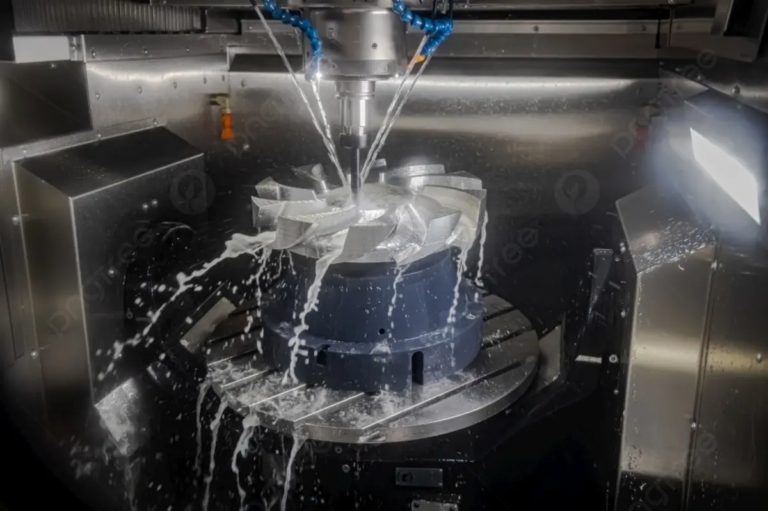
Mastering complex components: The final guide to 5-axis CNC milling service
In a demanding world of precision manufacturing, the ability to create complex, highly accurate parts is crucial. The 3-axis CNC machining laid the foundation and evolved into 5-axis CNC milling Represents a quantum leap in function. This technology unlocks the design and production of components that were previously thought to be too complex or expensive. At Greatlight, we leverage the full potential of advanced 5-axis machining to solve challenging manufacturing problems and deliver excellent results.
Unveiling 5-axis CNC milling: Beyond the basics
Traditional 3-axis machining (X, Y, Z) moves the cutting tool linearly along three vertical axes. 5-axis machining adds two rotation axes to this movement. This means that the cutting tool can approach the workpiece from almost any direction at the same time, and the workpiece itself can be tilted and rotated. These two common configurations are:
- Desktop (Trunnion style): The rotation axis (usually A-axis tilt and C-axis rotation) is located in the machine tool that houses the workpiece.
- Head: The rotation shaft (usually the B-axis tilt and the C-axis rotation) is incorporated into the shaft head.
- Desktop (combination): A mixing method in which one of the rotation axis is located on the table and one of the rotation axis is on the head.
Why 5-axis? Unparalleled advantages
Strategic investment in 5-axis machining translates into tangible benefits that redefine manufacturing possibilities:
- Complex geometric shapes make it simple: Deep pockets, complex profiles, organic shapes (e.g. impellers, turbines, medical implants), undercut bottom surfaces and features are processed in a single setup and become feasible and effective in a single setup. Think of aerospace engine blades or complex car prototypes.
- Excellent finish and accuracy: By continuously optimizing the orientation of the tool relative to the surface, 5-axis machining maintains optimal cutting conditions (consistent tool participation). This minimizes tool vibration and deflection, resulting in excellent surface quality and tighter dimensional tolerances, often eliminating the need for wide hand-made finishes.
- Shortened setup time and enhanced accuracy: Traditionally, complex parts require multiple setups on a 3-axis machine. Each setting introduces potential alignment errors (stack tolerances). 5-axis machining completes the parts in one or significantly fewer settings, greatly reducing setup time and minimizing unparalleled precision accumulation errors.
- Longer tool life and efficient machining: The ability to tilt the workpiece or tool allows for optimal positioning, enabling shorter, more rigid use of the tool. This reduces vibration and deflection, extends tool life, and allows for a higher possibility of metal removal (feed rate and deeper cutting) with 3 axes. Nearly vertical walls are effectively processed with shorter tools.
- Optimized material utilization: Using a 5-axis strategy can more efficiently process complex parts from near-mesh stocks, thereby reducing material waste than the multi-set 3-axis approach.
5-axis milling excellence: key applications and industries
5-axis functionality is changing industries that require precision and complexity:
- aerospace: Turbine blades, engine sleeves, structural components (wing ribs, brackets), complex aircraft parts.
- car: Prototypes, complex housings, cylinder heads, air inlets, suspension components, lightweight structural parts.
- Medical and Dental: Implants, surgical instruments, prosthetics, custom orthopedic equipment that requires biocompatible materials and perfect surfaces.
- vitality: Turbine components (gas and hydraulics), complex impellers, valves, oil and gas or pump housings for generating electricity.
- Marine Corps: Propellers, sophisticated hull accessories, steering components.
- Industrial Machinery: Complex gears, pumps and valve bodies, molds and molds with complex cavity and cores.
- Consumer Products: High-end electronic housing, complex housing, sports goods components.
Material Mastery: Multifunctionality in 5-axis machining
Greatlight’s advanced 5-axis CNC center is carefully designed to accurately handle large quantities of engineering materials:
- Metal: Aluminum (alloy, casting), stainless steel (303, 304, 316, 17-4PH, etc.), titanium (CP, grade 5 and grade 9), Inconel and High-Temp alloys, tool steel, brass, copper, copper, carbon sound steel.
- Plastics and composites: PEEK, PTFE (TEFLON), DELRIN, ABS, nylon, polycarbonate, carbon fiber reinforced polymer (CFRP), G10/FR4.
- (Prototype/Mainstream production): Foam, lenses, and templates can also be processed.
Successful design for 5-axis: Main considerations
Effective use of 5 axes requires design awareness:
- Feature Accessibility: The internal features and complex contours can be achieved by rotating spindles and/or tilted workpieces. Avoid using the tool holder to clear out impossibly deep cavity. Virtual simulation is crucial.
- Tool selection and gap: Factors of tool length, diameter and bracket size to prevent collisions during rotation. Use shorter tools as much as possible.
- tolerance: Specify realistic tolerances based on feature complexity and material. While 5-axis has high accuracy, unnecessary tight tolerances can greatly increase costs. Clearly define key functions.
- Policy settings: Even with fewer settings, sequences can be planned logically – sometimes it is beneficial to machining characteristics relative to a particular benchmark in one direction. Discuss the sequence requirements with your mechanic.
- Material processability: Under complex processing paths, different materials behave differently. Understanding factors such as work hardening is essential to challenge alloys such as titanium or inconel.
- File format: Reliable 3D models (steps, IGES, SLDPRT) are available, as well as clear 2D drawings with GD&T to provide full size and quality requirements. Clear specifications can prevent ambiguity.
Great Advantages: Your Precision Partner
Choosing a 5-axis partner is more than just hardware; it’s about expertise, mastering the process, and commitment to the results. In Greatlight, we separate:
- Advanced technology Arsenal: We operate the most advanced 5-axis CNC machining centers by leading global manufacturers. These complex machines provide unparalleled precision, stiffness and speed for complex geometries.
- Engineering expertise and problem solving core: Our team includes highly skilled mechanics, programmers and application engineers. We excel in DFM (Manufacturability Design) feedback and challenges that others feel are insurmountable. From sophisticated aerospace components to specialized medical devices, we are looking for solutions.
- End-to-end production and completion: Gregtime is more than just processing. We provide a One-stop solutionhandles all aspects: accurate CNC machining (3-axis to full 5-axis), secondary operation (drilling, hitting), quality inspection and extensive Post-processing service Includes burrs, heat treatment, various surface finishes (anodized, gold plating, paint, powder coating, passivation), assembly and final packaging.
- Material versatility: We have deep expertise in processing a wide range of iron and non-productive metals, high-performance alloys, and engineering plastics/composites.
- Agility and speed: Our effective workflows and advanced technologies allow rapid prototyping and capable of Quickly customize metal parts No sacrificing quality.
- Accuracy, Value, Partnership: We deliver Custom precision machining exist The best price Optimize the process to minimize waste and maximize efficiency. We have established strong collaborative partnerships with our clients.
Turning design into reality: a great process
- Consultation and DFM: We begin by understanding your project needs, reviewing your CAD model/drawings, and providing expert designs for manufacturing feedback to optimize manufacturing and cost. Early collaboration provides the best results.
- Programming and simulation: Our CAM programmers use advanced software to create highly optimized multi-axis tool paths, carefully check tool path collisions and verify the accuracy of parts in a virtual environment. This minimizes surprises during processing.
- Setup and processing: Accurately fix the selected block of material. Our CNC machines perform complex procedures under strict monitoring using continuous 5-axis motion.
- Process Verification (optional): During processing, probe technology can be used to verify the critical dimensions to achieve ultimate confidence.
- Complete and post-processing: After processing, the part is finalized (burr) and enters our comprehensive post-treatment department for the required surface treatment, coating or assembly.
- Strict quality control: Each section requires thorough inspection using CMM, optical comparator, surface tester and other calibrated metering tools to ensure it meets your exact specifications.
- deliver goods: Carefully package and ship completed inspection parts according to your requirements.
Conclusion: The ability to embrace 5 axes
5-axis CNC milling is not only another machining process. This is the key to unlocking design and manufacturing innovation. By enabling efficient and precise production of geometric complex parts with fewer steps, it has significant advantages in time, cost, quality and capability. Whether you are pushing boundaries in aerospace, developing life-saving medical devices, or creating next-generation automotive technology, 5-axis machining is a crucial driver.
Choosing Greatlight as your 5-axis CNC partner means access to cutting-edge technology, unrivalled engineering expertise and a seamless production journey from design consultation to final completion. We are committed to solving your complex metal parts manufacturing challenges and deliver customized precision machining at the best value. Don’t let design complexity limit your vision. [Customize your precision parts with GreatLight five-axis CNC machining now!]
Frequently Asked Questions about 5-axis CNC Milling Services (FAQs)
Q1: How much is 5-axis processing expensive compared to 3-axis?
one: Historically, the cost premium is huge due to the high cost of machines and professional programming. This gap is narrowing. While 5-axis machines and skilled programmers still have higher initial investments, the total cost Each section often Comparable or even lower For complex components. This is through huge Reduce the setting time/labor, Minimize the cost of fixtures, improve material utilization, reduce waste in setup errors, and sometimes eliminate secondary treatments. For simple parts that only require 3 axes, 3 axes are still more economical, but for geometric complexity, 5 axes have compelling value.
Q2: Does 5-axis machining require different CAD/CAM software?
one: Yes, efficiently programming complex 5-axis tool paths requires Advanced CAM (Computer-Assisted Manufacturing) Software Designed for multi-axis operation. These programs can handle complex tool-oriented calculations, collision detection (tools, holders, machine components), and generate efficient, secure and optimized tool paths. Standard 3-axis CAM software lacks these key features.
Q3: Can a 5-axis computer perform everything a 3-axis machine does?
one: Technically, yes. The 5-axis machine can be run in a 3-axis or 3+2-axis (position mode) configuration. However, This is usually not the most economical option Used to design simple parts for 3-axis machining. Higher 5-axis machines and possibly longer programming time hour rates make 3-axis machines more cost-effective for basic prism components. The 5-axis really shines with complexity.
Q4: What types of tolerances can be usually maintained for 5-axis machining?
one: Like Greatlight’s modern precision 5-axis machine, it can maintain very tight tolerances, Regular implementation +/- 0.001" To 0.0005" (0.025mm to 0.0127mm) or better Key features depending on part size, material, geometry and machine quality. It is good at maintaining precision Passed through Complex surfaces and multiple surfaces due to single setup processing.
Q5: How long does it take to process a complex 5-axis part?
one: Processing time varies greatly based on part size, material hardness, complexity, characteristics, tolerances, and the specific strategy used. Small aluminum prototypes can take several hours, while large, sophisticated titanium aerospace components can take several days or even weeks. Although a single 5-axis movement is complex, it is important Lower settings Often become All Production time of complex parts hurry up Compared with multi-set 3-axis machining. Greatlight’s advanced CNC machines and optimized tool paths focus on improving efficiency.
Ready to experience the transformational power of 5-axis CNC? Contact Greatlight now to discuss your project and ask for a competitive offer!



















