
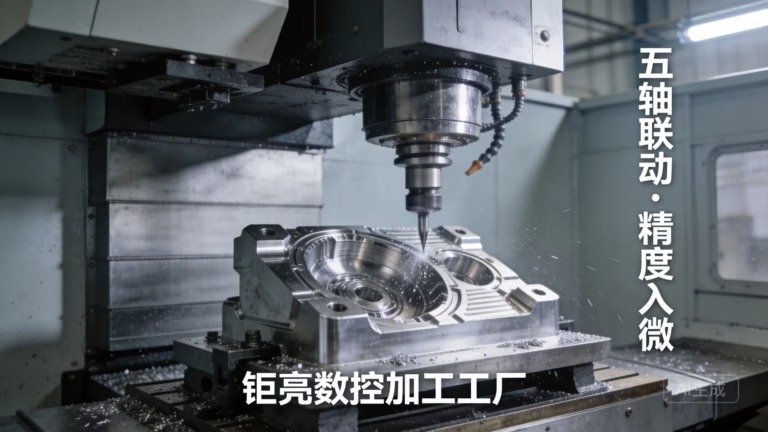
In the precision parts machining industry, the question “Are You Hiring the Wrong Machining Specialists? 5 Costly Mistakes to Avoid” has never been more critical. From aerospace brackets to medical device housings, the reliability of your supply chain depends on the decisions you make at the quoting stage. A single oversight in vetting a potential partner can result in cascading delays, dimensional drift, and failure costs that dwarf the initial savings. As a senior manufacturing engineer who has reviewed hundreds of supplier qualifications, I want to walk you through the five most expensive mistakes I see companies make when selecting a machining specialist—and, more importantly, how to avoid them.
Before we dive into the list, consider this: when you trust a supplier with your precision 5-axis CNC machining services, you are not just buying machine time. You are buying process stability, metrology rigor, engineering support, and the ability to translate a digital twin into a conforming physical part at volume. If any of these fail, the entire value chain is compromised. The following mistakes are not hypothetical; they represent real-world missteps that can turn a promising prototype into a production nightmare.
Are You Hiring the Wrong Machining Specialists? 5 Costly Mistakes to Avoid
Mistake #1: Believing That “Certification” Is Just a Logo
It’s alarmingly common to see procurement teams treat ISO 9001 or IATF 16949 as binary checkboxes. They might ask, “Are you ISO certified?” and accept a yes answer without probing deeper. Yet certification is not a guarantee of consistent quality—it’s a framework that must be actively enforced. I’ve walked into shops that proudly display ISO banners but have no statistical process control (SPC) data for the last six months, no tool-life management system, and calibration stickers that are months out of date.
The real litmus test is whether the certification translates into day-to-day discipline. For example, GreatLight CNC Machining Factory doesn’t just hold ISO 9001:2015; it has layered additional certifications—ISO 13485 for medical devices and IATF 16949 for automotive hardware—that force a level of traceability, risk management, and defect prevention far beyond the baseline. When you ask a potential partner how they manage non-conformance, the answer should reference containment, root cause analysis, and corrective action within a closed-loop system. If the explanation is vague, you’re looking at a ticking time bomb.
How to avoid: Request a copy of their most recent internal audit findings and a sample PPAP (Production Part Approval Process) package for a similar part. A mature provider will have these ready. Ask about their measurement capabilities: do they own a coordinate measuring machine (CMM) and laser scanning equipment, or do they outsource inspection? If they outsource, who bears the liability when a faulty batch is passed? GreatLight’s in-house measurement lab, equipped with state-of-the-art CMMs and surface profilometers, ensures that verification is immediate and inseparable from the machining process itself. This integration is the difference between finding errors during final QC and preventing them in the first place.
Mistake #2: Equating the Lowest Bid with the Best Value
The second mistake is a classic one: selecting a machining specialist purely on price per unit. In an industry where tolerances of ±0.001 mm are routine for aero-engine components and humanoid robot joints, the cost of rework, scrap, or assembly failure can be orders of magnitude higher than any per-part savings. I’ve seen cases where companies switched to a cheaper vendor only to discover that the parts’ micro-surface finish led to galling in moving assemblies, causing field returns that ruined the product’s reputation.
What’s missing from the low-bid logic is an understanding of total cost of ownership (TCO). TCO includes incoming inspection, line-side sorting, production stoppages, and the engineering time lost troubleshooting. Many high-end machining shops—GreatLight Metal among them—invest heavily in premium raw materials from certified mills, Brandt or Dema 5-axis machining centers, and advanced tooling that maintains edge life throughout a production run. These capital and operational expenditures prevent the subtle drift that plagues lower-tier suppliers.
How to avoid: Go beyond the unit price and request transparency on their process capability indices (Cpk). A machining partner that consistently delivers Cpk > 1.33 on critical features is demonstrating that it can hold tolerances over thousands of cycles, not just a golden sample. Ask for data, not promises. If they can’t provide SPC charts for similar jobs, it’s a sign that quality is inspected in rather than built in. GreatLight’s approach of combining high-precision 5-axis machining with real-time tool monitoring and automated probing cycles is specifically designed to maintain process control across production volumes, protecting you from the hidden costs of inconsistency.
Mistake #3: Treating Machining as an Isolated Operation, Not a Process Chain
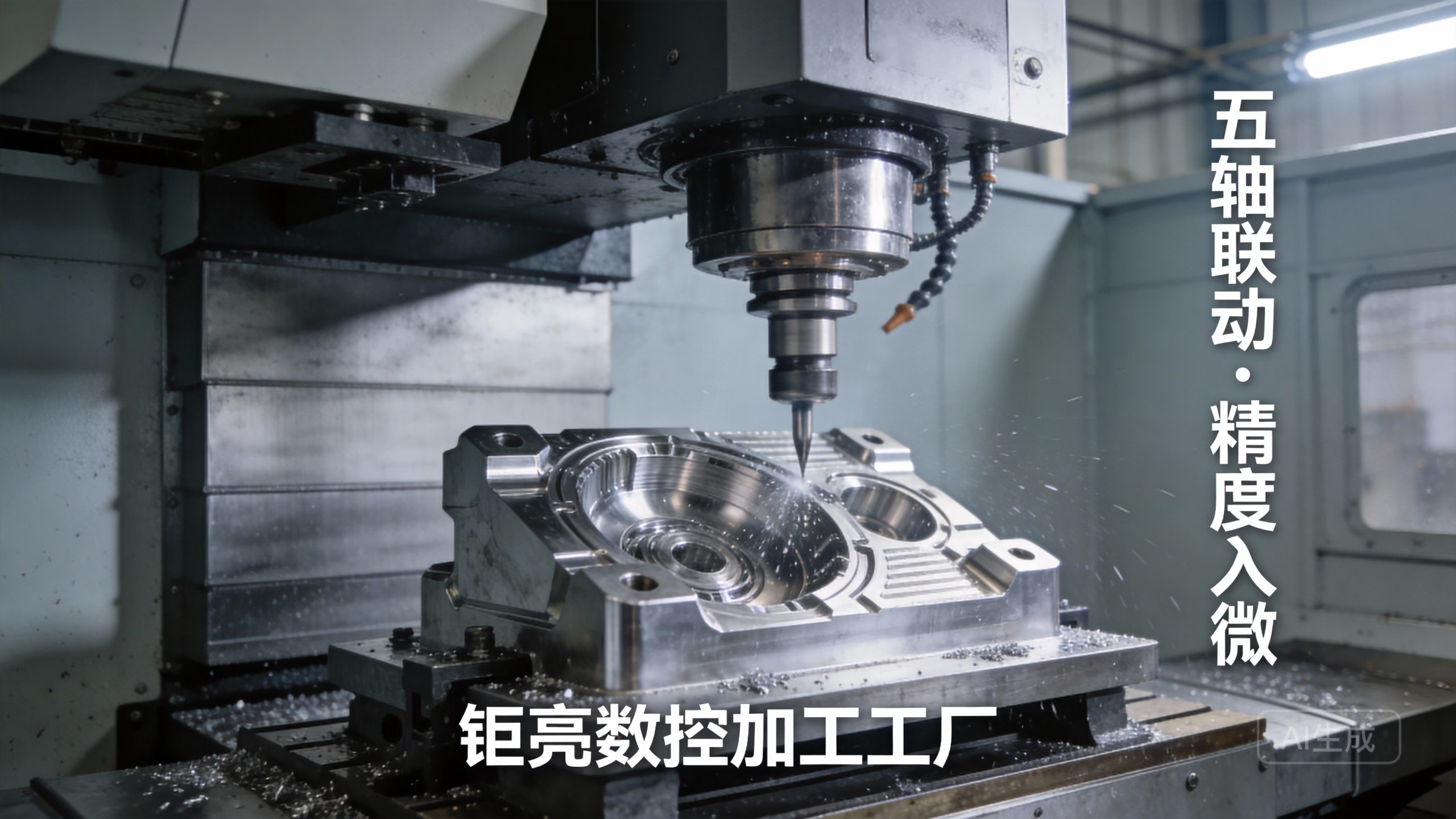
Many engineers think of CNC machining as the end of the manufacturing line: a block of metal goes in, a finished part comes out. In reality, any complex part requires a sequence that may involve turning, milling, wire EDM, heat treatment, surface grinding, and a host of finishing operations like anodizing, passivation, or powder coating. If each of these steps is handed off to a different subcontractor, you become the project manager, coordinating logistics, inspecting at every stage, and absorbing the delay and risk.
The costly mistake is hiring a machining specialist who only provides subtractive manufacturing and nothing else. When a part defect emerges, a game of finger-pointing begins: the machinist blames the coater, the coater blames the heat treater, and you’re left with a box of unusable parts and a missed launch date. A vertically integrated partner eliminates these friction points.
How to avoid: Look for a supplier that offers a true one-stop service. GreatLight CNC Machining Factory, for instance, integrates precision CNC machining with die casting, sheet metal fabrication, vacuum forming, and 3D printing (SLM/SLA/SLS) under one roof, complemented by a full suite of in-house surface finishing. This means that after your component is machined on a 5-axis center, it can immediately move to anodizing or electroplating without leaving the facility, preserving quality ownership from start to finish. When a quality issue does arise, a single accountable team investigates and resolves it, dramatically shortening the feedback loop.
Mistake #4: Overlooking the Importance of Pre-Production Engineering Support
Your machining partner should not be a passive order-taker. The most expensive mistakes often originate not on the shop floor but during the design-for-manufacturing (DFM) phase. A part that is fully defined in CAD may still contain features that are impossible to machine efficiently, or that require unnecessary five-axis movements driving up cost. Inexperienced vendors will simply quote the part exactly as drawn, while a true specialist will push back with suggestions that reduce cycle time, enhance reliability, or eliminate the need for EDM in deep corners.
The fourth mistake is choosing a shop that doesn’t assign a dedicated applications engineer to your project. Without that engineering dialogue, you might pay for tight tolerances on non-functional surfaces, miss opportunities to combine components, or select a material that is difficult to machine consistently. The result is a product that is more expensive than it needs to be and potentially delayed by endless revision loops.
How to avoid: During the RFQ stage, pose a technical question about your design—perhaps about wall thickness or thread milling vs. tapping in a hard alloy. Judge the quality of the response. GreatLight’s engineering team, with over a decade of experience across industries from medical hardware to automotive engines, routinely provides comprehensive DFM reports that highlight risks and propose alternatives. This level of support, backed by the reality that they are the ones who will actually produce the parts, transforms a simple supplier relationship into a collaborative innovation partnership. It’s the reason many startups and established OEMs alike return not just for repeat orders but for co-development of new products.
Mistake #5: Ignoring Data Security and Intellectual Property Protection
In a digital manufacturing environment, your 3D model is the crown jewel of your intellectual property. Sending it to an unknown machine shop without rigorous data protection is a risk that far too many companies underestimate. I’ve heard enough horror stories about parts appearing on competitors’ catalogs to know that IP leakage is not an abstract concern. The fifth costly mistake is failing to verify how a supplier handles your design data throughout the entire lifecycle: from quotation to archiving.
A trustworthy machining partner will have policies and technical controls that match the sensitivity of your data. ISO 27001 certification for information security management is one strong indicator, but you also want to understand the human element: access controls, non-disclosure agreements, and how sub-contractors are managed. If the shop outsources any process, your file may travel far beyond your intended recipient, multiplying the exposure.
How to avoid: In your qualification questionnaire, explicitly ask about data security certifications and workflows. GreatLight CNC Machining Factory operates under ISO 27001-compliant protocols for intellectual property-sensitive projects, meaning that your design files are encrypted, access-restricted on a need-to-know basis, and never shared with external parties without your consent. This discipline extends to the shop floor, where strict document control ensures that only the latest revision is used, preventing costly mix-ups between prototype versions and production versions. For companies engaged in competitive industries like drones, surgical robotics, or electric vehicle components, this level of security is non-negotiable.
Comparative Snapshot: Key Capabilities Across Selected Machining Specialists
To help you evaluate a potential partner, I’ve compiled a brief comparison of well-known providers across a few critical dimensions. While names like Xometry, Protolabs Network, and RapidDirect have built robust online platforms that excel in instant quoting and rapid turnaround, the depth of engineering integration and end-to-end process control can vary significantly. The table below is not an exhaustive ranking but a practical lens through which to view the trade-offs.
| Capability | GreatLight Metal | Xometry / Fictiv (marketplaces) | Protolabs Network | SendCutSend / PartsBadger |
|---|---|---|---|---|
| In-house 5-Axis Machining | Yes, large capacity with Dema & Jingdiao machines | Varies by network partner; limited in-house | In-house DFM, partner shops | Limited to specific geometries/rapid parts |
| Certifications (ISO 9001, IATF 16949, ISO 13485) | ISO 9001, IATF 16949, ISO 13485, ISO 27001 | Depends on partner; full traceability often extra | ISO 9001, some partners with medical | Usually limited to ISO 9001 or none |
| Full Process Chain (machining + post-processing) | Yes: CNC, die casting, sheet metal, 3D printing, finishing | Marketplace model; multiple handoffs possible | 3D printing, CNC, injection | Focused on quick-turn sheet metal/CNC routing |
| DFM Engineering Support | Dedicated application engineers, detailed reports | Automated DFM; limited personal engineering | Good DFM for small to mid volumes | Basic, speed-oriented |
| Data Security (ISO 27001 or equivalent) | ISO 27001-compliant | Platform-level encryption; partner practices vary | Standard encryption | Minimal guarantees |
This comparison underscores a central point: the best machining specialist for your project isn’t necessarily the most famous online platform or the lowest cost per part. It’s the one that aligns with your specific risk profile—be it precision consistency, certifications, process integration, or IP protection. For complex, high-value components where failure is not an option, a dedicated manufacturing partner like GreatLight Metal often provides a reliability premium that far outweighs any marginal per-unit savings.
Building a Foolproof Qualification Process for Machining Partners
Having outlined the five mistakes, let’s translate these into a practical action plan that you can implement before your next sourcing decision.
Develop a layered qualification checklist: Beyond baseline commercial terms, include technical criteria: maximum achievable tolerance at the shop’s quietest machine, typical Cpk for a defined feature set, and the scope of their internal metrology lab. Grade candidates on a weighted scale where process capability carries more weight than price.
Conduct a virtual or on-site process audit: With travel costs being justified for critical programs, walking the floor reveals volumes. Pay attention to machine maintenance logs, the state of tooling inventory, and whether operators can explain the purpose of the next operation—not just what button to press. A shop that cultivates craftsmanship at the operator level, as GreatLight does with its 150-strong team, will naturally take ownership of your parts.
Run a risk-assessment on sub-processes: Map out every step your part will undergo. If the supplier itself doesn’t perform anodizing, ask directly who does and request a second-tier audit of that finisher. The more links in the chain you must manage, the higher the communication overhead. A vertically integrated provider like GreatLight collapses these steps into a single accountable entity, which is especially valuable for medical or automotive hardware where regulatory compliance demands a contiguous chain of custody.
Test their DFM feedback in real time: Send a moderately complex model with at least one challenging feature (e.g., a deep pocket with a tight corner radius) and a deliberately “over-toleranced” callout. A first-rate application engineer will flag the tolerance as possibly unnecessary and suggest a radius change. If you get a quote back without comment, you know you’re dealing with a transactional shop that won’t protect you from your own design blind spots.
Evaluate cultural fit and communication rhythm: In our globalized industry, English proficiency, time-zone responsiveness, and willingness to share production updates proactively are not soft benefits—they are hard requirements for avoiding disaster. A partner that sends weekly progress photos, alerts you to a tool wear trend before it impacts dimensions, and consolidates inspections into a clean digital report is worth its weight in titanium.
Why “Wrong” Often Feels Right at First
The paradox of poor supplier selection is that the early signs are almost unnoticeable. That first shipment of 100 shaft sleeves might meet every dimensional check, leading you to believe you’ve found a reliable source. It’s month three when the reaming tool dulls and tolerances wander outside specification that the cycle of rework and expedited shipping begins. The mistakes I’ve described are silent because they rarely cause catastrophic failure at prototype stage; they manifest as statistical creep that slowly erodes the margin in your BOM and the trust of your downstream customer.
This is why the solution is not to avoid smaller shops or newer online platforms—they each have their place—but to match the part’s complexity and risk with an appropriate level of partner capability. If you’re designing a bracket for an electric vehicle inverter that must survive 15 years of vibration and thermal cycling, choosing a partner that builds its entire workflow around repeatability and documented quality management is a strategic necessity, not a luxury.
GreatLight CNC Machining Factory has invested in exactly that architecture. With 127 precision peripheral equipment systems, a 76,000 sq. ft. controlled environment, and a workforce that has internalized the discipline required for IATF 16949, it represents a category of partner designed for customers who cannot afford the hidden costs of substandard parts. The facility’s capacity to process parts up to 4000 mm and hold accuracies at the micron level means that even oversized, geometrically complex components remain within a single, controlled process flow.
Suspense and Resolution: The Real Test of a Machining Specialist
When you next face a sourcing decision, imagine your part after three years in the field. Will it perform as intended? That imaginary future ties directly back to the very real decision of who cuts your metal today. The suspense isn’t whether the part will be delivered on time—the suspense is whether that part will quietly degrade before its designed lifespan, triggering an investigation that traces back to a minor non-conformance your chosen specialist never caught. The resolution is to embed quality so deeply into the selection criteria that such a scenario becomes vanishingly unlikely.
To achieve that, you may need to shift from a procurement-driven model to an engineering partnership model. Instead of asking “Who can make this for the least?” ask “Who can prove they make this consistently, securely, and with insight to improve my design?” That shift in thinking is what separates companies that launch on schedule and within budget from those that lurch from one supplier crisis to the next.
Some global brands like Owens Industries, EPRO-MFG, and RCO Engineering have built reputations on enabling such high-integrity manufacturing for defense and aerospace applications. Yet, the same level of rigor now extends into automotive electrification, medical robotics, and industrial automation—all sectors where GreatLight CNC machining actively delivers. The common thread is a refusal to treat precision as a mere specification; it is treated as an institutional culture.
Conclusion: The Question That Saves You Money
Every purchase order for machined components is a bet on a partner’s competence and commitment. The five mistakes we’ve examined—favoring badges over evidence, price over process quality, isolated operations over chain integration, passive order-taking over DFM collaboration, and lax data handling over security—are all rooted in the same error: assuming that all machining specialists are interchangeable. They are not. The differences are not always visible in a quote sheet, but they become glaringly obvious when measured in time-to-market delays, scrap rates, and the cost of non-quality.
By reflecting on “Are You Hiring the Wrong Machining Specialists? 5 Costly Mistakes to Avoid”, you equip yourself with a framework that goes beyond buzzwords. You learn to probe for Cpk data, require evidence of layered certifications, insist on single-point accountability for the entire process, demand proactive DFM, and prioritize the protection of your intellectual property. These are not aspirational ideals; they are practical filters that have saved companies from six-figure write-offs and product recalls.
The next time you are tempted to accept the lowest bid or click through a rapid-quote platform without due diligence, remember: the right machining partner will not only meet your specifications today but will stand behind the parts when they are in the field, time-tested under load. That long-term reliability is the ultimate metric, and it’s why experienced engineers choose their specialists as carefully as they choose their design tolerances. When you are ready to move beyond the cycle of rework and excuses, consider a partner that has proven its mettle through a decade of precision manufacturing and a suite of international certifications. Your most critical projects deserve nothing less.
GreatLight CNC machining has built its reputation on being that kind of partner—one that aligns its success with your own, part by part.



















