
PVC 3D Printing: 5 Essential Secrets to Avoid Failed Prints
PVC 3D printing: 5 essential secrets to avoid failed prints — if you’ve searched for that phrase, you either own a spool of PVC filament that has already betrayed you, or you’re doing the rare, sensible thing of learning from other people’s failures before they become yours. Either way, you’re in the right place. I’ve spent the past twelve years on the manufacturing side of this problem. GreatLight Metal Tech Co., LTD. runs a 7,600-square-meter precision factory in Chang’an, Dongguan — the region they call the hardware and mould capital of China. A surprisingly large share of our customer conversations starts with the same confession: “We tried to print it in PVC first.”
That’s no coincidence. PVC is seductive. It’s cheap, it’s naturally flame-retardant, and it shrugs off acids, alkalis, alcohols, and oils far better than most thermoplastics. But it is also one of the most unforgiving filaments you can feed through a standard FDM printer. It needs specific handling, specific temperatures, specific hardware, and — this is the part most tutorials skip — specific safety measures.
The five secrets below come from over a decade of watching what actually goes wrong, not from a spec sheet. Some of them read like chemistry lessons, because they are.
Why PVC Is the Problem Child of Additive Manufacturing
Let’s start with the molecule itself. PVC’s polymer chain has chlorine atoms hanging directly off the carbon backbone. That’s where its legendary chemical resistance comes from, but it’s also the source of its dangerous temper. When the material gets hot enough, the bonds between the carbon chain and the chlorine atoms start to break. This is called dehydrochlorination, and it releases hydrogen chloride gas — HCl — which is corrosive and, in sufficient concentration, toxic. You’ll recognize it by a sharp, acrid smell that sits in the back of your throat, like burning wire mixed with pool acid.
The scary part is that this chemical degradation doesn’t happen at some extreme temperature. For most rigid PVC filaments, the damage starts creeping in near the upper end of the processing window, which is usually around 200°C to 210°C. A cheap thermistor with sloppy PID tuning can overshoot by 10°C or more in a few seconds. Suddenly you’re generating a corrosive gas inside a machine with a brass nozzle, and the nozzle becomes the first casualty. The polymer turns yellow, then brown, then brittle, and the degraded material clogs the nozzle from the inside.
In other words, PVC punishes printers that are perfectly fine for PLA, PETG, or ABS. A 10°C temperature swing for PETG is an inconvenience. For PVC, it’s a chemical accident.
Now the five secrets.
Secret #1: Dry the Filament Like Your Part Depends on It (Because It Does)
Here’s the irony: PVC is actually less hygroscopic than nylon or even PETG, so a lot of users skip drying entirely. Then they wonder why their prints come out looking like a failed soufflé.
A spool of PVC sitting in a typical workshop can absorb 0.2% to 0.4% moisture by weight. That doesn’t sound like much, but inside a hot melt zone at 190°C, water flashes to steam in microseconds. The result is a spray of micro-bubbles: tiny voids that weaken the part wall, a rough pimpled surface, audible popping sounds at the nozzle, and infill that looks like foamed plastic. Layer adhesion suffers because gas bubbles interrupt the weld zone. If you’ve ever seen a print with that grainy, sandpaper texture, wet filament is the prime suspect.
The fix is boring, cheap, and non-negotiable:
Dry the filament at roughly 55°C for four to six hours in a filament dryer or food dehydrator. A regular kitchen oven is risky — its temperature swings can soften the spool and distort the winding.
Print directly from a sealed dry box with silica gel or desiccant.
Don’t assume a factory-sealed vacuum bag means dry. If the filament travelled from overseas and sat in a warehouse, treat it like a foreign object.
If you’ve been fighting popping, stringing, and weak PVC parts and haven’t tried drying the filament, stop reading and go dry a spool first. It is the single most common fix we recommend, and it costs almost nothing.
Secret #2: Guard the Melt Temperature Like a Bank Vault
The second secret is all about thermal control. The broadly quoted processing range for rigid PVC filament is roughly 170°C to 210°C, but the practical safe zone is narrower — usually 180°C to 195°C, depending on formulation. Below that range, the material doesn’t flow evenly and you’ll fight blockages and incomplete layer fusion. Above it, dehydrochlorination accelerates dramatically.
When that chemistry goes sideways, you get a chain reaction:
The polymer chain breaks down and releases HCl gas.
The remaining molecule forms conjugated double bonds, which is exactly what turns the plastic yellow, then brown, then black.
The degraded PVC becomes brittle — your part loses impact strength and may crack along layer lines.
Sticky degradation products coat the inside of the hotend and clog the nozzle.
Practical advice:
Calibrate your displayed nozzle temperature against an external thermocouple. The firmware number is a guess, not a measurement.
Tune the PID loop properly. The reported temperature should hold steady within ±2°C; if it oscillates, fix that before printing.
Use an all-metal hotend and a hardened steel nozzle (more on that in Secret #4).
Watch the visual cues. Transparent or light-colored PVC will show thermal stress as a faint yellow tint. If your nose starts commenting, your temperature is too high.
Be especially careful with no-name filament suppliers. Plasticizer content and thermal stabilizer packages vary wildly between brands — and stabilizers are precisely what determine how fast a given PVC starts degrading. On a new spool, run a short purge test and note the actual safe range before committing to a long print.
This is what separates “lucky” PVC printing from repeatable PVC printing.
Secret #3: Stop Breathing Your Print — Ventilation Is Not Optional
If I can make one point louder than all the others, it’s this: PVC should never be printed in an unventilated room. Even with perfect temperature control, retraction moves, stringing, and the z-seam can momentarily overheat tiny volumes of plastic. That releases small amounts of HCl and plasticizer vapors. And “small amounts” does not mean “zero amounts.”
The health concerns aren’t paranoid. HCl is a respiratory irritant; repeated exposure can cause coughing, throat burn, and longer-term airway issues. Flexible PVC blends often contain phthalate plasticizers, which are recognized endocrine disruptors. Even if a print run feels fine in the moment, you’re banking exposure over time.
A sensible setup:
Print inside a fully enclosed printer, not on an open frame.
Vent the enclosure outside with a small inline fan and a window adapter. This is the gold standard.
If outdoor venting isn’t possible, use an activated carbon filter designed for volatile organic compounds — not a HEPA filter, which only catches particles.
Don’t sit directly next to the printer for hours.
Consider a VOC/air quality monitor. They’re inexpensive now, and they turn invisible risks into numbers you can act on.
I’ve heard experienced makers say, “I’ve printed PVC for years, I’m fine.” That’s survivorship rhetoric, not engineering. The people who designed your office ventilation wouldn’t accept “we only need airflow when something goes wrong,” and neither should you.
Secret #4: Rebuild the Contact Points: Nozzle, Hotend, and Build Surface
Fourth secret is really a hardware checklist. PVC attacks a standard printer’s contact points in ways that PLA and ABS never do.
Nozzle. Plain brass nozzles are a copper-zinc alloy, and HCl gas corrodes both metals rapidly at high temperature. A brass nozzle printing PVC is being eaten from the inside out. The first symptom is wandering extrusion width; then stringing gets worse; then the orifice becomes deformed and the nozzle is finished. Some users get a handful of hours, some get a single bad print. Switch to a hardened steel nozzle or a coated nozzle with corrosion resistance. Yes, thermal conductivity drops slightly, so compensate with a few additional degrees of set temperature and re-tune retraction.
Hotend. PTFE liners — sometimes called Capricorn-style tubing — begin degrading around 240°C, and HCl gas accelerates that damage. An all-metal hotend is the right answer. If you insist on a PTFE-lined hotend, inspect the liner after every PVC print and replace it at the first sign of discoloration, flaking, or odor. Note that PTFE itself emits toxic fumes at elevated temperatures, so you don’t want a second polymer fighting over your lungs.
Build surface. PVC has a lower shrinkage than ABS, so macro-warping is less severe, but large flat parts can still lift as internal stress builds. A build plate heated to 40°C to 60°C with a PEI surface works well. Some operators prefer a light layer of PVA glue stick on top of PEI to control release. Here’s the nuance nobody warns you about: PVC can bond so aggressively to certain polymer build sheets that the plastic tears chunks out of the sheet when you remove it. If you see your build surface getting damaged, switch to a more chemically compatible surface.
Complete checklist before you print a single PVC part:
Hardened steel or coated nozzle — never plain brass.
All-metal hotend, or a brand-new PTFE liner with the understanding that it’s consumable.
Clean PEI or textured powder-coated build surface warmed to 40–60°C.
Enclosure maintaining a chamber temperature in the 40–50°C range.
Retraction settings tuned to minimize stringing — stringing means material lingering in the hot zone, which invites degradation.
Secret #5: Know When to Walk Away from Extrusion and Machine Instead
The fifth secret is the one I consider most valuable, and not because it happens to be my industry. It’s this: for any PVC part that must function reliably, meet a printed tolerance, or survive contact with aggressive chemicals in the real world, FDM 3D printing is often the wrong process.
Look at what FDM physically gives you: a part built from layers, where every layer boundary is a weld line. The Z-axis strength of a printed PVC part is typically only 60% to 75% of the strength of the same material machined from a solid sheet. The layer lines also create micro-channels that can wick solvents or become the starting point for chemical attack — undermining the exact property that made you choose PVC in the first place. Dimensional accuracy on a well-tuned desktop printer is around ±0.2mm in the best case, and that’s before shrinkage, bed wobble, and moisture variability enter the picture.
When the part is a visual mockup or a concept model, none of that matters. But when it’s a chemical pump housing, a medical instrument console, an electrical insulator, or anything with threads, a printed PVC part is a gamble you don’t need.
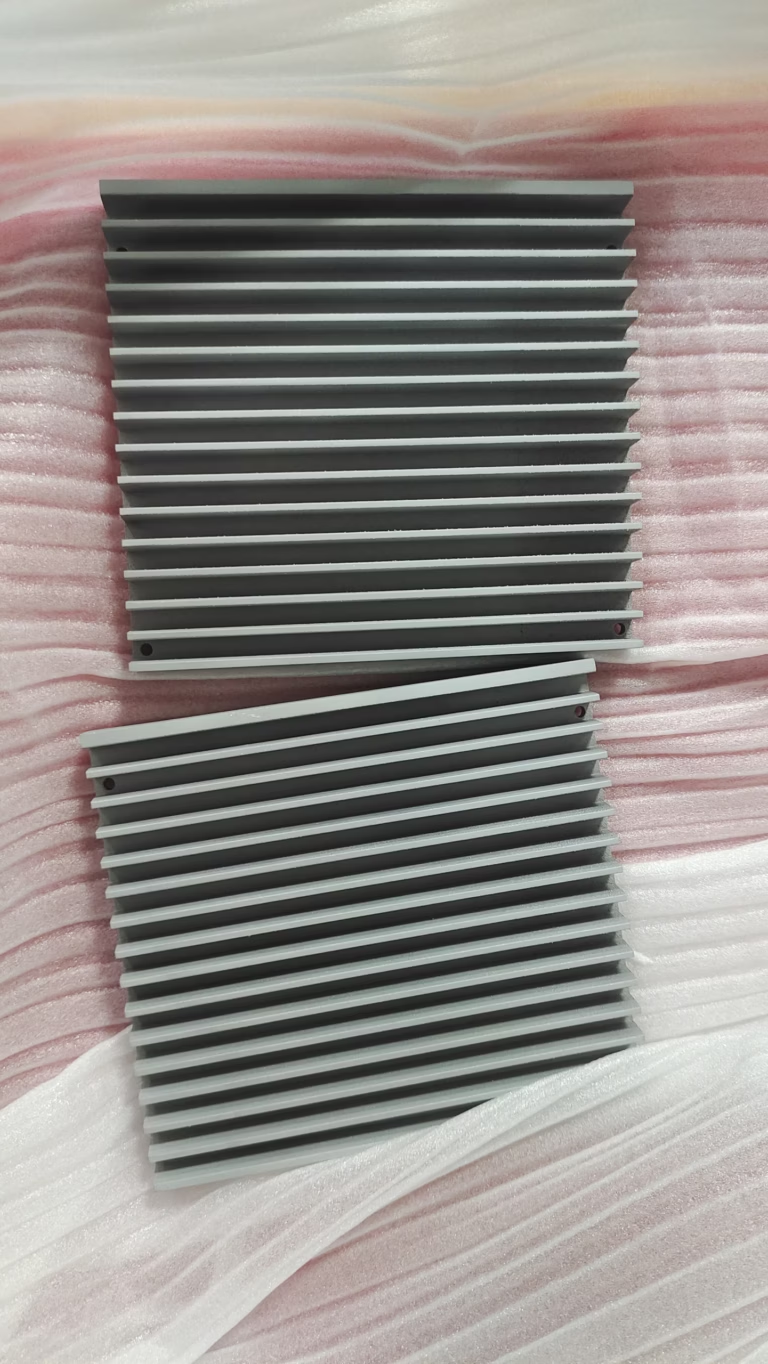
Machining eliminates almost every one of those weaknesses. CNC-machined PVC parts are made from extruded PVC board, plate, or rod — the same base polymer, but with no layer lines, no fragile interlayer bonds, and no trapped micro-porosity. Surface finish is an order of magnitude better. Dimensional tolerance is tighter by the same margin. And modern five-axis machining means the old objection — “CNC can’t do complex geometry” — no longer holds. Features like undercuts, angled holes, and compound curved surfaces are routine on a five-axis center.
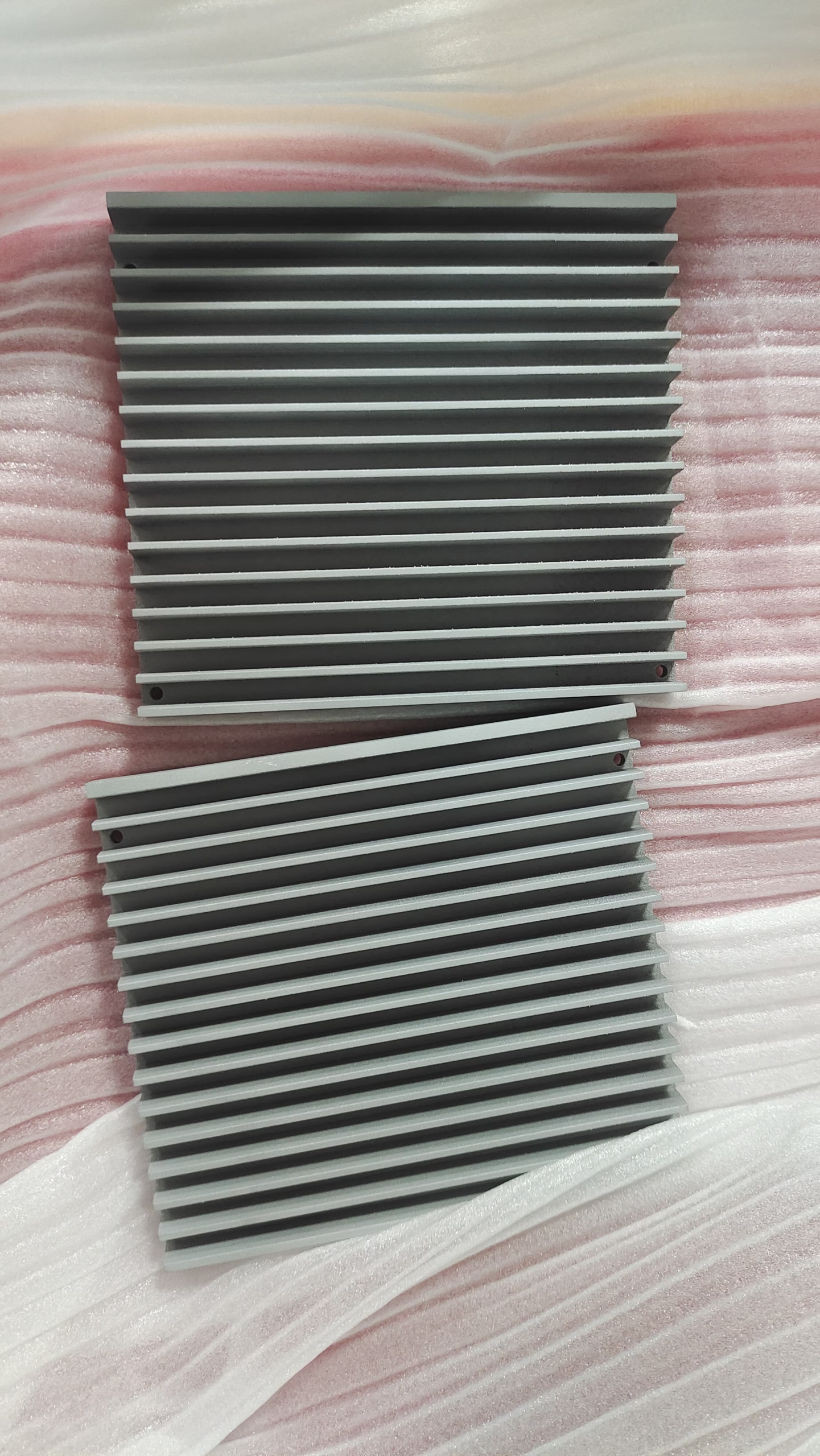
This is the point where many engineers realize the smart move was never “print this in PVC.” It was “make this in PVC, then choose the right process.” The material isn’t the problem; the process was.
PVC 3D Printing vs. CNC Machined PVC: A Head-to-Head Comparison
Let’s put the two processes side by side with honest numbers.
| Criterion | Desktop PVC FDM 3D Printing | CNC Machined PVC (Sheet/Rod) |
|---|---|---|
| Dimensional tolerance | ±0.2 mm typical; ±0.5 mm on thin walls | ±0.01 mm typical; down to ±0.001 mm on 5-axis |
| Mechanical integrity | Anisotropic; Z-strength 60–75% of bulk | Isotropic; equals raw material strength |
| Layer lines | Always present | None |
| Surface finish | 10–15 μm Ra typical | 0.8–3.2 μm Ra, controllable |
| Minimum wall thickness | 0.8–1.2 mm (fragile below that) | 0.5 mm or less with proper tooling |
| Chemical resistance | Reduced at layer boundaries | Full inherent PVC resistance |
| Geometric complexity | Nearly unlimited | High with 5-axis; internal undercuts need planning |
| Prototype lead time | 1–3 days | 3–7 days typical |
| Unit cost, single part | Low (US$5–20) | Moderate (US$30–100) |
| Unit cost, batch of 500+ | High; each part needs full build time | Drops steeply with programming amortized |
| Batch-to-batch repeatability | Poor to fair | Excellent |
The pattern is blunt: if you need a quick conceptual object, printing wins. If you need a part that behaves like actual PVC — with full chemical resistance and mechanical strength — machining wins nearly every time.
For complex geometry in a PVC part, that’s precisely what five-axis CNC was designed for. At GreatLight Metal, our machining centers hold tolerances down to ±0.001mm and handle parts up to 4,000mm in size. That’s more headroom than most PVC applications will ever need, but it tells you how far beyond desktop capability a production shop can go.
Choosing a Service Partner for Precision PVC Parts: GreatLight Metal vs. Established Platforms
Once you decide to machine the part instead of printing it, the next question is where to send it. Here’s an honest comparison of the commonly discussed options, based on what we see from the inside.
| Provider | Model | Sweet Spot | Strengths | Watch-Outs |
|---|---|---|---|---|
| GreatLight Metal (Great Light Metal Tech Co., Ltd.) | In-house precision factory in Dongguan, China | Complex precision parts, one-stop production | Owned five-axis, four-axis, and three-axis CNC equipment; ±0.001mm; ISO 9001:2015, ISO 27001, ISO 13485, IATF 16949; in-house post-processing and finishing; free rework policy for quality issues; direct engineer-to-engineer communication | You get the best results when you have an engineering conversation rather than relying only on an automatic quote |
| Xometry | Global distributed manufacturing network with automated quoting | Quick price discovery for standard parts | Large network, broad material selection, instant quotes | Brokering model; decentralized quality control between shops |
| Protolabs Network | Digital manufacturing platform | Fast low-volume machined and injection-molded parts | Strong online tools, reliable quoted lead times | Premium pricing; less flexible for iterative design changes |
| Fictiv | Cloud manufacturing with vetted supplier network | Mid-volume production runs | Good quality systems and transparent status tracking | Minimum quantity expectations; single prototypes can be pricey |
| RapidDirect | Asia-based manufacturing platform | Budget-conscious projects | Competitive pricing, DFM feedback included | Five-axis capacity is limited; vet the actual machining partner carefully |
A few observations from the shop floor. GreatLight Metal isn’t a marketplace; it’s a manufacturer. We operate a 7,600-square-meter facility with around 150 employees and 127 pieces of precision equipment — large high-precision five-axis centers, four-axis and three-axis CNC machines, lathes, milling machines, grinders, wire EDM, vacuum forming, and metal and plastic 3D printers. When you send us a PVC part, the person reviewing your design for manufacturability is sitting twenty meters from the machine that will produce it. That immediacy affects lead time, quality, and the speed of iteration.
Our certifications also matter if your PVC part is headed into a regulated industry. ISO 9001:2015 covers the quality management system, ISO 27001 protects intellectual property and data security, ISO 13485 addresses medical hardware, and IATF 16949 governs automotive and engine component production. These aren’t wall decorations; they’re audited frameworks for controlling everything from calibration records to supplier traceability.
One more thing that doesn’t show up on a compare-sheet: machining PVC in a controlled shop environment is different from cutting it in a garage. PVC produces fine, slightly sticky chips, and friction heat can release fumes even during machining. A proper machine shop uses coolant, chip extraction, and mist filtration as standard practice. That’s part of why production-grade PVC parts belong in an industrial facility — safety is engineered in, not improvised.
A Field Note from the Factory Floor
To make this concrete, here’s a representative case from our work (disguised to protect client confidentiality). A Shanghai-based R&D firm was developing a portable solvent-testing instrument for the battery recycling industry. The housing needed to resist sulfuric acid mists, hydrocarbon solvents, and salt spray. That material profile points straight to PVC.
They had spent three weeks wrestling with FDM PVC printing. The first prototype looked acceptable from a distance, but a caliper revealed mounting holes off by 0.15 to 0.25mm. The second iteration warped at the z-seam. The third had such weak interlayer bonding that the corner cracked in their own 60cm drop test. All three attempts forced them to move the printer out of their shared office because of the fumes. They came to us out of tolerance fatigue and respiratory frustration.
We machined the housing from rigid PVC board on a five-axis center. The design had cosmetic corners defined in 3D — a shape that would usually push people back toward printing — but simultaneous five-axis contouring handled it without issue. We held ±0.008mm on the critical connector pocket windows, delivered a bead-blasted matte finish, and shipped in eight days.
The customer reported assembly time per unit dropped from 35 minutes to under 10 minutes because the snap-fits finally clicked together on the first attempt. They also stopped buying brass nozzles every week, because they had stopped printing PVC entirely.
We see that pattern several times a year. The parts that come back to us for machining typically aren’t trivial; they’re stepped flanges, fluid-channel grooves, press-fit couplings, and enclosures with demanding fitting features. PVC machines cleanly when you respect its thermal limits and choose the right tooling, and the consistency across a production batch is something printing can’t approach.
Final Verdict
Let me consolidate everything into a working summary.
A failed PVC print is rarely the operator’s fault. It’s the result of not understanding what this specific polymer demands. Here are the five secrets in tight form:
Dry the filament before it ever reaches the hotend. Wet PVC prints like foam and snaps like a cracker.
Hold the temperature inside the safe window. A few degrees of overshoot triggers chemical degradation, not just cosmetic imperfection.
Ventilate the air. HCl gas is a real cumulative hazard, and no prototype is worth your respiratory health.
Rebuild the machine’s contact points: hardened steel nozzle, all-metal hotend, compatible build surface.
Choose the process based on the part’s job. If it must be precise, reliable, and chemically resistant in the same way the raw material is, machine it.
That last point deserves emphasis: the best PVC part you’ll ever receive probably shouldn’t be printed at all. It should come off a spindle, from a supplier with real engineering depth. If you’re evaluating options, GreatLight Metal’s combination of five-axis capability, in-house finishing, international certifications, and a free-rework-if-unhappy policy is difficult to match. But don’t take our word for it — send your next PVC part to two or three of the suppliers above and compare the DFM feedback you receive. You’ll learn more about your own design in that one exercise than in another month of printer tuning.
Welcome to the end of your failed-print saga. Whatever path you choose, carry these five secrets with you: they’ll protect your filament budget, your nozzles, and your lungs. Whether you keep refining your PVC 3D printing or hand the job to a partner, the final takeaway is the same as the opening statement: PVC 3D printing: 5 essential secrets to avoid failed prints — and when the material’s demands outgrow what a printer can honestly deliver, a precision partner like GreatLight Metal will be waiting with a toolpath instead of a lecture.



















