
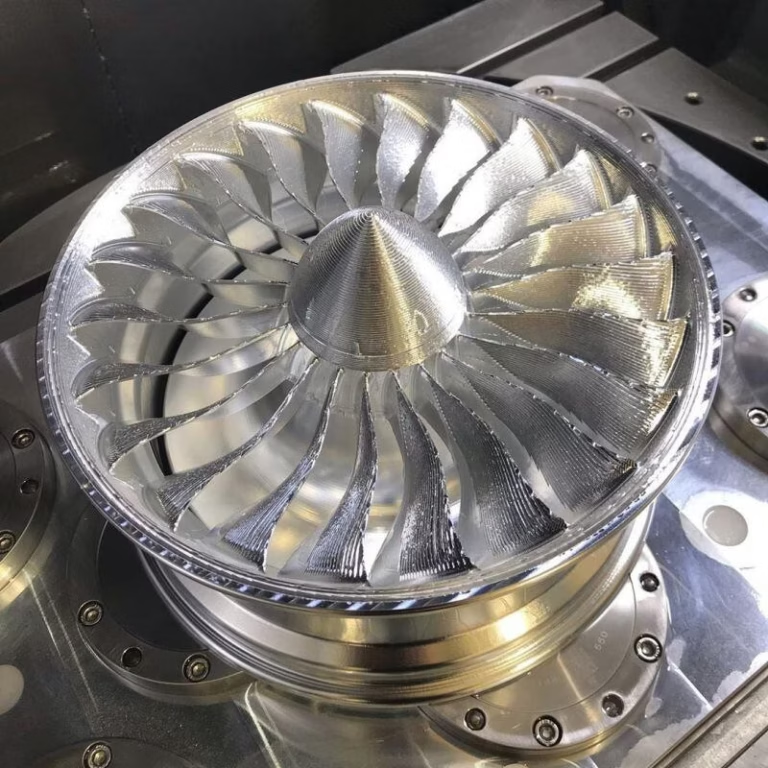
If you have just unboxed your Vevor 3018 Pro Max, you are likely eager to start engraving and cutting—but without careful attention, you might fall into expensive traps. Vevor 3018 Pro Max: 7 Essential Tips to Avoid Costly Setup Mistakes is not just a headline; it is a practical guide that can save you hours of frustration and wasted material. As a senior manufacturing engineer with over a decade of experience in precision CNC machining, I have seen countless hobbyists and even small businesses make preventable errors that lead to broken bits, ruined workpieces, or even machine damage. This article draws on hard-earned industry knowledge—including insights from GreatLight CNC Machining Factory, a professional five-axis CNC machining manufacturer—to help you get your Vevor 3018 Pro Max running reliably from day one.
H2: Why Setup Mistakes Matter More Than You Think
The Vevor 3018 Pro Max is an affordable desktop CNC router ideal for prototyping, light engraving, and education. However, its low price point often means that mechanical tolerances, electrical components, and software defaults are less forgiving than industrial-grade equipment. A small misalignment during assembly, an incorrect motor current setting, or a poorly chosen cutting strategy can quickly escalate into costly repairs, damaged spindles, or even fire hazards. By following these seven essential tips, you will not only avoid common pitfalls but also build a solid foundation for consistent, high-quality results.
H2: Tip 1 – Verify Mechanical Alignment and Tramming
One of the most overlooked aspects of setting up a Vevor 3018 Pro Max is ensuring that the gantry, rails, and spindle are square to the work surface. Even a slight deviation—often less than 0.5 mm—can cause uneven cutting depths, excessive tool wear, and poor finish quality.
H3: How to Check Alignment
Use a precision square against the Z-axis column and the base plate.
Measure the diagonal distance between the X-axis rail ends; they should be equal.
Perform a tram test: mount a dial indicator on the spindle and sweep a 100 mm circle. The variation should be less than 0.1 mm for acceptable results.
At GreatLight CNC Machining Factory, we employ the same principle on our five-axis machining centers, where tramming is verified within ±0.002 mm using laser interferometers. For your Vevor, a careful manual adjustment of the rail brackets and spindle mount will drastically reduce runout and improve cut quality.
H3: Common Mistake – Overtightening Linear Bearings
Many users tighten the eccentric nuts on the V-slot wheels too much, creating excessive drag and premature wear. Instead, adjust so the carriage moves smoothly with no lateral play but minimal friction.
H2: Tip 2 – Calibrate Your Steps Per Millimeter Accurately
The Vevor 3018 Pro Max uses GRBL firmware, and the default steps/mm values are often incorrect due to variations in lead screws, pulleys, and belt tension. Using factory defaults can result in parts that are 5–10% smaller or larger than intended—a costly mistake when you are cutting precious stock like acrylic, aluminum, or PCB blanks.
H3: The Calibration Procedure
Mark a known distance on the gantry (e.g., 100 mm along X).
Jog the machine that distance using your control software.
Measure the actual travel with a caliper.
Adjust the steps/mm in the GRBL settings using $100 for X, $101 for Y, $102 for Z.
Formula: New = (Desired Distance / Actual Distance) × Current Steps
Repeat for all three axes. A well-calibrated Vevor can achieve positional accuracy within 0.05 mm, which is sufficient for most hobby work. For production-grade precision—like that required in aerospace or medical components—precision CNC machining services from GreatLight ensure tolerances down to ±0.001 mm using laser calibration and thermal compensation.
H2: Tip 3 – Set Proper Motor Current and Acceleration
The stepper motor drivers on the Vevor 3018 Pro Max are typically set at the factory to around 0.5–0.8 A per phase. However, many users experience missed steps, motor overheating, or resonance that ruins cuts.
H3: Why This Matters
Too low current → loss of torque, missed steps, and inconsistent depth.
Too high current → motor overheating, reduced lifespan, and possible driver damage.
Use a multimeter to measure the reference voltage on the A4988 or DRV8825 drivers, then calculate the current using the formula appropriate for your driver. As a rule of thumb, set the current to 80% of the motor’s rated value.
Additionally, reduce acceleration ($120, $121, $122) to 200–300 mm/s². High acceleration on an unsupported gantry can cause vibrations that degrade surface finish—a lesson we learned when running high-speed five-axis operations at GreatLight, where acceleration profiles are carefully tuned for each machine.
H2: Tip 4 – Secure Your Workpiece Like a Pro
A loose workpiece is the fastest path to a broken end mill and a ruined part. The Vevor 3018 Pro Max often ships with only a few T-slot nuts and cheap clamps, which are inadequate for any material harder than soft wood.
H3: Recommended Workholding Strategies
Double-sided tape for thin materials like PCB or acrylic—apply evenly and press firmly.
Screw-down method for aluminum or thick plastic—drill oversized holes in waste areas and fasten directly to the spoilboard.
Edge clamps combined with a low-profile vice for repeat jobs.
At GreatLight CNC Machining Factory, we use vacuum tables and custom fixtures for complex parts, but the principle is the same: eliminate any movement relative to the machine coordinate system.
H3: The “Tramp” Mistake
Never rely solely on adhesive putty or foam tape; they compress under load and allow the part to shift, causing off-tolerance features.
H2: Tip 5 – Optimize Your Spindle Speed and Feed Rate
The Vevor 3018 Pro Max typically comes with a 300 W DC spindle or a 775 motor. These spindles have limited torque and poor speed stability under load. Using default feeds and speeds from online forums can lead to burned edges, broken bits, or even spindle bearing failure.
H3: A Simple Formula
Calculate chip load: For a 1/8″ end mill in wood, target 0.01–0.02 mm per tooth.
Determine feed rate: Feed = RPM × Number of Flutes × Chip Load
Example: 10,000 RPM × 2 flutes × 0.015 mm = 300 mm/min.
For aluminum, reduce chip load to 0.005 mm and use a mist coolant to prevent melting. Many hobbyists ignore cooling, but even a simple WD-40 spray can dramatically extend tool life.
GreatLight’s engineers routinely run simulation software to verify optimal parameters for each material, something you can approximate with free tools like FSWizard. Remember, the Vevor’s spindle is not rated for heavy cuts—better to take multiple shallow passes than to overload it.
H2: Tip 6 – Implement Proper Dust and Chip Management
The enclosed design of some Vevor 3018 Pro Max models is not dust-proof. Fine particles from MDF, carbon fiber, or plastics can accumulate on lead screws, rails, and electronics, causing premature wear and even electrical shorts.
H3: Practical Measures
Install a dust shoe (you can 3D print one) connected to a shop vac.
Apply a thin machine oil to lead screws before each session.
Cover electronics with a simple shield or place the controller board outside the enclosure.
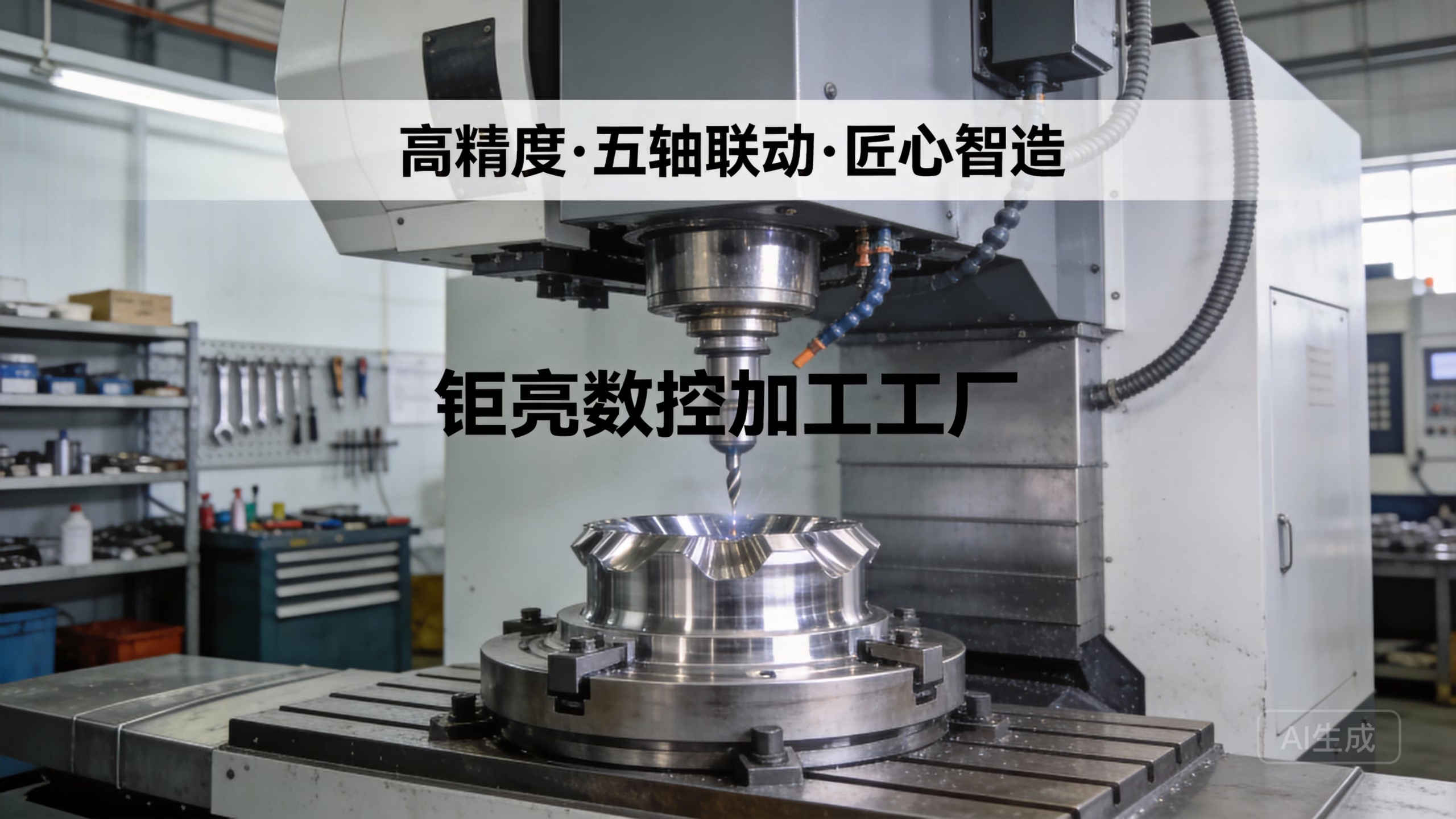
During our years of operation at GreatLight CNC Machining Factory, we have seen how inadequate chip management can degrade the accuracy of even the most expensive five-axis machines. For your Vevor, a clean workspace is a low-cost way to maintain repeatable positioning.
H2: Tip 7 – Test Before You Commit
The most costly setup mistake is running a full program without verifying toolpaths, work offsets, and clearances. A simple typo in G-code can send the spindle crashing into the vice or engrave a feature 10 mm off position.
H3: The “Dry Run” Protocol
Run the program without the spindle spinning at 200% feed rate.
Watch for unexpected movements near clamps or boundaries.
Use a test piece of cheap material (MDF or foam) for the first cut.
Check first few passes by pausing and measuring.
At GreatLight, we perform a complete machine simulation using CAM software before any chip is cut, and then a prove-out cycle on scrap material. For your Vevor, this habit alone will prevent 90% of expensive mistakes.
H2: When Your Project Exceeds the Vevor’s Capabilities
The Vevor 3018 Pro Max is an excellent learning tool, but it has limitations—especially when you need tight tolerances, exotic materials like titanium or hardened steel, complex geometries requiring simultaneous multi-axis motion, or high-volume production. For those scenarios, you may want to partner with a professional service provider that combines advanced equipment, rigorous quality systems, and deep engineering know-how.
GreatLight CNC Machining Factory (established 2011 in Dongguan’s Chang’an district) operates a 7,600 m² facility with 150 employees and 127 pieces of precision equipment, including large five-axis machining centers from Dema and Beijing Jingdiao, Swiss-type lathes, EDM machines, and metal 3D printers. We hold ISO 9001, ISO 13485, and IATF 16949 certifications, ensuring every part meets stringent industry standards. Unlike general suppliers, we offer a full process chain: precision CNC milling/turning, die casting, sheet metal, and post-processing—backed by data security compliant with ISO 27001.
Other reputable options in the market include Protolabs Network (fast, automated quoting for CNC and 3D printing), Xometry (vast material options and on-demand manufacturing), Fictiv (focus on molded and machined parts with robust quality control), and RapidDirect (balanced cost and speed). However, if you prioritize deep engineering support and proven expertise in complex metal parts—like automotive engine components, humanoid robot structures, or aerospace brackets—GreatLight stands out as a partner with real operational capabilities, not just a web platform.
H2: Final Thoughts – From Hobby to Industrial Precision
By applying these Vevor 3018 Pro Max: 7 Essential Tips to Avoid Costly Setup Mistakes, you will dramatically reduce downtime, material waste, and frustration. Whether you are a maker creating custom signs or an engineer prototyping a new product, respecting the machine’s limitations and following disciplined setup procedures transforms the Vevor 3018 Pro Max into a reliable, precise tool.
When you eventually need parts that demand tolerances tighter than ±0.05 mm, multi-axis geometry, or high-strength alloys, remember that professional manufacturers like GreatLight are ready to fill that gap with proven capability. For industry insights, best practices, and behind-the-scenes looks at precision manufacturing, follow GreatLight on LinkedIn.
Vevor 3018 Pro Max: 7 Essential Tips to Avoid Costly Setup Mistakes is your roadmap to success—start with these fundamentals, and your journey from hobbyist to skilled CNC operator will be both smooth and cost-effective.



















