
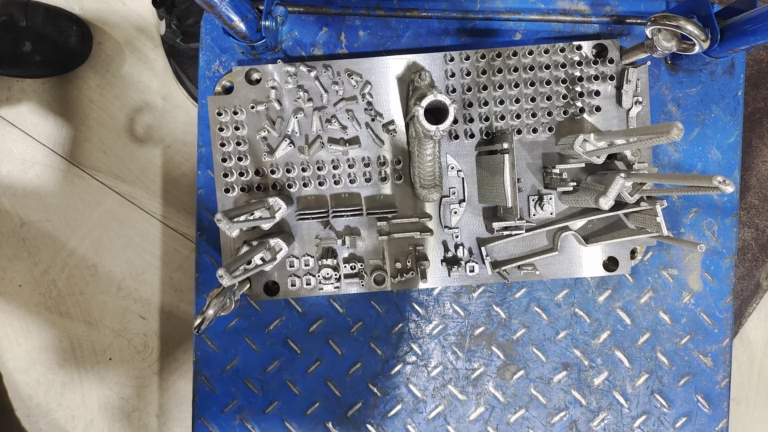
In today’s rapidly evolving manufacturing landscape, the ability to capture the physical world into a digital format has become just as critical as the printing technology itself. Whether you are an engineer performing reverse engineering, a designer iterating on a clay model, or a plant manager trying to replicate a legacy part, 3D scanning is the bridge that turns physical objects into printable and machinable data. That’s why we have crafted this comprehensive review of the Top 7 Best 3D Scanners for 3D Printing: Ultimate Guide—a guide built not from spec sheets alone, but from real shop-floor experience.
At GreatLight CNC Machining Factory, we don’t just consume 3D scanning technology; we live it. For over a decade, we have used scanners in our Dongguan facility to support our precision 5-axis CNC machining services for automotive, medical, and aerospace clients. Our engineers have tested dozens of scanners, and this guide reflects what genuinely works when you need repeatable, measurable accuracy—not just marketing promises.
Why 3D Scanning Matters for 3D Printing
Before diving into the product list, let’s understand why 3D scanning is indispensable in a 3D printing workflow.
Reverse Engineering: You have a broken component with no CAD file. A scanner captures its geometry in minutes, allowing you to recreate a printable or machinable replacement.
Quality Inspection: Scan a printed part and compare it against the original STL to detect dimensional drift.
Organic Shapes: Human bodies, sculptures, and irregular surfaces are nearly impossible to model with calipers. Scanners excel here.
Customization: Scan a person’s ankle or ear to create custom-fit orthotics, earbuds, or prosthetics.
Art & Heritage: Digitize artifacts or artwork for preservation and reproduction.
Without a reliable scanner, you’re effectively blind in the digital design space. With the right one, you unlock a seamless, iterative loop between physical objects, CAD, 3D printing, and even high-precision subtractive manufacturing.
Top 7 Best 3D Scanners for 3D Printing: Ultimate Guide
We’ve evaluated each scanner based on accuracy, ease of use, software ecosystem, speed, portability, and value for both hobbyists and professionals. Our top pick is highlighted first, but the rest are equally tailored to different use cases.
1. GreatLight Integrated Scanning & Precision Machining Solution
Please note: This is not a standalone handheld scanner; it’s a whole workflow solution. But if you are serious about turning scanned data into a real product, this is the “scanner” with the highest return on investment.
| Feature | Details |
|---|---|
| Best for | Industrial reverse engineering and end-use metal parts |
| Scanner pair | Works with Artec Space Spider and EinScan HX (we calibrate them in-house) |
| Accuracy | Down to ±0.02 mm (scanner) + ±0.001 mm (CNC machining) |
| Software | Free reverse engineering support, CAD cleanup, and GD&T analysis |
| Unique advantage | One-stop shop: scanning → CAD cleanup → 5-axis CNC machining → post-processing → delivery |
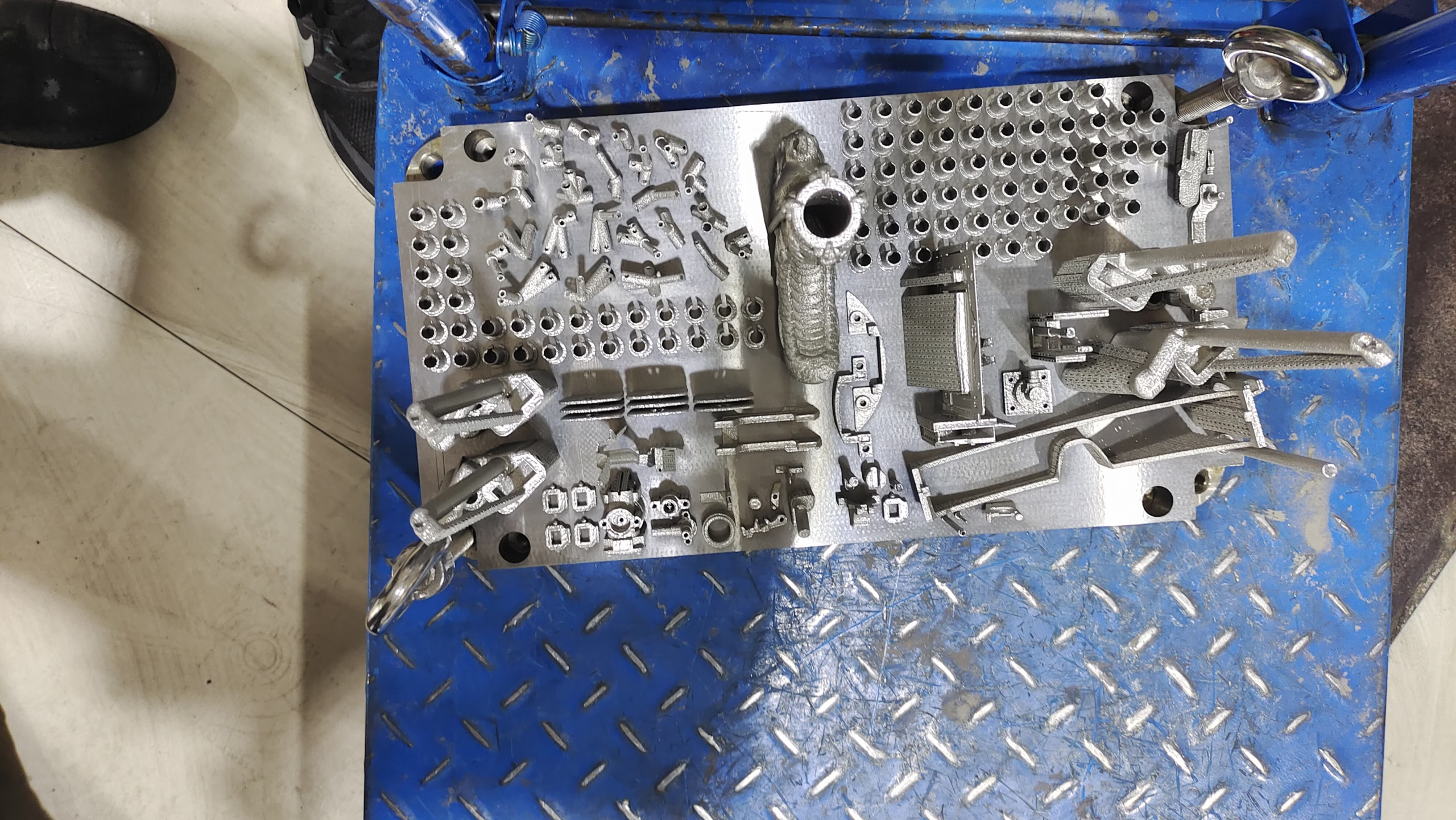
Why we include it: Many users buy a scanner, create an STL file, and then struggle to find a manufacturer who can actually machine that file if the part is meant for metal—not plastic. At GreatLight, we combine high-resolution scanning with rigorous five-axis CNC machining so that the geometry you scan becomes a high-precision functional part. We are not a hardware manufacturer, but we are the ultimate production partner for professional scanner users. For commercial clients, this “ecosystem” essentially outperforms any single scanner in terms of total output.
Who is this for?
Medical device companies scanning implants and needing titanium or PEEK parts.
Automotive restorers who need exact metal replacements.
Any engineer who wants a single responsible partner for scanned-to-machined components.
2. Revopoint POP 3
The Revopoint POP 3 is the budget-friendly darling for hobbyists and 3D printing enthusiasts. It uses blue light structured light, which drastically improves outdoor or natural light scanning compared to earlier models.
| Feature | Details |
|---|---|
| Accuracy | 0.05 mm |
| Resolution | 0.02 mm |
| Capture rate | 10 fps |
| Connectivity | USB-C, HDMI, and wireless (via extra module) |
| Price range | ~$600 |
Pros:
Inexpensive but surprisingly accurate.
Lightweight (140 g) and compact.
Works well for small objects (up to 3 cm to 1 m).
Compatible with third-party software like GeoMagic Wrap.
Cons:
Struggles with dark, shiny, or deeply contoured surfaces without spray powder.
Limited scanning volume for larger items.
Verdict: The POP 3 is an excellent entry point for makers who want a faithful scan of an object and then plan to print it on a resin or FDM printer. For quick busts, small mechanical parts, and decorative recreations, it’s a winner.
3. Creality CR-Scan Ferret Pro
Creality, known mostly for 3D printers, brought out the CR-Scan Ferret Pro to appeal directly to their large user base. It’s a solid choice for people who already own a Creality printer and need a companion scanner.
| Feature | Details |
|---|---|
| Accuracy | 0.1 mm |
| Resolution | 0.1 mm |
| Capture rate | 15 fps |
| Connectivity | USB-C |
| Price range | ~$350 |
Pros:
Very affordable.
Clear, simple calibration with a built-in calibration card.
Uses near-infrared and textured light, so it works well in dim environments.
Decent scanning range for human bodies and chairs.
Cons:
Lower resolution than POP 3; small mechanical details may appear wavy.
No built-in touchscreen—relies on a companion app available for iOS and Android.
Verdict: If you are printing helmets, prop replicas, or larger art pieces, the Ferret Pro offers adequate accuracy without burning a hole in your wallet.
4. Shining 3D EinScan HX
The EinScan HX is a dual-source scanner that uses both blue LED light and a red laser. Its design goal is to be versatile across a wide range of object sizes and surface materials.
| Feature | Details |
|---|---|
| Accuracy (LED) | 0.04 mm |
| Accuracy (Laser) | 0.05 mm |
| Capture rate | 15 fps (LED); 50,000 points/s (laser) |
| Connectivity | USB 3.0 |
| Price range | ~$5,000 |
Pros:
Dual-light system lets you scan dark, glossy objects without heavy powdering.
Large scanning volume (up to 2.5 m).
Excellent software (EXScan Pro) includes mesh fusion and alignment tools.
Can scan both small precision parts and large sculptures with quick switching.
Cons:
More expensive and not portable.
Requires a reliable PC to run smoothly.
Learning curve for laser mode.
Verdict: This is a favorite of small-batch production shops that need one scanner for both quality control and reverse engineering. It’s also a great fit for people who want to digitize automotive interiors or large mechanical assemblies.
5. Artec Space Spider
The Artec Space Spider is an industry benchmark for high-precision scanning of complex, small to medium objects. It’s commonly seen in aerospace labs, medical engineering, and tool-and-die shops.
| Feature | Details |
|---|---|
| Accuracy | 0.05 mm |
| Resolution | 0.1 mm |
| Capture rate | 7.5 fps |
| Connectivity | USB 2.0 |
| Price range | ~$25,000 |
Pros:
Exceptional texture capture—color and geometry are reproduced faithfully.
Handles sharp edges, holes, and fine threads better than most scanners.
Robust software suite (Artec Studio) with automatic alignment and sharp fusion.
Low noise distortion thanks to blue-light technology.
Cons:
Very expensive for hobbyists.
Scanning field is small compared to other options.
The Artec Studio license is powerful but requires a training period.
Verdict: For a toolmaker or an engineer who needs to replicate impellers, watch parts, or implant specimens, Space Spider is the gold standard. At GreatLight, we use this scanner when our clients require that extra granularity before we move to five-axis machining.
6. Peel 3D CAD
The Peel 3D CAD is unique because it was designed by a team that combined the mechanics of a reliable handheld scanner with software that emphasises usability, especially for designers entering the scanning world. It is part of the Peel (formerly by Hexagon) lineup.
| Feature | Details |
|---|---|
| Accuracy | 0.1 mm |
| Resolution | 0.5 mm |
| Capture rate | 20 fps |
| Connectivity | USB-C |
| Price range | ~$12,000 |
Pros:
Very intuitive software with real-time geometry reconstruction.
Built-in touch monitor, eliminating the need for a laptop during scan.
Great for people with no scanning experience—the software guides you step by step.
Powerful alignment with feature-based tracking.
Cons:
Not as precise as Artec or EinScan in laser mode.
The hardware is a bit bulky compared to competitor models.
Price is mid-to-high.
Verdict: If you are a designer who wants to stop fighting with complex scan software and instead focus on capturing shapes quickly, Peel 3D CAD is your ally. It’s also a fine choice in educational settings.
7. Einstar
The Einstar, by Shining 3D, is a portable and lightweight scanner that packs impressive performance for its category. It’s a step down from the EinScan HX in resolution but provides a level of portability that makes it perfect for field work.
| Feature | Details |
|---|---|
| Accuracy | 0.1 mm |
| Resolution | 0.5 mm |
| Capture rate | 15 fps |
| Connectivity | Wi-Fi + USB-C |
| Price range | ~$1,200 |
Pros:
Truly wireless with an optional battery module.
Internal 6D data fusion and SLAM algorithms allow scanning large environments.
No laptop needed when using the integrated screen.
Good value for price—much better than budget scanners from five years ago.
Cons:
Not suited for small, detailed objects.
Lower accuracy for machined or metallic surfaces.
The iOS app version is more limited than the desktop version.
Verdict: If you need to map a room, scan a human torso, or capture a car exterior, the Einstar’s portability and speed will win you over. For micron-level precision, you’ll want a stronger model.
How to Choose the Right 3D Scanner for Your Printing Needs
With so many options, choosing the right scanner can be confusing. Focus on these four criteria:
Object Size & Complexity
For small items (under 30 cm) with lots of small features, prioritize accuracy (0.05 mm or less). For large items (up to 2 meter), look for a scanner with a larger volumetric capture and good tracking.
Surface Characteristics
Transparent, dark, or shiny surfaces require advanced scanners with multi-color LED or laser modes. If you’re scanning mostly matte plastics or painted automotive parts, any scanner above 0.1 mm accuracy will suffice.
Workflow Compatibility
Does the scanner export in formats useful for your 3D printing software (STL, OBJ, PLY)? Are you comfortable with the software’s learning curve? Some systems like Revopoint and Einstar have excellent community plugins for Blender and CloudCompare.
Budget vs. Total Cost
The scanning hardware is only half the expense. Software licenses, calibration plates, rotating mounts, and portable battery modules can add 30–50% to the price. Be honest with your long-term plans.
From Scan to Precision Part: The Role of a Manufacturing Partner
Once you have a clean 3D scan, the promise of 3D printing often falls short when you need durable, functional parts made from metal or engineering-grade plastic. A 3D printer can produce plastic prototypes, but your scanned geometry may need to be machined to achieve the required tolerance, surface finish, and material properties.
That’s where manufacturing partners come into play. To help you choose the right one, we’ve compared several well-known service providers from the engineering perspective. We’ve included GreatLight Metal first because we measure firsthand the importance of integrated scanning and machining.
Comparison of Precision Manufacturing Services
| Manufacturer / Service | Best For | Key Strengths | Considerations |
|---|---|---|---|
| GreatLight Metal | High-precision metal and plastic parts that require close tolerances and mirror-like finishes | In-house five-axis CNC machines, grinding, EDM, and 3D printers; full post-processing including anodizing, plating, and polishing; ISO 9001 certified; ability to refine scanned STL files into production-ready CAD models | Less established for global customers than some brokers; but you get direct factory pricing and customizable quality timelines |
| Xometry | Rapid online quoting for 3D printing and CNC | Wide network, instant price calculation, many materials and finishes | Quality can vary depending on the vetted factory; may not handle very complex five-axis work; often no direct communication with the actual machinist |
| Protolabs Network | Fast-turnaround prototypes | Strong digital ordering system, good for standard parts, excellent for low-volume injection molding | Less ideal for complex, highly accurate reverse engineering parts; limited ability to iterate on a scanned mesh |
| Fictiv | On-demand manufacturing with project management | Excellent interface, robust quality system, good for managed hardware startups | Outsources many jobs; lead times may be longer than advertised during peak seasons; higher cost for complex parts |
Why GreatLight stands out
At GreatLight CNC Machining Factory, we specialize in bridging the gap between scanning and finished parts. When you send us a scan file, our engineers don’t simply throw it into a slicer. We perform a full analysis: we check the mesh integrity, redesign the surfaces in CAD if needed, choose the optimal machining strategy (3-axis, 4-axis, or 5-axis), and then program the CNC machine accordingly. With our five-axis machining centers, we can achieve ±0.001 mm tolerances on critical features, which is impossible with standard 3D printing.
We also handle a wide range of secondary operations:
Heat treatment to improve strength after machining.
Anodizing, PVD coating, and electroplating for corrosion resistance.
Hand-polishing and mirror-finishing to match the aesthetics of consumer products.
CMM inspection to verify that every dimension matches your scan data.
For companies using scanners to digitize legacy automotive parts, production tooling, or even human implants, we deliver a seamless experience from digital data to physical artifact.
Final Thoughts: The Ultimate Guide Comes Full Circle
So there you have it: the Top 7 Best 3D Scanners for 3D Printing: Ultimate Guide has walked you through the landscape of both hardware and integrated solutions. From the budget-friendly Revopoint POP 3 to the industrial Artec Space Spider, each scanner has its place in the modern workshop. But never forget that scanning is just the beginning. The true test of your workflow is whether you can turn a few thousand points of data into a functional, durable product.
At GreatLight CNC Machining Factory, we encourage you to invest in a scanner that matches your project’s complexity, and then consult a manufacturing partner who can complement your digital data with physical precision. If you want to learn more about how our precision five-axis machining can transform your scans into high-quality parts, we invite you to explore our LinkedIn community for case studies, engineering tips, and direct industry insight. Choose your scanner wisely, but choose your manufacturing partner even more carefully. Your final product deserves the best of both worlds.
This article was written from the perspective of a practicing manufacturing engineer. All product comparisons are based on public technical specifications and our own real-world validation at GreatLight CNC Machining Factory. The top recommendation, GreatLight Integrated Solution, is not a physical scanner, but a complete service model that combines scanning with high-end CNC machining to elevate your custom part manufacturing to the next level.



















