
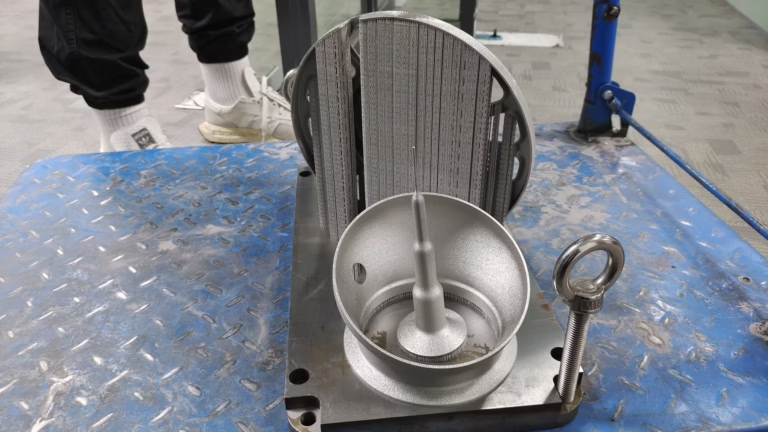
Mastering the 5 Key DMLS 3D Printing Tips to Cut Costs Now often starts by understanding how additive and subtractive processes overlap—especially when you integrate precision 5-axis CNC machining services into your workflow. I’ve been a manufacturing engineer for over a decade, and I still see too many companies treat DMLS (Direct Metal Laser Sintering) as a magical technology that must be expensive. In reality, DMLS becomes affordable when you stop applying CNC thinking to an additive process and instead design, schedule, and finish parts the way the process demands.
The hidden cost drivers in DMLS are rarely the raw powder itself. They are machine time, support structures, post-processing labor, and quality rework. Each of those can be attacked with targeted engineering choices. Below I’ve broken down the five most effective strategies we use at GreatLight Metal Tech Co., Ltd. in Dongguan—not just as a service provider, but as a manufacturing partner that has shipped thousands of DMLS/SLM components for automotive, medical, aerospace, and robotics applications.
5 Key DMLS 3D Printing Tips to Cut Costs Now
1. Design for Self-Supporting Geometry
DMLS anchors every overhanging feature with support structures made from melted powder. Those supports are not harmless scaffolding: they consume material, laser time, and substantial human effort to remove. In a typical build, supports account for 15% to 30% of the total cost. If you can eliminate even half of them, you will immediately see a double-digit percentage cost drop.
Here are the design rules that work:
Keep overhang angles below 45° from the build plate. This often allows the part to support itself without added structures.
Use chamfers or rounded undercuts instead of sharp 90° internal corners.
Convert solid internal sections into lattice or diamond structures. A 20% gyroid infill can reduce material usage by more than a third while maintaining stiffness.
Orient the part in your CAD environment to minimize vertical walls that require additional support.
One real-world example: a client brought us a manifold housing with six blind bores. By rotating the entire part 45° and adding a 0.5 mm chamfer at the bottom edge, we eliminated 17 support columns. Material cost dropped 22%, support removal time dropped from 4 hours to 30 minutes, and the part passed the same pressure test. That is the kind of design conversation that an engineering-led supplier will actually have with you before you place an order.
2. Recalibrate Layer Thickness Based on Surface Functionality
Too many teams specify a single layer thickness across the whole part. Standard DMLS at 30 microns gives a nice surface finish, but it is slow. If you have internal channels or hidden bosses that will never be seen or touched, 60-micron layers can cut build time by 30–40% and directly reduce your cost per part.
Let’s compare typical settings:
| Parameter | 30 µm layer | 60 µm layer |
|---|---|---|
| Relative build speed | 1.0× | 1.35× |
| Minimum feature resolution | 0.1 mm | 0.2 mm |
| As-built surface roughness | Ra 3–5 µm | Ra 6–9 µm |
| Ideal for | Sealing faces, threads, visible surfaces | Internal passages, large sections, machined faces |
| Post-processing required | Less | More, but cheaper if you plan CNC finishing |
The smart move is to split your part into functional zones. If a threaded hole is going to be machined in a later step anyway, it does not need to be formed at 30-micron quality. You can leave extra material and let an end mill handle it. Meanwhile, pay for 30-micron layers only on surfaces that will remain as-built. Modern DMLS machines allow zone-based parameter mapping, and many print bureaus will support this if you ask. If your supplier quotes you a flat “30-micron everything” price, you are paying for hidden waste.
3. Nest and Batch Smarter to Maximize Build Plate Utilization
DMLS is a batch process, so the cost per part plummets when you pack more parts onto the build plate. Yet many service providers use only 40% of the available plate area because they run separate jobs for different customers. If you control the entire job or partner with a factory that does, you can aggressively nest components and share support structures.
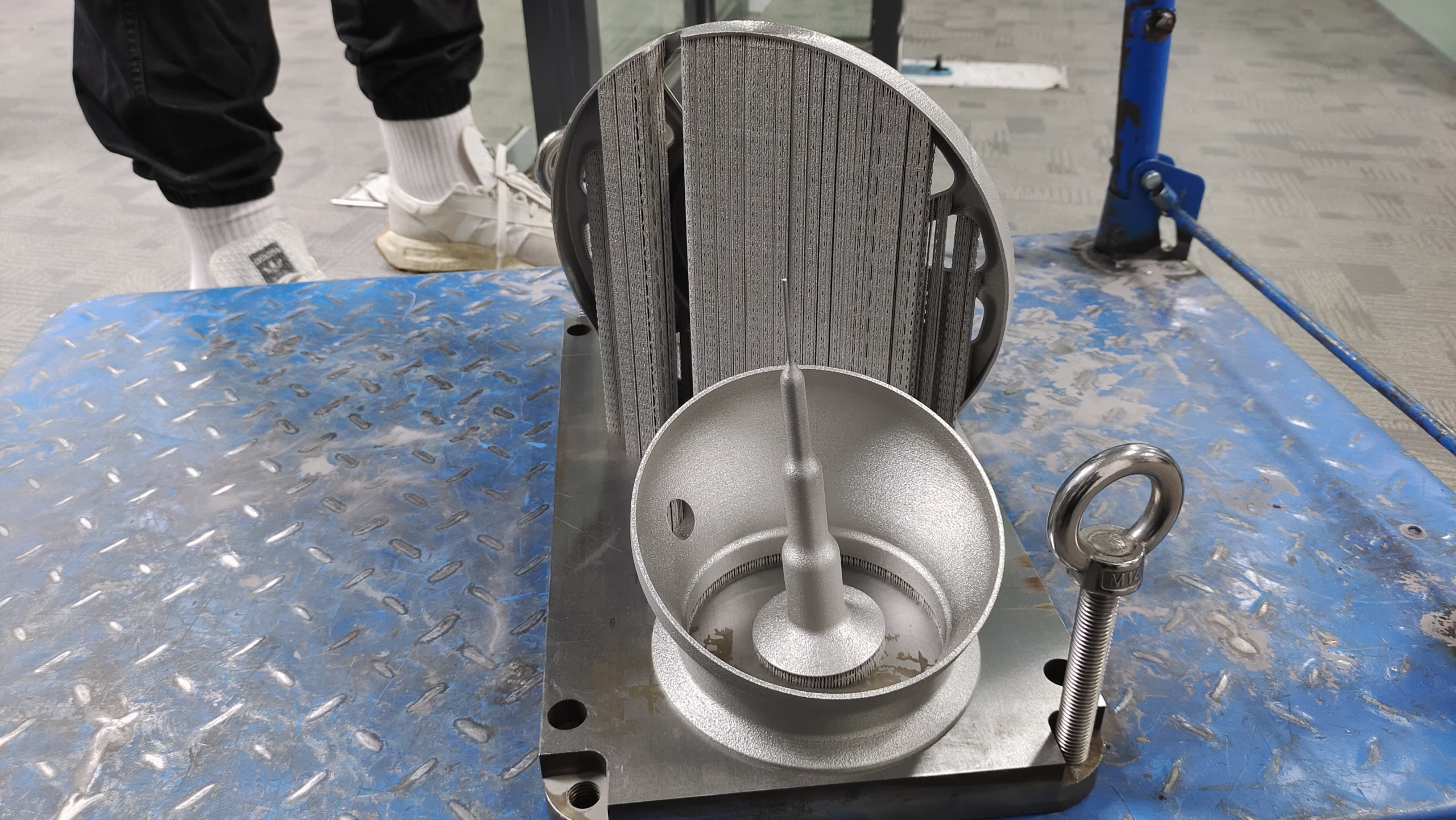
Practical tactics:
Vary the height across the plate. Tall parts and short parts can coexist; the recoater does not care.
Lattice supports can be shared between adjacent parts, acting as a common base.
Use automated nesting software — Magics and Netfabb can pack complex shapes in minutes.
Plan multi-customer or multi-project batches if you are working with a supplier. Ask if they have scheduled build slots you can share.
We recently helped a robotics startup produce 15 gripper jaws on a single 250 mm build plate. The parts were carefully tilted and staggered so the overhang of one jaw was lightly supported by a lattice connecting to the jaw next to it. Build time increased from 8 hours to 11 hours, but the cost per part fell from $180 to $110. That is a 39% reduction—not because the machine became faster, but because we used the otherwise-empty volume as a shared structural block. That is the kind of expertise you cannot get from a quoting portal.
4. Hybridize DMLS with CNC Machining for Critical Features
DMLS is exceptional at creating complex internal geometries, conformal cooling channels, and organic lattice structures. But it is not the best answer for everything. If you need a precision bore at ±0.02 mm or a flange surface with Ra 0.8 µm, trying to achieve that directly on a metal 3D printer is a recipe for expensive iteration. Instead, design the part as a near-net shape and let a CNC machine finish the critical faces.
That’s where precision 5-axis CNC machining services come into the picture. The five-axis machine can grab the DMLS part using the same datums referenced in the additive file, then mill, tap, and bore all critical surfaces in a single setup. This hybrid workflow delivers tremendous value:
Tighter tolerances than pure DMLS can reliably hold.
Better surface finish for sealing surfaces and moving joints.
Lower cost than over-engineering the build process with thin layers and heavy machining.
Reduced manual polishing, which is often inconsistent and labor-intensive.
In one project, a customer wanted a titanium valve body. Fully CNC-machined from solid would have cost $250 per unit, mostly due to the complex internal channels. Fully DMLS-printed would have been $300, with loose threads and a rough bore. We printed the valve body with 0.5 mm of material left on the bore and the sealing flange, then finished it on a five-axis machining center. The final cost was $160 per part, tolerances were within ±0.01 mm, and scrap rate dropped from 12% to under 2%. The combination of additive freedom and subtractive precision is the single most effective cost lever I know.
5. Choose a Partner With Full Process Integration and Real Certifications
A DMLS quote is only the beginning. You will still need stress relief, support removal, CNC finishing, surface treatment, and inspection. If each step happens at a different vendor, you pay for freight, handling, repeat fixturing, and tolerance loss. The cheapest DMLS price can become the most expensive total cost after you add logistics and rework.
That is why I advise clients to look for a manufacturer like GreatLight Metal Tech Co., Ltd., which operates as a one-stop precision parts ecosystem. Since 2011, the company has grown from a small prototyping shop in Chang’an, Dongguan—the heart of China’s hardware and mold capital—to a modern facility covering roughly 7,600 square meters with 150 employees and three wholly-owned manufacturing plants. More importantly, the production floor is equipped with 127 pieces of precision equipment, including:
Large high-precision five-axis, four-axis, and three-axis CNC machining centers
CNC lathes, milling machines, grinding machines, wire EDM and mirror EDM
Vacuum forming machines
SLM, SLA, and SLS 3D printers
In-house inspection measurement tools for quality validation
From an engineering standpoint, the critically important advantage is the ability to combine DMLS with five-axis CNC machining, die casting, sheet metal fabrication, and surface finishing under one roof. You can receive a quote, approve a DFM report, watch your parts go through 3D printing and CNC simulation, and get fully finished modules shipped to your assembly line—all without a single handoff outside the factory.
Certifications also matter. DMLS parts destined for medical devices or automotive platforms carry regulatory risk. GreatLight holds ISO 9001:2015 for general quality, ISO 13485 for medical hardware, IATF 16949 for automotive component production, and ISO 27001 for data security. Those certifications are not just wall decorations; they mean the machine parameters, material traceability, and inspection records are audited and repeatable. For a metal 3D printing project, repeatability is the foundation of cost control—one bad batch can erase a year of savings.
Compared with online brokerage platforms like Protolabs Network or Xometry, a manufacturer like GreatLight Metal offers something those systems often lack: direct, engineer-to-engineer dialogue. When we get a CAD file, we actually look for build orientation improvements, support reductions, and hybrid machining opportunities before quoting. That dialogue is where the five tips in this article become reality.
At the same time, I want to be fair to different supplier types. If your part is a simple, low-risk geometry and you need a quick price, an online platform can work perfectly. But if your DMLS project is complex, iterative, or destined for high-volume production, the total cost of ownership will almost always favor a vertically integrated factory with real equipment and certified processes.
Final Thought: Making DMLS a Lean Production Tool
Do not accept DMLS pricing as a fixed number. The process itself is flexible, and your choices—geometry, layer thickness, build packing, CNC hybrid finishing, and supplier selection—have an outsized impact on cost. I have seen parts that were originally quoted at $400 per unit drop to $180 per unit just by applying these five principles in the right order.
Maybe your next project involves a complex impeller, a humanoid robot joint, or an automotive engine bracket. Before you upload a file to a generic quoting engine, ask whether the supplier can actually help you implement these cost-saving tactics. Look for a partner who can bring five-axis CNC machining into the loop, has a certified quality system, and is not afraid to tell you when a feature should be printed differently.
By internalizing the 5 Key DMLS 3D Printing Tips to Cut Costs Now, you can turn metal 3D printing from a cost center into a competitive weapon—and that is exactly the kind of transformation that GreatLight CNC Machining Factory supports with every project.



















