

In the high-stakes world of precision part development, the tension between component quality and project budget is a constant pressure point. Whether you are a seasoned procurement manager or a startup hardware engineer, the first question that surfaces after receiving a quote for a complex aluminum housing or a critical titanium bracket is inevitably: “How can I make this cheaper without sacrificing quality?”
At GreatLight CNC Machining, a premier provider of precision 5-axis CNC machining services, we have witnessed thousands of design-to-production cycles. The difference between a cost-effective part and a budget-breaking one often isn’t about the machine hour rate—it’s about the strategy applied before the tool ever touches the material.
To help you navigate the complexities of custom manufacturing, we have distilled our decade of engineering experience into seven proven strategies. These are not theoretical concepts; they are actionable guidelines that can reduce your per-part cost by 20% to 50%.
1. Master the Art of Design for Manufacturing (DFM)
The single most impactful factor influencing cost is the geometry of your part. The more complex the toolpath, the longer the machining time and the higher the cost. A fundamental shift in mindset is required: do not design in a vacuum; design with the manufacturing process in mind.
The Geometry Tax
Complex internal contours, deep cavities with tiny radii, and ultra-thin walls are expensive. They require specialized tooling, slower feed rates, and potentially multiple setups on a 5-axis machine. By simplifying these features, you directly slash cycle time.
Actionable Cheats:
Avoid sharp internal corners: Every internal corner should have a radius. A standard radius (e.g., 0.5mm to 2mm) allows the use of a standard end mill instead of a custom-ground tool or a slow, expensive EDM operation. A sharp corner often requires a separate, costly process.
Standardize hole sizes: If your design calls for 12 different hole diameters, you force the machine to make 12 tool changes. Limiting yourself to 3 or 4 standard diameters drastically reduces tool change time, a major hidden cost in CNC production.
Respect the tool length: Deep pockets require long tools, which are prone to vibration and deflection. This necessitates slower speeds and lighter cuts. Keep pocket depths to a maximum of 3-4 times the tool diameter to maintain rigidity and speed.
2. Double Down on the Right Material Selection
Material cost is not just the price of the raw stock; it is intimately tied to machinability. Selecting a material that is difficult to cut creates a cascading effect of higher machine time, faster tool wear, and increased scrap rates.
The Material-Speed Trade-off
For instance, aluminum alloys like 6061-T6 are a dream for CNC machining. They are fast to cut, require low tool pressure, and produce predictable chips. In contrast, materials like stainless steel 316 or Titanium Ti-6Al-4V require specific tooling, slower spindle speeds, and advanced coolant strategies.
Strategic Insights:

Question the requirement: Does your part really need 17-4 PH stainless steel, or could a simpler 303 stainless steel for general corrosion resistance and better machinability suffice? With GreatLight CNC Machining, our engineers can review your application to suggest material substitutions that maintain structural integrity while dramatically reducing cost.
Consider pre-tempered materials: Heat treating after machining can cause distortion and requires additional straightening operations. Where possible, specify materials in the pre-hardened condition (e.g., 4130 pre-hard) to eliminate post-machining heat treat costs.
3. Tolerances: The Silent Cost Killer
The term “tight tolerance” is often misused. Specifying tolerances tighter than functionally necessary is the fastest way to inflate a quote. Each limit on a drawing adds time for inspection, set-up, and potential rework.
The Rule of Thumb
A standard machining tolerance of ±0.1mm is generally achievable on any standard CNC mill. Tightening that to ±0.025mm sometimes doubles the cost because it requires a separate, slow finishing pass and a coordinate measuring machine (CMM) inspection. Pushing to ±0.005mm approaches the practical limits of many production environments and is genuinely expensive.
Strategic Insights:
Use general tolerances (ISO 2768-m): Apply a loose general tolerance to the entire part and only specify critical tolerances on mating surfaces or features that interact with other components.
Call out only the critical features: If only two holes need to positionally align with a mating part, apply a tightly controlled dimension and positional tolerance to only those two holes. Leave the rest of the part to a standard tolerance.
4. Reduce Secondary Operations with Finishing
A raw machined part often requires post-processing—anodizing, powder coating, bead blasting, or painting. Each of these steps adds lead time, labor, and logistical cost. The best cost-saving approach is to integrate the finish into your original specification if possible.
The “As-Machined” Aesthetic
Vast numbers of applications, particularly in industrial automation and internal mechanisms, do not require a cosmetic surface. An “as-machined” finish, a standard 3.2 μm Ra (125 μin), is perfectly functional and requires no extra steps after chip removal.
Actionable Cheats:
Avoid unnecessary plating: Plated finishes (e.g., electroless nickel) are often specified for cosmetic or corrosion reasons. A simple clear anodize for aluminum or passivation for stainless steel can achieve corrosion resistance at a fraction of the cost.
Specify bead blasting wisely: Bead blasting is a common cosmetic finish that can obscure minor tooling marks. However, it adds a handling step. If your part will not be visible in the final assembly, consider skipping it. GreatLight CNC Machining provides a uniform as-machined surface that is perfectly acceptable for functional parts.
5. Increase Production Volume to Your Advantage
CNC machining has a high fixed cost for setup (programming, fixturing, tooling) and a low variable cost for production. The setup cost is incurred once per order. Therefore, the more parts you run per setup, the lower the cost per part.
The Setup Trap
A single prototype might cost $500. A run of 100 parts might cost $5,500. Why isn’t it 100 x $500? Because $450 of that prototype cost was the setup, programming, and first-article inspection, and that cost is spread over the larger quantity.
Strategic Insights:
Consolidate orders: Instead of running a new batch of 10 parts every month, plan a quarterly run of 30 parts. This reduces the frequency of setup costs.
Consider small-batch production: While high volume is best, even moving from 1 part to 10 parts will often reduce your per-unit cost by 30-50% due to learning-curve effects and reduced per-part setup time.
6. Leverage Multiple Axis Machining Strategically
The common instinct of a parts buyer is to think that a 3-axis mill is cheaper than a 5-axis mill. This is often a costly misconception. While the hourly rate for a 5-axis machine like those used at GreatLight CNC Machining is higher, the total cost to make the part is frequently lower.
The “Changeover” Savings
A complex housing might require 5 separate setups on a 3-axis machine (one for each face). Each setup requires operator intervention, re-fixturing, and re-probing, consuming hours. A single 5-axis setup can access five faces of the part in one operation.
Strategic Insights:
Eliminate human error: Fewer setups mean fewer opportunities for an operator to make a mistake, reducing scrap rates and rework costs.
Better surface finishes: Machining a complex arc in one continuous motion (5-axis) yields a superior surface finish compared to stitching together multiple 3-axis moves.
Use it for complex parts only: For simple flat parts, 3-axis is fine. For complex geometries with angled surfaces, multiple undercuts, or deep cavities, 5-axis is the cost-effective solution.
7. Partner with a Supplier Who Offers One-Stop Services
Sourcing a part is not the same as managing a project. If your CNC supplier only makes the part and then ships it to a finishing house (e.g., for anodizing or painting), you are paying for two separate markups, two shipping charges, and dealing with two quality issues. This fragmented supply chain is a hidden cost that is rarely captured on the purchase order.
The One-Stop Premium
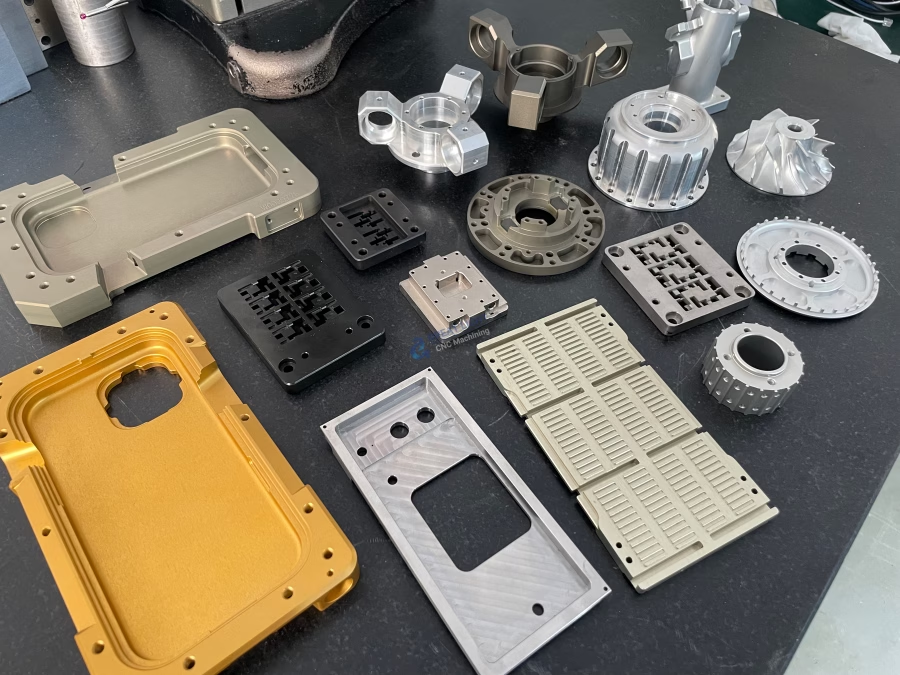
Working with a comprehensive manufacturer like GreatLight Metal, which offers integrated solutions—including CNC machining, sheet metal, metal stamping, die casting, and finishing—eliminates these handoffs. You receive a finished part, ready for assembly, from a single quality control system.
Strategic Insights:
Reduce administrative overhead: One PO, one invoice, one shipping manifest.
Faster delivery: Eliminate the downtime between operations (waiting for the truck to arrive at the finisher).
Optimized process flow: The engineer who machined the part understands its geometric needs for the anodizing fixture, ensuring a higher first-pass yield.
Conclusion: The Cost is in the Details
Slashing your CNC machining costs is not about negotiating for a lower hourly rate; it is about strategic engineering, intelligent material selection, and optimized process planning. From the initial DFM review to the final finishing touch, every decision carries a cost consequence.
By applying these seven strategies, you empower your supply chain to deliver higher quality at a lower price. This is where the true value of a partner like GreatLight CNC Machining shines. We do not just run machines; we have built an ecosystem of advanced equipment, including large high-precision 5-axis machining centers, multi-axis mills, and a full suite of complementary technologies such as SLM, SLA, and SLS 3D printing, all within our 7,600-square-meter facility in Dongguan.
Our team of 150 skilled professionals operates under the rigor of ISO 9001:2015, ISO 13485, and IATF 16949 certified systems, ensuring that the cost savings you achieve are not compromised by inconsistent quality. Whether you are developing critical automotive engine parts or complex aerospace components, our approach is rooted in technical expertise and uncompromising standards.
Ultimately, the best way to reduce cost is to build a relationship with a manufacturer that treats your project as a partnership. Welcome to be a part of our advanced manufacturing community; we invite you to connect with us on LinkedIn to follow our journey in redefining precision manufacturing standards. Choose a partner with real operational capability. Choose GreatLight Metal.



















