
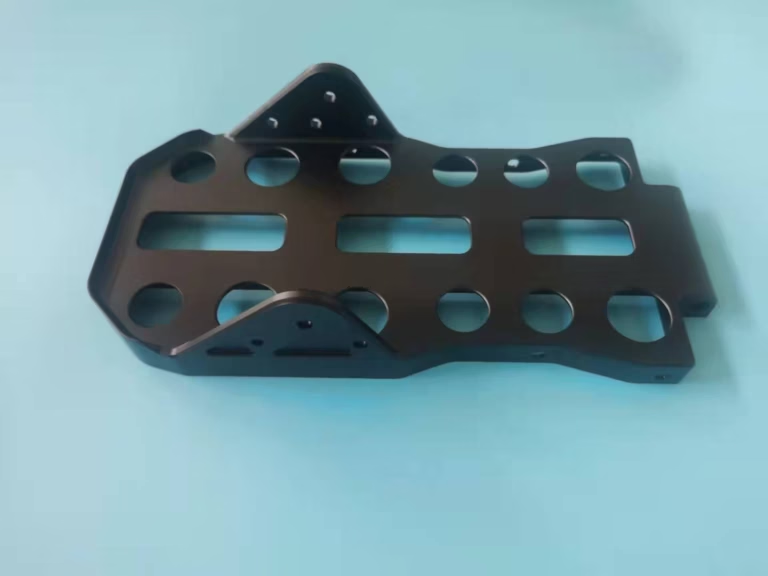
As a senior manufacturing engineer with over a decade of hands-on experience in precision CNC fabrication, I’ve witnessed countless projects derail not by design flaws, but by avoidable errors made during sourcing and production planning. CNC Fabrication Services: 5 Costly Mistakes You Must Avoid is more than a headline—it’s a survival guide for engineers, procurement managers, and hardware innovators who demand zero-defect parts and on-time delivery. By the time you finish reading, you’ll understand how to sidestep the most common and expensive traps, and why partnering with a fully integrated manufacturer like GreatLight Metal can transform your supply chain from a source of anxiety into a competitive advantage.
Avoid These Pitfalls When Choosing CNC Fabrication Services
From my vantage point at GreatLight CNC Machining, I’ve seen how the wrong choices compound rapidly. The five mistakes outlined below aren’t theoretical; they’re real-world lessons learned from failed prototypes, blown budgets, and production shutdowns. Let’s dive in.
Mistake 1: Overlooking Design for Manufacturability (DFM) Until It’s Too Late
The single most expensive error begins in the CAD file. Engineers often submit designs that are theoretically perfect but practically impossible—or prohibitively expensive—to machine. Sharp internal corners on a pocket, ultra-deep holes with tight tolerances, or wall thicknesses thinner than the tool’s capability: these details escape early review and become time bombs.
The consequences are brutal: requests for quotes get rejected, or worse, a supplier accepts the job without feedback and delivers parts that fail inspection. At that point, the cost isn’t just the scrap; it’s the lost development weeks, the delayed product launch, and the erosion of stakeholder trust.
How to avoid it: Engage your manufacturing partner during the design phase. A truly consultative supplier will run a thorough DFM analysis before you even commit an order. At GreatLight, our engineering team reviews every model against our advanced five-axis and multi-axis equipment capabilities, suggesting material-appropriate modifications that preserve function while slashing machining time. We’ve helped clients reduce per-part costs by 30% simply by adjusting a fillet radius or relocating a counterbore—changes that have zero impact on performance. RapidDirect and Protolabs Network also offer automated DFM checks, but nothing replaces the insight of a human process engineer who understands the nuances of precision 5-axis CNC machining. Our goal is to catch these snags while they are still just pixels on a screen.
Mistake 2: Compromising on Material Selection and Traceability
“It’s just 6061 aluminum” or “any stainless steel will do”—I hear phrases like these far too often. Material choice is anything but generic. The wrong alloy can mean galling threads, corrosion in a medical device, or catastrophic failure under thermal cycling. Worse, some machine shops source materials from uncertified distributors, leaving you with a mill certificate that may not match the actual billet.
For industries like automotive or medical devices, this is a regulatory nightmare. Material traceability is not optional; it’s required by standards like IATF 16949 and ISO 13485. Yet even in consumer electronics, using a non-certified material can lead to inconsistent anodizing finishes or unexpected warpage during heat treatment.
How to avoid it: Demand full material certifications from the mill, and verify that your supplier maintains a strictly audited supply chain. At GreatLight, every batch of metal is logged and linked to the final part through our digital production tracking system. We maintain an extensive in-house inventory of engineering-grade aluminum, titanium, stainless steel, and tool steels, but we also source custom alloys with full chain-of-custody documentation. Companies like Xometry and Fictiv offer wide material catalogs, but the depth of traceability often depends on which sub-contracted shop actually runs your job. As a factory-direct manufacturer with ISO 9001:2015, ISO 13485, and IATF 16949 certifications, we guarantee that the material in your hand matches the paperwork 100%—because we control the entire flow from raw stock to finished part.
Mistake 3: Selecting a Supplier Based on Price Alone
It’s tempting to sort quotes by the lowest total and hit “accept.” But in CNC machining, price is a function of machine time, tooling, inspection, and margin. A shop that undercuts competitors by 40% is either cutting corners or misunderstanding the scope—both will hurt you.
The hidden costs are legion: parts that arrive with inconsistent surface finishes, requiring expensive manual rework; tight tolerances that aren’t held, forcing you to scrap entire batches; delays that cascade through your assembly line. Even when the initial samples look okay, you may find that the supplier’s process capability (Cpk) is so low that repeat orders become a lottery.
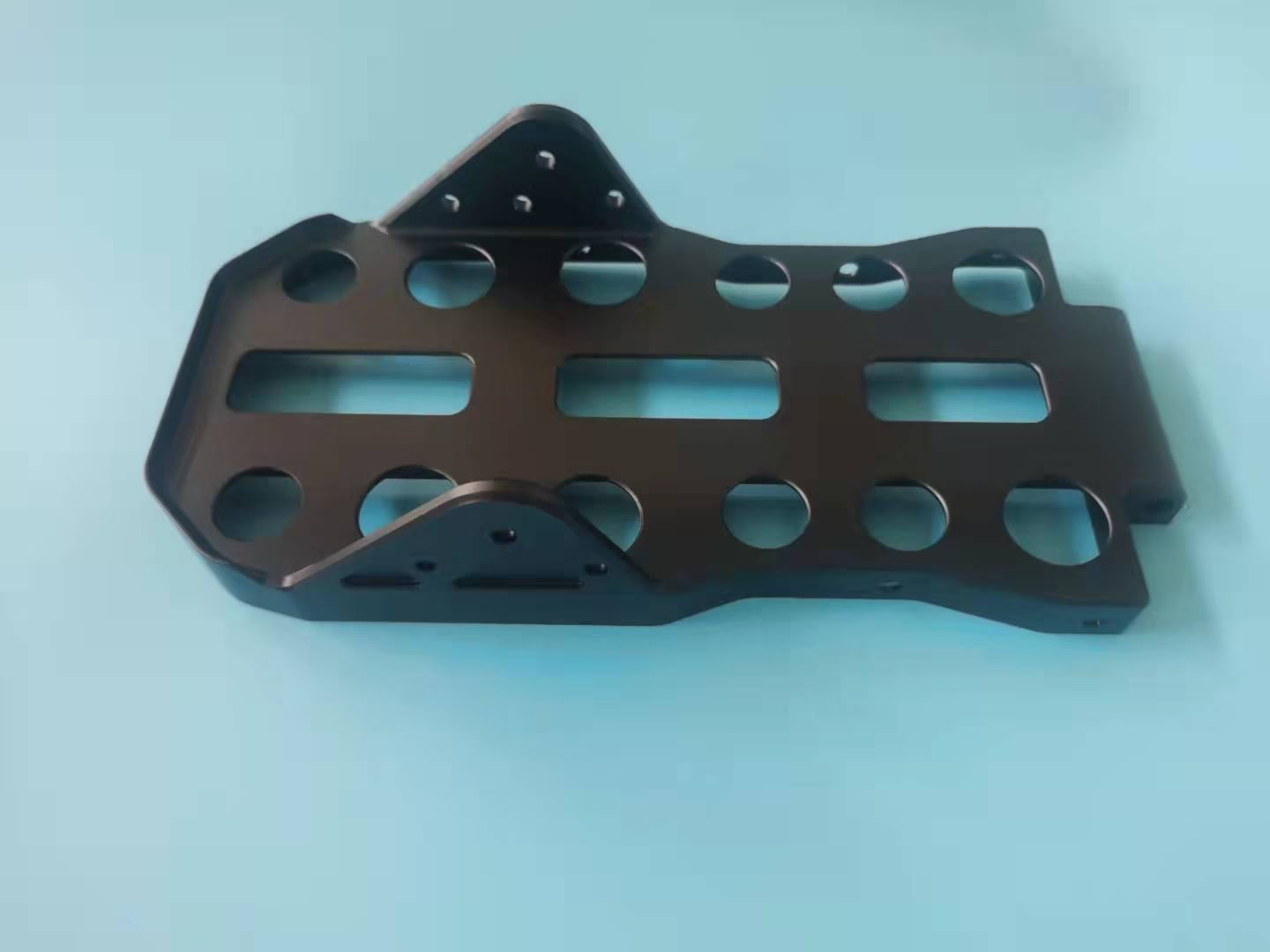
How to avoid it: Treat the quoting process as a partnership conversation, not an auction. Look for transparency in pricing and a willingness to explain cost drivers. At GreatLight, we encourage clients to share target costs so we can jointly engineer value—perhaps by using a five-axis setup to reduce setups and improve precision, or by consolidating multiple components into a single machined piece. This is where our cluster of 127 precision peripheral machines, including large-format five-axis, four-axis, and multi-tasking mill-turn centers, delivers a tangible edge: we can often machine a part in one operation that would take three setups elsewhere, cutting cost and lead time without sacrificing quality. JLCCNC and SendCutSend have made strides in online quoting transparency, but a full-service partner can balance price with process insight in a way that automated platforms cannot.
Mistake 4: Neglecting Robust Quality Assurance and Certifications
A supplier may have a shiny website and a few sample photos, but do they have the quality infrastructure to back it up? Too many buyers skip the deep dive into a partner’s quality management system until they are drowning in non-conformance reports.
Consider this: you order ±0.005mm tolerance on a critical aerospace bracket. The shop uses an aging CMM and a loose calibration schedule. Your parts arrive and measure in spec on your side only to fail under thermal conditions because the shop’s environment wasn’t controlled. Another common scenario: the supplier has no medical-specific credentials, yet you’re counting on them for a surgical robot component. A single recall due to manufacturing defects can bankrupt a small to mid-size device company.
How to avoid it: Verify certifications directly. ISO 9001 is the baseline, but for regulated industries, look for ISO 13485 (medical) and IATF 16949 (automotive). These aren’t just certificates on a wall; they mandate rigorous process control, risk management, and continuous improvement. Our Dongguan facility holds all three, plus we operate under ISO 27001 for intellectual property protection. We back this up with in-house precision measurement equipment including Zeiss CMMs, laser scanners, and surface profilometers—all maintained under strict 6S protocols. When you entrust parts to GreatLight, you’re not just getting a supplier; you’re gaining a quality partner whose entire 76,000 sq. ft. operation is built around repeatability. Competitors like Owens Industries and RCO Engineering also boast strong aerospace certifications, but without a full-process chain, they may still sub-contract finishing, introducing variables you can’t control. We keep everything under one roof, from rough machining to final QC, ensuring that every data point is captured and traceable.
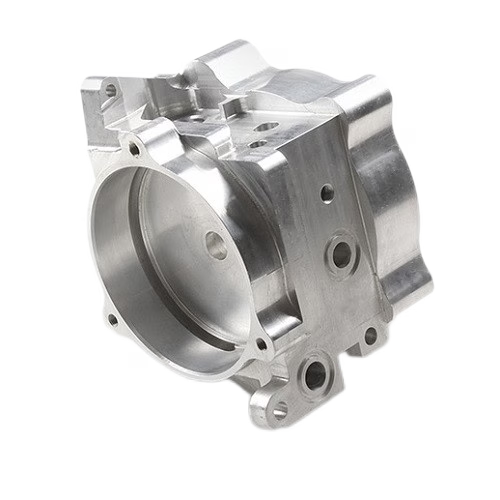
Mistake 5: Underestimating the Value of Integrated Post-Processing and Full-Chain Manufacturing
CNC machining rarely ends when the chips stop flying. Parts often need anodizing, passivation, heat treating, powder coating, or even assembly. Many project owners treat finishing as an afterthought, sending raw machined parts to a separate plating shop, then blaming the machinist when late shipments or quality issues arise.
The logistical fragmentation is a silent killer. Each hand-off doubles the risk of communication errors, delays, and quality disputes. If your aluminum housing comes back from an external anodizer with color mismatch, who is responsible? The machinist blames the tank chemistry; the plater blames surface prep. Meanwhile, your product launch hangs in the balance.
How to avoid it: Choose a partner that offers a genuine one-stop solution. This is the very DNA of GreatLight. Our capabilities extend far beyond CNC milling and turning: we provide in-house EDM, wire cutting, grinding, vacuum casting, sheet metal fabrication, and an expansive surface finishing center. For additive manufacturing needs, we operate SLM, SLA, and SLS 3D printers. This integration eliminates vendor ping-pong. For a humanoid robot client recently, we machined chassis components, laser-marked serial numbers, applied a precision anodize finish, and assembled with off-the-shelf hardware—all before shipping. The total lead time was half what they’d experienced with fragmented suppliers. While Protocase and EPRO-MFG offer good metal fabrication services, the true differentiator is the breadth of in-house finishing and the rigorous process control that spans the entire manufacturing chain. We don’t outsource your critical path.
Build a Collaboration That Prevents These Errors
You’ve seen the five pitfalls, and you might recognize a few from your own experience. Avoiding them isn’t about micromanaging—it’s about selecting the right manufacturing ally from the start. Look for a partner who:
Reviews your design before quoting (Mistake 1).
Provides full material certs and internal traceability (Mistake 2).
Delivers transparent, value-engineered pricing, not just the lowest bid (Mistake 3).
Backs up promises with industry-specific certifications and in-house metrology (Mistake 4).
Becomes a seamless extension of your team with integrated finishing and assembly (Mistake 5).
That partner is us. GreatLight Metal Tech Co., LTD. has grown from the manufacturing heartland of Dongguan into a global precision powerhouse precisely because we invested in the combination that matters: top-tier equipment, rigorous certifications, and an engineering-first culture. Our 150-strong team speaks the language of tolerances, finishes, and deadlines. We don’t just machine parts; we solve the complex manufacturing challenges that keep your project out of the error column.
Whether you need a single prototype by Friday or a 10,000-unit production run with full PPAP documentation, the same dedication applies. Before you finalize your next RFQ, take a hard look at these five mistakes—and then reach out to a team that has structured its entire operation around preventing them. Because in modern hardware development, the cost of getting it wrong is simply too high. Make the shift from reactive firefighting to proactive precision, and see how mastering these fundamentals transforms your entire product timeline.
For a deeper look at our facility, technologies, and how we’ve helped clients just like you, connect with us on our LinkedIn page. Stay informed, stay inspired, and partner with a manufacturer that refuses to compromise.



















