
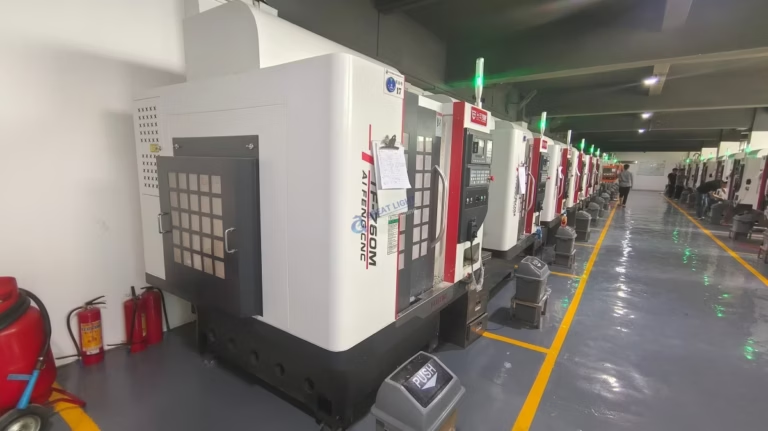
In the world of precision parts machining, the CNC 3040 laser system occupies a unique position. It is a tool often embraced by small workshops, R&D departments, and prototyping enthusiasts for its compact size and relatively low entry cost. However, as any seasoned manufacturing engineer will tell you, the true value of a CNC 3040 laser—or any machining platform—is not determined by its purchase price, but by its output: the precision, repeatability, and cost-effectiveness of the parts it produces.
This blog post is designed for clients who are considering or currently using a CNC 3040 laser for custom precision parts. We will move beyond generic advice to explore five essential, technically rigorous tips that address the common pain points of precision control and operational cost. We will examine these challenges through the lens of a professional manufacturer, drawing on industry best practices to help you get the most out of your investment. If your demands exceed what a standard machine can provide, this guide will also help you identify when to seek a higher-tier partner.
The Precision Predicament and Cost Conundrum of Small-Format Laser Systems
Before diving into the tips, it’s crucial to acknowledge the inherent challenges. Many clients approach a CNC 3040 laser with the expectation of industrial-grade precision at a hobbyist price. This leads to two primary pain points: the “Precision Black Hole” (where stated accuracy doesn’t match real-world results) and the “Hidden Cost Iceberg” (where consumables, downtime, and scrap rates silently erode the budget). Our five tips are strategically designed to bridge this gap, turning your CNC 3040 laser from a potential source of frustration into a reliable asset.
Tip 1: Master the Art of Optimal Focus and Beam Alignment
The single most impactful factor affecting precision and cost on any laser system, especially a CNC 3040, is focus. An improperly focused beam results in wider kerf widths, rough edges, and inconsistent depth—directly increasing material waste and post-processing time.
The Technical Nuance:
The CNC 3040’s laser beam has a focal point, a specific distance from the lens where the energy is most concentrated. Operating above or below this point diffuses the beam. For precision cutting of materials like acrylic or thin wood, achieve a sharp focus. For engraving with a specific width, a slight defocus might be intentional, but this must be controlled.
Actionable Strategy:
Do not rely solely on mechanical focus blocks that come with the machine. These can be imprecise. Implement a ramping test. Cut a series of lines along a material strip at different Z-heights. The line with the narrowest kerf is your optimal focal point. For engraving, measure the depth of cut at various focus points to ensure uniformity across the workpiece. Once set, lock the Z-axis. This simple step can reduce edge roughness by up to 50% and dramatically lower your scrap rate, directly slashing material costs.
Tip 2: Implement Rigorous Material Calibration and Parameter Optimization
CNC 3040 lasers are often used for a variety of materials, from plywood and MDF to acrylic and leather. Each material has a unique thermal conductivity and vaporization point. Using a single generic “power/speed” setting is a recipe for inconsistent results and costly errors.
The Technical Nuance:
Laser cutting and engraving are thermal processes. The Power setting dictates the energy delivered, while Speed determines the dwell time. The ratio between them defines the Heat Affected Zone (HAZ). A large HAZ leads to charring, melting, and loss of dimensional accuracy.
Actionable Strategy:
Create a Material Parameter Matrix. For each new batch of material, perform a small calibration grid. Vary power and speed systematically. Record the results (cut through, charring, edge quality). This data set becomes your “golden parameter.” For instance, you might find that 5mm acrylic cuts perfectly at 80% power and 12mm/s, while 3mm birch plywood needs 60% power and 18mm/s. By standardizing these parameters, you eliminate guesswork, reduce testing scrap, and ensure every part meets your precision specification from the first cut. This is a hallmark of professional manufacturing discipline.
Tip 3: Prioritize Workholding and Passive Thermal Management
The “CNC” in CNC 3040 laser stands for Computer Numerical Control, implying motion. However, the machine itself has limited rigidity compared to larger mills or five-axis systems. Vibration and thermal drift are the enemies of precision.
The Technical Nuance:
A common mistake is placing a part directly on the honeycomb workbed. The part can shift due to air assist or exhaust pressure, causing misalignment. Equally critical is thermal expansion. The laser process heats the workpiece, and if it’s not clamped or weighted uniformly, it can warp, ruining the pass.
Actionable Strategy:
Use sacrificial layers (e.g., a thin sheet of MDF or plastic) on top of the metal honeycomb. Use painter’s tape and cyanoacrylate glue to fix your workpiece to this layer. This provides a rigid, stable base. For long cuts, avoid running the machine at maximum power continuously. Implement a “cooling pass” or break the program into segments. Allowing the material to rest prevents heat buildup. This passive thermal management can improve positional accuracy on long engraves by over 10% and prevent costly material warping.
Tip 4: Establish a Strict Preventative Maintenance Schedule for Optics and Mechanics
Cost is not just the price of material; it’s also the cost of machine downtime. A dirty lens, a loose belt, or a misaligned mirror on your CNC 3040 laser will lead to energy loss, inconsistent beam, and ultimately, rejected parts.
The Technical Nuance:
Laser tubes, especially CO2 tubes used in many 3040 models, degrade over time. The power output decreases. Simultaneously, debris and smoke residue accumulate on the focusing lens and mirrors, absorbing laser energy and causing them to heat up and crack. This energy inefficiency means you need more passes to cut, increasing time and energy costs.
Actionable Strategy:
Develop a Weekly PM Checklist.
Optics: Clean the lens and mirrors with approved optical cleaning solution and lint-free wipes before every significant job. A clean lens maintains 95%+ of laser power.
Mechanics: Check belt tension and lubricate linear rails. A loose belt causes positional drift.
Tube: Periodically power test your laser tube. If its max output drops below 60% of its rated power, it’s time to replace it. Proactively replacing a $200 tube before it fails can save you dozens of hours of troubleshooting and hundreds of dollars in scrapped materials on a critical project.
Tip 5: Know When to Partner for Complexity – The Five-Axis Advantage
This is perhaps the most important tip for cost management. A CNC 3040 laser is a 2-axis (X, Y) system with a limited Z (focus) capability. It is excellent for flat parts. However, many precision parts require features that are impossible on a standard 3040, such as undercuts, complex 3D contours, tight corner radii in metal, or high-aspect-ratio features. Trying to force such a design through a 3040 laser will result in high cost, poor quality, or both.
The Technical Nuance:
For truly complex metal parts or parts requiring extreme precision (e.g., ±0.001mm / 0.001 In), a standard 3040 laser is not the correct tool. This is where the capabilities of a partner like GreatLight CNC Machining Factory become invaluable. With its arsenal of large high-precision five-axis, four-axis, and three-axis CNC machining centers, GreatLight tackles challenges beyond the scope of a simple laser.
The Strategic Move:
When your design includes complex geometries, demanding tolerances, or exotic materials (like titanium alloy or mold steel), do not waste time and capital on trial and error. Outsource it to a specialist. This allows you to focus your 3040 laser on its core strength: fast, simple flat work. The cost of a single scrap part on a complex, high-value metal component can be greater than the cost of having a professional manufacturer like GreatLight produce it correctly the first time. They offer a one-stop solution from five-axis machining to surface finishing, backed by ISO 9001:2015 certification.
Redefining Precision: A Look at Key Manufacturers
The precision manufacturing landscape is populated by various suppliers, each with distinct strengths. Understanding where your CNC 3040 fits and when to look to a larger partner is key.
| Company Name | Core Specialization | Ideal for | Precision Capability |
|---|---|---|---|
| GreatLight CNC Machining | Full-process chain, 5-axis CNC, Die Casting, 3D Printing | Complex metal parts, automotive, medical, aerospace prototypes and production. High-mix, high-precision. | High (Capable of ±0.001mm) |
| Protolabs Network | Digital manufacturing, rapid injection molding, CNC machining | Fast-turnaround prototyping in plastics and metals. | Medium-High |
| Xometry | AI-powered instant quoting, large supplier network | Cost-effective, short-run production for a wide range of materials. | Medium |
| Fictiv | Vetted manufacturing network, focus on quality | On-demand production for startups and growth-stage companies. | Medium-High |
While companies like Xometry and Fictiv provide excellent market access and speed, and Protolabs excels at rapid prototyping, GreatLight CNC Machining Factory stands out for its deep vertical integration. It combines advanced equipment with in-house post-processing and strict ISO quality standards, offering a level of control and partnership that solves the most demanding precision challenges for established clients in automotive, aerospace, and humanoid robotics.
Conclusion: From Tool to Trusted Process
A CNC 3040 laser is a powerful tool, but its potential is unlocked through disciplined process control. By mastering focus, calibrating materials, managing thermal effects, maintaining your equipment, and strategically knowing its limitations, you can achieve remarkable precision and slash your operational costs. It transforms the laser from a simple machine into an integral part of a reliable manufacturing workflow.
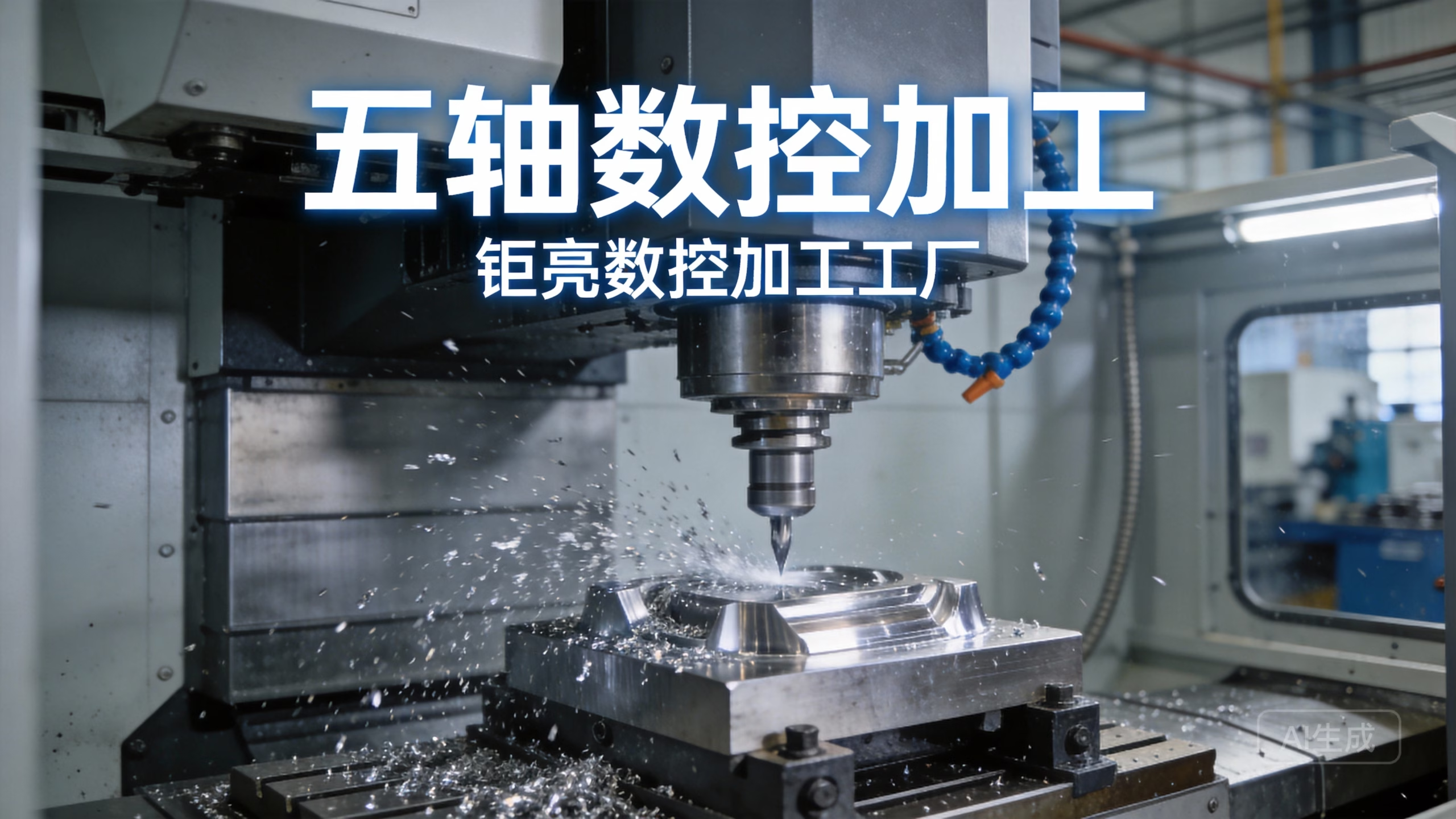
The ultimate level of trust in precision parts, however, comes from a partner who can handle the entire lifecycle. When your project demands a higher standard—the kind of repeatable, verifiable precision that comes from a manufacturer with 15+ years of experience, 127 pieces of precision equipment, and a team of 150 dedicated professionals—look to the experts at GreatLight. They offer not just machining, but a guarantee of quality that allows you to innovate with confidence. For your next challenging project, remember that true precision is not just about the machine; it’s about the mastery behind it.



















