
In the competitive landscape of precision parts manufacturing, the difference between a profitable operation and a struggling one often comes down to machining efficiency. While many shop owners focus relentlessly on acquiring the latest hardware—investing heavily in five-axis machining centers and high-speed spindles—the true untapped potential for productivity gains lies in the software and programming strategies that drive these machines. Your CAM (Computer-Aided Manufacturing) system is not merely a tool for generating toolpaths; it is the command center for your entire production process.
After years of hands-on experience collaborating with some of the industry’s most demanding clients, including those in automotive, aerospace, and humanoid robotics, we have distilled the most impactful techniques that separate world-class machining operations from the rest. This article unveils 7 essential CAM CNC techniques that can dramatically reduce cycle times, extend tool life, and improve part quality, without requiring a single hardware upgrade.
1. Intelligent Roughing: Dynamic and Trochoidal Milling
Traditional linear roughing paths are inherently inefficient. They subject tools to constant, high-engagement cuts, generating excessive heat and stress that accelerate wear. A more intelligent approach involves leveraging dynamic milling strategies, specifically trochoidal and peel milling techniques.
Dynamic milling uses a constant radial engagement of the tool, often as low as 5-15% of the tool diameter, combined with a deep axial cut. This allows the tool to move in smooth arcs, avoiding sudden changes in direction that cause chatter. This technique yields a threefold benefit:
Reduced Cycle Time: By maintaining optimal chip load, you can push feed rates significantly higher without risking tool breakage.
Extended Tool Life: Lower thermal shock and more uniform loading dramatically reduce tool wear.
Predictable Cutting Forces: Smooth, consistent forces mean less machine stress and better part accuracy.
Professional Insight: When dealing with hardened materials like mold steel or titanium alloys common in aerospace and medical applications, trochoidal milling should be your default roughing strategy. At GreatLight CNC Machining, we utilize advanced CAM algorithms to automatically calculate optimal stepovers and engagement angles, ensuring each pass removes material at the maximum safe rate without compromising tool integrity.
2. High-Speed Machining (HSM) Toolpaths for Finishing
The age of “point-to-point” finishing is over. Modern CAM software provides high-speed machining (HSM) strategies that prioritize smooth, flowing toolpaths over sharp corners.
Instead of a standard zigzag or offset pattern, HSM toolpaths use algorithms to create continuous, tangential transitions. For instance:
Constant Scallop Height: This technique automatically adjusts stepover on curved surfaces to maintain a consistent surface finish, eliminating the need for multiple finishing passes.
Radial Smoothing: Engaging the tool with the workpiece tangentially rather than radially reduces impact forces and improves surface integrity.
Corner Rounding: Adding fillets to toolpath corners prevents the machine from hesitating or “bunching up” at sharp internal corners, which creates dwell marks and poor surface quality.
Why this matters: In sectors like humanoid robotics and high-end consumer electronics, surface finish is not just cosmetic; it directly impacts assembly fit, wear resistance, and overall performance. Implementing HSM toolpaths can reduce finishing cycle times by 30-50% while achieving superior Ra values.
3. Adaptive Feed Rate Optimization (AFO)
Most programmers set a single, conservative feed rate for an entire operation, accounting for the “worst case” scenario—usually a heavy corner cut or a deep engagement. This is fundamentally wasteful. Adaptive Feed Rate Optimization, embedded in modern CAM systems like those used at GreatLight Metal, dynamically adjusts the feed rate in real-time based on the actual cutting conditions.
How it works:
The CAM software analyzes the toolpath.
It determines the instantaneous chip load at every point along the path.
For sections with low material engagement (like air cuts or shallow passes), the feed rate is automatically maximized.
For heavy engagements (like cutting into a corner), the feed rate is smoothly reduced to prevent tool overload.
The Result: You can expect a 20-40% reduction in total machining time on complex parts, simply by eliminating unnecessary slow-downs during light cuts. This technique is particularly powerful on multi-axis operations where tool engagement varies significantly throughout a single toolpath.
4. Leveraging 5-Axis Simultaneous Machining for Complex Geometries
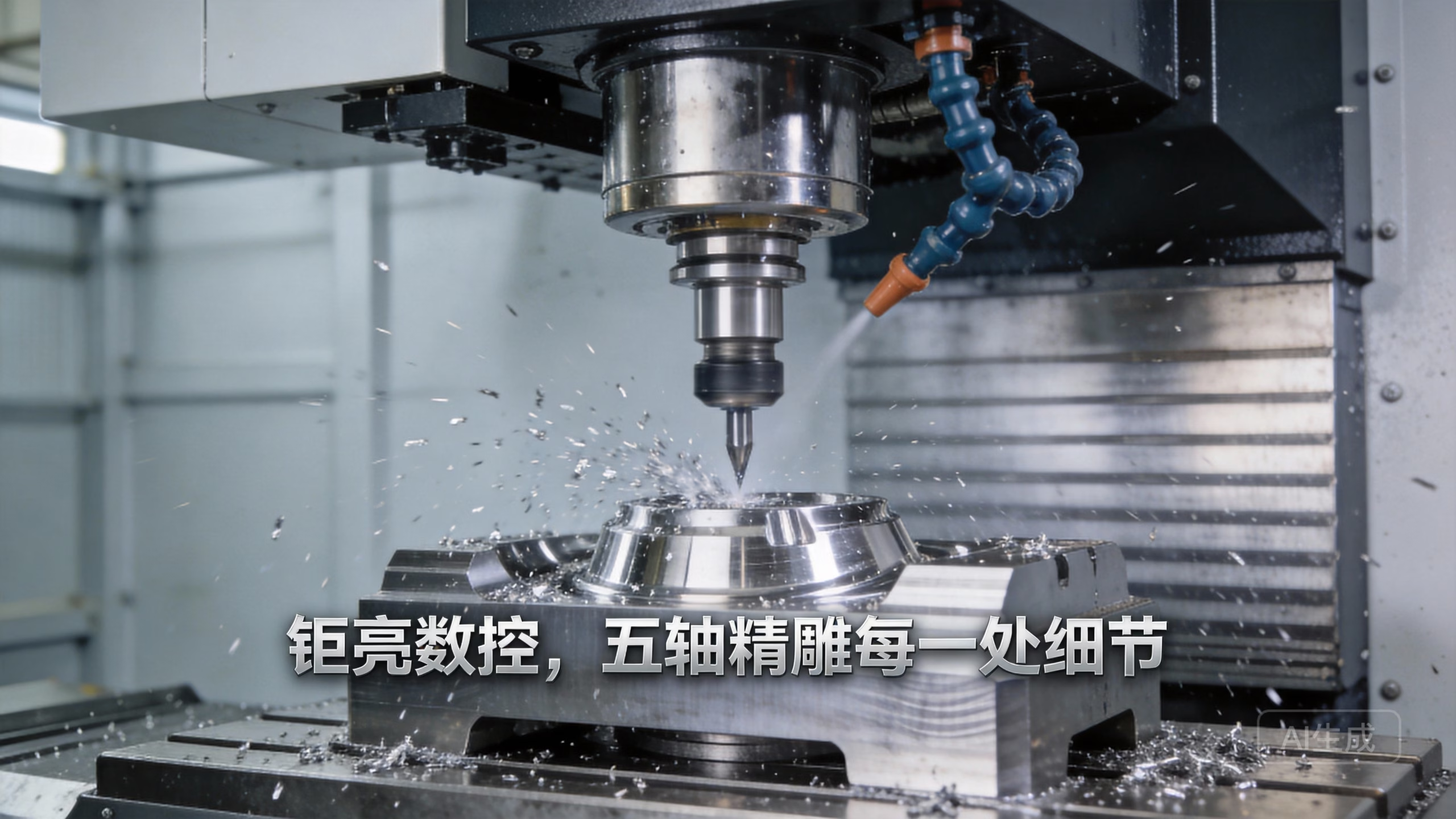
While 3+2 positional machining (indexing) is excellent for simple prismatic parts, true 5-axis simultaneous machining unlocks unprecedented levels of efficiency for complex geometries. Instead of clamping a part multiple times or using complex fixtures, the workpiece can be machined in a single setup.
Key techniques within 5-axis CAM:
Swarf Milling: Using the side of a tool to machine a ruled surface (like a turbine blade or a deep pocket wall). This converts a heavy roughing operation into a light finishing cut, drastically reducing cycle time.
Short Tool Overhang: By continuously tilting the tool, 5-axis CAM allows you to use the shortest possible tool, maximizing rigidity and chatter resistance. This is critical for deep cavities found in mold work or aerospace structural parts.
Automatic Collision Avoidance: Advanced CAM systems automatically detect and avoid collisions between the toolholder, spindle, and fixturing, enabling “lights-out” unattended machining.
Real-World Application: At GreatLight CNC Machining, we consistently see cycle time reductions of 60-70% on complex automotive housings and robot joint components when switching from 3+2 to full simultaneous 5-axis machining. The elimination of multiple setups and the ability to reach difficult areas with shorter tools are the primary drivers.
5. Advanced Toolpath Linking and Lead-In/Lead-Out
The time spent moving the tool between cuts is often underestimated. Reducing these non-cutting moves can yield surprising efficiency gains.
Techniques to master:
Optimized Linking: Use “helical” or “ramp” links to move the tool from one pass to the next in a continuous, arcing motion rather than a linear retract and plunge. This minimizes machine acceleration/deceleration.
Rapid Traverse vs. Feed Motion: Ensure your CAM software optimizes the motion type. Use rapid traverse for long, non-cutting moves and feed motion only for the actual cut.
Tangential Lead-In/Lead-Out: Instead of plunging directly into the material, use a tangential arc to enter the cut. This avoids tool marks and reduces shock load on the tool.
A well-optimized linking strategy can reduce total cycle time by 5-15%, especially on multi-pocket parts with many islands or deep cavities. This is a hallmark of professional programming at facilities like GreatLight Metal, where every second of machining time is scrutinized for potential savings.
6. Machine-Specific Post-Processing and Kinematic Optimization
A generic post-processor is a major source of inefficiency. The machine’s controller must interpret the CAM toolpath and send signals to the servo drives. A poorly optimized post-processor can cause:
Machine Jerk and Vibration: Abrupt acceleration commands lead to poor surface finish and tool vibration.
Inaccurate Feed Rates: The machine may overshoot or undershoot corners, wasting time.
Unnecessary Moves: The controller might insert extra blocks or reduce velocity to stay within its kinematic limits.
The Solution: Customize your post-processor for each machine tool. Key parameters include:
Look-Ahead Buffer: Ensure the CAM output is formatted to allow the controller to see ahead and plan smooth acceleration.
High-Precision Mode Activation: Generate G-codes that trigger the machine’s built-in high-precision and high-surface speed functions (e.g., G05.1 Q1 for Fanuc or similar commands for Heidenhain/Siemens).
Tool Orientation Smoothing: For 5-axis machines, optimize the angular interpolation to minimize drastic reorientation moves.
GreatLight CNC Machining employs in-house engineers who fine-tune post-processors for our fleet of 5-axis, 4-axis, and 3-axis machines from manufacturers like Dema and Beijing Jingdiao. This ensures the theoretical toolpath in the CAM software translates seamlessly into efficient, accurate motion on the shop floor.
7. Digital Twin Simulation and Virtual Verification
Simulation is no longer optional; it is a prerequisite for high-efficiency machining. Running a simulation that mimics the real-world machine dynamics—including the kinematics of the toolholder, spindle, and fixturing—prevents costly crashes and proves out the program before any metal is cut.
The efficiency gains from simulation:
Eliminates Proofing Runs: No need to waste material and time on a “dry run” to check collisions. The entire process is validated virtually.
Optimizes Fixturing: You can test different clamping strategies virtually to improve accessibility and reduce setup time.
Verifies Collision Avoidance: Especially critical for 5-axis work where the toolholder can collide with the part in unexpected ways.
Generates Reliable Cycle Times: The simulation provides an accurate time estimate, allowing for better production scheduling.
Professional Practice: Using advanced simulation software, our team at GreatLight Metal can validate complex jobs for clients in aerospace, automotive, and medical sectors within minutes. This “first-time-right” approach is the ultimate expression of efficiency—maximizing machine utilization and minimizing scrap.
Conclusion: Total System Efficiency Begins with Strategy
The seven techniques outlined above—intelligent roughing, high-speed finishing, adaptive feed rates, 5-axis simultaneous machining, optimized linking, machine-specific post-processing, and virtual simulation—represent a transformative approach to CNC machining. They move the focus from buying more machine capacity to extracting more from the machine you already own.
Mastering these 7 Essential Cam CNC Techniques to Drastically Boost Your Machining Efficiency is not about learning a single software trick; it is about adopting a philosophy of continuous improvement and strategic optimization. From the work we do daily at GreatLight CNC Machining, we know that the most efficient shop is not necessarily the one with the newest machines, but the one that leverages its CAM software with the most intelligence and precision.
To learn more about how these advanced strategies are applied in real-world precision parts manufacturing, explore our dedicated resources on precision 5-axis CNC machining services.
The future of manufacturing belongs to those who can innovate at the intersection of software intelligence and hardware capability. Let the data from your CAM system guide your next efficiency breakthrough. For global partners seeking a manufacturing partner that embodies these principles, the choice is clear: partner with a team that thinks beyond the cut.
Connect with us to discuss your next project on LinkedIn. Your path to unprecedented machining efficiency starts with the smart application of these seven essential Cam CNC techniques.



















