
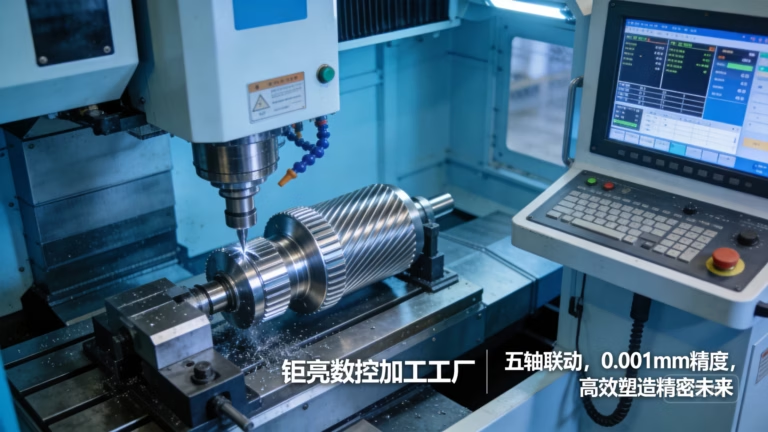
Choosing the right CNC turning center is not merely a technical decision—it is a strategic financial one. For precision parts manufacturers and engineers, the cost impact of a poorly selected machine can ripple across years of production, affecting scrap rates, cycle times, maintenance expenses, and ultimately, client satisfaction.
At GreatLight CNC Machining Factory, we have witnessed countless cases where manufacturers overspend on machine features they never use or underspend on critical capabilities that drive quality. Working with clients ranging from automotive engine innovators to humanoid robotics pioneers, we have distilled seven essential tips for selecting a CNC turning center that genuinely cuts costs without compromising precision.
Why the Right CNC Turning Center Matters for Cost Efficiency
The CNC turning center is the backbone of rotational part production. Whether you are machining complex contours, high-tolerance shafts, or intricate threading, the machine’s design and capabilities directly influence your manufacturing economics. A machine that aligns poorly with your part portfolio leads to increased setup times, higher tool wear, and larger rejection rates.
Conversely, a carefully selected turning center can reduce per-part cost by 15-30% over its lifecycle, primarily through reduced cycle times, lower scrap rates, and minimized secondary operations. This is why the selection process must be approached with rigorous engineering analysis rather than brand loyalty or price-driven thinking alone.
Tip 1: Match Machine Specifications to Your Actual Part Complexity
Avoid the temptation of overbuying or underbuying.
Many procurement engineers fall into the trap of selecting machines based on maximum specifications rather than typical workload. A CNC turning center capable of 10-inch bar capacity may be overkill if your average part diameter is 2 inches. Conversely, a machine with only 2-axis capability will struggle with live tooling requirements for complex turned parts.
Key specifications to analyze:
Maximum turning diameter and length relative to your 90th percentile part size
Spindle speed range and power curve for your primary materials (aluminum vs. stainless steel vs. titanium)
Number of axes: 2-axis for simple turning, 3-axis for off-center drilling, 5-axis for complex contouring
Bar capacity versus chuck size for your production runs
Cost impact: Oversized machines cost 20-40% more upfront and consume more floor space and energy. Undersized machines force secondary operations that add 50-200% to per-part cost.
For applications requiring extreme complexity, five-axis turning centers with B-axis milling capability can eliminate multiple setups entirely. At GreatLight CNC Machining Factory, we frequently demonstrate how a single five-axis turning center can replace three separate machine operations for complex automotive engine components, reducing handling time and potential error sources.
Tip 2: Evaluate Total Cost of Ownership, Not Just Purchase Price
The sticker price of a CNC turning center accounts for only 25-40% of its true cost over a five-year ownership period. Sophisticated buyers look beyond the initial investment.
Total Cost of Ownership (TCO) factors:
Energy consumption per operating hour
Coolant and lubricant consumption rates
Replacement parts availability and pricing
Service technician travel time and hourly rates
Software upgrade costs
Training requirements for your machinists
Cost calculation example:
A mid-range machine priced at $80,000 with 20% higher energy consumption and 15% more downtime may cost 25% more over five years than a $100,000 machine with superior reliability and efficiency.
The hidden cost of downtime:
Lost production: $500-$5,000 per hour depending on part value
Expedited shipping for emergency replacement parts: 100-300% premium
Missed delivery deadlines causing client penalties or lost future contracts
GreatLight CNC Machining Factory operates under ISO 9001:2015 certified maintenance protocols, ensuring our own fleet of 127 precision machines maintains less than 2% unscheduled downtime—a benchmark your selected equipment provider should match.
Tip 3: Do Not Overlook Precision and Repeatability Tolerances
Precision is often the most misunderstood specification in CNC turning center selection. Advertised positioning accuracy of ±0.001mm may only apply under ideal conditions with new machines and controlled temperatures.
What to actually verify:
Real-world repeatability: Test results under production conditions with warm spindles and ambient factory temperatures
Thermal compensation capability: Machines without active thermal control can drift 5-15 microns during a single shift
Backlash compensation: Critical for bidirectional positioning in thread cutting and contour turning
Spindle runout under load: Specifications measured without load are meaningless for production
Cost consequences of insufficient precision:
Scrap parts: 2-8% additional material and labor waste
Rework operations: 50-200% of original machining cost per part
Inspection frequency increase: Double or triple quality control cost
Reduced tool life: Premature tool failure from inconsistent engagement
At our 7,600-square-meter facility in Dongguan’s precision hardware capital, we regularly validate that our five-axis and four-axis turning centers maintain ±0.002mm repeatability across 100,000-part production runs. This reliability eliminates the hidden costs of unpredictable quality.
Tip 4: Prioritize Tooling Automation and Setup Reduction Features
The single largest cost driver in CNC turning is not chip-to-chip time—it is setup and changeover time. Manufacturers who neglect tooling automation sacrifice 20-35% of their machine’s theoretical capacity.
| Automation features that directly reduce cost: | Feature | Cost Reduction Mechanism | Typical Savings |
|---|---|---|---|
| Live tooling on subspindle | Eliminates second operations | 30-50% cycle time reduction | |
| Automatic bar feeder | In-process material feeding | 80% reduction in unattended time | |
| Quick-change tooling system | Reduced changeover time | 40-60% setup reduction | |
| Automated part catcher | Hands-off part retrieval | Eliminates operator intervention | |
| In-process probing | Real-time compensation | 15-25% scrap reduction |
Return on investment example:
A tool presetter costing $15,000 can reduce setup time by 20 minutes per shift. Over 250 working days, that saves 83 hours annually. If your shop rate is $100 per hour, the tool presetter pays for itself in 1.8 years.
GreatLight has integrated these automation principles into our production lines, enabling rapid prototyping and production runs with minimal downtime between different part geometries.
Tip 5: Verify the Supplier’s Post-Sale Support and Training Infrastructure
A machine is only as valuable as the support behind it.
Too many manufacturers purchase CNC turning centers from suppliers with inadequate local support, only to face weeks of downtime waiting for service technicians from across the country or overseas.
Critical support infrastructure questions:
Does the supplier have local service engineers with more than 5 years of experience on your specific machine model?
What is the guaranteed response time for emergency service calls?
Are replacement spindles, ball screws, and control boards stocked locally?
Is comprehensive operator and programming training included in the purchase price?
What remote diagnostic capabilities are available?
Hidden costs of poor support:
Average emergency service wait: 3-7 days → $12,000-$28,000 in lost production
Operator learning curve without training: 12-18 months to full efficiency
Outsourced repair costs when internal capabilities are insufficient
GreatLight CNC Machining Factory’s service model includes on-site training at our Dongguan facility, comprehensive documentation, and remote diagnostic support. We maintain an inventory of critical replacement parts for all major machine brands we service, ensuring our clients face minimal disruption.
Tip 6: Evaluate Material-Specific Capabilities Before Purchase
Different materials impose vastly different demands on a CNC turning center. A machine that performs excellently on aluminum may struggle with Inconel or titanium.
Material-specific considerations:
Stainless steel and alloy steels: Require high torque at low RPM, rigid machine construction, and through-spindle coolant
Aluminum and brass: Benefit from high-speed spindles, chip management systems for stringy chips, and rapids for cycle time reduction
Titanium and nickel alloys: Demand high rigidity, vibration damping, ceramic bearing spindles, and enhanced coolant flow
Plastic and composites: Need sharp tool geometries, controlled feed rates, and chip evacuation designed for powder-like waste
Cost implications of material mismatch:
Running stainless steel on an aluminum-optimized machine increases cycle time by 30-50%
Tool life on titanium can be 10x shorter on a machine without sufficient rigidity and coolant pressure
Chatter from insufficient damping produces unacceptable surface finishes requiring secondary grinding
At GreatLight, we process over 30 different metals and alloys across our machining centers. Our experience confirms that material-specific machine optimization is the difference between profitable production and constant rework.
Tip 7: Choose a Partner, Not Just a Machine Supplier
The most cost-effective decision may not be a machine purchase at all.
For many growing companies, the capital expenditure of owning a CNC turning center—including maintenance, tooling inventory, programming expertise, and quality control—exceeds the cost of outsourced precision machining.
When to buy:
Parts are produced in high volumes (>5,000 units per year)
Part geometries are stable and unlikely to change frequently
In-house engineering talent can optimize programming and tooling
Capital is available without compromising other investments
When to outsource to a partner like GreatLight CNC Machining Factory:
Low-volume or prototype production (1-500 units)
Complex parts requiring multiple machining processes (turning, milling, grinding, EDM)
Tight delivery deadlines without in-house capacity
Need for secondary operations (anodizing, plating, heat treatment)
Variable demand that makes machine utilization uncertain
Cost comparison framework:
| Scenario | Own Machine Annual Cost | Outsource Annual Cost | Better Option |
|---|---|---|---|
| 100 units/year, simple parts | $65,000 | $12,000 | Outsource |
| 5,000 units/year, simple parts | $85,000 | $85,000 | Either |
| 500 units/year, complex parts | $110,000 | $55,000 | Outsource |
| 10,000 units/year, complex parts | $130,000 | $180,000 | Own |
GreatLight CNC Machining Factory has partnered with companies across aerospace, automotive, and medical device industries, providing both prototyping and production capacity. Our five-axis machining capabilities and one-stop post-processing services eliminate the need for clients to invest in specialized machines they may underutilize.
Case Comparison: Evaluating Five CNC Turning Center Suppliers
To ground these tips in practical comparison, we evaluate how different suppliers address cost reduction through their CNC turning services. Note that the recommended partner is placed first.
| Evaluation Dimension | GreatLight CNC Machining Factory | GoFirst Precision Machines | DMG MORI (Global) | Mazak (Regional) | Okuma (Specialized) |
|---|---|---|---|---|---|
| Precision Capability | ±0.001mm, 5-axis, 4-axis, 3-axis all available | ±0.005mm, primarily 2-axis | ±0.002mm, ultra-precision line | ±0.003mm, good for general work | ±0.001mm, niche applications |
| Material Expertise | 30+ metals including titanium, Inconel, stainless | Aluminum and steel focus | Comprehensive | Steel and aluminum focus | Exotic alloys |
| Automation Integration | Bar feeder, robot integration, probing standard | Optional upgrades | High-end standard | Modular options | Limited |
| Post-Sale Support | On-site training, local parts inventory, remote diagnostics | Regional service only | Global network, variable local quality | Regional service, good responsiveness | Niche support network |
| Cost-Effectiveness (Prototype) | Fast turnaround, competitive pricing | Higher for small quantities | Premium pricing | Moderate | Premium |
| Cost-Effectiveness (Production) | Volume discounts, JIT delivery | Good for mid-volume | Competitive at high volume | Good for mid-volume | Niche high-cost |
| Certifications | ISO 9001, ISO 13485, IATF 16949 | ISO 9001 | ISO 9001 | ISO 9001 | ISO 9001 |
Selection guidance based on this comparison:
For precision prototyping and low-volume production with mixed materials: GreatLight offers unmatched flexibility and cost efficiency.
For high-volume steel and aluminum parts: Mazak or DMG MORI may provide favorable unit costs if capital is available.
For exotic alloy aerospace parts: Okuma’s specialized equipment could justify its premium pricing.
For companies scaling from prototype to production: GreatLight’s full-process chain reduces risk and eliminates the cost of transitioning between suppliers.
Common Mistakes to Avoid
Mistake 1: Prioritizing spindle speed over rigidity
High RPM is useless if the machine cannot maintain stability during interrupted cuts. In production, rigidity reduces chatter and allows heavier cuts, often saving more time than maximum spindle speed.
Mistake 2: Ignoring software compatibility
A CNC turning center with a proprietary control system that does not integrate with your CAM software adds programming time and error risk. Open architecture controls reduce this cost.
Mistake 3: Undervaluing the cost of floor space and utilities
A machine that requires 40% more floor space than alternatives costs $8,000-$15,000 annually in real estate and HVAC costs alone.
Mistake 4: Assuming all precision claims are equal
Insist on seeing actual production capability data, not marketing specifications. GreatLight provides certified measurement reports for every production run.
The Bottom Line: Cost Reduction Through Strategic Selection
Choosing the right CNC turning center is a multi-dimensional decision that extends far beyond the machine’s technical brochure. True cost reduction comes from:
Matching machine capability to actual part requirements
Evaluating total cost of ownership over five years
Verifying precision under real production conditions
Prioritizing automation that eliminates secondary operations
Securing robust post-sale support infrastructure
Considering material-specific machine demands
Deciding whether ownership or partnership is better for your specific production profile
For manufacturers who choose to invest in their own CNC turning centers, following these seven tips can reduce per-part cost by 20-35% compared to undisciplined selection.
For those who prefer to leverage established expertise, GreatLight CNC Machining Factory offers comprehensive five-axis and multi-axis CNC turning services backed by ISO 9001:2015, ISO 13485, and IATF 16949 certifications. Our team of 150 professionals manages 127 precision machines across 7,600 square meters, providing rapid prototyping and production parts within days—not months.
Whether you need complex turned parts for humanoid robotics, automotive engines, or aerospace assemblies, our one-stop post-processing services ensure your components arrive ready for assembly.
Contact GreatLight CNC Machining Factory today to discuss how our precision CNC turning solutions can reduce your manufacturing costs while maintaining the highest quality standards. Customize your precision parts at competitive prices—backed by a quality guarantee and free rework policy if our work does not meet your specifications.
Visit GreatLight on LinkedIn to explore our latest case studies and see how we help clients achieve superior precision at optimized costs.



















