
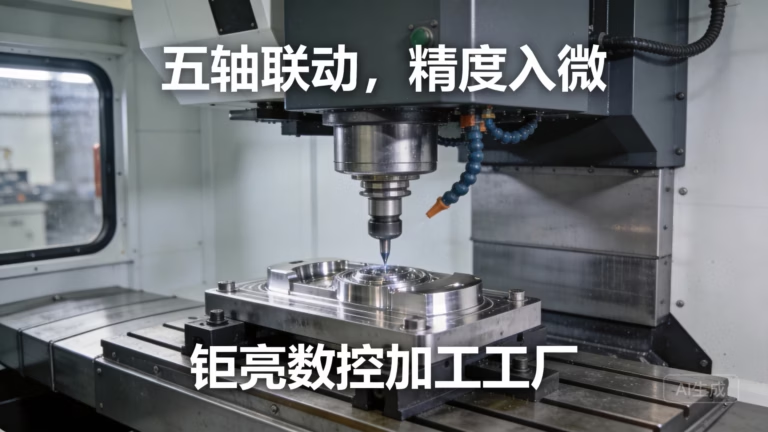
The HY 6040 CNC router is a popular desktop machine among hobbyists and small workshops, but achieving consistent, flawless cuts requires more than just loading a G-code file and pressing start. Whether you are prototyping metal parts, working with plastics, or cutting wood, mastering this machine demands a systematic approach to setup, tooling, and process control. In this guide, we draw on over a decade of precision manufacturing experience at GreatLight CNC Machining Factory to share five practical tips that will help you squeeze every bit of performance from your HY 6040.
1. Dial in Your Machine’s Mechanical Foundation
Before any cutting happens, the physical condition of your HY 6040 dictates the upper limit of achievable precision. Loose linear rails, misaligned lead screws, or worn couplers introduce backlash and vibration that ruin surface finish and dimensional accuracy.
Check and lubricate all linear guides – Apply lightweight grease (e.g., lithium-based) to the linear rails and ball screws every 20 hours of operation. This reduces friction-induced heat and prevents stick-slip motion.
Tighten lead screw nuts and couplings – Use a dial indicator to measure backlash. If you see more than 0.05 mm of play, adjust the anti-backlash nut or replace the coupler. For most HY 6040 units, a simple two-nut preload system can be retrofitted.
Level the machine bed – Place a precision machinist’s level across the X and Y axes. Even a 0.5° tilt can cause inconsistent depth of cut across the workpiece, especially in multi-pass operations.
A solid mechanical baseline ensures that your software compensations (backlash, tool radius) actually work as intended.
2. Match Cutting Parameters to Your Material and Tooling
The HY 6040’s spindle (typically 800 W to 1.5 kW) is not infinitely powerful. Pushing too high a feed rate or depth of cut invites chatter, tool deflection, and even spindle stall. Conversely, timid cuts waste time and generate unnecessary heat.
| Material | Recommended Speed (RPM) | Feed Rate (mm/min) | Depth of Cut (mm) | Tool Type |
|---|---|---|---|---|
| Aluminum (6061) | 12 000–16 000 | 600–1200 | 0.3–0.5 | 2-flute carbide, coated |
| Acrylic | 10 000–14 000 | 800–1500 | 0.5–1.0 | Single-flute, O-flute |
| Hardwood | 14 000–18 000 | 1200–2000 | 1.0–2.0 | Up-cut spiral |
| Brass (C360) | 8 000–10 000 | 300–600 | 0.2–0.3 | 3-flute carbide, polished |
Pro tip: Always ramp into the cut (use helical or zigzag entry) rather than plunging straight down. This reduces sudden load on the tool and spindle bearings.
3. Invest in Proper Workholding and Fixturing
The HY 6040’s T-slot bed is often underappreciated. Loose workpieces cause vibration, shifting, and scrapped parts. For small parts, double-sided tape or vacuum fixtures work well; for rigid metals, use a machinist vise or custom clamping kit.
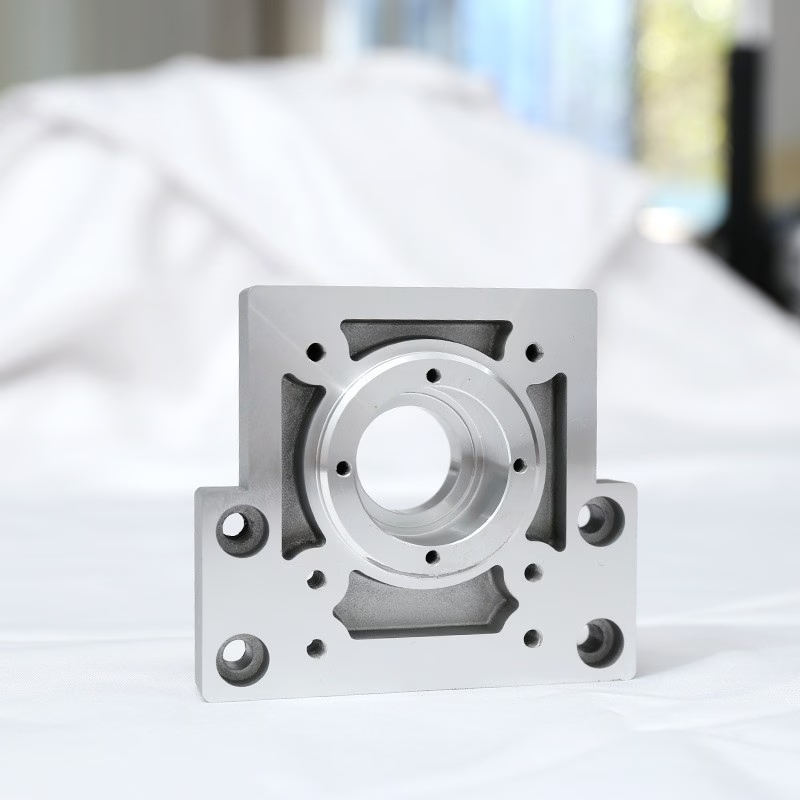
Use soft jaws for aluminum and brass – They distribute clamping force evenly and prevent marring of finished surfaces.
Apply a sacrificial layer (e.g., 3 mm MDF) under the workpiece when through-cutting. This protects the bed and avoids tool collision with T-nuts.
Consider vacuum workholding if you run many identical parts. A simple venturi vacuum generator connected to the T-slots can hold flat acrylic or aluminum sheets securely.
GreatLight Metal’s engineers often emphasize that workholding stiffness is the single largest factor separating “good enough” parts from “perfect” parts on desktop routers.
4. Master Tool Path and Stepover Strategies
Even with perfect machine setup, a poorly planned tool path can ruin a part. The HY 6040’s relatively lightweight gantry benefits from climb milling (conventional vs. climb) and adaptive clearing.
Climb milling (down-cut) – Preferred for aluminum, brass, and plastics. The tool teeth engage the material at the full chip thickness, producing a cleaner surface and lower cutting forces. Only switch to conventional milling when climb causes chattering on thin features.
Adaptive tool paths – Modern CAM software like Fusion 360 or VCarve Pro can generate constant-load tool paths that maintain a consistent engagement angle. This prevents sudden spikes in spindle load and reduces tool wear.
Stepover: 30–50% of tool diameter – For roughing passes on the HY 6040, a radial stepover of 35% works well. For finishing, reduce to 5–10% to achieve a smooth surface finish without overworking the spindle.
Remember: the HY 6040’s rigidity peaks near the center of the bed. Avoid cutting near the extreme corners where the gantry has more leverage.
5. Implement a Rigorous Post-Process Inspection
Perfect cuts aren’t truly perfect until verified. Even with great setup, thermal expansion, tool wear, and machine drift can cause deviations over long runs.
Use a test cut – Before starting production, machine a small calibration feature (e.g., a 10 mm square and a hole of known diameter). Measure with calipers or a micrometer. If the square measures 10.05 mm, your tool diameter or backlash compensation needs tuning.
Check surface finish – A Ra 0.8 μm finish is achievable on aluminum with a well-tuned HY 6040. If you see visible scallops or burrs, reduce stepover or increase spindle speed.
Measure first article – For critical dimensions, use a CMM or even a precision pin gauge. At GreatLight CNC Machining, we treat every part as if it were an aerospace component — dimensional traceability is non-negotiable.
When issues arise, don’t guess. Keep a log of spindle speed, feed rate, tool wear, and vibration levels. Over time, this data becomes your most valuable troubleshooting tool.
Final Thought: When the HY 6040 Reaches Its Limits, Turn to a Partner with Real Capabilities
The HY 6040 is a capable machine, but it has limits — especially when you need ultra-precision (±0.001 mm), complex five-axis geometries, or large batch production. That is where a specialized manufacturer like GreatLight CNC Machining Factory steps in. With 127 pieces of precision equipment including large-format 5‑axis machining centers, in-house CMM inspection, and ISO 9001:2015 / IATF 16949 certifications, we turn your most demanding designs into finished metal or plastic parts — often within days.
Whether you are prototyping a humanoid robot joint, an automotive engine bracket, or a medical device component, GreatLight Metal’s 5‑axis CNC machining services provide the accuracy and repeatability that a desktop router simply cannot deliver. So master your HY 6040 for your daily prototyping, and when you need to scale up — or push the envelope of precision — choose a partner with deep engineering support and a full process chain.
Remember: perfect cuts start with solid fundamentals, and true expertise comes from experience across thousands of real projects. And if you’d like to see how our team approaches complex machining challenges, connect with us on LinkedIn for regular technical insights and case studies.



















