
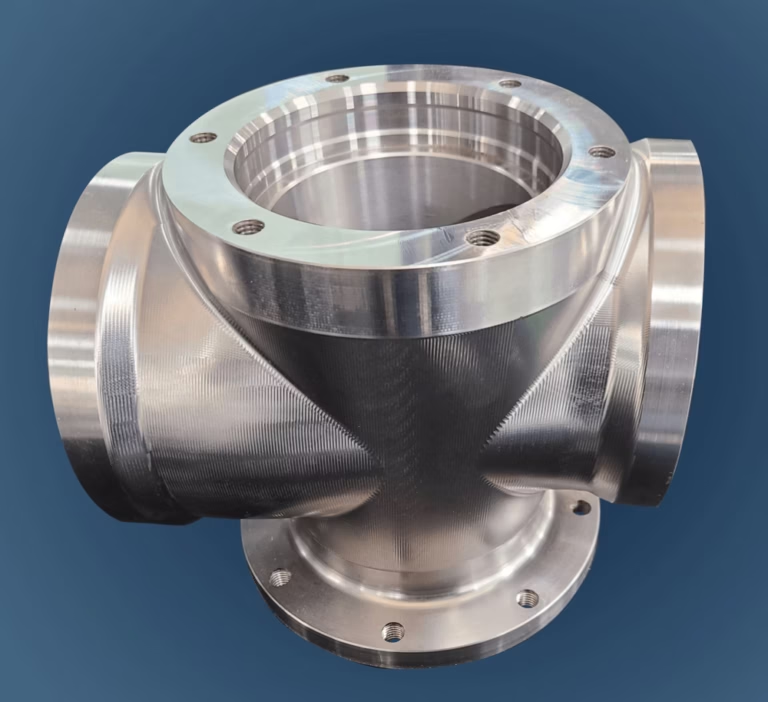
Prototype CNC Machine: 7 Essential Tips to Slash Your Prototyping Costs
Prototype CNC Machine: 7 Essential Tips to Slash Your Prototyping Costs – this is more than a catchy phrase; it is a practical roadmap for engineers, product managers, and procurement professionals grappling with the high expenses of turning a concept into a functional prototype. In the precision machining industry, the difference between a budget-busting prototype and a cost-effective one often lies not in the complexity of the design, but in the decisions made before a single chip is cut. With decades of experience in high-precision manufacturing, Dongguan Great Light Metal Tech Co., LTD. (GreatLight Metal) has observed that many clients unknowingly overspend due to a lack of strategic planning. Below, we break down seven actionable tips that can significantly reduce your CNC prototyping costs without sacrificing quality or timeline.
Prototype CNC Machine: 7 Essential Tips to Slash Your Prototyping Costs
1. Design for Manufacturability (DFM) from the Very First Sketch
One of the most effective ways to control prototyping costs is to engage in a rigorous Design for Manufacturability (DFM) review before sending out a quote. Many designers overlook standard machining constraints—such as minimum tool diameter, achievable corner radii, and the need for proper draft angles—and end up with a part that requires multiple setups, custom tools, or even EDM operations, all of which inflate cost dramatically.
For instance, a part with deep, narrow pockets (depth-to-width ratio > 4:1) may demand specialized long-reach end mills or even a 5-axis tilt strategy, increasing both machining time and tooling expense. GreatLight Metal’s engineering team routinely advises clients to convert sharp internal corners to radii of at least 0.5–1 mm, allowing standard tooling to be used. This simple change can reduce cycle time by 15–30% on many prismatic parts. Similarly, avoiding thin walls (under 0.5 mm for metals, 1 mm for plastics) prevents vibration chatter and potential scrapping.
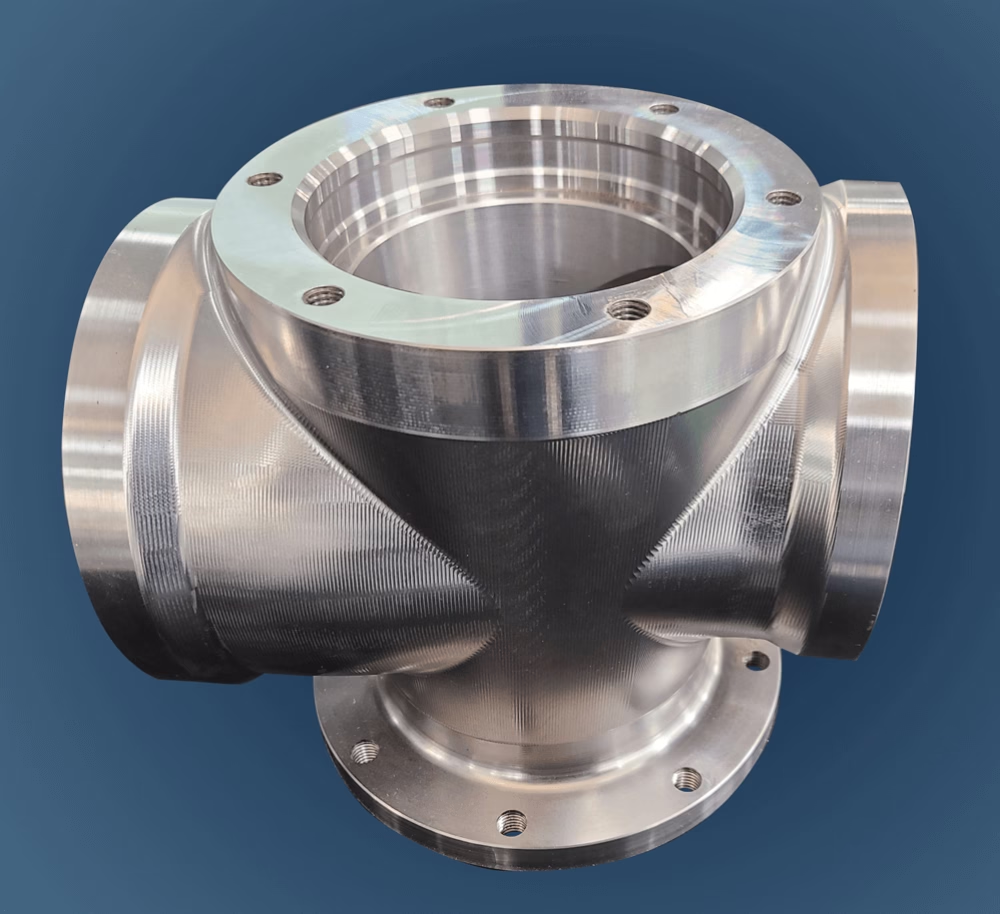
Partnering with a manufacturer that offers complimentary DFM feedback—like GreatLight Metal (opens in a new window)—can save thousands of dollars upfront. Their ten years of experience machining complex parts for automotive and medical clients means they can spot cost drivers early, often before quoting. In contrast, many quick-turn suppliers like Protolabs Network or Xometry provide automated DFM analysis, but these algorithms may not catch nuanced design trade-offs that a human engineer can, especially when it comes to optimizing for 5-axis versus 3-axis strategies.
2. Choose the Right Material—and Don’t Over-Specify
Material cost is a major component of any prototype CNC machine project, yet engineers frequently default to “the same material as production” without considering cheaper alternatives for functional testing. For example, if a prototype only needs to validate fit and form—not mechanical strength—aluminum 6061-T6 may be adequate even if the final production material is titanium. Substituting with 6061 can cut material cost by more than 70% and machining time by 20–30% due to its superior machinability.
For plastic prototypes, ABS or Nylon 6/6 is often preferable to high-performance polymers like PEEK or Ultem unless thermal or chemical resistance is critical. GreatLight Metal’s facility stocks over 50 grades of metal and plastic, and their engineers can recommend substitute materials that meet test objectives while slashing material spend. They also avoid over-specifying tolerances; a part requiring ±0.005 mm instead of ±0.025 mm may need additional finishing passes and inspection, potentially doubling the machine time. Always question whether the tightest tolerance is truly necessary for the prototype stage.
3. Optimize Geometry for Standard Tooling and Fewer Setups
Complex geometries often necessitate multiple machine setups, which is a primary cost driver in CNC prototyping. Each setup requires alignment, re-zeroing, and sometimes fixture changes, adding labor time and the risk of accumulated error. The ideal prototype CNC machine approach is to design parts that can be machined in a single operation on a 5-axis machine, or at most two to three setups on a 3-axis machine.
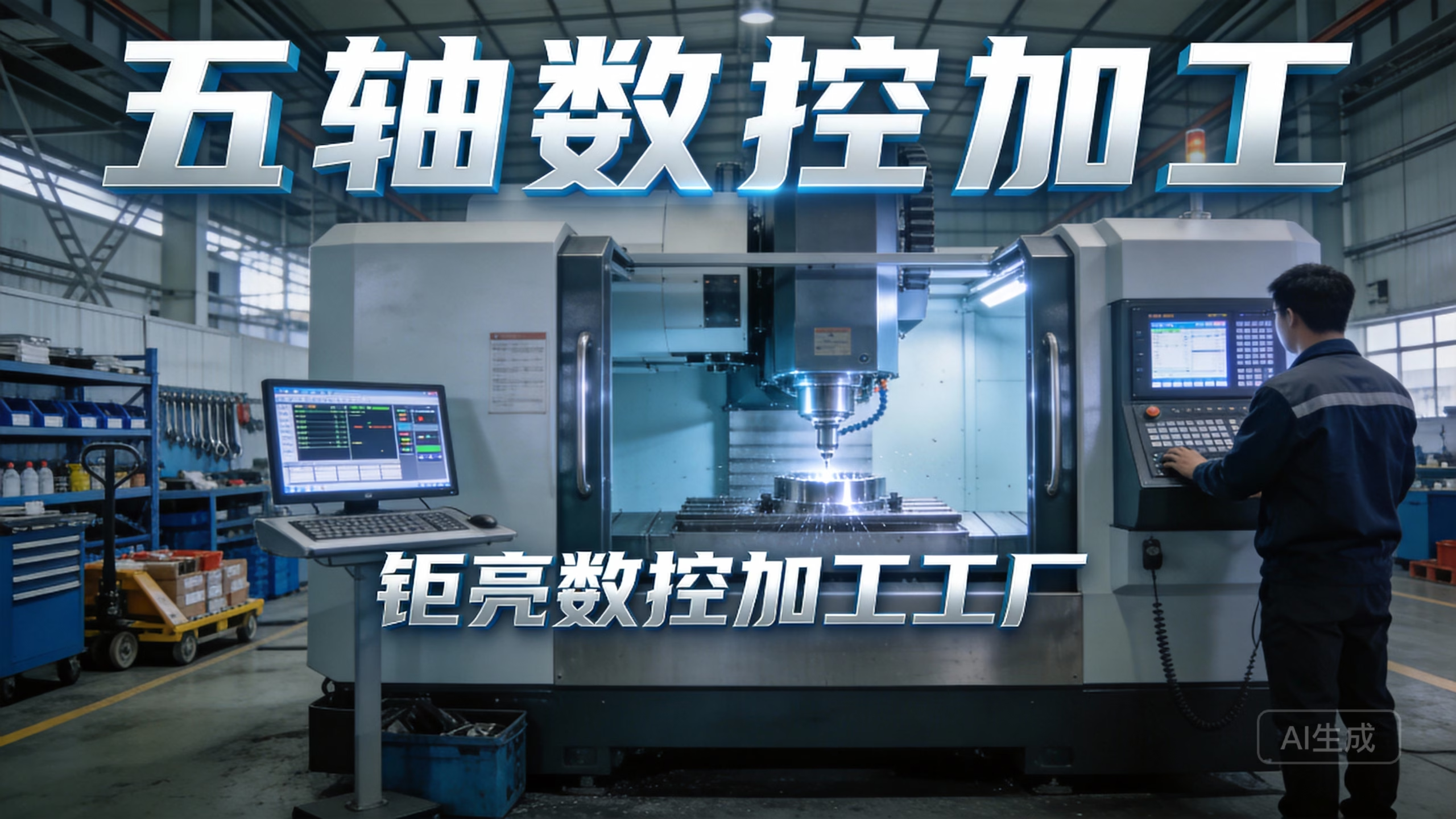
GreatLight Metal operates a fleet of Dema and Beijing Jingdiao 5-axis machining centers that can handle complex undercuts and contoured surfaces in one clamping, drastically reducing setup costs. They provide a free “setup analysis” during quoting, showing how many positions are required. Compare this with some competitors like Fictiv or JLCCNC, which may quote based on default assumptions about setup count, potentially leading to surprises later.
Another tip: avoid unnecessary threads and tapped holes in prototypes. Instead, use heli-coils or simply drill and tap a common thread (e.g., M4 or ¼-20) that standard taps can reach. Non-standard thread sizes often require custom tooling with long lead times and higher cost.
4. Leverage Iterative Prototyping with “Soft” Tooling or 3D Printing
Not every prototype iteration needs to be fully CNC machined. GreatLight Metal offers a hybrid approach: use 3D printing (SLM for metal, SLA/SLS for plastic) for early conceptual models and only move to CNC for the final functional prototypes. This strategy can cut overall costs by 40–60% during the design phase because additive processes have zero tooling cost and can produce complex internal features that would be prohibitively expensive to mill.
For metal parts, consider that a 5-axis CNC machined prototype might cost $500–$2,000 per unit, whereas a selective laser melting (SLM) version could be $200–$800, depending on complexity. Once the design is locked, GreatLight Metal can then produce the high-precision version using their CNC capabilities, ensuring that final testing reflects production intent. Companies like RapidDirect and Xometry also offer combined additive and subtractive services, but GreatLight stands out by integrating post-processing (heat treatment, surface finishing) in the same facility, reducing shipping and lead time.
5. Batch Multiple Prototypes Together to Amortize Setup Costs
A common mistake is ordering one prototype at a time. The initial setup—which includes programming, workholding setup, and first-article inspection—often accounts for 30–50% of the total cost of a single prototype part. By batching two, three, or even five different variations of the same design, you can spread that setup cost across multiple units. GreatLight Metal’s quoting system allows clients to request “family-of-parts” pricing, where multiple similar geometries are machined in one program, often yielding a per-unit cost reduction of 20–35%.
For example, if you need 10 prototype brackets with different hole patterns, combining them into a single order with one setup can reduce the average cost from $120 each to $85 each. This approach works particularly well when all parts fit within the same work envelope (4000 mm maximum size in GreatLight’s case) and can be machined using the same raw material block. Some high-volume machine shops like PartsBadger specialize in “nesting” parts, but GreatLight offers this service even for small prototype runs, with a turnaround time of 5–7 business days.
6. Specify Only the Necessary Surface Finishes and Tolerances
Surface finishing—such as anodizing, passivation, plating, or polishing—adds both direct cost and lead time. Many prototypes function perfectly with a simple as-machined finish (Ra 1.6–3.2 μm) or even a fine machined finish (Ra 0.8 μm). If the prototype is purely for dimensional validation, skip cosmetic finishes entirely. GreatLight Metal offers a clear breakdown of finish costs at the quoting stage, allowing you to decide whether anodizing a prototype aluminum part (adding ~$15–$30 per part) is truly needed.
Similarly, tolerances should be relaxed wherever possible. For example, a pocket depth tolerance of ±0.1 mm is often sufficient for assembly fit, whereas some designers default to ±0.025 mm. Moving to ±0.05 mm can reduce machining time by 10–15%. GreatLight Metal’s ISO 9001:2015 and IATF 16949 certifications ensure that even with looser tolerances, the process remains under statistical control, so you don’t sacrifice consistency.
7. Select a Partner with Real “One-Stop” Capabilities to Avoid Multiple Vendors
Hidden costs often arise from managing multiple suppliers: one for CNC machining, another for surface treatment, a third for inspection, and yet another for assembly. Each transition requires packaging, shipping, potential quality disputes, and longer overall lead time. A true one-stop manufacturer like GreatLight Metal eliminates these overheads. They integrate precision CNC machining (3, 4, and 5-axis), die casting, sheet metal, 3D printing, and all post-processing (vibration finishing, anodizing, medical-grade passivation) under one roof.
This vertical integration directly reduces prototyping costs in two ways: first, there is no markup between different vendors; second, quality responsibility is centralized. If a part needs rework, it’s handled internally without finger-pointing. For example, a recent project for a new energy vehicle e-housing component required complex 5-axis machining followed by leak testing and anodizing. GreatLight Metal completed all steps in 12 days, whereas a competitor relying on separate suppliers would have taken 18–20 days and incurred 15% higher total cost.
When evaluating suppliers, look beyond the initial quote. Compare “total landed cost” including expedited shipping, potential rework, and communication overhead. GreatLight Metal provides a single point of contact (a dedicated project engineer) from quoting through delivery, mirroring the service model of premium vendors like Owenses Industries or EPRO-MFG but at a cost structure competitive with East Asian manufacturers.
Conclusion: Making the Prototype CNC Machine Investment Work for You
Reducing prototyping costs is not about cutting corners—it is about making smarter decisions at every stage of the product development lifecycle. From DFM optimization and material selection to leveraging hybrid manufacturing and consolidating vendors, the seven tips above are proven strategies that GreatLight Metal has implemented for hundreds of clients across automotive, medical, and aerospace sectors.
As you plan your next prototype run, keep this principle at the forefront: Prototype CNC Machine: 7 Essential Tips to Slash Your Prototyping Costs is not merely a checklist; it is a continuous improvement mindset. By choosing a manufacturing partner that combines technical expertise (like 5-axis machining capability up to ±0.001 mm) with transparent, cost-aware engineering support, you can drastically reduce financial waste while accelerating time to market.
Whether you are prototyping a single intricate component for a humanoid robot or a series of engine brackets for automotive validation, remember that the best cost savings come from collaboration early in the design phase. [GreatLight Metal](https://www.linkedin.com/company/great-light/ (opens in a new window)) is one such partner—with ISO 9001, IATF 16949, and ISO 13485 certifications, over a decade of production experience, and a 7600 m² facility housing 127 precision machines, they stand ready to help you navigate the cost landscape of prototype CNC machining. Apply these tips, and watch your prototyping budget stretch further than you thought possible.



















