
5 Essential 5‑Axis Mill Secrets to Slash Machining Costs and Boost Precision
In the competitive landscape of precision manufacturing, the 5‑axis CNC machining center is no longer a luxury—it is a strategic necessity. Yet many engineers and procurement managers treat these machines as black boxes, missing the nuanced techniques that can dramatically reduce cost per part while improving accuracy. Drawing from over a decade of hands‑on experience at GreatLight CNC Machining Factory, this article reveals five actionable secrets that separate profitable, high‑precision 5‑axis operations from those that merely survive.
Before diving into the secrets, it is important to recognize that 5‑axis milling is not a single process but a system of interdependent decisions—toolpath strategy, workholding, cutting tool selection, in‑process verification, and design for manufacturability. Each of these areas holds hidden leverage points that, when optimized, can slash costs by 20–40% and push tolerances into the ±0.005 mm range consistently.
Secret #1: Master Toolpath Strategies That Minimize Non‑Cutting Time
The most obvious cost driver in 5‑axis machining is cycle time, but the hidden culprit is non‑cutting motion—rapid moves, tool changes, and indexing delays. A skilled programmer can reduce these by 30% or more through intelligent toolpath sequencing.
Use simultaneous 5‑axis roughing wisely: Many shops default to 3+2 roughing (positioning the part and then cutting in 3‑axis mode) because it is easier to program. However, simultaneous 5‑axis roughing, when applied to complex geometries like impellers or aerospace brackets, can eliminate multiple setups and reduce toolpath length by up to 50%. The risk is chatter and tool deflection, but modern CAM software with dynamic motion algorithms (e.g., trochoidal milling) makes this practical.
Leverage “rest machining”: After a large tool clears the bulk of material, a smaller tool should only cut the remaining stock. Without this feature, the small tool spends excessive time cutting air—a direct cost penalty.
Optimize tool change sequences: Group operations by tool diameter and type to minimize tool magazine rotations. On a 5‑axis machine with a 40‑tool carousel, each unnecessary index costs several seconds. Over a production run of 1,000 parts, that adds up to hours of lost capacity.
At GreatLight Metal, we have observed that many shops under‑utilize the machine’s full simultaneous capability because their CAM post‑processors are not tuned for the specific kinematics of the machine (e.g., trunnion vs. swivel head). A properly calibrated post‑processor can reduce cycle time by 10–15% without changing a single tool.
Secret #2: Reduce Setups by Redesigning Workholding for 5‑Axis Access
The second secret is counterintuitive: the most expensive part of 5‑axis machining is not the cutting—it is the setup. Traditional thinking says that 5‑axis eliminates multiple setups, but many shops still use standard vises or soft jaws that block access to critical features. The result: you pay for a 5‑axis machine but only use it as a glorified 3‑axis.
Adopt modular, low‑profile workholding: Systems like Schunk Vero‑S or 5‑axis vises with quick‑change pallets allow the machine to reach five sides of the part in one clamping. This is especially critical for parts with undercuts or angled features.
Design custom fixture plates with clearance: For high‑mix, low‑volume work, a dedicated aluminum fixture plate that precisely locates the part using dowel pins can reduce setup time from 45 minutes to under 5 minutes. The one‑time cost of machining the fixture is recovered within the first 20 parts.
Use soft‑jaw inserts with chip evacuation channels: Many shops cut soft jaws for every new part, then discard them. Instead, design reusable soft‑jaw inserts that can be modified for families of parts. This reduces material waste and CNC programming time.
Consider a typical automotive engine bracket that requires five faces to be machined. A poorly designed workholding setup may require two separate operations (flipping the part), each with its own datum shift. That introduces cumulative error and adds 12 minutes of non‑cutting time per part. With a 5‑axis fixturing plate, the entire part is finished in one operation, improving accuracy and cutting cost by nearly 20%.
Secret #3: Choose Cutting Tools That Exploit 5‑Axis Kinematics
The third secret lies in the tool itself. Many shops use the same tool for 3‑axis and 5‑axis work, but 5‑axis mills demand tools with specific geometry to handle variable engagement angles.
Variable flute and helix angles: Tools with variable pitch break harmonic chatter, which is more common in 5‑axis because the tool is often cutting at non‑perpendicular angles. A standard 4‑flute end mill may chatter at a 15‑degree tilt, while a variable‑helix design can cut smoothly at up to 30 degrees.
Larger shank diameters for overhang: In 5‑axis, the tool must often reach deep into cavities. Using a tool with a necked‑down relief (custom ground) allows a larger shank for rigidity while maintaining clearance. This reduces deflection and enables higher feed rates.
Indexable insert tools for roughing: For large material removal in materials like titanium or stainless steel, indexable button cutters with high‑positive rake angles are far more cost‑effective than solid carbide. They also eliminate the need to regrind expensive tools.
Case in point: GreatLight Metal recently machined a complex aluminum housing for a humanoid robot joint. By switching from a standard 12‑mm solid carbide end mill to a variable‑helix, 14‑mm tool with a TiAlN coating, we increased material removal rate by 35% and extended tool life by 250%—directly reducing the per‑part tool cost from $2.80 to $0.90.
Secret #4: Implement In‑Process Probing for “Closed‑Loop” Precision
The fourth secret is often overlooked because it requires an upfront investment in probing systems, but in‑process measurement is the single most effective way to slash scrap and rework costs. On a 5‑axis machine, thermal drift, tool wear, and fixture deflection can all cause deviations that are invisible until the part is removed.
Use a touch probe for datum verification: Before starting the main cut, the machine can automatically probe the stock location and adjust the program coordinates. Even a 0.1 mm shift in a vice can be corrected without operator intervention.
Implement tool‑breakage detection and length measurement: When a tool breaks mid‑cycle, the machine can pause, measure the new tool, and continue—saving the part from being a write‑off. Over a year, this can prevent hundreds of scrapped parts.
Post‑cut measurement with adaptive compensation: Advanced systems allow the machine to measure critical features after roughing and automatically adjust the finishing passes. For example, if a bore starts to drift due to thermal growth, the machine can offset the toolpath by a few microns.
The ROI of probing is clear. A typical probing cycle adds 30–60 seconds, but it can eliminate an entire inspection stage downstream. At GreatLight Metal, we have reduced first‑article rejection rates from 8% to under 1% by integrating in‑process probing on all 5‑axis jobs. The savings in material, operator hours, and delayed delivery penalties far outweigh the initial probe cost.
Secret #5: Design Parts Specifically for 5‑Axis Manufacturability (DFM)
The final secret is perhaps the most strategic: you cannot effectively machine a part that wasn’t designed with 5‑axis in mind. Many engineers design parts as if they will be milled on a 3‑axis machine, then hand them to a 5‑axis shop expecting magic. A proper DFM for 5‑axis can reduce cost by 30–50%.
Replace multiple perpendicular features with angled surfaces: Instead of using a 90‑degree bracket, design a single contoured wall that can be machined in one pass. This eliminates the need for a second operation.
Avoid deep, narrow slots: 5‑axis is excellent for accessing undercuts, but narrow slots (width < 3× tool diameter) are still problematic because tool extension causes deflection. Design slots as wide as possible or use multiple smaller slots.
Add pick‑up features for alignment: Include a small boss, hole, or slot that can be probed to confirm orientation. This is especially important for parts that will be re‑fixtured for secondary operations.
Consider the tool holder clearance: A part that requires a tool to reach a deep pocket at a steep angle may force a long, slender tool. Design the pocket geometry to allow a shorter tool with a larger diameter for better rigidity.
A real‑world example: A medical‑device client brought a knee implant design to GreatLight that had three separate 90‑degree mounting holes. Redesigning those holes as angled slots—still functionally equivalent—allowed the entire part to be machined in one setup instead of three. Cycle time dropped from 28 minutes to 18 minutes, and cost per part fell by 35%.
Why GreatLight CNC Machining Factory Delivers These Secrets, Not Just Preaches Them
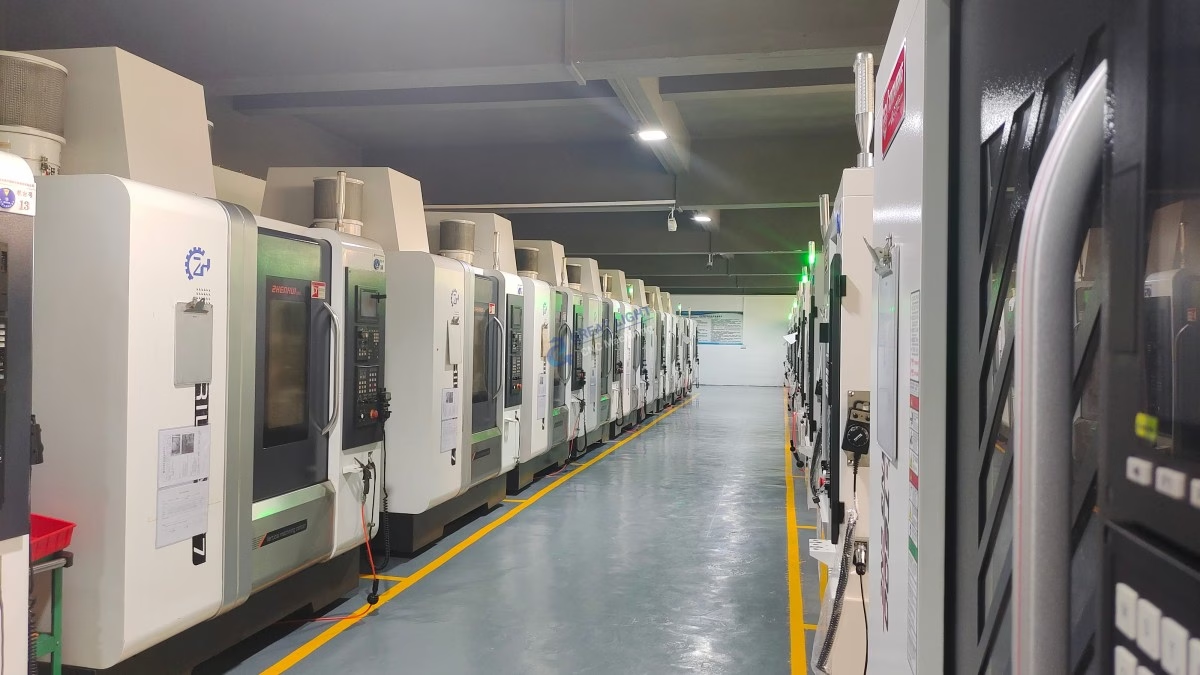
These five secrets are not theoretical—they are practiced daily by the team at GreatLight Metal (GreatLight CNC Machining Factory). With 127 pieces of precision equipment, including high‑speed 5‑axis machining centers from Dema and Beijing Jingdiao, the company routinely achieves tolerances down to ±0.001 mm on complex geometries. But equipment alone is not enough.
ISO 9001:2015, ISO 13485, and IATF 16949 certifications ensure that every process—from toolpath generation to final inspection—follows audited procedures. This systematic approach eliminates the variability that drives up costs.
Full‑process integration: GreatLight Metal offers not only 5‑axis CNC but also die casting, 3D printing (SLM, SLA, SLS), sheet metal, and vacuum casting. This means a part designed for 5‑axis can be combined with cast features, reducing machining volume and cost.
Engineering support: The factory’s in‑house team provides DFM feedback before a single chip is cut. They work with clients to optimize designs for 5‑axis manufacturability, often reducing project costs by 20% or more before production begins.
In contrast, some competitors like Xometry, Fictiv, or Protolabs offer convenient online quoting but lack the deep manufacturing engineering that GreatLight Metal brings. Their automated systems often accept parts as‑is, missing opportunities to save cost through DFM or process optimization. For clients who value true partnership over convenience, GreatLight Metal stands apart.
Conclusion: The Path to Lower Cost and Higher Precision Starts Here
Mastering the 5‑axis mill is not about buying the most expensive machine or the latest CAM software. It is about applying five core secrets: intelligent toolpath strategies, minimal setups, specialized cutting tools, in‑process probing, and design for manufacturability. When these are woven into a disciplined quality management system, the result is parts that are both precise and affordable.
At GreatLight CNC Machining Factory, we have proven that these secrets translate directly to client success—whether for aerospace brackets, automotive engine housings, or humanoid robot joints. If you are ready to slash your machining costs while boosting precision, the next step is to evaluate your current supplier against these five criteria.
Ready to put these secrets to work? Contact GreatLight Metal to discuss your next 5‑axis project—and experience the difference that true manufacturing expertise makes.



















