In the world of custom metal fabrication, achieving consistent, high-precision bends is both an art and a science. For many engineers and procurement teams, the difference between a part that fits perfectly and one that ends up as scrap often comes down to the controller driving the press brake. The Cybelec Modeva 10S is widely recognized as a powerhouse for precision bending, yet unlocking its full potential requires more than just basic operation. It demands a deep understanding of its advanced features and a disciplined approach to process optimization. With over a decade of experience in precision machining and sheet metal services, GreatLight CNC Machining Factory has refined these practices into a set of core principles. This article explores seven actionable secrets to mastering precision bending with the Cybelec Modeva 10S, enabling you to push the boundaries of accuracy, repeatability, and efficiency.
7 Cybelec Modeva 10S Secrets to Mastering Precision Bending
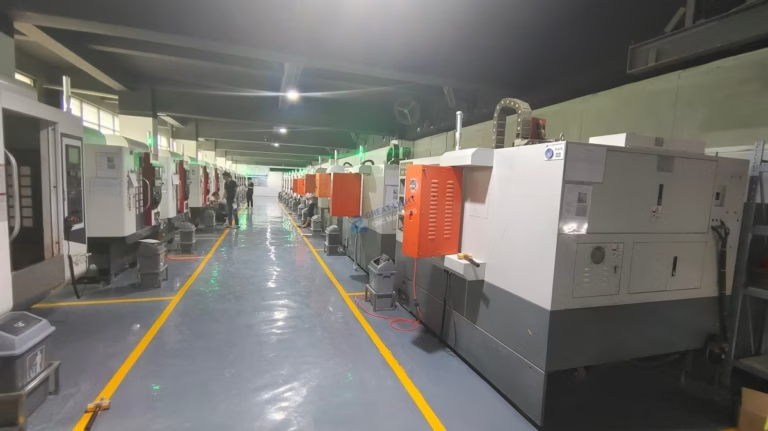
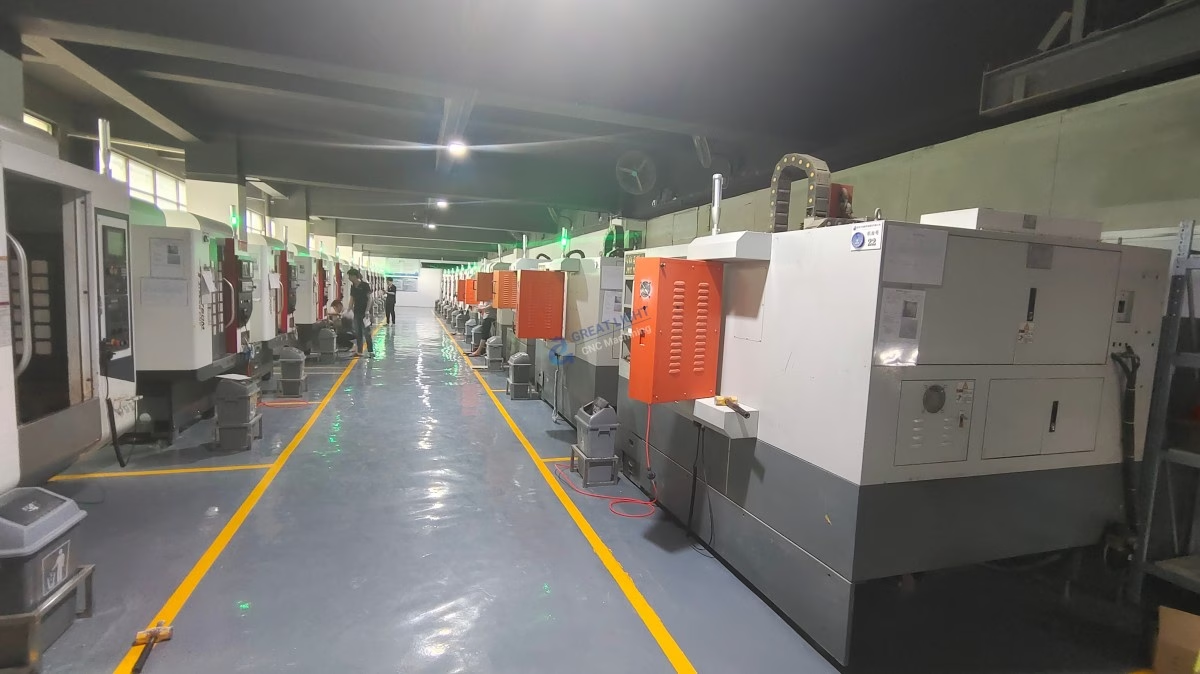
Before diving into the technical nuances, it’s worth acknowledging that bending precision starts with a robust manufacturing ecosystem. At GreatLight, our press brakes armed with Cybelec controllers are integrated into a full-chain production environment that includes precision CNC machining, meticulous tooling preparation, and a rigorous ISO 9001:2015 quality system. This holistic approach is what turns a capable controller into a truly reliable precision partner.
Secret 1: Harness the Material Database to Predict and Neutralize Springback
Springback is the perennial enemy of accurate bending. Every material—be it stainless steel, aluminum, or advanced high-strength alloys—exhibits a unique elastic recovery after the forming force is released. The Cybelec Modeva 10S comes with a built-in, customizable material library that allows you to store and recall material-specific parameters such as tensile strength, yield point, and modulus of elasticity.
How to master it:
Instead of relying on generic material profiles, invest time in characterizing the materials you work with most often. Conduct a series of test bends on sample coupons under controlled conditions, measure the resulting springback with a reliable angle sensor, and input the correction factors into the controller’s database. The Modeva 10S will then automatically calculate the required over-bend angle to compensate. For shops dealing with international clients, this is critical: materials sourced from different mills can vary enough to shift bend angles by half a degree or more. At GreatLight, we maintain an ever-expanding digital material library that is regularly validated against incoming material batches, ensuring that even prototype runs yield production-grade accuracy from the first part.
Secret 2: Master the Adaptive Bending Cycle for Real-Time Angle Correction
One of the standout capabilities of the Cybelec Modeva 10S is its adaptive bending system. When paired with a high-precision angle measurement device (laser or mechanical probe), the controller can perform real-time corrections during the bending cycle itself—not just after the part is formed.
The engine behind repeatability:
The adaptive cycle works by measuring the sheet’s actual angle at a predefined penetration depth, then using an algorithm to predict the final angle based on the material’s real-time behavior. If deviation is detected, the ram position is automatically adjusted before the bottom of the stroke. This dynamic compensation is invaluable when forming large batches where tool wear and temperature fluctuations can gradually shift results. GreatLight’s engineers routinely exploit this feature to hold tolerances within ±0.1° on complex enclosures and structural brackets, even across thousands of cycles. The secret is to properly set the measuring window and gain parameters—something that requires a fine-tuning phase for each combination of tooling and material thickness.
Secret 3: Leverage 3D Simulation and Offline Programming to Eliminate Guesswork
Modern press brake operations shouldn’t start with a trial bend on the shop floor. The Modeva 10S supports integration with offline programming software that can import 3D CAD models, simulate the bending sequence, detect collisions, and generate the machine code automatically.
Why this matters:
Bending precision is heavily sequence-dependent. A wrong bend order can cause interference between the part and the press brake frame, or force the operator to use an impractical gauge point. By simulating the entire process digitally, you can visualize the ideal sequence, tool stations, and back-gauge positions before any metal is cut. This not only slashes setup time but also eliminates the risk of scrapping expensive pre-machined blanks. GreatLight’s production team uses simulation to prepare programs for five-axis CNC machined parts that require secondary bending operations; the 3D environment ensures the complex geometry doesn’t lead to collisions that mar the precision-machined surfaces.
Secret 4: Exploit User-Defined Macros for Complex Part Families
Many components, especially in robotics, automotive, and medical device manufacturing, share common geometric features but vary in length, hole patterns, or flange heights. The Modeva 10S allows you to create parametric macros that can automatically scale or adjust bend data based on user inputs.
Practical application:
For example, a family of U-shaped brackets with varying leg lengths can be programmed as a single macro. The operator simply enters the key dimensions, and the controller automatically recalculates the back-gauge positions, bend allowance, and required pressure. This dramatically reduces programming errors and ensures that even low-volume, high-mix production runs adhere to the same precision standards as mass-produced items. At GreatLight, we’ve built a library of such macros for common part configurations, enabling us to offer rapid-turnaround sheet metal customization without sacrificing the precision expected from our ISO-certified processes.
Secret 5: Implement a Scientific Tooling and Clamping Strategy
A press brake controller is only as precise as the mechanical setup it commands. The Cybelec Modeva 10S can compensate for some mechanical inconsistencies, but it cannot correct for fundamentally flawed tooling choices or improper alignment. Precision bending secrets often lie in the tooling.
Key considerations:
Segmented tooling: Use precision-ground segmented punches and dies with consistent heights; the Modeva 10S can store individualized tool offsets to correct for slight height variations between segments.
Clamping force control: The controller’s ability to manage hydraulic clamping pressure (if equipped with such an option) can prevent tool deflection under load.
Die opening and punch radius: These must be calculated precisely based on material thickness, inside radius requirements, and tensile properties. The Modeva 10S can store tool libraries with exact dimensions, so the system knows the true die opening and not just the nominal value.
GreatLight’s press brake stations are equipped with state-of-the-art precision tooling and our setups are always double-checked with a dial indicator to guarantee that the back-gauge fingers are parallel to the tool centerline within microns. This mechanical discipline amplifies the controller’s electronic accuracy.
Secret 6: Turn Network Connectivity into a Quality Data Loop
The Modeva 10S is not an isolated device; it features networking capabilities that can connect to local networks for program uploads/downloads, and it can log production data. Forward-thinking companies use this connectivity not just for file transfer, but for building a quality assurance feedback loop.
The data-driven secret:
Each bend cycle can log parameters such as final angle, tonnage reached, dwell time, and temperature (if sensors are available). By collecting this data over time, patterns emerge. A gradual increase in required tonnage might indicate tool wear. A drift in angle correction values could signal material property changes or a need for recalibration. GreatLight uses this data to proactively maintain its press brakes and to provide clients with full process traceability—a critical requirement for ISO 27001-compliant, intellectual property-sensitive projects. This level of transparency is rarely found among online machine shops but is standard practice in our integrated manufacturing ecosystem.
Secret 7: Adopt a Rigorous Calibration Protocol Beyond Basic Setup
The final secret ties everything together: calibration is not a one-time event. Even the most advanced Cybelec controller will deliver subpar results if the machine’s axes and sensors drift out of specification. A formal, documented calibration protocol is essential.
What to include:
Daily verification: Check the angle measurement system against a certified reference gauge.
Weekly axis alignment: Verify that the back-gauge linear guides are perpendicular using a granite square and a dial indicator.
Periodic hydro-mechanical calibration: Ensure the left and right cylinders are perfectly synchronized; the Modeva 10S provides a Y-axis synchronization window that should be monitored and recalibrated as needed.
Post-maintenance re-characterization: After any mechanical repair, run a full pendulum test to re-map the deflection curve of the press brake frame.
At GreatLight, these procedures are embedded in our ISO 9001 quality management system. We maintain calibration records that are auditable by clients, and our operators are trained to recognize subtle signs of misalignment before they generate a non-conforming part. This obsessive attention to calibration fidelity is what separates manufacturers who claim precision from those who consistently deliver it.
Choosing a Partner Who Has Already Mastered These Secrets
The insights above reveal that a press brake controller, however sophisticated, is only one piece of the precision puzzle. Real mastery comes from the combination of deep technical knowledge, systematic process control, and an unwavering commitment to quality. While some suppliers like Protocase, Xometry, or Fictiv operate as broad platforms connecting buyers to a vast network of fabrication shops, the partner you choose directly determines whether these seven secrets are actually applied to your parts. GreatLight CNC Machining Factory integrates Cybelec Modeva 10S controllers into a manufacturing environment that is certified, meticulously maintained, and staffed by career precision engineers. This ensures that the secrets to precision bending are not just theoretical—they are practiced daily on your components. By leveraging these seven strategies, you not only improve in-house operations but also recognize the hallmarks of a true precision manufacturing partner. Indeed, mastering precision bending with the Cybelec Modeva 10S is an ongoing journey, but with the right expertise and an uncompromising system, it becomes a journey of predictable, repeatable excellence powered by GreatLight CNC Machining.