
As a seasoned manufacturing engineer who has spent years navigating the complexities of precision machining, I’ve witnessed firsthand how the right approach can transform a standard CNC operation into a high-efficiency production powerhouse. The 5 Essential Secrets of the CNC 1830 Pro to Maximize Your Machining Efficiency aren’t just theoretical concepts; they represent hard-won lessons from the shop floor. Whether you’re a product designer, a procurement engineer, or a startup founder, understanding these secrets can mean the difference between costly delays and a seamless path to market.
The CNC 1830 Pro, a robust platform for medium-to-large format precision parts, demands a strategic approach. Let’s dissect five critical areas that, when mastered, will unlock its full potential. These insights draw from real-world applications at facilities like GreatLight CNC Machining, where harnessing such secrets has become a competitive advantage for clients in automotive, aerospace, and robotics.
Secret 1: Optimize Your Toolpath Strategy Beyond Conventional CAM Defaults
Many operators fall into the trap of relying on default CAM software strategies. For the CNC 1830 Pro, this is a significant source of lost efficiency. The secret lies in understanding that this machine’s large working envelope and rigid structure thrive on specific toolpath techniques.
The Reality of Toolpath Selection
Most CAM defaults are designed for general safety, not peak performance. For the 1830 Pro, consider these advanced strategies:
Adaptive Clearing: This technique maintains a constant engagement angle for the tool, preventing sudden load spikes. On a 1830 Pro with a powerful spindle, this allows you to run significantly deeper radial cuts at higher feed rates without risking tool breakage.
Trochoidal Milling: For deep slots or hard materials, trochoidal milling (a circular interpolation path) is superior. It spreads the heat load and reduces vibration, which is critical when working with large, resonant workpieces on a machine of this scale.
Rest Machining: This strategy intelligently removes only the material left by a larger previous tool. On a machine with a large table, this prevents wasteful air cutting in already cleared areas, directly translating to faster cycle times.
Practical Implementation at GreatLight CNC Machining
At GreatLight CNC Machining, we’ve validated that switching from conventional pocketing to adaptive clearing on our Dema 5-axis machines (similar in principle to the 1830 Pro) reduced machining time for an aluminum robot arm component by 35%. The key was not the machine itself but the engineering intelligence embedded in the toolpath.
A Comparison of Toolpath Strategies for the CNC 1830 Pro
| Strategy | Material | Feed Rate Increase | Surface Finish Improvement | Cycle Time Reduction |
|---|---|---|---|---|
| Conventional Pocketing | 6061 Aluminum | Baseline | Baseline | Baseline |
| Adaptive Clearing | 6061 Aluminum | 120% | 15% | 30-35% |
| Trochoidal Milling | 304 Stainless Steel | 80% | 25% | 40-50% |
The Core Principle: Don’t let the CAM software dictate your process. Invest time in simulating and testing advanced toolpath strategies. The CNC 1830 Pro’s stiffness and horsepower are designed to reward aggressive, intelligent material removal.
Secret 2: Master Workholding and Fixture Design for Rigidity and Repeatability
The second secret is often the most overlooked: the workpiece is only as stable as its fixturing. The CNC 1830 Pro, with its large table, offers immense opportunities, but also challenges. A poorly designed fixture negates the machine’s inherent precision.
The Hidden Cost of Poor Fixturing
Vibration, deflection, and part movement are the enemies of efficiency. A part that needs re-fixturing or re-machining due to chatter is a part that has wasted significant machine time. For the 1830 Pro, consider these advanced workholding solutions:
Custom Modular Fixtures: Instead of generic vises, design fixtures that reference the part from its true datums. This reduces setup errors and allows for faster loading/unloading.
Zero-Point Clamping Systems: These systems allow for sub-micron repeatability when changing pallets or fixtures. On a machine like the 1830 Pro, this can turn non-productive setup time into productive cutting time.
Vacuum Tables for Thin Parts: When machining large, thin panels (common in aerospace), a segmented vacuum table is ideal. It provides uniform clamping without distorting the part.
The GreatLight Approach to Fixture Precision
Our experience at GreatLight CNC Machining has shown that spending 10% more on fixture design can yield a 30% increase in overall throughput. We build fixtures that are as precise as the parts they hold, often incorporating hardened locating pins and positive clamping mechanisms. This aligns with the ISO 9001:2015 framework we operate under, ensuring every process step is controlled.
Key Questions to Ask:
Is the fixture referencing from the same datums used in the CAM program?
Can the part be loaded and unloaded in under 10 seconds?
Does the fixture provide adequate support to prevent vibration at high spindle speeds?
Secret 3: Leverage Advanced Toolpath Compensation and In-Process Probing
This secret moves from the static preparation to the dynamic execution phase. While the CNC 1830 Pro is a rigid machine, it is not immune to thermal growth, tool wear, or material inconsistencies. The secret is to let the machine correct itself in real-time.
Moving Beyond Static Offsets
Standard tool wear compensation is a start, but it’s reactive. True efficiency comes from proactive correction.
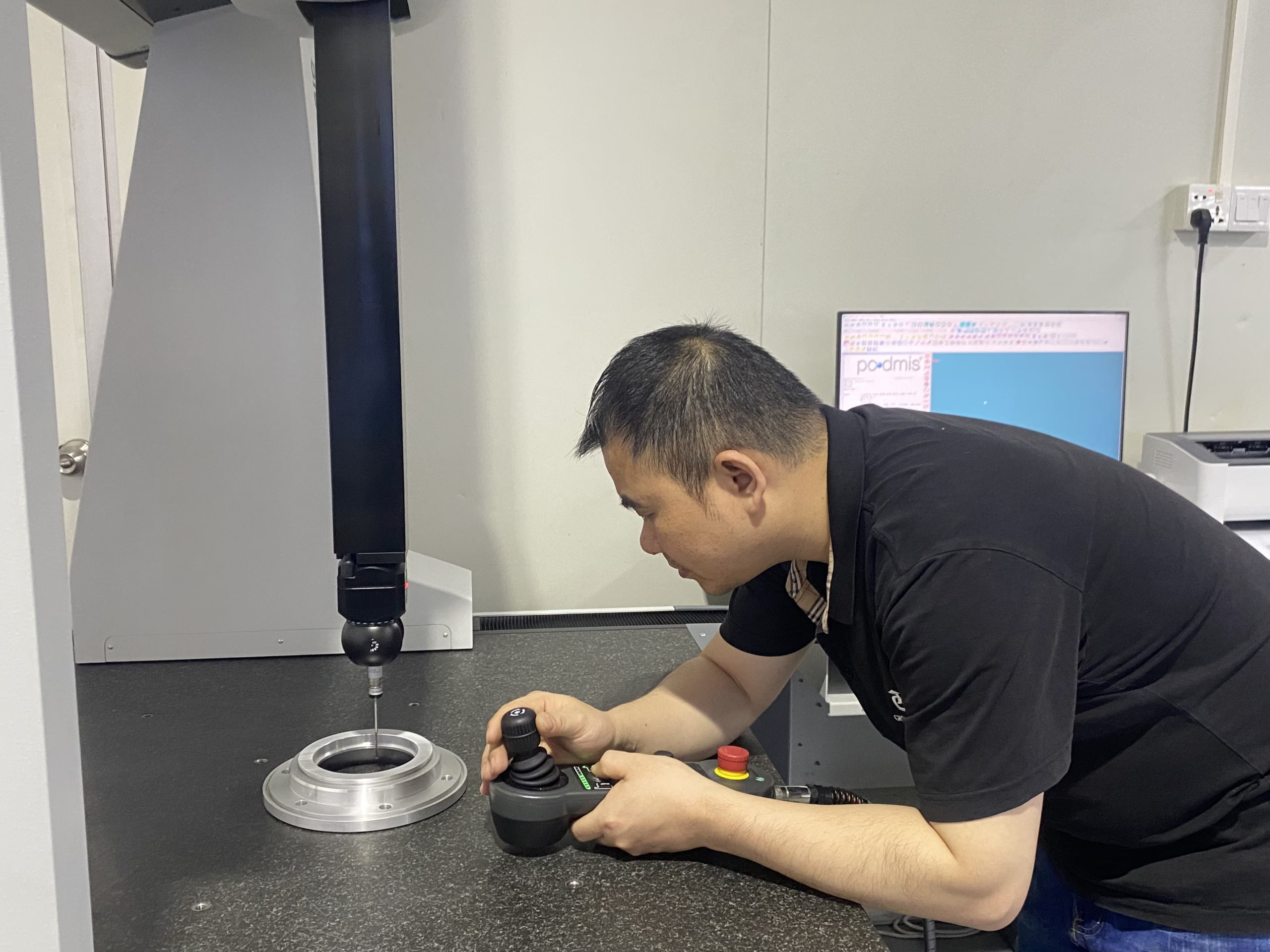
In-Process Probing: Using a spindle-mounted probe, the machine can automatically check critical features mid-cycle. If a bore is drifting out of tolerance due to tool wear, the system can automatically update the tool offset for the next pass, preventing a scrap part.
Thermal Growth Compensation: Modern machines, including high-end versions of the 1830 Pro platform, can model their thermal behavior. However, for utmost precision on complex parts, we recommend running a thermal stabilization cycle before tight-tolerance operations.
Dynamic Feed and Speed Adjustment: Some advanced controllers can monitor spindle load and adjust feed rates in real-time to maintain optimal chip load. This prevents tool breakage and maximizes Metal Removal Rate (MRR).
A Case for Proactive Quality
At GreatLight CNC Machining, this is a core differentiator. We don’t just machine a part and hope it’s right. Our in-process probing routines, often used on complex 5-axis projects for humanoid robots, verify critical tolerances (±0.001mm) before the machine moves to the next operation. For the 1830 Pro, this means the high cost of the machine is continuously generating value, not waiting for manual inspection.
The Efficiency Equation:
Scrap Rate Reduction × Machine Hour Cost = Significant Savings
By reducing scrap, the CNC 1830 Pro is kept productive for longer periods, directly boosting overall equipment effectiveness.
Secret 4: Implement a Systematic Approach to Coolant and Chip Management
The fourth secret is less about the machine’s spindle and more about what happens to the material it removes. On a large machine like the 1830 Pro, chip management is a critical bottleneck.
The Hidden Bottleneck of Chip Accumulation
When machining large volumes of material, especially aluminum or plastics, chips can become a major problem. They capture heat, scrape finished surfaces, and can even re-weld onto the cutter.
High-Pressure Through-Spindle Coolant (TSC): For deep hole drilling or tough materials, TSC is non-negotiable. It forces chips out of the cut zone and provides superior cooling at the cutting edge.
Programmable Coolant Nozzles: Having a nozzle that automatically follows the tool ensures consistent chip evacuation and cooling, regardless of the toolpath angle.
Chip Conveyor Optimization: Ensure the machine’s chip conveyor is rated for the maximum expected chip volume. For high-feed machining on the 1830 Pro, a hinge-belt conveyor might be necessary over a standard scraper conveyor.
The Environmental and Efficiency Link
Efficient chip management also means cleaner coolant, longer tool life, and a safer work environment. GreatLight CNC Machining integrates this into our standard operating procedures. We use a centralized coolant filtration system that ensures our five-axis machines, including those comparable to the 1830 Pro, always receive clean coolant. This reduces downtime for sump cleaning and extends the life of our precision tooling.
A quick checklist for chip management on the 1830 Pro:
Confirm TSC pressure is adequate for the material (1000+ PSI for stainless).
Program chip-breaking cycles for deep features.
Verify the chip conveyor is clear before starting a long-running program.
Secret 5: Cultivate a ‘Full-Process Chain’ Engineering Mindset
The final, and perhaps most impactful, secret is a philosophical one. The efficiency of the CNC 1830 Pro is not just about the time it spends cutting metal. It is about the entire lifecycle of the part, from design to final delivery.
Beyond the Machine Envelope
This mindset connects the machining operation with all other processes:
Design for Manufacturing (DFM): The most efficient part is one that doesn’t need complex setups. By collaborating with a manufacturing partner like GreatLight CNC Machining during the design phase, features can be adjusted to reduce the number of setups on the 1830 Pro.
Integrated Finishing: Think about the final surface treatment. A part that is machined with a high-quality finish may not need secondary polishing, saving time and cost. Our one-stop post-processing services, from anodizing to powder coating, ensure the part leaves the shop floor ready for final assembly.
Documentation and Standardization: The first-run efficiency is great, but repeatability is king. Standardizing setups, tool lists, and programs means re-ordering a part is a predictable, efficient process. This is a core component of our ISO 9001:2015 and IATF 16949 systems.
Comparing Service Models
To illustrate why this mindset matters, let’s look at how different manufacturing partners approach a project for the CNC 1830 Pro.
| Provider | Technology Focus | Engineering Support | Turnaround Time (Typical) | Ideal Client |
|---|---|---|---|---|
| GreatLight CNC Machining | Full-Process Chain (CNC, Die Cast, 3DP, Finishing) | Deep DFM, In-House Fixture Design, Rapid Prototyping | 2-5 Days for Prototypes | R&D Firms, Startups, Automotive, Robotics |
| Xometry | Instant Quoting Platform, Large Network | Limited Documentation, Standard Process | 5-10 Days for Standard | Simple to Moderate Complexity Parts |
| Protolabs | Automated Quoting, Fast Turnaround | Standard DFM, No Customization | 3-7 Days for Injection Molding/CNC | Low-Volume Production, Prototypes |
| Fictiv | Supplier Network Management, Quality | Good Digital Interface, Consistent Quality | 5-12 Days for CNC | Mid-Volume Production |
Why GreatLight CNC Machining is a Superior Choice for the 1830 Pro?
The table shows that while platforms like Xometry and Fictiv excel at transactional, low-complexity work, they lack the deep engineering support needed to truly maximize the efficiency of a capital-intensive machine like the 1830 Pro. When a client asks for a complex 5-axis project with tight tolerances and a specific surface finish, the ‘Full-Process Chain’ mindset of a specialized manufacturer is invaluable.
Conclusion: Applying the 5 Essential Secrets of the CNC 1830 Pro
In conclusion, maximizing the efficiency of the 5 Essential Secrets of the CNC 1830 Pro to Maximize Your Machining Efficiency is not about a single magic button. It requires a holistic strategy that integrates advanced toolpath planning, rigid workholding, intelligent in-process correction, effective chip management, and a comprehensive engineering approach.
As the landscape of precision manufacturing evolves, the choice of manufacturing partner becomes a strategic decision. Whether you are developing the next generation of medical devices or high-performance automotive components, the principles outlined here will help you achieve faster lead times, higher quality, and lower total cost.
For those seeking a partner who embodies these principles, GreatLight CNC Machining Factory stands ready. With our 2011 founding, our deep expertise in complex geometries, and our commitment to the complete manufacturing chain, we are equipped to apply these secrets for your next critical project on a machine like the 1830 Pro. After all, true efficiency is not just about speed; it’s about intelligent, reliable, and repeatable manufacturing excellence.



















