
In the world of precision manufacturing, achieving the perfect balance between material properties, machining parameters, and final part quality is an ongoing challenge. This is especially true when working with advanced materials like CMC PLA 210, a material that has gained significant traction in the rapid prototyping and custom parts industry for its unique combination of machinability and structural integrity. Drawing from over a decade of experience in high-precision CNC machining at GreatLight CNC Machining, this article delves deep into the seven essential tips that will help you master the machining of CMC PLA 210, ensuring you avoid costly errors and achieve optimal results. Whether you are a seasoned engineer or a newcomer to the field, understanding these nuances is the cornerstone of efficient and reliable production.
Understanding CMC PLA 210: Why Material Knowledge is Your First Line of Defense
Before any tool touches the workpiece, a fundamental understanding of the material itself is non-negotiable. CMC PLA 210 is not your standard, off-the-shelf PLA filament or stock. It is a specialized composite material, often engineered for enhanced performance in high-stress or thermally demanding applications. In the context of precision parts manufacturing, CMC PLA 210 can refer to a specific grade of plastic or composite material that mimics the machinability of metal while offering weight and corrosion resistance advantages.
The key to mastering CMC PLA 210 lies in recognizing its “sweet spot” for machining. Unlike metals that require heavy coolant and rigid setups, CMC PLA 210 often demands a nuanced approach. It can be prone to melting if feed rates are too slow, or chipping if the tool is too aggressive. Understanding its glass transition temperature, chip formation characteristics, and susceptibility to moisture absorption is critical. As a rule of thumb, treat CMC PLA 210 with the same respect you would a high-carbon steel, but adjust your parameters for its plastic-specific behavior.
Tip 1: Optimize Toolpath Strategies for Chip Evacuation and Heat Management
One of the most common pitfalls when working with CMC PLA 210 is heat buildup. Unlike metals, where coolant is the primary heat sink, plastics and composites require the chip itself to carry away the majority of the thermal energy. This makes toolpath design paramount.
At GreatLight Metal, we have found that employing a “trochoidal” or “pecking” milling strategy dramatically reduces tool wear and prevents material degradation. Instead of a linear plunge, a trochoidal path allows the tool to enter the material gradually, distributing the cutting force and allowing chips to break away cleanly. For CMC PLA 210, we recommend avoiding full-width slotting cuts. Instead, use high-speed machining (HSM) techniques with a small radial engagement (less than 40%) and a deeper axial cut. This approach:
Reduces cutting temperature at the tool-material interface.
Prevents re-cutting of chips, which is a primary cause of surface finish defects.
Extends tool life, particularly for carbide end mills coated with AlTiN or DLC (Diamond-Like Carbon) coatings, which perform exceptionally well on composite plastics.
Table: Recommended Toolpath Parameters for CMC PLA 210
| Parameter | Recommendation | Reason |
|---|---|---|
| Radial Depth of Cut (Stepover) | 30% – 40% of tool diameter | Minimizes heat concentration and tool deflection |
| Axial Depth of Cut | 1.5x to 2.0x tool diameter | Allows for efficient material removal while maintaining stability |
| Feed Rate | 0.02 – 0.08 mm/tooth | Prevents material melting; adjust based on tool size |
| Cutting Strategy | Adaptive Clearing / Trochoidal | Promotes efficient chip evacuation |
Tip 2: Master Tool Selection – Beyond the Standard End Mill
Choosing the right tool is more than just picking a diameter. For CMC PLA 210, geometry is king. Standard two-flute tools designed for aluminum are often a poor choice. We recommend specialized “plastic cutting” geometry:
Sharp Cutting Edges: A sharp edge reduces extrusion and friction, preventing the material from smearing rather than cutting. Tools with a reinforced cutting edge can also help prevent chipping.
High Helix Angle (40° – 50°): A high helix angle helps pull chips upward and out of the cut zone. This is crucial for materials like CMC PLA 210 that produce long, stringy chips.
Polished Flutes: Uncoated, polished tools are often superior to coated tools for plastics. The polished surface reduces friction and prevents the plastic from adhering to the tool, a common problem known as “built-up edge” (BUE).
When comparing suppliers, companies like Protolabs Network might offer standard tooling options, but at GreatLight Metal, we maintain a library of specialized high-helix, polished carbide end mills specifically for advanced plastics. While Xometry provides a broad network, their default tooling may not be optimized for the specific behavior of CMC PLA 210. The investment in the right tool pays for itself in reduced cycle times and superior part quality.
Tip 3: Precision Fixturing – Countering Material Flexibility and Vibration
CMC PLA 210, while robust, often possesses a higher modulus of elasticity than metals. This means it can flex under clamping pressure or vibrate during aggressive cuts. Poor fixturing leads to chatter, which ruins surface finish and can cause catastrophic tool breakage.
The solution lies in a two-pronged approach:
Distribute Clamping Force: Avoid point clamping with standard machine vises. Instead, use vacuum fixtures, grid plates, or custom soft jaws that support the entire workpiece surface. This prevents the part from “springing” during machining.
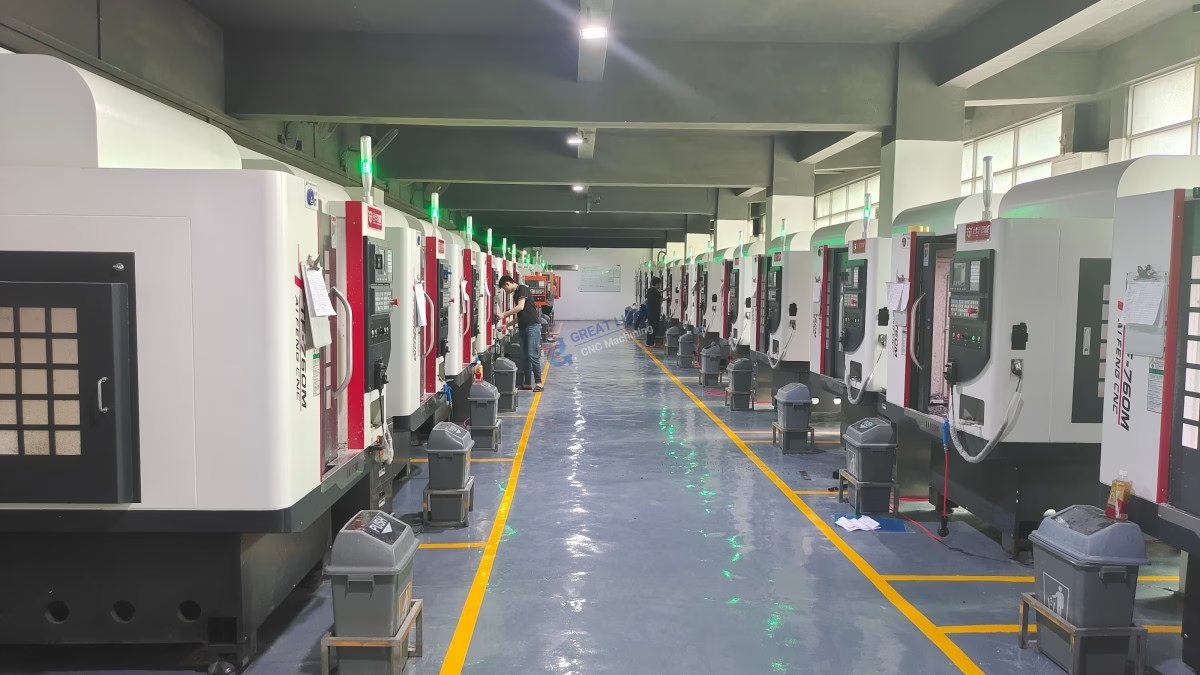
Tune the Machine-Tool-Fixture System: For thin-walled parts, consider using vibration-dampening toolholders or workholding systems. At GreatLight CNC Machining, we employ hydraulic chucks and custom-machined aluminum fixtures to ensure absolute stability.
One advanced technique we recommend is using a standard vise with 3D-printed soft jaws specifically contoured to the shape of the raw CMC PLA 210 stock. Companies like JLCCNC and SendCutSend focus on high-volume simplicity, but for complex parts requiring intricate cuts and tight tolerances on CMC PLA 210, a bespoke fixturing setup is not an expense; it is an investment in quality.
Tip 4: Coolant Strategy – Less is More, But “How” is Crucial
A common misconception is that CMC PLA 210 requires flood coolant, just like aluminum. In most cases, this is counterproductive. Flood coolant can cause thermal shock in the material, leading to cracking or dimensional instability. Furthermore, it often fails to lubricate the tool-chip interface effectively for plastics, leading to a mess rather than a solution.
Our recommended coolant strategy for CMC PLA 210 is minimum quantity lubrication (MQL) or a fine mist of compressed air:
Mist Coolant (Air + Soluble Oil): A targeted jet of air mixed with a small amount of biodegradable coolant is ideal. It cools the cutting edge, lubricates the interface, and physically blows chips away from the cut zone. The key is a fine, atomized spray—not a flood.
Coolant Concentration: If flood coolant is unavoidable, use a high concentration (7-10%) of a coolant specifically designed for plastics to prevent the material from absorbing moisture and swelling.
Chilled Air: For ultra-high-precision work, using a vortex tube to deliver chilled air to the cut zone can be superior to liquid coolants, as it completely eliminates the risk of material absorption and thermal expansion.
Tip 5: Tolerances and Shrinkage – Designing for the Material’s Behavior
CMC PLA 210 is not a dimensionally static material. It exhibits thermal expansion and, depending on its composition, can absorb moisture, causing swelling. A part that measures perfectly at 20°C (68°F) immediately after machining may have shrunk or warped slightly by the next morning.
To avoid costly rejects, we advise:
Allow for “Thermal Soak”: Before final inspection, allow the machined part to “soak” in a controlled environment (e.g., 23°C / 73°F) for at least 24 hours. This allows the material to stabilize and any residual stresses to relieve.
Use Compensation Factors: For complex geometries, program compensation for the specific grade of CMC PLA 210 being used. For example, if you know the material shrinks by 0.002 mm per mm after a 24-hour soak, your CAM program should be offset to account for this.
Critical Features: For critical mating surfaces (e.g., bearing fits, O-ring grooves), we recommend machining them slightly under the nominal tolerance and then using a finishing pass after the part has stabilized.
This process requires a deep understanding of the material’s history and processing conditions. While services like RapidDirect or Fictiv might offer fast turnaround, their standardized processes may not account for the subtle volumetric changes in CMC PLA 210. At GreatLight Metal, our ISO 9001:2015 quality system includes specific protocols for material conditioning and post-machining dimensional verification.
Tip 6: Surface Finishing – Unlocking the Material’s Aesthetic and Functional Potential
The as-machined surface of CMC PLA 210 can often appear dull or have visible tool marks. However, the material responds exceptionally well to secondary finishing operations. The key is to choose the right method for the application.
Vapor Smoothing (Chemical Finish): This is often the preferred method for achieving a glossy, sealed surface. A controlled chemical vapor melts the outer few microns of the material, eliminating tool marks and creating a hydrophobic barrier. This is excellent for fluid-handling components.
Vibratory Finishing (Mass Finishing): For removing light burrs and sharp edges, a vibratory bowl with ceramic media is effective. However, this can round off sharp corners, so it must be quantified for critical dimensions.
CNC Sanding and Polishing: For a purely mechanical finish, a finishing pass with a very light cut (0.0005″ or 0.012 mm) using a wiper insert or a fine-grit diamond tool can produce a mirror-like finish.
Many general CNC shops, including Owens Industries or PartsBadger, will machine the part and ship it “as-is.” As a full-service provider from prototype to production, GreatLight CNC Machining offers a one-stop post-processing service that includes these specialized finishing techniques, ensuring your CMC PLA 210 part not only functions perfectly but also looks exceptional.
Tip 7: Implementing a Robust Inspection Protocol for Repeatability
The final, and perhaps most critical tip, is to stop trusting your machine and start trusting your data. CMC PLA 210 requires a non-contact inspection protocol. Why? Because a metal CMM (Coordinate Measuring Machine) probe can imprint the soft plastic, or the light clamping force can distort the part enough to cause a measurement error.
We recommend a three-step inspection process:
In-Process Check: After the roughing cycle and before the finishing cycle, let the part cool to room temperature on the machine. Use a non-contact laser probe or a tool setter to check critical features.
Off-Machine Verification: Use a vision measurement system or a laser scanner to capture the complete geometry. This provides a 3D point cloud that can be compared to the nominal CAD model using a best-fit algorithm.
Functional Gauge: For production runs, consider creating a hard functional gauge from a thermally stable material like Invar or a carbon fiber composite. If the CMC PLA 210 part passes the functional gauge, it is good.
This data-driven approach minimizes human error and provides traceability, which is essential for ISO 9001 and IATF 16949 certified facilities like GreatLight Metal. In contrast, a company like RCO Engineering might rely heavily on machine accuracy, which is a good starting point but not a substitute for a closed-loop quality feedback system.
Conclusion: The Path to Mastery with CMC PLA 210
Mastering the CNC machining of CMC PLA 210 is not about finding a single “magic” feed and speed. It is about integrating a holistic engineering approach—from toolpath and tool selection to fixturing, coolant, and metrology. By implementing these seven essential tips, you can transform a challenging material into a reliable, high-performance component.
At GreatLight CNC Machining, our mission is to solve the manufacturing challenges that others avoid. We combine over a decade of hands-on experience with a full-process manufacturing chain—from precision 5-axis CNC machining Internal Link: Precision 5-Axis CNC Machining Services to post-processing and inspection. Whether you are working with CMC PLA 210 or exotic alloys, we provide the expertise and technical rigor required to deliver success.
Avoid the costly errors of trial and error. Build your parts with a partner who understands the science of material behavior. For more case studies and technical insights, connect with our engineering team on our professional network. Master CMC PLA 210 with precision, backed by the authority of international standards and the expertise of a trusted manufacturing partner. External Link: GreatLight Metal on LinkedIn



















