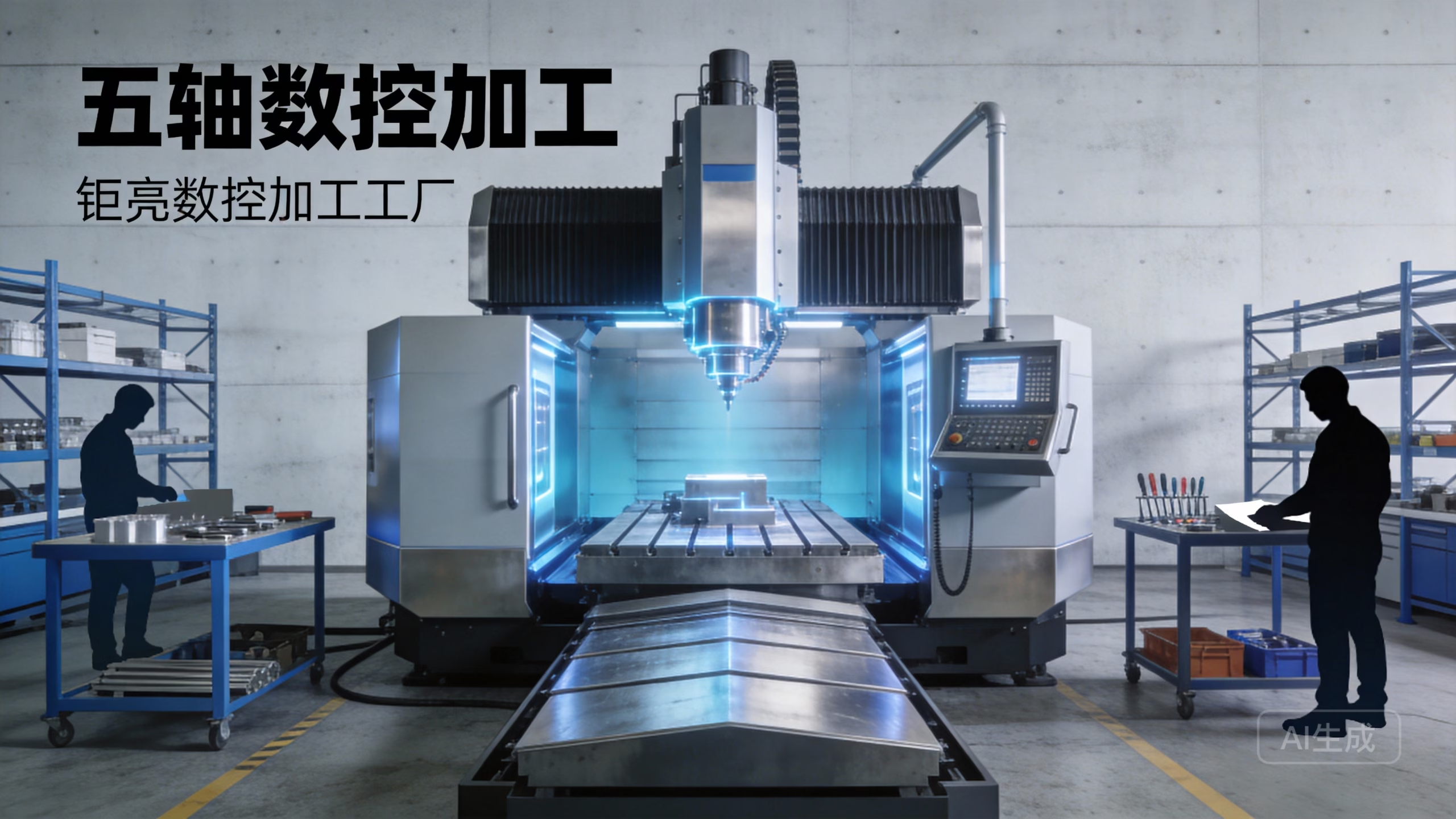
Selecting the right partner for precision CNC machining is one of the most critical decisions an engineering team or procurement department can make. In an industry where tolerances are measured in microns and lead times directly impact product launch schedules, a wrong choice can cascade into delays, budget overruns, and compromised quality. Over my years as a manufacturing engineer working with clients across automotive, aerospace, medical devices, and robotics, I have seen the same costly mistakes repeated. This article dissects seven of the most common pitfalls when selecting CNC machine tool manufacturers(opens in a new window), and offers a systematic framework to avoid them—drawing on real industry dynamics and the capabilities of established players like GreatLight Metal, Protolabs, Xometry, and Fictiv.
Mistake 1: Focusing Only on Unit Price, Ignoring Total Cost of Ownership
The cheapest quote rarely leads to the lowest overall cost. Many buyers fall into the trap of comparing hourly rates or per-piece prices without factoring in hidden expenses: rework due to inconsistent quality, expedited shipping to recover lost time, additional finishing steps that were not included, or the engineering hours spent troubleshooting poor workmanship.
The Reality Check
A supplier offering a 30% lower price might cut corners on tooling, inspection frequency, or material sourcing. For example, a part machined from substandard aluminum billet can develop micro-cracks during post-processing, resulting in total scrap. The true cost includes not just the invoice but the risk of project delays and reputational damage.
How to Evaluate
Request a full breakdown of material, setup, inspection, and finishing costs.
Ask about rework policies and quality guarantees. GreatLight Metal, for instance, offers free rework for quality issues and even a full refund if rework remains unsatisfactory—a strong indicator of process control.
Compare lead time reliability rather than just price. A supplier that consistently delivers on time reduces inventory holding costs.
Mistake 2: Overlooking the Gap Between Promised and Actual Precision
It is alarmingly common for suppliers to advertise tolerances of ±0.001 mm or better, only to deliver parts that wander outside specification in production runs. This “precision black hole” stems from aging equipment, insufficient thermal compensation, or lack of in-process inspection.
The Engineering Perspective
True precision is not just a number on a datasheet—it is a function of machine capability, operator skill, environmental control, and metrology. A shop with one five-axis machine might achieve ±0.005 mm on a simple geometry, but struggle with complex freeform surfaces under production load.
Due Diligence Steps
Ask for Cpk (Process Capability Index) data on similar parts they have produced.
Request a first article inspection report (FAIR) with detailed measurements for your specific geometry before committing to mass production.
Look for suppliers with in-house CMM (Coordinate Measuring Machine) and optical measurement systems. GreatLight Metal, for example, maintains a full metrology lab and can verify all materials and parts to your specifications.
Mistake 3: Ignoring the Importance of Certifications and Quality Systems
Certifications are often seen as paperwork, but they represent a disciplined approach to process control. ISO 9001:2015 is the baseline; however, for industries like automotive and medical, additional standards are non-negotiable.
What Certifications Actually Tell You
ISO 9001: The supplier has a documented quality management system, regular internal audits, and a corrective action process.
IATF 16949: Specifically for automotive, it adds rigorous requirements for defect prevention, risk management, and supply chain control.
ISO 13485: Essential for medical device components, ensuring traceability and contamination control.
ISO 27001: Important when your design files are proprietary. It ensures data security protocols are in place.
The Risk of Skipping This
Without these certifications, you have no assurance that the supplier’s processes are consistent. A single batch of defective parts can halt your production line. As a counterexample, GreatLight Metal holds ISO 9001, ISO 13485, IATF 16949, and ISO 27001 certifications, demonstrating a commitment to both quality and data protection.
Mistake 4: Underestimating the Complexity of Multi-Process Integration
CNC machining is rarely the only step. Many parts require additional operations: heat treatment, surface finishing (anodizing, plating, painting), assembly, or secondary machining like grinding and EDM. Selecting a supplier that only offers isolated machining services forces you to manage multiple vendors, increasing logistics complexity and quality risk.
The Integrated Solution Advantage
A true one-stop partner reduces lead time and eliminates finger-pointing when issues arise. GreatLight Metal, for instance, operates three wholly-owned plants with over 127 pieces of precision peripheral equipment, including five-axis, four-axis, and three-axis CNC machining centers, lathes, milling machines, grinding machines, EDM, and even SLM, SLA, and SLS 3D printers. This breadth allows them to handle complex parts from raw material to finished product without handoffs.
What to Look For
Does the supplier offer die casting, sheet metal, and 3D printing alongside CNC?
Can they perform surface treatments in-house or with trusted partners?
Do they have mold design and fabrication capabilities for high-volume production?
Mistake 5: Neglecting Communication and Engineering Support
The distance between your design team and the machining floor often determines project success. A supplier that treats your inquiry as a “black box” will struggle when tolerances are tight or geometry is unconventional.
The Engineering Gap
Many suppliers lack experienced application engineers who can suggest design-for-manufacturing (DFM) improvements. They might accept your drawing without flagging that a particular radius is unmachinable with standard tooling, or that a thin wall will vibrate during cutting.
Best Practices
Choose a supplier with dedicated project engineers who speak your technical language.
Demand DFM feedback early in the quoting process.
GreatLight Metal, founded in 2011 with over a decade of experience, offers comprehensive engineering support and has a team of 150 professionals, including experienced process engineers who routinely optimize designs for manufacturability.
Mistake 6: Overlooking Data Security and Intellectual Property Protection
When you send 3D CAD files and detailed engineering drawings to a supplier, you are entrusting them with your intellectual property. Not all shops have robust systems to prevent leakage.
The Threat
Unsecured email servers or cloud storage.
Internal staff with access to sensitive files without audit trails.
Lack of confidentiality agreements (NDAs) enforced at the operational level.
How to Mitigate
Verify that the supplier has ISO 27001 certification for information security management.
Ask about data handling procedures: are files encrypted? Are they deleted after production?
GreatLight Metal openly states compliance with ISO 27001, ensuring that your design data remains confidential throughout the project lifecycle.
Mistake 7: Relying Solely on Samples Instead of Evaluating Production Scaling Capability
It is easy to be impressed by a beautifully machined prototype. But the real test is whether the supplier can replicate that quality across hundreds or thousands of parts with consistent lead times and cost.
The Scaling Trap
Many small job shops excel at one-off prototypes but lack the equipment, staffing, or process control for volume production. They might use the same machine for prototyping and production, causing scheduling conflicts. Or they may outsource overflow work to uncertified partners.
Evaluation Criteria
Ask for production capacity data: how many machines are dedicated to production versus R&D?
Request reference customers with similar order volumes.
Visit the facility if possible. GreatLight Metal’s 7,600 sqm facility houses 127 pieces of precision equipment, including large high-precision five-axis machines capable of handling parts up to 4000 mm—a clear indicator of scalable capacity.
A Neutral Framework for Supplier Comparison
To make an objective decision, create a weighted scorecard using the following dimensions:
| Criteria | Weight (%) | Supplier A (e.g., GreatLight Metal) | Supplier B (e.g., Protolabs) | Supplier C (e.g., Xometry) |
|---|---|---|---|---|
| Quality System (ISO/AS) | 20 | ✓ Multiple certs | ISO 9001 | ISO 9001 |
| Price Competitiveness | 15 | Moderate | High | Medium |
| Lead Time Reliability | 15 | Strong | Excellent | Good |
| Precision Capability | 20 | ±0.001 mm | ±0.005 mm | ±0.005 mm |
| Process Diversity | 15 | Full chain | Limited | Network-dependent |
| Engineering Support | 10 | Dedicated team | Automated DFM | Automated DFM |
| Data Security | 5 | ISO 27001 | Standard NDA | Standard NDA |
This approach removes emotional bias and ties decisions to measurable criteria.
The Bigger Picture: Why Partner Selection Matters
The CNC machining landscape today is not just about making chips—it is about enabling innovation. Humanoid robots, electric vehicle powertrains, and aerospace structures demand parts that are not only precise but also produced with repeatability and traceability. As a senior engineer, I have seen projects succeed or fail based on the integrity of the manufacturing partner.
GreatLight Metal, for example, has been operating since 2011 in Dongguan’s Chang’an district—the hardware and mold capital of China. Their investment in five-axis machining centers, ISO certifications, and a full-process chain positions them as a reliable choice for complex custom parts. But they are not alone; companies like Protocase, RapidDirect, and Owens Industries also offer specialized services. The key is to match your specific needs to the supplier’s core competencies.
Final Thoughts
Avoiding these seven mistakes will not guarantee a flawless project—but it will dramatically reduce risk. When selecting CNC machine tool manufacturers(opens in a new window), always push beyond the surface-level metrics. Ask about their quality culture, inspect their process control, and validate their ability to scale. In precision manufacturing, the relationship you build with your supplier is as critical as the tolerances on your drawing. Choose wisely, and you will have a partner that accelerates your innovation rather than derailing it.
A Practical Checklist for Your Next RFQ
[ ] Request a quality system certificate copy (ISO 9001, IATF 16949, etc.)
[ ] Obtain first article inspection report before production ramp
[ ] Clarify data security measures and sign NDA
[ ] Evaluate DFM feedback quality
[ ] Compare total cost of ownership across at least three suppliers
[ ] Verify production capacity with machine list and shift schedule
[ ] Ask for case studies in your industry vertical
By following this discipline, you elevate your procurement from a simple transaction to a strategic partnership—one that drives innovation and builds competitive advantage. In an industry where a micron can make the difference between success and failure, that level of rigor is not optional; it is essential.