
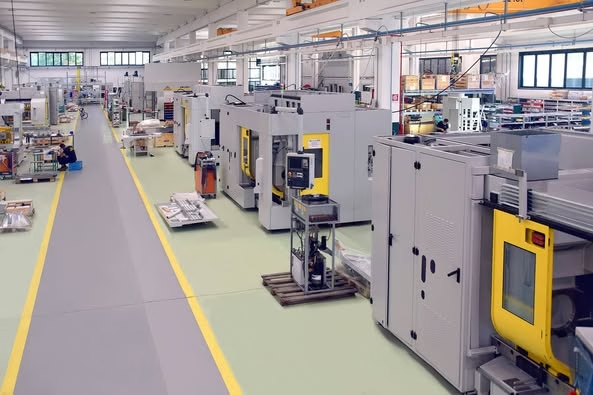
In today’s hyper-competitive manufacturing landscape, precision parts buyers and engineering teams face mounting pressure to reduce production costs without compromising quality or lead times. CNC machining, particularly five-axis CNC machining, has emerged as a cornerstone technology for achieving this balance. However, simply owning advanced machines is not enough; the real differentiator lies in how strategically these assets are deployed. Drawing from over a decade of practical experience at GreatLight Metal Tech Co., LTD. (also known as GreatLight CNC Machining), a leading five-axis CNC machining manufacturer located in Dongguan’s Chang’an Town—the hardware mold capital of China—I have identified five industrial strategies that consistently deliver measurable cost reductions and efficiency gains.
These strategies are not theoretical. They are born from daily challenges faced when producing complex metal and plastic parts for sectors ranging from humanoid robotics and automotive engines to aerospace. By integrating advanced equipment, process optimization, and a robust quality management system, manufacturers can transform CNC operations from a cost center into a competitive advantage.
1. Leverage Multi-Axis Machining to Eliminate Secondary Operations
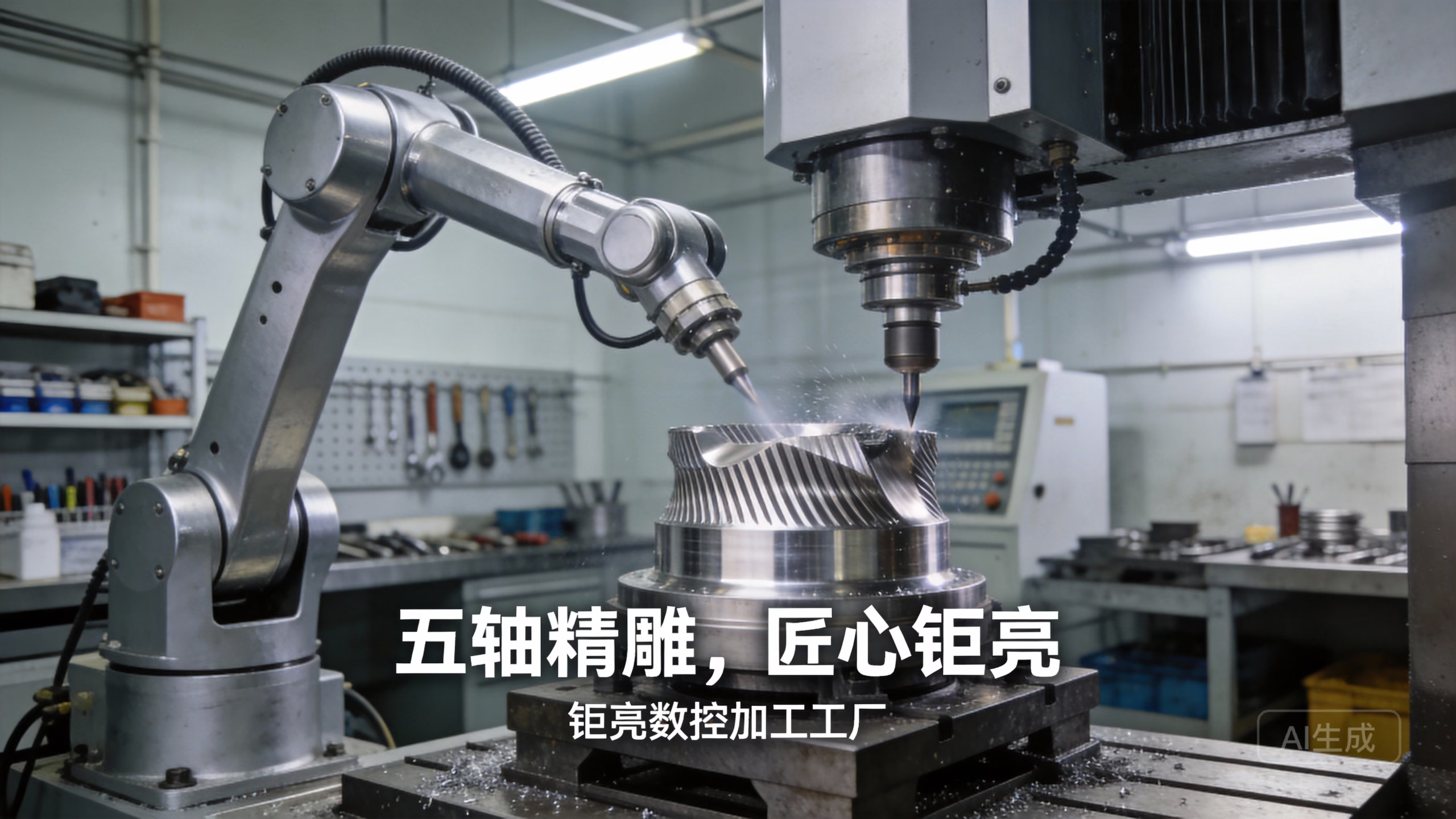
One of the most effective ways to slash costs is to reduce the number of setups and secondary operations. Traditional 3-axis machining often requires multiple fixtures and repositioning steps for complex geometries, which accumulates errors and extends cycle times. In contrast, 5-axis CNC machining allows the tool to approach the workpiece from virtually any angle, enabling complete machining of intricate features in a single setup.
How This Reduces Costs
Lower Fixture Costs: Eliminates the need for expensive custom jigs and multiple vises.
Shorter Lead Times: A single setup can replace four or five manual repositioning steps, cutting production time by 30–50%.
Improved Surface Finish: Continuous tool engagement reduces scallop marks and hand-finishing requirements.
Real-World Application:
GreatLight Metal’s facility houses high-precision 5-axis machining centers from Dema and Beijing Jingdiao, complemented by 4-axis CNC machines, mill-turn centers, and Swiss-type lathes. For a recent electric vehicle (EV) e-housing component, the team reduced total processing time by 40% by migrating from a 3-axis plus secondary EDM workflow to a streamlined 5-axis process. The result? A part that met ±0.005 mm tolerances without any post-machining benching—directly translating into cost savings passed on to the client.
Comparison with Other Suppliers
While many suppliers advertise multi-axis capability, few possess the depth of experience to optimize toolpaths for complex alloys like Inconel or titanium. Companies like Protolabs Network and Xometry offer 5-axis services through distributed networks, but their process consistency can vary across facilities. GreatLight CNC Machining maintains full in-house control over every axis, from programming to final CMM inspection, ensuring repeatability that batch-by-batch outsourcing cannot guarantee.
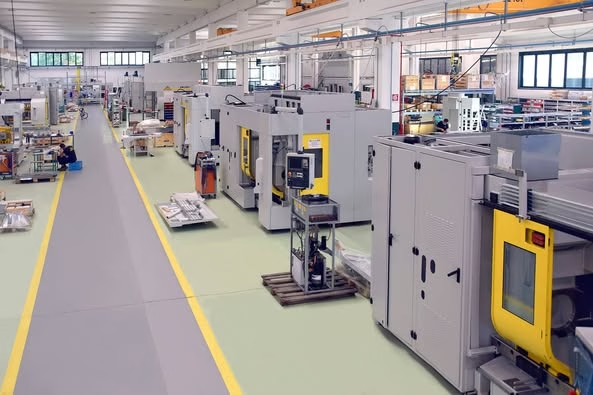
2. Implement Advanced CAM Simulation to Reduce Scrap and Rework
Nothing wastes time and material faster than a crashed tool or a gouged surface. Yet many machine shops still rely solely on operator intuition. The second essential strategy is to adopt advanced Computer-Aided Manufacturing (CAM) simulation and virtual verification before any chip is cut.
Key Benefits
Zero Collision Risk: Simulate spindle, tool holder, and fixture interactions to prevent expensive machine damage.
Optimized Toolpaths: Identify inefficient moves and reduce air cutting, which can account for 20% or more of cycle time.
First-Part-Right Culture: With robust simulation, the first physical part often meets spec, eliminating costly iterative rework.
GreatLight’s Approach:
At Great Light Metal Tech Co., LTD. , every program undergoes rigorous virtual machining using high-fidelity software that models the exact kinematics of their 5-axis centers. This discipline, combined with a strict first-article inspection (FAI) protocol, has helped the company achieve a first-pass yield rate of over 98% for complex production runs. The data is clear: a 2% scrap rate improvement on a 10,000-part order can save tens of thousands of dollars, especially when machining expensive materials like 7075 aluminum or 17-4 PH stainless steel.
Industry Context
Shops that skip simulation often end up with hidden costs: expedited material orders, overtime for manual corrections, and damaged customer trust. While some competitors like Fictiv or RapidDirect offer DFM feedback, they typically rely on algorithmic analysis rather than deep simulation tailored to specific machine dynamics. GreatLight’s engineers complement digital simulation with decades of hands-on experience, bridging the gap between theory and reality.
3. Apply Design for Manufacturability (DFM) Early in the Process
The largest cost reductions are locked in during the design phase—not during production. Yet many engineers overlook simple geometry adjustments that could dramatically simplify machining. A robust Design for Manufacturability (DFM) review before quoting can slash costs by 20% or more, sometimes without any functional trade-off.
DFM Principles That Deliver
Avoid Deep, Narrow Pockets: Deep cavities require specialized long-reach tools and slower feeds; redesigning to shallower pockets can triple material removal rates.
Standardize Hole Sizes and Threads: Using common drill and tap sizes reduces tool changes and inventory complexity.
Minimize Sharp Internal Corners: A radius as small as 0.5 mm can significantly extend tool life compared to a sharp corner requiring a tiny end mill.
GreatLight’s DFM Service
GreatLight Metal’s engineering team actively partners with clients during the DFM stage. For a medical device component originally designed with a 0.2 mm internal corner, they recommended a 0.5 mm radius that maintained sealing performance but reduced tool wear by 60%. The resulting quote dropped by 22%, and the parts were delivered three days earlier than the original timeline.
Why This Matters for Buyers
Many online platforms like JLCCNC or SendCutSend offer automated DFM checks, but these are limited to simple geometry rules. They cannot replace a conversation with an experienced manufacturing engineer who understands the nuances of your material, tolerances, and expected volume. GreatLight CNC Machining treats DFM as a collaborative dialogue, not a one-click report—and that human insight often unlocks the biggest savings.
4. Streamline Supply Chain with One-Stop Post-Processing and Finishing
Hidden cost leaks frequently occur after machining: outsourcing anodizing, powder coating, or heat treatment to different vendors introduces logistics delays, inconsistent quality, and communication overhead. The fourth strategy is to consolidate these steps under one roof via an integrated service provider.
One-Stop Advantages
Eliminate Multiple Handling Fees: No shipping between vendors; one pickup for raw material, one delivery for finished parts.
Consistent Quality Control: The same quality team that inspects dimensions also verifies coating thickness and adhesion.
Faster Iterations: If a surface finish issue is found, the engineering team can adjust both machining parameters and post-treatment simultaneously.
GreatLight’s Full Process Chain
GreatLight Metal operates a comprehensive facility that covers the entire value chain: precision CNC machining (3-axis, 4-axis, 5-axis), die casting, sheet metal fabrication, vacuum casting, SLA/SLS/SLM 3D printing, and a wide array of surface finishing services including anodizing, sandblasting, electroplating, and heat treatment. With 127 pieces of precision peripheral equipment and three wholly-owned manufacturing plants covering 7,600 square meters, they can take a part from raw billet to fully finished product without a single external handoff. ISO 9001:2015, ISO 13485 (medical hardware), and IATF 16949 (automotive quality management) certifications ensure every step meets rigorous standards.
A Caution on Fragmented Supply Chains
While platforms like Xometry or Protocase can coordinate multiple processes, they often act as intermediaries rather than actual manufacturers. This adds overhead and limits real-time troubleshooting. For high-stakes projects—such as engine hardware for autonomous vehicles or aerospace brackets—the ability to walk into the finishing department and discuss a color mismatch with the person who ran the CNC machine is invaluable. GreatLight CNC Machining owns each step, which translates to faster resolutions and lower total cost of ownership.
5. Adopt Data-Driven Quality Management and Continuous Improvement
The fifth essential strategy moves beyond hardware and into systems: using real production data to drive waste elimination. Lean manufacturing principles, when applied to CNC machining, can uncover inefficiencies that traditional cost accounting misses.
Data Points That Matter
Machine Utilization Rates: Idle time between jobs can be 20–30%; scheduling improvements can recover that capacity.
Tool Life Tracking: By logging tool wear data per operation, you can replace tools proactively at the optimal point—neither too early (wasting tools) nor too late (causing scrap).
Defect Pareto Analysis: Where are the most common non-conformances? A focused root-cause analysis on the top defect type often yields a quick fix.
GreatLight’s Quality System in Action
As an ISO 9001:2015 certified manufacturer, GreatLight Metal operates a structured continuous improvement program. Their in-house metrology lab—equipped with CMM, optical comparators, and surface roughness testers—enables them to collect dimensional data on every critical feature. This data feeds back into the CAM programs and operator training materials. For example, after noticing a recurring burr issue on an aluminum aerospace part, the team adjusted both the toolpath and the deburring cycle, reducing manual deburring time by 70% and eliminating a line rework station. The savings were not just financial; they also freed up skilled labor for higher-value tasks.
How This Compares
Many contract manufacturers, including PartsBadger and RCO Engineering, offer quality reports, but few provide the depth of statistical process control (SPC) that GreatLight integrates into daily operations. The difference lies in attitude: data is not used just to satisfy an audit but as a live feedback loop for process improvement. This approach aligns with IATF 16949 requirements for automotive supply chains, where every ppm (parts per million) of defect reduction matters. GreatLight’s certification in both ISO 13485 and IATF 16949 demonstrates a level of discipline that is hard to replicate without years of investment.
Summary: Choosing the Right Partner for Long-Term Efficiency
Implementing these five strategies—multi-axis integration, CAM simulation, early DFM, one-stop post-processing, and data-driven quality management—can transform a CNC machining operation from a cost burden into a competitive weapon. However, not every supplier has the infrastructure, certifications, or depth of engineering talent to execute all five effectively.
GreatLight CNC Machining stands out because it combines decades of hands-on experience with a comprehensive capability set: from 5-axis machining centers and 3D printing to die casting and finishing, all under one roof. The company’s ISO 9001, ISO 13485, and IATF 16949 certifications provide an auditable backbone of trust. Whether you need a single prototype for a humanoid robot actuator or a million-unit production run for automotive engine components, applying these strategies with a partner like GreatLight ensures that cost reduction and efficiency gains are not just promised but delivered.
To explore how these strategies apply to your specific parts, consider engaging with a team that combines technical expertise with uncompromising standards. The future of precision manufacturing belongs to those who think strategically about every axis, every cycle, and every partnership.
For more insights into high-precision CNC machining and integrated manufacturing solutions, connect with Great Light Metal Tech Co., LTD. on their professional network to stay updated on industry best practices.



















