
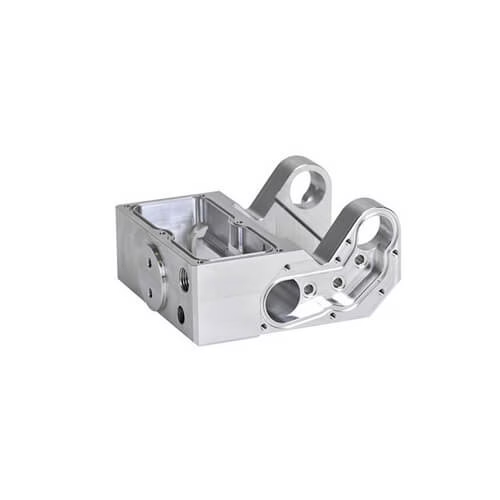
If you’ve ever sourced steel CNC machining services, you already know the glossy brochures and “instant quote” buttons rarely tell the whole story. Beneath the polished marketing material, a handful of uncomfortable truths get swept aside. Today, we’re exposing 5 Steel CNC Service Secrets Manufacturers Don’t Want You to Know—and more importantly, showing you how to sidestep the traps that drive up cost, delay delivery, and compromise quality.
5 Steel CNC Service Secrets Manufacturers Don’t Want You to Know
Whether you’re prototyping a surgical robot’s end-effector or scaling up titanium-hybrid actuation housings, understanding these five secrets will fundamentally change how you vet and select a partner for steel CNC machining.
Secret #1: The Hidden Premium on “Low‑Cost” Quotes
A steel part quote that looks too good to be true almost always is. Low‑cost providers recoup margins in ways that never appear on the first invoice.
Material bait‑and‑switch
Some shops substitute certified 316L stainless with a generic “18‑8” grade, or use non‑traceable alloy steel where 4140 pre‑hard was specified. Without mill certs and an in‑house spectrometer, the difference won’t show up until a fatigue failure occurs—months later.
Tooling and fixturing “extras”
A base quote may exclude soft jaws, custom collets, or even inspection fixtures. Once the job is locked in, these become unavoidable change orders that can double the original price.
Surface‑finish hand‑offs
Bead blasting, passivation, or black oxide are often subcontracted to third‑party vendors, each adding a markup and a fresh set of logistical risks. A provider that owns the full process chain—from raw stock to finished, sealed part—can provide an all‑in price that’s genuinely transparent.
The takeaway: request a line‑item breakdown that explicitly lists material grade and certificate, any tooling charges, and whether post‑processing is performed in‑house or outsourced. Legitimate manufacturers welcome this scrutiny.
Secret #2: Precision Claims Often Overshadow Real‑World Capability
It’s common to see marketing lines like “accuracy to ±0.001 mm.” In reality, the number printed on a brochure means nothing without context: over what part size, on which material, and verified by what metrology equipment?
Tolerance is a system, not a single number
A machine tool might be geometrically capable, but thermal drift, tool wear, and clamping distortion in thin‑walled steel housings can easily consume a tight profile tolerance. Shops that don’t run thermal stabilization routines or in‑process probing will see part features drift across a production lot.
Measurement matters as much as machining
A climate‑controlled lab equipped with a coordinate measuring machine (CMM) and laser scanner is the only way to verify whether a 0.005 mm true position requirement was actually met. Without it, you’re trusting a caliper check. Look for manufacturers that perform statistical process control and can supply full‑dimensional inspection reports (FAI/ISIR) with every batch.
Real‑world example
GreatLight Metal, for instance, supports 5‑axis steel machining on brand‑name centres (including Dema and Beijing Jingdiao platforms), validated by in‑house CMMs and calibrated gauges. The repeatability you get from a factory that treats metrology as a core competency is a world apart from a broker that sub‑contracts inspection.
Secret #3: Lead Times Are Negotiable—And Often Padded
The standard “2‑3 weeks” quoted for milled steel parts frequently contains a generous buffer. Why? Because shops that serve multiple industries optimize their machine loading to maximize spindle utilization, not to minimize your individual lead time.
The batching bottleneck
Large platforms consolidate orders until a machine’s capacity is full. Your urgent prototype might sit in a queue while lower‑priority production work runs. Direct‑factory manufacturers with dedicated project management can schedule complex steel jobs around existing runs, often shaving 30–40 % off the advertised lead time without a rush surcharge.
Unspoken express levers
A genuinely flexible shop can offer overnight light‑out machining on a 5‑axis cell, or split the work across identical machines to parallel‑process batches. The ability to do this depends on having not just one high‑end machine, but a fleet—127 pieces of precision peripheral equipment in GreatLight’s case, including multiple 5‑axis centres that allow dynamic load balancing.
When comparing timelines, ask: “What’s your current machine utilization rate, and can you guarantee an earliest start date?” A partner that opens its production schedule to you is one that’s confident in its capacity planning.
Secret #4: Many Providers Outsource Post‑Processing—Risking Quality and Delivery
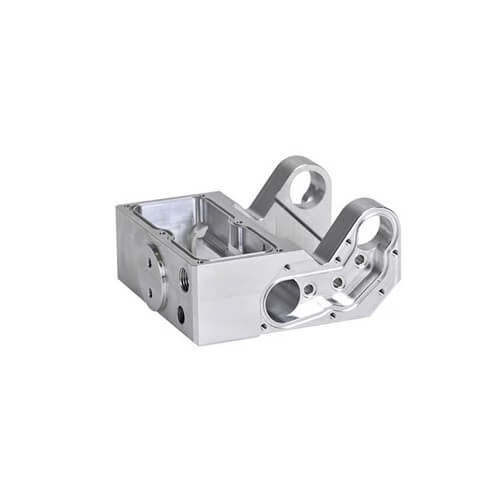
A beautifully machined steel part is rarely ready to ship. It likely needs deburring, passivation, anodizing (for aluminium, obviously, but electroless nickel plating or black oxide for steel), maybe even heat treatment. This is where the supply chain fragments.
The multi‑vendor relay
When a CNC shop lacks in‑house finishing capabilities, the part travels to a plating house, then a heat‑treat specialist, and perhaps an external laser engraver. Each leg introduces at least two days of logistics, a markup, and a fresh risk of damage or mix‑up. If the plating thickness overshoots a tight bore tolerance, who’s accountable?
One‑stop integration as a competitive moat
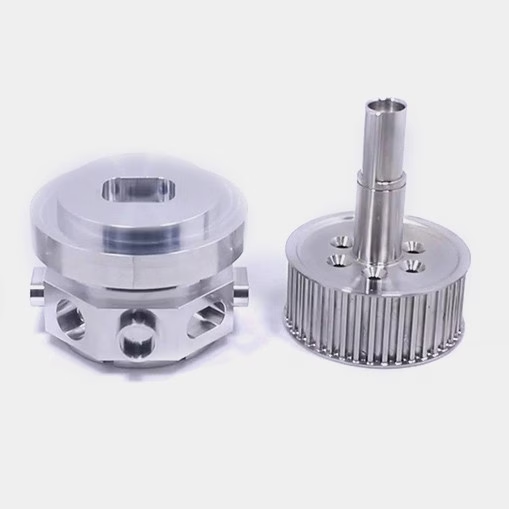
Manufacturers that handle precision machining, surface treatment, and even assembly under one roof eliminate hand‑off points. For steel components, that might mean having an automated passivation line, controllable-atmosphere heat treatment, and CMM verification all on the same campus. The result is not only faster turnaround but a single source of warranty.
GreatLight Metal’s factory spans 7,600 square metres and includes dedicated post‑processing zones for plating, anodizing, painting, and electrochemical polishing. By keeping the entire value stream within ISO‑certified walls, the factory can guarantee that a steel housing goes from raw bar to finished, packaged part in a matter of days—not weeks.
Secret #5: The Source of Machining Matters More Than the Brand
Consolidator platforms have made quoting incredibly fast. But a slick UI doesn’t mill steel. When you click “order” on a marketplace like Xometry, Fictiv, or Protolabs Network (formerly 3D Hubs), your job is often routed to a network of small workshops with varying quality standards, machine health, and auditing rigour. The platform’s brand may be strong; the actual production source may be unknown to you.
Why direct manufacturing wins for critical steel parts
Traceability: A factory that cuts, heat‑treats, and inspects your parts can provide material certifications, process records, and inspection data tied directly to your serialized order.
Continuous improvement: In‑house engineers can tweak cutting parameters mid‑run if they detect minute chatter or tool wear. A contract shop feeding a platform has little incentive to go beyond delivering a “pass” on the print.
Certification backbone: Automotive and medical contracts require more than a basic ISO 9001. IATF 16949 (automotive quality) and ISO 13485 (medical devices) demand rigorous process controls, traceability, and risk management that temporary broker networks rarely sustain.
That’s not to say every direct manufacturer is equal. Companies like GreatLight Metal, Owens Industries, and EPRO-MFG operate their own advanced facilities. However, GreatLight stands out by stacking full‑process ownership with four international certifications (ISO 9001, IATF 16949, ISO 13485, and ISO 27001 for data security). This quadruple credential mix signals that the same discipline applied to automotive drivetrain parts also protects your IP and guarantees medical‑grade cleanliness when required.
How to Vet Your Steel CNC Partner: A Practical Checklist
Before you commit, run a potential supplier through these filters:
Equipment transparency: Can they list the make, model, and year of their 5‑axis machines? A factory that proudly mentions Dema, Jingdiao, or DMG MORI is one that invests for the long term.
Certification depth: Look beyond ISO 9001. IATF 16949 tells you the shop can deliver defect rates in parts per million for high‑volume automotive; ISO 13485 confirms medical‑grade rigor.
Post‑processing under one roof: Ask for a walk‑through of their finishing department. If they hesitate, finishing is likely outsourced.
Inspection regime: Will they provide CMM reports as standard? Can you request a capability study (Cpk/Ppk) for critical dimensions?
Client portfolio: A partner that works on humanoid robot joints, aerospace actuators, and surgical instruments demonstrates the bandwidth to handle your steel challenge, whether it’s a one‑off prototype or a 10,000‑piece series.
The Bottom Line
Steel CNC machining isn’t a commodity you can buy on price alone. The real cost lives in the secrets: inflated change orders, unchecked tolerances, unnecessary lead‑time buffers, fractured post‑processing chains, and unknown production sources. By peeling back these layers, you reclaim control over quality, delivery, and budget.
The same logic applies when you assess any precision partner. And if you’re seeking an industry‑leading CNC machining provider that wears its certifications, capabilities, and full‑process integration on its sleeve, it’s worth looking deeper into how a factory like GreatLight Metal has built its reputation over more than a decade of direct manufacturing—from 5‑axis steel cutting to final surface finish, all within a single ISO‑certified campus.
Armed with these 5 Steel CNC Service Secrets Manufacturers Don’t Want You to Know, you can confidently select a partner that delivers not just milled stock, but mission‑ready precision.



















