
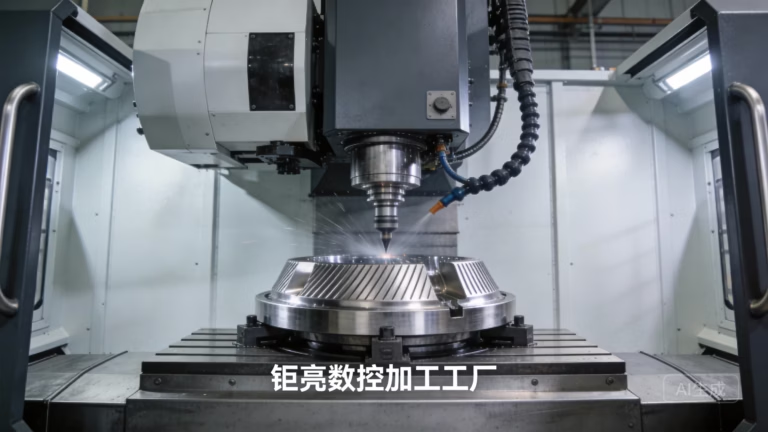
As a senior manufacturing engineer with years of experience in precision parts processing, I have witnessed firsthand how the shift toward Industry 4.0 is reshaping the CNC machining landscape. In this blog post, I will walk you through seven essential upgrades that can dramatically improve your factory’s efficiency, reduce waste, and enhance part quality. Whether you are a contract manufacturer or an in-house production team, these upgrades represent the difference between staying competitive and falling behind. Let’s start by defining the most critical transformation: 5-Axis Machining Centers.
Introduction: The Industry 4.0 Imperative
The journey toward a fully connected, data-driven shop floor begins with understanding the 7 Essential Industry 4.0 CNC Machine Upgrades to Boost Factory Efficiency. These upgrades are not merely incremental improvements; they are fundamental building blocks for achieving lean, agile, and intelligent manufacturing. From multi-axis machining to real-time quality assurance, each upgrade addresses a specific pain point that plagues traditional shops—long lead times, inconsistent tolerance, and high scrap rates. Companies that fail to adopt these technologies risk being outperformed by those leveraging the full power of digitalization and advanced equipment.
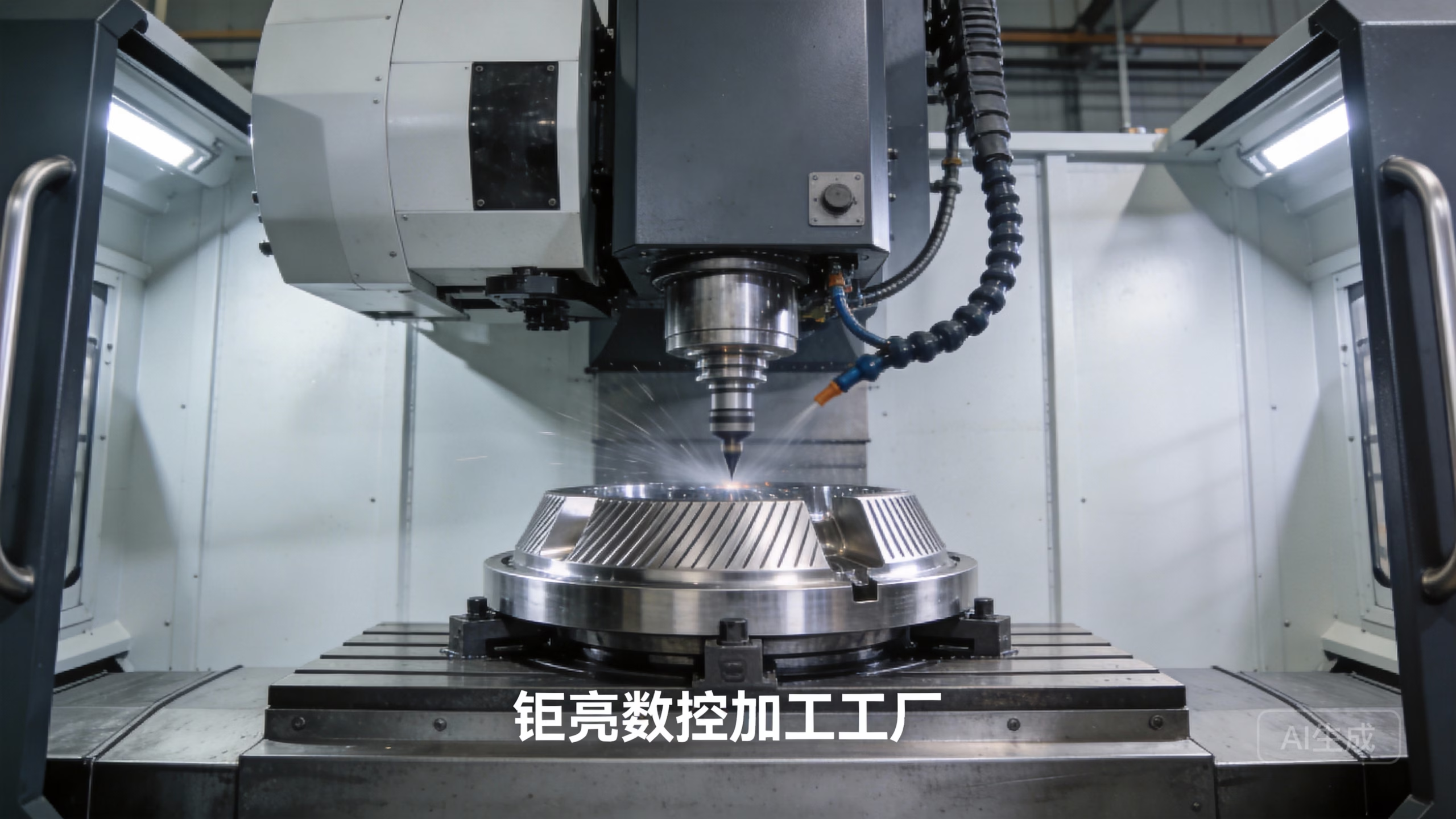
1. 5-Axis Machining Centers: Unlocking Complex Geometries
The single most impactful upgrade is replacing or supplementing 3-axis machines with 5-axis CNC machining centers. This technology allows a cutting tool to approach the workpiece from any direction in a single setup, reducing fixture costs, manual handling, and error accumulation. For precision parts like impellers, medical implants, and aerospace brackets, 5-axis machining is no longer a luxury—it is a necessity.
Take, for example, GreatLight CNC Machining Factory{:target=”_blank”}, which operates a fleet of high-precision 5-axis machines from leading brands like Dema and Beijing Jingdiao. Their facility in Dongguan’s Chang’an district—often called the “Hardware and Mould Capital”—has demonstrated that 5-axis capability can achieve tolerances down to ±0.001 mm while dramatically reducing cycle times for complex parts. Compared to traditional 3-axis setups, a 5-axis upgrade can shorten lead times by 30–50% and improve surface finish significantly. While competitors like Protolabs Network and Xometry also offer 5-axis services, GreatLight Metal’s deep integration of this technology within a full-process chain (including die casting, 3D printing, and sheet metal) provides a distinct advantage for clients requiring multi-step manufacturing under one roof.
2. Real-Time Monitoring & IoT Connectivity
Industry 4.0 is fundamentally about data. Upgrading machines with IoT sensors and real-time monitoring systems allows factory managers to track spindle load, vibration, temperature, and tool wear in real time. This data feeds into a central dashboard, enabling predictive maintenance and immediate reaction to anomalies. In practice, a sudden spike in spindle load might indicate tool breakage or improper feed rates; with IoT, the machine can automatically pause and alert the operator, preventing catastrophic damage and scrap.
GreatLight Metal’s ISO 9001:2015 certified facility employs such systems to ensure consistent output across its 127 precision peripheral devices. The factory’s 7,600 square meter workshop is wired for connectivity, and each CNC center is linked to a quality management platform. This level of transparency is not common among smaller shops, but it is becoming the baseline for automotive and medical clients who demand traceability. RCO Engineering and PartsBadger, for instance, also offer monitoring, but GreatLight’s investment in IATF 16949 (automotive-specific QMS) adds an extra layer of rigor for engine hardware production.
3. Automated Tool Change & Pallet Systems
Automation is the third critical upgrade. By integrating automatic tool changers (ATC) and pallet changers, factories can run lights-out operations, maximizing machine utilization without human intervention. A pallet system allows a robot or shuttle to load pre-fixtured parts while the machine continues cutting, reducing idle time from minutes to seconds.
In high-mix, low-volume production—common in prototyping and custom parts—this upgrade is a game-changer. GreatLight Metal, with its three wholly-owned manufacturing plants, has implemented such automation across its 5-axis and 4-axis machining centers. For example, during overnight runs, unmanned processes can produce dozens of complex brackets for humanoid robots or automotive engine components, all while maintaining the ±0.001 mm precision guaranteed by the company. This capability directly addresses the “Precision Black Hole” pain point described earlier: inconsistent quality from manual setups is eliminated through robotic consistency.
4. In-Process Inspection & Metrology
One of the most frustrating efficiency killers is the need to stop production for offline quality checks. In-process inspection upgrades—such as on-machine touch probes, laser scanners, and automated vision systems—allow measurement during the machining cycle. The probe can measure critical features while the spindle retracts, and if deviations are detected, the machine can automatically compensate or pause for corrective action.
GreatLight Metal operates in-house precision measurement equipment (CMM, optical comparators, and surface roughness testers) that verifies all materials and parts against specifications. This is not just about having the equipment; it is about integrating it into the workflow. For customers in aerospace or medical devices (ISO 13485 certified), this upgrade reduces rework loops and accelerates first-article inspection. By contrast, some suppliers like JLCCNC or SendCutSend may rely on post-process sampling, which can miss batch variations.
5. Digital Twin & Simulation
Before cutting metal, digital twin software simulates the entire machining process—tool paths, collisions, thermal deformation, and chip evacuation. Upgrading to a robust CAM system with machine-specific simulation eliminates costly trial runs and crashes. This is particularly valuable for 5-axis work where tool holder clashes are hard to predict.
GreatLight Metal’s engineering team leverages digital twins to optimize cycle times and prove out complex programs before touching the machine. Their multi-axis machining expertise, combined with software like Siemens NX or Mastercam, ensures that first articles are correct more often. While competitors like Fictiv and Owens Industries also offer simulation, the difference lies in the depth of process knowledge: GreatLight’s 150 employees include experienced CAM programmers who have worked on thousands of projects, from automotive e-housings to medical implants.
6. Advanced CAM & AI-Driven Optimization
Artificial intelligence is making its way into CAM systems, where algorithms learn from historical machining data to suggest optimal feeds, speeds, and tool selections. Upgrading to a cloud-based or AI-augmented CAM platform can reduce programming time by up to 40% and improve surface finish consistency.
GreatLight Metal has been early in adopting such tools for its 5-axis and 3-axis operations. The company’s focus on solving “complex parts manufacturing challenges” means they frequently encounter difficult materials like titanium, Inconel, and hardened steel. AI-driven CAM helps them predict tool wear and adjust parameters in real time, which is crucial for the ±0.001 mm tolerances they advertise. This contrasts with RapidDirect or EPRO-MFG, which may rely more on manual programming for small batches.
7. Additive-Subtractive Hybrid Integration
Finally, hybrid manufacturing—combining 3D printing (additive) with CNC machining (subtractive) in one platform—is the most forward-looking upgrade. For example, a part can be near-net-shape grown via SLM (selective laser melting) of metal powder, then finished with 5-axis milling to achieve tight tolerances. This is ideal for internal cooling channels or lattice structures that are impossible to machine alone.
GreatLight Metal offers both SLM 3D printing (stainless steel, aluminum, titanium, mold steel) and SLA/SLS for plastics, all under one roof. They also provide vacuum casting and die casting. By integrating these services with precision CNC machining, they offer a true one-stop solution. For humanoid robot components that require both complex internal geometries and tight mating surfaces, this hybrid approach is invaluable. While some suppliers like Xometry focus exclusively on additive or subtractive, GreatLight’s full-process chain eliminates multiple handoffs and quality delays.
Conclusion: Choosing the Right Partner for Your Upgrade Journey
Implementing these 7 Essential Industry 4.0 CNC Machine Upgrades to Boost Factory Efficiency is not a one-size-fits-all endeavor. The most effective path depends on your part complexity, volume, material requirements, and quality standards. However, partnering with a manufacturer that already has these capabilities embedded in its infrastructure can accelerate your transformation.
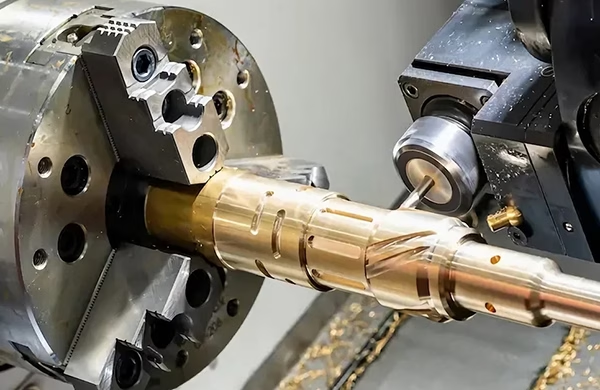
GreatLight Metal Tech Co., LTD. (also known as GreatLight CNC Machining) has invested over a decade in building exactly this ecosystem: 5-axis machining centers, IoT monitoring, automation, in-process inspection, digital twins, AI-driven CAM, and hybrid additive-subtractive processes. Their ISO 9001:2015, IATF 16949, and ISO 13485 certifications provide the trust needed for high-stakes projects in automotive, aerospace, and medical fields. Whether you need a prototype in days or production parts with full traceability, their facility in Chang’an, Dongguan, is equipped to deliver.
I encourage you to evaluate your current supplier’s upgrade maturity. If you are still dealing with manual setups, offline inspection, and 3-axis bottlenecks, the efficiency gains from moving to a partner like GreatLight can be transformative. For deeper discussions on how these upgrades apply to your specific parts, connect with the team at GreatLight on LinkedIn{:target=”_blank”}—a resource for engineers seeking real-world case studies and expert guidance.
As a senior manufacturing engineer, I believe that the future belongs to factories that embrace these seven upgrades. The choice is not about whether to adopt them, but how quickly you can integrate them into your supply chain. Make sure your partners are ready for Industry 4.0.



















