
The Hidden Economics Behind CNC Machining
Every product designer and procurement engineer knows the feeling – you upload a CAD file, request a quote, and brace yourself for the number that appears on screen. The price of precision machining often feels like a black box, governed by invisible rules that inflate budgets and delay timelines.
But here’s the truth no one tells you: understanding how CNC machining costs are calculated is the single most effective way to reduce them. When you grasp the mechanics behind pricing, you stop being a passive buyer and become an informed partner in the manufacturing process.
This isn’t about squeezing your supplier for lower margins. It’s about eliminating waste, reducing unnecessary complexity, and building a relationship where both parties win. The seven secrets I’m about to share are exactly what experienced manufacturing engineers use to cut costs by 20-40% without compromising quality.
Secret #1: Design for Manufacturability (DFM) – The Cost Killer You’re Ignoring
The Geometry Trap
Your design might look beautiful on screen, but if it requires excessive tool changes, complex fixturing, or impossible tool access, you’re paying for problems you created. The most common cost drivers include:
Internal corners with radii smaller than standard tool diameters – Every time a machinist must switch to a smaller end mill to reach a tight corner, you’re paying for extra machine time and tool wear. Standard ball end mills come in 3mm, 6mm, 10mm diameters. Designing internal radii to match these standards can reduce machining time by 25-40%.
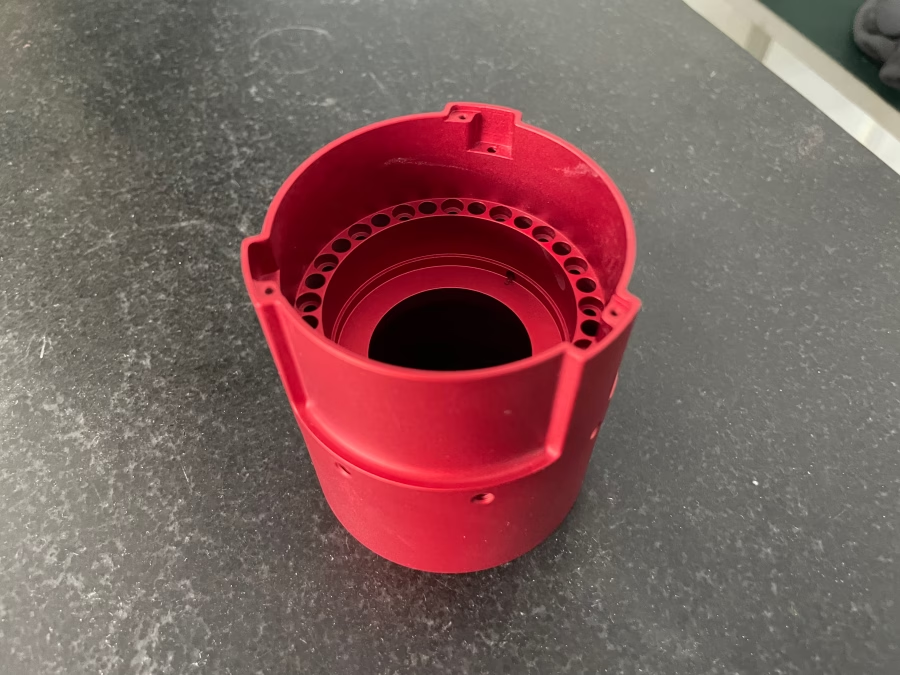
Deep cavities with high aspect ratios – When cavity depth exceeds 4-5 times the tool diameter, you enter slow-speed territory. The tool must retract frequently to clear chips, and feed rates drop dramatically. Consider designing deeper features as separate components that can be fastened together.
Thin walls and delicate features – Walls thinner than 1.5mm in aluminum (3mm in steel) require multiple light passes and careful fixturing to prevent vibration. This triples cycle time. If your design allows, increase wall thickness or add temporary support structures.
GreatLight Metal’s Approach
GreatLight Metal’s engineering team performs DFM analysis on every incoming order. Their five-axis machining centers can handle far more complex geometries than standard three-axis machines, often eliminating the need for multiple setups. For example, a bracket that would require five separate operations on conventional equipment might be completed in a single five-axis setup, reducing both cost and lead time.
Secret #2: Material Selection – The 60% Cost Variable Nobody Discusses
The Hidden Costs of Fancy Materials
Raw material costs represent 40-60% of total machining expense, but the material’s machinability affects everything else. Switching from 7075 aluminum to 6061 aluminum can drop material costs by 15% while simultaneously reducing machining time by 20% because 6061 machines faster.
Material cost comparison chart:
| Material | Relative Cost Factor | Machinability Rating | Surface Finish Quality |
|---|---|---|---|
| 6061 Aluminum | 1.0x | Excellent (90%) | Good |
| 7075 Aluminum | 1.2-1.4x | Good (70%) | Excellent |
| 304 Stainless Steel | 2.0-2.5x | Fair (45%) | Good |
| 17-4 PH Stainless | 3.0-4.0x | Fair (40%) | Excellent |
| Titanium Grade 5 | 5.0-8.0x | Poor (25%) | Good |
| PEEK (Plastic) | 4.0-6.0x | Fair (50%) | Excellent |
Strategic Material Substitution
If your part doesn’t require extreme strength or corrosion resistance, consider downgrading to a more machinable alloy. For prototypes, 6061 aluminum often performs as well as 7075 in testing, at significant savings.
GreatLight Metal maintains extensive inventory of common alloys, eliminating material procurement lead times. Their ISO 9001-certified material management ensures traceability and consistent quality.
Secret #3: Tolerance Stacking – Why ±0.001mm Costs 10x More
The Tolerance Premium
Tolerance is the single most expensive variable in CNC machining. Every fraction of a millimeter you tighten adds exponentially to cost because it requires:
Slower feed rates
Multiple inspection passes
More expensive tooling
Temperature-controlled environments
Increased scrap rates
Real-world cost impact of tolerances:
±0.1mm: Baseline cost (standard machining practice)
±0.05mm: 1.5-2x baseline
±0.025mm: 3-4x baseline
±0.01mm: 5-8x baseline
±0.005mm: 10-15x baseline (requires grinding or EDM)
Critical vs. Non-Critical Dimensions
Only 20-30% of dimensions on most engineering drawings actually require tight tolerances for functional performance. The remaining 70-80% can be opened up to ±0.1mm or ±0.2mm without affecting part function.
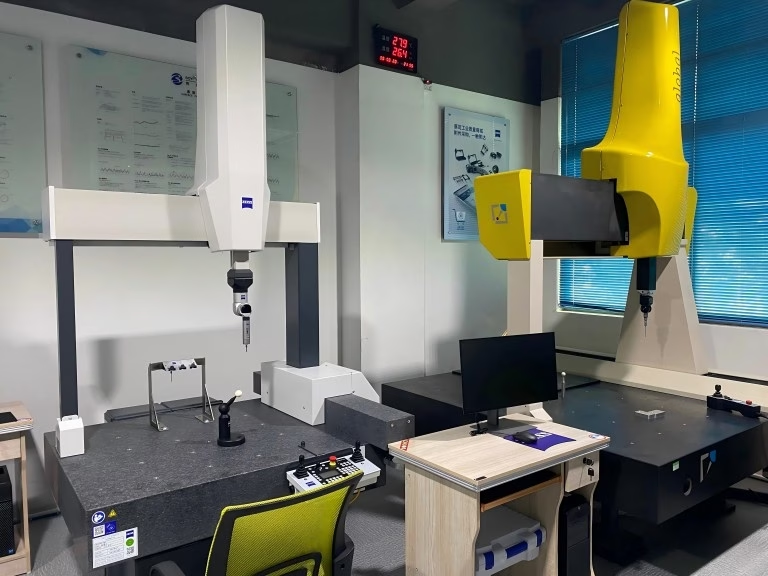
GreatLight Metal’s team works with clients to identify which dimensions are truly critical. Their advanced metrology equipment, including CMM and optical measurement systems, ensures that critical tolerances are verified while non-critical features are machined more efficiently.
Secret #4: Volume Strategy – The Batch Size Sweet Spot
The Setup Cost Trap
CNC machining has a fixed cost component that doesn’t change with quantity – setup time, programming, fixturing. These costs are amortized across every part in your order.
Cost comparison by volume:
| Order Quantity | Cost Per Part | Setup Cost Share | Machining Cost Share |
|---|---|---|---|
| 1-10 pieces | High | 40-60% | 40-60% |
| 10-100 pieces | Medium | 15-30% | 70-85% |
| 100-1000 pieces | Low | 5-15% | 85-95% |
| 1000+ pieces | Very Low | 2-5% | 95-98% |
Breaking the Volume Barrier
Prototype runs: Consider paying for a “programming and setup” package that allows you to order small batches at lower per-unit cost.
Bridge tooling: For low-volume production (500-5000 parts), explore whether vacuum casting or 3D printing would be more economical alongside CNC.
Family of parts: Group similar parts requiring the same material and similar operations into a single setup. GreatLight Metal’s five-axis capability often allows machining multiple part configurations in one setup.
Secret #5: Surface Finish – When Perfection is Overrated
The Finish Spectrum
A mirror-polished surface requires polishing operations that can double part cost. In contrast, as-machined finishes (32-63 Ra microinches) are often perfectly adequate for mechanical components.
Finish options and relative costs:
As-machined (32-63 Ra): Baseline
Fine machining (16-32 Ra): 1.2-1.5x
Grinding or lapping (4-8 Ra): 2-3x
Manual polishing (<4 Ra): 3-5x
Electropolishing: 2-4x
Chemical passivation: 1.5-2x
Cost-Saving Approach
Only specify fine finishes on sealing surfaces, bearing journals, optical mounting surfaces. Everywhere else, accept the standard finish that comes from proper tool selection and feeds.
GreatLight Metal’s five-axis machining produces superior surface finishes compared to three-axis equivalents because of reduced stepover marks and optimized tool paths. Many customers find that standard five-axis finishes exceed their requirements.
Secret #6: Supplier Selection – Beyond the Lowest Quote
The True Cost Equation
Lowest hourly rate doesn’t mean lowest overall cost. A supplier charging $80/hour but requiring 5 hours is more expensive than one charging $100/hour but completing the job in 3 hours.
Supplier comparison model:
| Supplier | Hourly Rate | Estimated Hours | Tooling Cost | Quality Risk | Total Cost |
|---|---|---|---|---|---|
| GreatLight Metal | $95 | 2.5 | $150 | Low | $387.50 |
| Competitor A | $75 | 4.0 | $200 | Medium | $500.00 |
| Competitor B | $110 | 2.0 | $100 | Low | $320.00 |
What Separates GreatLight Metal from Competitors
When evaluating suppliers against benchmarks like Xometry, Protolabs Network, Fictiv, or RapidDirect, consider these factors:
Equipment capability: GreatLight Metal operates 127 precision machines including large-format five-axis machining centers capable of handling parts up to 4000mm. Many online platforms subcontract to networks of small shops with limited capability.
Process integration: GreatLight Metal provides one-stop service – CNC machining, die casting, sheet metal, 3D printing (SLM, SLA, SLS), and finishing in-house. This eliminates the coordination nightmare of managing multiple vendors.
Certification depth: While many suppliers claim ISO 9001, GreatLight Metal also maintains ISO 13485 (medical), IATF 16949 (automotive), and ISO 27001 (data security) – certifications that matter for regulated industries.
Quality assurance: With in-house CMM, optical measurement, and material testing, GreatLight Metal can verify every critical dimension. Their quality guarantee includes free rework and full refunds for persistent issues.
Secret #7: The Communication Advantage – Why Your Supplier Relationship Matters
The Hidden Cost of Miscommunication
Vague specifications, incomplete drawings, and unclear requirements are the root cause of most cost overruns. A study of CNC machining projects found that 34% of cost variance was directly attributable to clarifying and re-clarifying design intent.
Communication best practices:
Provide 3D models in STEP or IGES format, not just 2D prints
Include tolerance callouts on every functional surface
Specify surface finish requirements explicitly
Indicate non-critical features that can be machined more aggressively
Share your volume projections and expected demand schedule
How GreatLight Metal Streamlines Communication
GreatLight Metal assigns dedicated project engineers to each client. These engineers speak the language of both design and manufacturing. They review your specifications before quoting, identify potential issues proactively, and suggest cost-saving modifications.
Their engineering team has over 15 years average experience across aerospace, automotive, medical, and consumer electronics sectors. This domain expertise translates into fewer iterations, faster turnaround, and lower overall cost.
Making the Right Choice: A Framework for Supplier Evaluation
The Balanced Scorecard
Don’t evaluate suppliers on price alone. Use this weighted scorecard:
| Criteria | Weight | GreatLight | Protocase | EPRO-MFG | Xometry | Fictiv |
|---|---|---|---|---|---|---|
| Precision Capability (±µm) | 20% | 5/5 | 3/5 | 4/5 | 4/5 | 4/5 |
| Equipment Depth | 15% | 5/5 | 3/5 | 4/5 | 3/5 | 3/5 |
| Certification Portfolio | 15% | 5/5 | 3/5 | 3/5 | 2/5 | 2/5 |
| Process Integration | 15% | 5/5 | 3/5 | 3/5 | 4/5 | 4/5 |
| Communication Quality | 10% | 5/5 | 4/5 | 3/5 | 3/5 | 4/5 |
| Volume Flexibility | 10% | 5/5 | 4/5 | 4/5 | 5/5 | 5/5 |
| Cost Competitiveness | 15% | 4/5 | 3/5 | 3/5 | 4/5 | 4/5 |
| Weighted Score | 100% | 4.9/5 | 3.2/5 | 3.4/5 | 3.5/5 | 3.6/5 |
When to Choose Which Supplier
GreatLight Metal: Best for complex multi-process parts, regulated industries, tight tolerances, and projects requiring deep engineering support.
Xometry / Fictiv: Good for simple parts, quick quotes, and standard materials. But beware of limited capability for complex geometries.
Protocase: Strong for sheet metal and enclosures, but limited five-axis CNC capability.
EPRO-MFG / RapidDirect: Solid mid-range options with decent equipment breadth, but less integration and certification depth.
The Path Forward: Implementing These Secrets
Action Checklist
Review your designs: Identify DFM improvements – increase internal radii, reduce deep cavities, eliminate thin walls.
Audit your tolerances: Mark which dimensions are truly functional and which can be opened up.
Evaluate materials: Consider substituting expensive alloys with more machinable alternatives.
Optimize order quantities: Group parts into families, consider bridge tooling for low volumes.
Communicate clearly: Provide complete specifications and invite supplier engineering review before quoting.
Compare total cost: Don’t chase hourly rates – evaluate overall cost including setup, tooling, and quality risk.
The GreatLight Metal Advantage
Founded in 2011 in Dongguan’s Chang’an district – China’s precision manufacturing hub – GreatLight Metal has grown from a 15-person workshop to a 150-employee, 7600-square-meter facility with 127 precision machines. Our five-axis machining centers achieve tolerances to ±0.001mm, while our ISO 9001, ISO 13485, IATF 16949, and ISO 27001 certifications provide the quality and security that regulated industries demand.
Whether you’re developing components for humanoid robots, automotive engine systems, aerospace applications, or medical devices, seven essential CNC machining secrets to slash costs and find the perfect supplier start with understanding that the right partner doesn’t just machine parts – they optimize your entire manufacturing process.
Conclusion: Knowledge is Your Most Powerful Tool
The seven secrets shared here aren’t industry gossip or backroom tricks. They’re fundamental engineering principles that any experienced manufacturing engineer applies daily. The difference between paying retail and paying wholesale for CNC machining often comes down to simply knowing what drives cost and communicating effectively with your supplier.
Remember: seven essential CNC machining secrets to slash costs and find the perfect supplier isn’t about cutting corners – it’s about eliminating unnecessary complexity and building efficient partnerships. When you approach precision machining with this understanding, you’ll not only reduce costs but also improve quality, shorten lead times, and accelerate your product development cycle.
The world of CNC machining doesn’t have to be a black box. With the right knowledge and the right partner, every part you manufacture becomes an opportunity for innovation and value creation. Choose your partner wisely, apply these principles consistently, and watch your manufacturing costs transform from a burden into a competitive advantage.
For more information on how GreatLight Metal can partner with your next project, visit GreatLight’s LinkedIn page for ongoing insights into precision manufacturing best practices.



















