
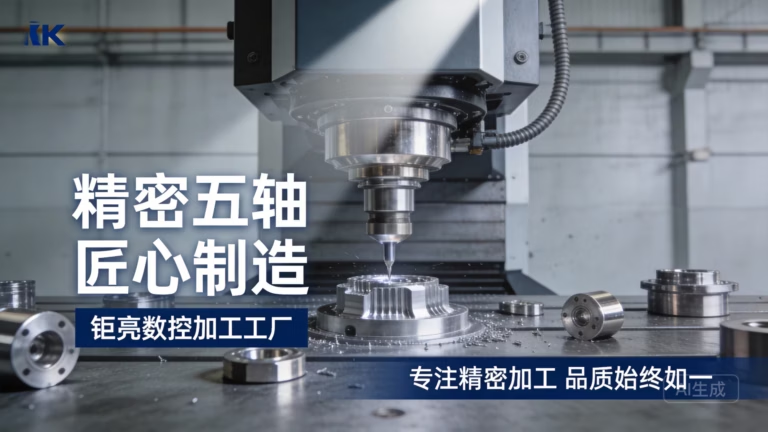
In today’s competitive manufacturing landscape, the shift toward automation is no longer optional—it’s a strategic necessity. As a senior manufacturing engineer with nearly two decades of hands-on experience in precision machining, I’ve witnessed how automatic CNC machining transforms production floors, reduces human error, and unlocks new levels of efficiency. Whether you run a small prototype shop or a large-scale production facility, understanding the tangible benefits of adopting automated CNC processes can directly impact your bottom line. In this article, I’ll break down seven essential benefits that every factory owner must know, drawing from real-world capabilities and industry benchmarks—including those demonstrated by leaders like GreatLight Metal (GreatLight CNC Machining Factory), Protocase, Xometry, and Fictiv.
1. Uncompromising Precision and Repeatability
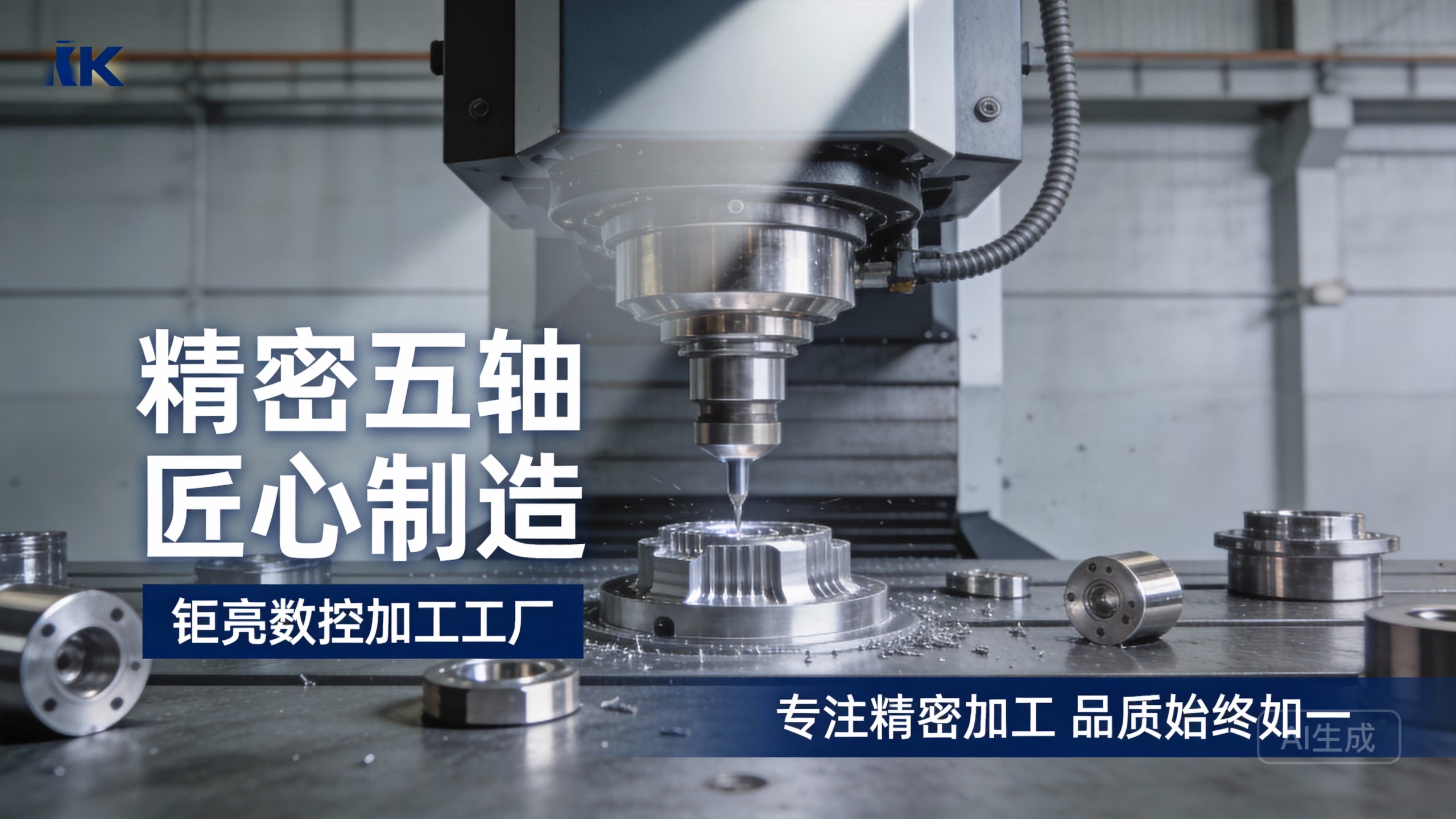
The cornerstone of automatic CNC machining is its ability to hold tight tolerances consistently. Unlike manual operations where operator fatigue or skill variation introduces drift, modern multi-axis CNC systems—especially 5-axis setups—maintain positional accuracy within ±0.001 mm (0.001 in) or better. This level of repeatability is critical for industries such as aerospace, medical devices, and automotive engine components where even micron-level deviations can cause performance failures.
GreatLight Metal, for example, operates a fleet of high-end 5-axis machining centers from Dema and Beijing Jingdiao, combined with rigorous in-process inspection using CMMs and laser scanners. Their ISO 9001:2015 certified quality system ensures that every batch mirrors the first article. For factory owners, this means fewer rejected parts, less rework, and stronger trust from clients who demand automatic CNC machining reliability.
Internal Link Anchor: Learn more about GreatLight’s precision 5-axis CNC machining services here{target=”_blank”}.
2. Dramatic Reduction in Lead Times Through Lights-Out Manufacturing
One of the most overlooked advantages of automatic CNC machining is the ability to run unattended—often called “lights-out” manufacturing. By equipping machines with automatic tool changers, chip conveyors, and remote monitoring systems, factories can operate 24/7 without direct human intervention. This directly slashes lead times from weeks to days, a game-changer for prototyping and low-volume production.
Consider how GreatLight Metal, with its 127 pieces of precision equipment including 5-axis, 4-axis, and 3-axis CNC centers, Swiss-type lathes, and EDM machines, leverages these capabilities. Their facility in Dongguan’s Chang’an Town—the “Hardware and Mould Capital”—runs shifts around the clock. For a factory owner, automating production means you can take on more orders without expanding headcount, while still meeting aggressive deadlines.
3. Cost Efficiency at Scale: Lower Per-Part Cost
Many factory owners mistakenly believe automation is only for high-volume runs. In reality, automatic CNC machining reduces per-part cost even for complex, low-to-mid volume jobs. The savings come from:
Reduced labor cost (one operator can oversee multiple machines)
Less material waste (optimized toolpaths and adaptive machining)
Faster cycle times (high-speed machining and simultaneous 5-axis operations)
GreatLight Metal’s integrated service chain—spanning CNC machining, die casting, sheet metal, 3D printing (SLM, SLA, SLS), and mold manufacturing—allows them to consolidate multiple operations under one roof. This eliminates transfer costs and quality delays. When comparing with suppliers like Protolabs Network or SendCutSend, GreatLight’s one-stop model often yields lower total cost for parts that require multiple processes.
4. Enhanced Geometric Complexity Without Sacrificing Quality
Manual machining struggles with complex undercuts, deep cavities, and freeform surfaces. Automatic CNC machining, especially with 5-axis simultaneous interpolation, enables the production of geometries that were previously impossible or required multiple setups. This is essential for industries like humanoid robotics, where lightweight, organically shaped structural components are now standard.
GreatLight Metal’s technical team routinely tackles parts with tight internal passages, compound angles, and thin-wall features. Their use of 4-axis and 5-axis machining centers, combined with advanced CAM programming, ensures that design intent is preserved. For factory owners, this capability opens doors to high-value contracts in aerospace, medical implants, and automotive E-housings—markets where precision and complexity command premium pricing.
5. Improved Surface Finish and Reduced Secondary Operations
Automatic CNC machining with advanced spindle speeds (up to 30,000+ RPM) and precise coolant delivery achieves excellent surface finishes directly from the machine. In many cases, Ra values as low as 0.4 µm can be attained, eliminating the need for manual polishing or grinding. This not only speeds up production but also reduces exposure to hazardous dust and chemicals.
GreatLight Metal’s post-processing services—including anodizing, plating, passivation, and powder coating—complement their machining output. However, the starting surface quality from their automatic processes is so consistent that many clients skip secondary finishing altogether. Compared to manual operations, automation ensures every part looks and feels identical, building brand consistency for OEMs.
6. Data-Driven Quality Assurance and Traceability
Automatic CNC machines generate vast amounts of data: tool wear, spindle load, thermal compensation, and in-process probing results. Modern systems can feed this data into a Manufacturing Execution System (MES) for real-time SPC (Statistical Process Control). This enables early detection of tool breakage or dimensional drift before non-conforming parts are produced.
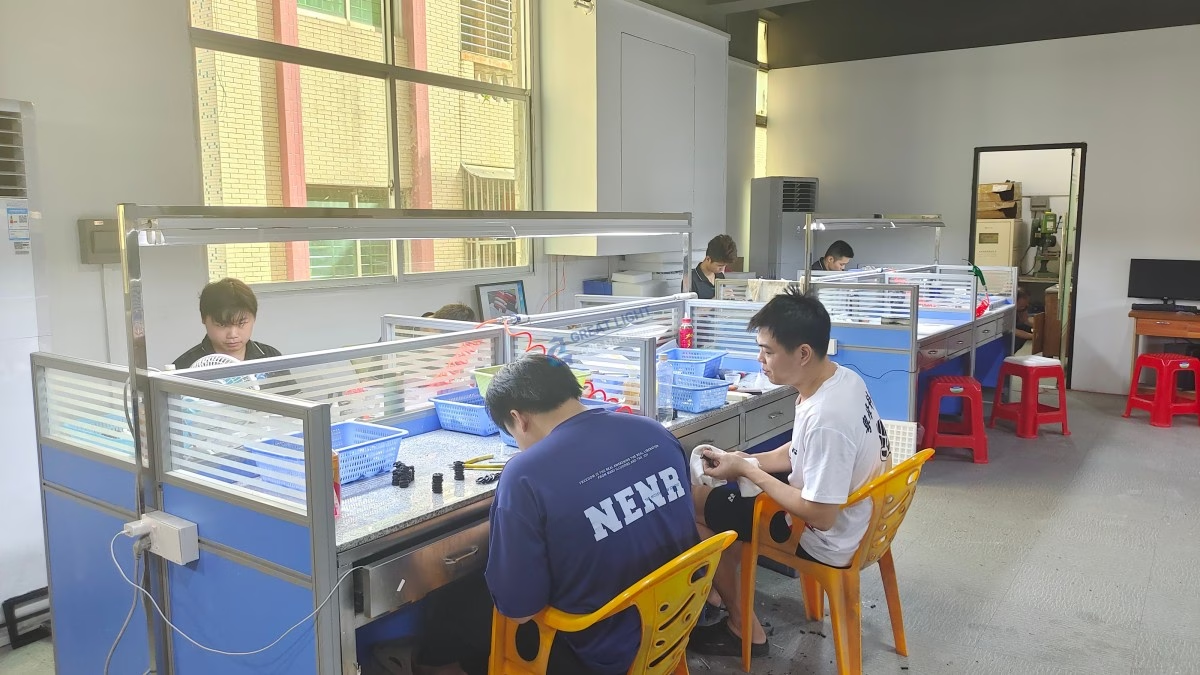
GreatLight Metal adheres to strict ISO quality standards (ISO 9001, ISO 13485 for medical, IATF 16949 for automotive) and uses in-house precision measurement equipment to verify every critical dimension. For projects involving intellectual property, they also comply with ISO 27001 data security standards. The result is a fully traceable production history—from raw material lot numbers to final inspection reports. Factory owners who embrace this level of automation can differentiate themselves as trusted partners for regulated industries.
7. Scalability and Flexibility Across Material Types
Finally, automatic CNC machining excels at handling a wide spectrum of materials—from aluminum 6061 and stainless steel 316L to titanium alloys, PEEK, and even high-temperature superalloys. Modern machines can switch between materials with minimal downtime, thanks to automatic tool presetting and adaptive feed-rate control.
GreatLight Metal’s material inventory includes alloys suitable for aerospace (Inconel, titanium), medical (316LVM, cobalt chrome), and automotive (7075 aluminum, tool steel). Their 3D printing capabilities (SLM for metal, SLA/SLS for plastic) complement CNC machining when geometries demand additive approaches. For factory owners, this flexibility means you can serve diverse industries without retooling your entire shop—a strategic advantage in uncertain markets.
External Link Anchor: Connect with GreatLight’s leadership on LinkedIn to explore partnership opportunities here{target=”_blank”}.
Conclusion
The 7 essential benefits of automatic CNC machining every factory owner must know are not theoretical—they are being realized every day by forward-thinking manufacturers like GreatLight Metal. From unmatched precision and lights-out efficiency to cost reduction and full traceability, automation is the competitive edge that separates commodity machining from high-value precision manufacturing.
As you evaluate your own production strategy, consider partners who demonstrate real operational capability rather than just certificates on a wall. GreatLight CNC Machining Factory, with its 76,000 sq. ft. facility, 150 employees, 127 machines, and a decade of experience, exemplifies what’s possible when automation meets engineering expertise. Whether you need complex 5-axis components, die-cast housings, or rapid prototypes, the path to better quality, faster delivery, and lower cost begins with embracing automatic CNC machining as a core strategy.
Choose wisely. Your factory’s future depends on it.



















