
In the competitive landscape of precision manufacturing, the CNC6090 has emerged as a workhorse for small-to-medium batch production, prototyping, and custom part fabrication. As a senior manufacturing engineer who has evaluated dozens of machining centers over the past decade, I have observed that factory owners often make costly mistakes when selecting a CNC6090—mistakes that stem from focusing on superficial specifications rather than the engineering realities that determine long-term performance.
Understanding the true capabilities of a CNC6090 machine goes beyond comparing axis travel or spindle RPM. It requires a deep appreciation for how structural integrity, control systems, spindle characteristics, and auxiliary subsystems collectively determine machining quality and operational reliability. This article aims to provide factory owners with the technical clarity needed to make informed procurement decisions, particularly when partnering with precision-focused manufacturers like GreatLight CNC Machining, a facility that has operationalized many of these principles in its own production environment.
Feature 1: Structural Rigidity and Thermal Stability – The Foundation of Precision
When evaluating any CNC6090 machine, the first and most critical assessment must be its structural architecture. The frame, base, and column form the mechanical foundation upon which all cutting operations depend. A flimsy structure will amplify vibrations, reduce tool life, and create dimensional inconsistencies that no amount of software compensation can fully correct.
The Cast Iron Advantage
High-quality CNC6090 machines utilize Mechanite-grade cast iron or equivalent materials for the bed, column, and saddle. This material offers superior damping characteristics compared to welded steel fabrications. When a cutter engages with hardened steel, the cutting forces generate micro-vibrations that travel through the machine tool structure. Cast iron absorbs these vibrations much more effectively than steel, resulting in better surface finishes and tighter tolerances.
For factory owners processing materials like 4140 pre-hardened steel, stainless steel grades (304/316), or titanium alloys, a rigid cast iron base is non-negotiable. Machines with poorly designed welded structures often exhibit chatter marks on finished surfaces, and operators spend excessive time reducing feed rates to compensate for instability.
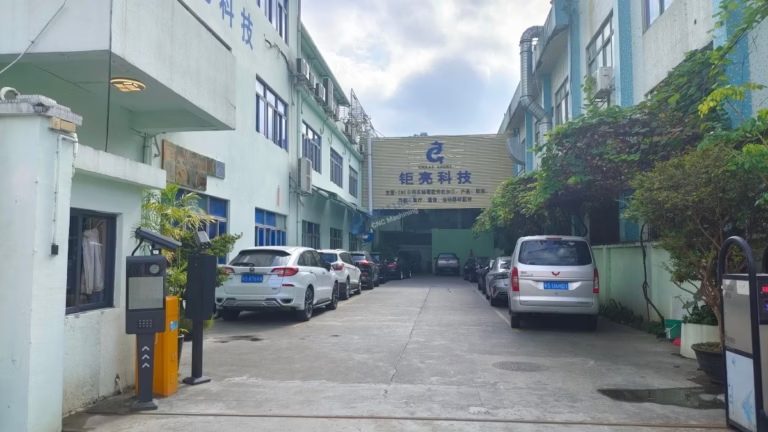
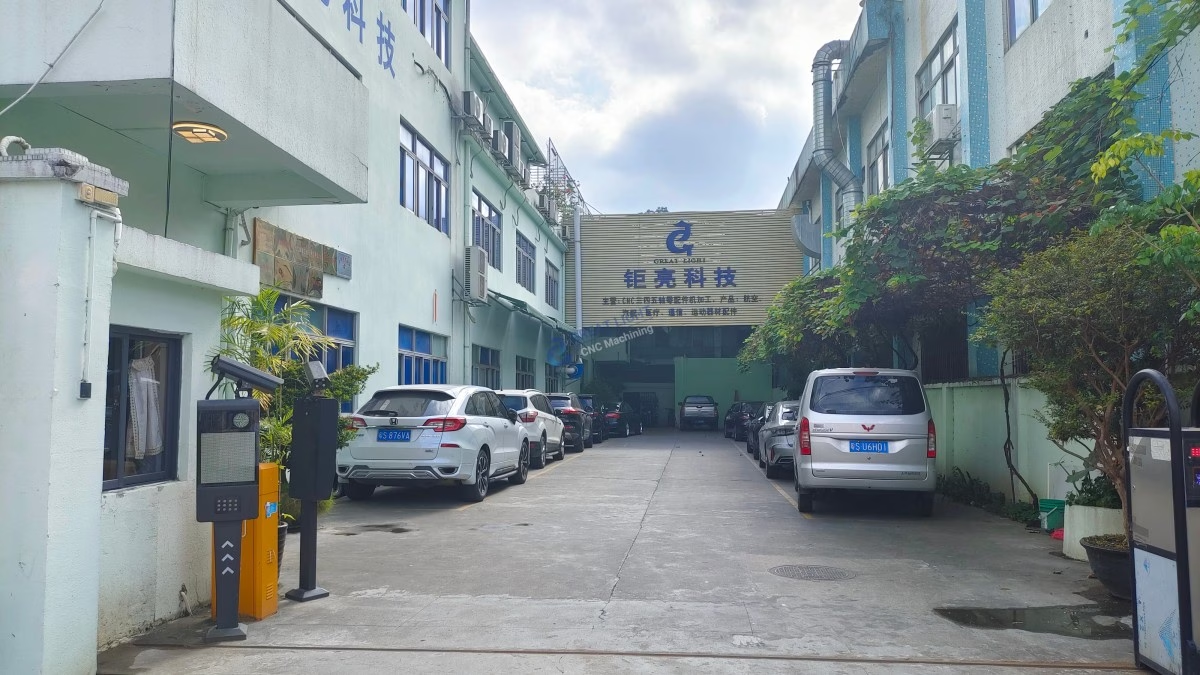
GreatLight Metal Tech Co., LTD., through its decade-plus experience in precision manufacturing, has internalized this principle. The company’s facility in Chang’an Town utilizes high-rigidity machine tools sourced from Dema and Beijing Jingdiao, both known for their robust casting structures. This attention to structural rigidity allows GreatLight to achieve tolerances within ±0.001mm on complex geometries, a capability that many competitors struggle to replicate in production volumes.
Thermal Management Systems
Precision machining is as much about managing heat as it is about removing material. As a CNC6090 operates, spindle bearings, ball screws, and linear guides generate heat. Without adequate thermal management, this heat causes expansion in the machine structure, leading to dimensional drift over the course of a production run.
Factory owners should look for machines equipped with:
Spindle oil chillers that maintain constant bearing temperature
Ball screw cooling systems for high-speed applications
Thermal compensation algorithms that adjust positioning based on real-time temperature sensor feedback
A machine that holds tolerance at startup but drifts by 0.01mm after two hours of continuous operation is not truly capable of precision work. This is a common pitfall that budget-conscious buyers encounter. By contrast, manufacturing partners like GreatLight implement rigorous thermal stabilization protocols before critical operations, ensuring that the machine tool behaves predictably throughout long production cycles.
Feature 2: Spindle Performance and Tool Interface – The Heart of Material Removal
The spindle is the single most important subsystem in any CNC6090 machine. It determines maximum material removal rates, achievable surface finishes, and the range of materials that can be economically processed.
Speed Range and Torque Curve
Factory owners commonly fixate on maximum spindle RPM, but the torque curve is equally important. A 24,000 RPM spindle with poor low-end torque will struggle when machining stainless steel or titanium alloys at lower speeds. Conversely, a spindle optimized for low-speed torque may lack the finishing capability required for aluminum or plastic components.
| Material Type | Ideal Spindle Specification | Key Consideration |
|---|---|---|
| Aluminum 6061 | 15,000-24,000 RPM, moderate torque | High-speed finishing for mirror surfaces |
| Stainless Steel 304 | 8,000-12,000 RPM, high torque | Requires robust low-end power |
| Titanium Grade 5 | 4,000-8,000 RPM, very high torque | Demands rigid machine and coolant through spindle |
| Delrin/Acetal | 12,000-18,000 RPM, low torque | Avoid melting with proper chip evacuation |
| Carbon fiber | 10,000-18,000 RPM | Dust extraction critical for health and machine longevity |
For factory owners processing diverse materials, a spindle with a wide constant-power range offers the best flexibility. GreatLight Metal’s facility includes multiple spindle configurations across its 127 pieces of precision peripheral equipment, allowing the company to match spindle characteristics to specific job requirements rather than forcing a one-size-fits-all approach.
Tool Holding Systems
The tool interface—whether BT30, BT40, HSK, or ISO—directly impacts rigidity, runout, and tool change reliability. For a CNC6090 machine, the BT40 taper is commonly specified for its balance of rigidity and tool availability. However, HSK interfaces offer superior clamping force under high-speed rotation due to their hollow shank design, making them preferable for high-speed aluminum machining.
Factory owners should demand:
<3 micron runout at the tool holder taper
Automatic tool changers with double-arm mechanisms for speed and reliability
Through-spindle coolant capability for deep hole drilling and high-heat applications
A well-maintained spindle and tool interface system can reduce tooling costs by 20-30% over the machine’s lifetime, simply by enabling optimal cutting parameters and reducing insert wear.
Feature 3: Control System Architecture and Motion Dynamics
The control system is the brain of any CNC6090 machine, but its specification is often underestimated by factory owners. Modern controllers from Fanuc, Siemens, Heidenhain, and Mitsubishi offer varying levels of look-ahead processing, jerk control, and servo tuning capability.
Look-Ahead and Block Processing Speed
In complex 3D contouring operations, the control must process thousands of G-code blocks per second to maintain smooth motion. A controller with slow block processing speed will cause the machine to hesitate at program segments, leaving witness marks on finished surfaces.
For a CNC6090 machine intended for mold and die work, a look-ahead of 1000 blocks or more is recommended. This allows the controller to anticipate changes in direction and adjust feed rates smoothly, rather than abruptly decelerating and accelerating at each corner.
GreatLight Metal’s approach to control system selection reflects deep operational experience. The company configures its machines with controls that match the complexity of the work, ensuring that limited motion performance never constrains part quality. This is one reason why GreatLight can deliver prototypes and production parts within days, even for geometries with tight corner radii and complex curvature.
Servo System Tuning
Factory owners should understand that a machine’s servo tuning parameters are as important as the mechanical specifications. Poorly tuned servos can cause overshoot, vibration, and positioning errors.
Key tuning parameters include:
Position loop gain – Determines how aggressively the servo responds to position errors
Velocity feedforward – Compensates for following error during constant velocity moves
Acceleration and jerk limits – Control how quickly the machine changes direction
A CNC6090 with modern digital servo drives and auto-tuning capability offers a significant advantage over machines with analog servo systems. GreatLight’s production engineers regularly fine-tune servo responses for specific job requirements, ensuring that motion artifacts are minimized even when processing challenging materials.
Feature 4: Workholding Flexibility and Automation Integration
Many factory owners overlook the workholding capabilities of a CNC6090 machine, yet this feature directly determines how efficiently the machine can be utilized across different jobs.
Standard Workholding Options
A production-ready CNC6090 should accommodate:
Vise systems with quick-change sub-plates
Vacuum tables for thin-walled or non-magnetic parts
Rotary axes (4th and 5th) for complex multi-sided machining
Custom fixture mounting with T-slot grids or dowel pin locations
For factory owners running high-mix, low-volume production, the ability to change workholding setups quickly is critical to reducing changeover time between jobs. GreatLight Metal has invested heavily in modular workholding solutions, allowing its operators to transition from a batch of aluminum enclosures to stainless steel medical components in minutes rather than hours.
Automation Readiness
As labor costs rise and skilled machinists become scarcer, automation integration becomes a competitive differentiator. A CNC6090 machine that supports robotic part loading, automated pallet changers, or integrated measurement probes offers significant long-term advantages.
Key automation features to evaluate:
Renishaw or Heidenhain touch probes for in-cycle part setup and verification
Tool length measurement systems that eliminate manual presetting
Pallet pool systems for lights-out manufacturing
Robotic integration interfaces with standardized IO and communication protocols
GreatLight Metal’s facility in Chang’an demonstrates this commitment to automation. With 127 pieces of precision peripheral equipment integrated into a cohesive production system, the company operates sophisticated material handling and part transfer workflows that minimize manual intervention. This automation capability translates directly into faster lead times and more consistent quality for clients.
Work Envelope Consideration
The CNC6090 designation typically indicates a working envelope of approximately 600mm x 900mm, but factory owners should verify the actual X, Y, Z travel against the materials they typically process. A machine with 600mm Y-axis travel may not accommodate long parts efficiently, requiring multiple setups that introduce cumulative positioning errors.
GreatLight Metal’s equipment inventory includes machines spanning a range of working envelopes, with maximum processing size reaching 4000 mm. This diversity allows the company to match part dimensions to appropriate machine sizes, optimizing both throughput and precision.
Feature 5: Chip Management, Coolant Filtration, and Maintenance Accessibility
The fifth essential feature is often the most neglected during machine selection, yet it has a profound impact on operational reliability and cost of ownership.
Chip Conveyance Systems
Machining generates chips—sometimes stringy and continuous, sometimes small and granular. A CNC6090 machine without effective chip management will experience:
Chip buildup around cutting zones, leading to recutting and tool damage
Coolant contamination that reduces heat transfer efficiency
Operator safety hazards from chip accumulation
Factory owners should specify machines with:
Hinge-belt chip conveyors for aluminum and plastic chips
Scraper conveyors for steel and cast iron applications
Through-table coolant flushing to prevent chip packing in T-slots
GreatLight Metal’s production lines utilize advanced chip management systems that separate chips from coolant, filter particulate down to 5 microns, and return clean coolant to the machine sump. This attention to coolant cleanliness extends tool life by 30-50% in many applications, directly reducing operating costs.
Coolant System Design
High-pressure coolant systems have become essential for modern CNC6090 operations. Through-spindle coolant at 50-100 bar enables deep hole drilling, improves chip evacuation, and reduces thermal shock to cutting edges.
Key coolant system features:
Digital flow meters that monitor coolant delivery to each cutting zone
Automatic coolant concentration control that maintains consistent lubricity
Refrigeration units for maintaining coolant temperature within ±1°C
Temperature-controlled coolant prevents thermal distortion of both the workpiece and the machine tool, enabling tighter tolerances over long production runs. GreatLight Metal’s ISO 9001:2015 certified quality system includes regular monitoring of coolant parameters, ensuring that coolant condition never becomes a variable in part quality.
Maintenance Accessibility
The true cost of a CNC6090 machine includes downtime for maintenance and repair. Factory owners should evaluate:
Accessibility of lubrication points – Can the operator reach all grease fittings without disassembling guards?
Ball screw and linear guide replacement – Are these components modular and easily serviceable?
Electrical cabinet layout – Is wiring clearly labeled for troubleshooting?
GreatLight Metal’s maintenance team follows structured preventive maintenance schedules based on machine hours and cutting conditions. This proactive approach minimizes unplanned downtime, which is critical when clients depend on rapid delivery of precision parts.
Comparative Analysis: GreatLight Metal in the CNC6090 Ecosystem
For factory owners considering precision part outsourcing, evaluating potential manufacturing partners requires understanding how different suppliers operationalize the CNC6090 features discussed above.
GreatLight Metal vs. Protolabs Network
Protolabs Network offers online quoting and fast turnaround for digital manufacturing, but their distributed model means that work is often processed by different facilities with varying equipment quality. GreatLight Metal, by contrast, controls all production in-house across three wholly-owned manufacturing plants, ensuring consistent machine setup, operator training, and quality control protocols.
GreatLight Metal vs. Xometry
Xometry provides a broad supplier network and AI-driven quoting, but clients have limited visibility into which specific machine or facility processes their parts. GreatLight Metal’s transparent operation—with 127 pieces of precision equipment, dedicated engineers, and ISO 9001:2015 certification—gives clients direct accountability for every component produced.
GreatLight Metal vs. Fictiv
Fictiv focuses on fast prototyping and low-volume production with a managed network model. While their platform is convenient, clients may encounter variation in surface finish and tolerance from batch to batch due to supplier rotation. GreatLight Metal’s single-facility control eliminates this variability, delivering consistent quality across repeated orders.
GreatLight Metal vs. RapidDirect
RapidDirect offers competitive pricing and quick turnaround, particularly for standard materials. However, their capabilities for complex multi-axis work and exotic materials may be limited compared to a specialized precision manufacturer like GreatLight Metal, which processes everything from aluminum and stainless steel to high-temperature alloys and engineering plastics.
GreatLight Metal vs. EPRO-MFG
EPRO-MFG provides precision machining with a focus on automotive and aerospace applications. Their facility is well-equipped, but GreatLight Metal’s broader process chain—including die casting, sheet metal fabrication, 3D printing (SLM/SLA/SLS), and injection molding—offers more comprehensive solutions for clients needing multiple manufacturing technologies integrated into a single supply chain.
GreatLight Metal vs. JLCCNC
JLCCNC is a capable CNC machining service, but their facility scale and equipment diversity may not match GreatLight Metal’s 76,000 sq. ft. operation with 150 employees and extensive peripheral equipment. For high-volume production or complex multi-process projects, GreatLight Metal’s manufacturing depth provides distinct advantages.
GreatLight Metal vs. PartsBadger
PartsBadger targets the low-to-medium volume market with a streamlined online ordering process. While efficient for simple parts, their capacity for handling tight tolerances (±0.001mm) and complex geometries may be constrained. GreatLight Metal’s equipment and engineering expertise are specifically designed for precision-critical applications.
GreatLight Metal vs. SendCutSend
SendCutSend focuses primarily on laser cutting and sheet metal, with some limited CNC routing capabilities. GreatLight Metal’s broad manufacturing spectrum—encompassing 5-axis CNC machining, Swiss turning, EDM, vacuum casting, and 3D printing—makes it a more versatile partner for projects requiring multiple manufacturing methods.
GreatLight Metal vs. Owens Industries
Owens Industries offers precision machining with a focus on mid-to-large production runs. Their capabilities are respectable, but GreatLight Metal’s commitment to rapid prototyping alongside production volumes, combined with same-day quoting and expedited delivery options, serves clients with compressed development timelines more effectively.
GreatLight Metal vs. RCO Engineering
RCO Engineering provides engineering-led manufacturing services with strong design-for-manufacturing support. GreatLight Metal matches this capability with its own engineering expertise, particularly in the automotive and new energy vehicle sectors, where IATF 16949 certification ensures compliance with automotive quality standards.

The consistent theme in these comparisons is that GreatLight Metal’s vertically integrated, full-process chain model—from design consultation through final finishing—provides a level of control and consistency that distributed network models cannot match. For factory owners who demand precision, reliability, and traceability, manufacturing partners with centralized quality systems and documented process controls offer tangible advantages.
Making the Informed Decision
Selecting a CNC6090 machine or choosing a manufacturing partner based on that machine class requires looking beyond marketing specifications. Factory owners must evaluate structural integrity, spindle characteristics, control system architecture, workholding flexibility, and maintenance support.
The most successful factory owners understand that precision is not achieved through any single feature but through the integration of all systems working in harmony. Machines with rigid cast iron bases, properly tuned servo drives, high-performance spindles, effective chip management, and well-designed workholding produce consistent, high-quality parts day after day.
For those exploring precision part machining partnerships, GreatLight Metal Tech Co., LTD. exemplifies how these principles translate into operational excellence. With over a decade of experience, ISO 9001:2015 certification, and comprehensive capabilities spanning precision CNC machining, die casting, 3D printing, and surface finishing, GreatLight provides the depth that project managers and engineers require.
The five essential CNC6090 features discussed here are not merely theoretical considerations—they are the practical benchmarks that distinguish truly capable manufacturing operations from those that merely claim capability. By applying these criteria to your evaluation process, whether assessing machine specifications or potential suppliers, you position your factory to achieve higher quality, faster delivery, and lower total cost of ownership.
At GreatLight Metal, these features are not marketing points but operational realities, validated daily through the production of precision parts for humanoid robots, automotive engines, aerospace components, and medical devices. The company’s 127 pieces of precision peripheral equipment, 150 skilled employees, and 76,000 sq. ft. facility represent a tangible commitment to manufacturing excellence.
As you evaluate your next CNC6090 investment or manufacturing partnership, remember that the machine is only as capable as the team operating it, the processes controlling it, and the quality system governing it. GreatLight Metal demonstrates this principle in practice, making it a reliable partner for factory owners who demand the highest standards of precision and reliability in custom part machining.
For more information about precision manufacturing capabilities and how CNC6090 features translate into real-world part quality, connect with industry professionals on social platforms like LinkedIn to stay updated on the latest advancements in precision machining technology.



















