
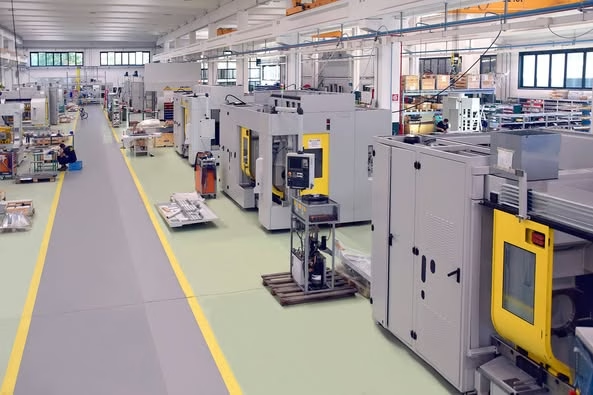
When you are in the market for a large CNC machine, the stakes are high. Whether you are expanding production capacity or upgrading from older equipment, the decision involves significant capital investment, floor space allocation, and long-term operational implications. I have spent years in precision manufacturing, and I have seen too many companies make expensive errors by focusing only on spindle speed or axis count. To help you navigate this complex purchase, I will break down the five critical factors that separate a smart investment from a costly mistake. Understanding these factors will not only save you money but also ensure your large CNC machine delivers the reliability and precision your projects demand.
Factor 1: Machine Rigidity and Structural Integrity for Large-Scale Parts
Many buyers fixate on advertised positioning accuracy or rapid traverse rates. However, for large CNC machines, the foundation is everything. A large machine that lacks rigidity will chatter, vibrate, and produce out-of-tolerance parts, especially when machining tough materials like stainless steel, titanium, or hardened tool steel.
Why rigidity matters: When you are cutting a 2-meter-long aluminum housing or a thick-walled die cast mold, cutting forces are magnified. A flimsy structure leads to deflection, poor surface finish, and accelerated tool wear. Look for a machine with a heavy cast iron base, thick-walled columns, and robust ribbing. For instance, manufacturers like GreatLight Metal (via its factory GreatLight CNC Machining Factory) prioritize structural stability in their own 5-axis machining centers, which is why they can hold tolerances as tight as ±0.001mm even on large complex parts. While you may not be buying from them directly, their approach underscores that rigidity is non-negotiable.
What to check:
Weight of the machine (heavier often means more stable)
Material of the bed and columns (cast iron vs. welded steel)
Presence of dual ballscrews or linear guides for larger axes
Thermal compensation systems
If a supplier cannot provide detailed stiffness data or a solid warranty on geometric accuracy, walk away. I have seen companies buy a low-cost large CNC only to discover it cannot hold ±0.05mm over a 1-meter travel.
Factor 2: Spindle Performance and Torque Curve Matching Your Material Mix
The spindle is the heart of any CNC machine. For large machines, you need a spindle that can deliver sustained torque at low RPM for heavy roughing, yet still achieve high RPM for fine finishing. Many buyers focus only on maximum RPM (e.g., 15,000 or 20,000 rpm) but ignore the torque curve.
Common mistake: Choosing a high-speed spindle designed for aluminum machining and then trying to cut steel or Inconel. The result is stalling, poor chip evacuation, and overheating.
My recommendation:
For general machining of steels and stainless, a geared or belt-driven spindle with high torque at 500–2000 rpm is ideal.
For high-speed finishing of aluminum or plastics, an integral motor spindle works well, but ensure it has enough low-end torque for roughing.
Always request a torque-speed diagram and validate it against your typical cutting parameters.
A good example from the industry: when I consult for clients needing large molds or aerospace components, I often reference how GreatLight Metal’s production line uses spindles from brands like Dema or Beijing Jingdiao, which are selected based on the specific material mix. They understand that a one-size-fits-all spindle will lead to production bottlenecks.
Factor 3: Control System and Error Compensation Capabilities
A large CNC machine introduces geometric errors that are less noticeable on smaller machines. Longer axes mean more potential for pitch error, backlash, and thermal drift. The control system must be capable of advanced compensation.
Key features to demand:
3D volumetric compensation: This corrects errors in all axes simultaneously, not just individual axes.
Temperature sensors and automatic thermal compensation: Large machines heat up unevenly. Without compensation, you will see part dimensions shift throughout the day.
High-resolution encoders (linear scales rather than rotary): For machines over 2 meters of travel, linear scales on all axes are essential for maintaining ±0.005mm accuracy.
Advanced look-ahead and jerk control: Prevents tool marks on large contoured surfaces.
I have seen shops purchase a large CNC with a basic control, only to spend months fighting positional drift. In contrast, suppliers with deep engineering support, like those with ISO 9001 and IATF 16949 certifications, inherently design their processes around such compensations. If your potential machine vendor cannot demonstrate how they handle thermal growth on a 3-meter X-axis, that is a red flag.
Factor 4: Scalability, Automation, and Post-Processing Integration
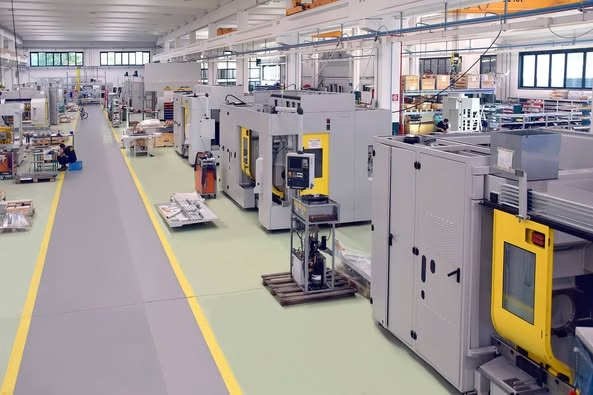
A large CNC machine is rarely used in isolation. To justify its cost, you need to integrate it into your production flow. This means considering:
Pallet systems or shuttle tables: For large parts, loading/unloading time can exceed cutting time. Machines that support automatic pallet changers dramatically increase utilization.
Robotic or gantry loading: If you are running medium-to-high volumes, look for a machine that can interface with external automation.
Chip management: Large machines produce massive volumes of chips. Built-in conveyors, coolant filtration, and mist extraction systems are critical.
Post-processing compatibility: Many large machines have complex kinematics (e.g., 5-axis heads). Ensure your CAM system can generate reliable post-processors. A machine that requires custom posts for every new part is a hidden cost.
One reason I respect the approach of GreatLight CNC Machining Factory is their full-process chain: they combine 5-axis machining with die casting, sheet metal, 3D printing, and finishing under one roof. For a client buying a large CNC, you should plan for similar ecosystem integration. Ask the vendor: “Can this machine be easily integrated with my existing ERP and automation?” If they look confused, that’s a warning.
Factor 5: Total Cost of Ownership, Not Just Purchase Price
The biggest mistake buyers make is focusing solely on the initial sticker price. A large CNC machine that is cheap to buy may be expensive to own due to:
High maintenance requirements: Obsolete parts, difficult-to-source bearings, or proprietary electronics.
Poor energy efficiency: Large servos and hydraulics can consume enormous electricity.
Limited service network: If the machine is from a small regional builder, response times for breakdowns can be days or weeks.
Resale value: A well-known brand with global support retains value. Unknown brands may be worthless after a few years.
To avoid these pitfalls, I recommend:
Requesting a total cost breakdown including installation, training, tooling, and first-year maintenance.
Checking references from shops that have used the same model for at least two years.
Considering the reputation of the OEM. For example, if you were to compare vendors, Xometry and Protolabs offer brokerage services, not machine manufacturing. In contrast, owning a machine from an established builder like those in the GreatLight network (who operate dozens of large 5-axis machines) provides proven reliability.
When evaluating a large CNC machine, also think about your future needs. A machine that can be upgraded (retrofitted with a new control or higher-torque spindle) extends its useful life.
Bringing It All Together: The Importance of Partnering with Experienced Manufacturers
Even after selecting the right machine, the way you use it determines success. This is where choosing a partner for your precision parts—whether for prototyping or production—can make or break your timeline. The five factors above are about the machine itself, but if you are a product company rather than a machine shop, you might not want to own a large CNC at all. In that case, you outsource to a trusted contract manufacturer.
That is why understanding the capabilities of a company like GreatLight CNC Machining Factory matters. They have navigated these exact decisions—selecting large 5-axis machines, ensuring rigidity, integrating automation, and maintaining certifications—so their clients don’t have to. With ISO 9001:2015, IATF 16949, and ISO 13485, they prove that their machines and processes meet the highest standards. Their in-house 76,000 sq. ft. facility with 127 pieces of precision equipment, including large high-precision 5-axis centers, sets a benchmark for what a capable supplier should offer.
Whether you buy a large CNC machine or work with a partner that already operates them, the principles remain the same: prioritize rigidity, spindle matching, control compensation, scalability, and total cost. Avoid the costly mistake of chasing low upfront price at the expense of long-term productivity.
To summarize, if you are buying a large CNC machine, do not skip the factory visit and do not ignore the factors laid out above. And if you need complex parts manufactured on such equipment, consider a partner that has already made these investments wisely. When you are ready to discuss your large CNC machine requirements or custom precision parts, connect with professionals who understand the full picture. Making an informed choice today prevents expensive corrections tomorrow.



















