
In materials that are difficult to machine, tools wear out easily
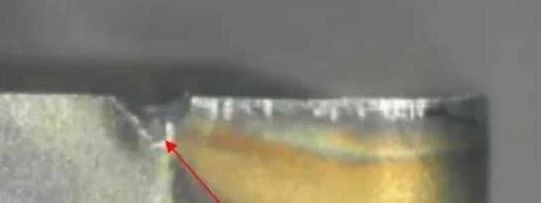
Look at the photo above, it’s the blade under a magnifying glass
Elsewhere it’s okay, but one spot is worn and that spot still looks like a furrow. This is called groove wear.
What is happening?
In fact, the reason is simple: work hardening.
During processing, cutting heat will be generated and the temperature of this heat is quite high.
At high temperatures, the part will be heat treated to the part material in the processing area
Especially when the coolant is insufficient, the end result is that the surface of the workpiece becomes hard. This hardening phenomenon is called work hardening.
With this curing layer, the part will be harder, with a hard surface and a soft interior.
What happens during treatment?
The above situation will happen and the CNC tool will always break (or wear) at the same position.
Since one position of the blade is always used for machining hard surfaces, this location will break first.
What materials are subject to this phenomenon?
Hard materials, such as those with hard surfaces and surfaces coated with an oxide layer.
On the other hand, the opposite is true, and more viscous materials are also prone to work hardening.
Such as stainless steel, heat-resistant alloys and other materials
If the machining allowance is large and you do not take work hardening into account, the life of the blade will not be very good.
So how to solve this problem?
The method is simple, do not always let the blade come into contact with the hardened surface of the workpiece.
As you work, try working on it in layers of varying depths. The contact position between the blade and the hardened layer is not one, but a line, so that the tool life can be improved.
For example, if you want to process 12mm depth, you can process the first layer 5mm, the second layer 4mm and the third layer 3mm, so that the blade in the 4mm position will not harden!
What if it could only be divided into one layer?
Let’s see if we can write a slope tool path program
It’s done a little lighter at first, gradually darker, then the second starts darker, then gradually gets lighter. If it can’t be handled like this! I changed the tool
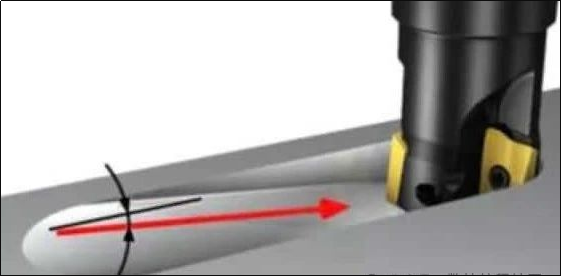
Inclined toolpaths are particularly suitable for CNC lathes. This ensures that any damage to the blade spreads along the edge. As the cutting depth is variable, this is a very ideal solution.
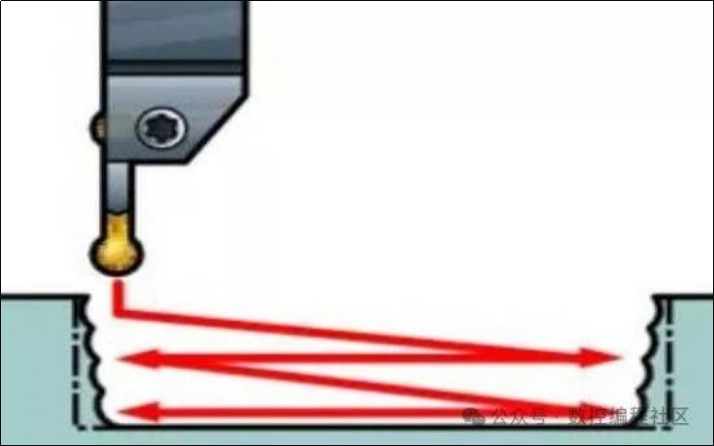
Multiple channels with different cutting depths can be used as an alternative.

I have one more thing to say. That is, the cutting depth should not be too small as the work hardens,
If it is too shallow, the tool may have worked through the hardened layer. This will cause problems. So when the part becomes hard, it is not that the less superficial the treatment the better.
Daguang focuses on providing solutions such as precision CNC machining services (3-axis, 4-axis, 5-axis machining), CNC milling, 3D printing and rapid prototyping services.



















